

“We were told we were exporting democracy. Are we also importing future Democrat voters whose political culture we spent decades helping shape?”
Beginning in 2025, USAID was effectively taken apart. Secretary of State Marco Rubio announced that more than 80 percent of the agency’s programs had been canceled after a review of roughly 6,200 contracts. By July, USAID had stopped implementing foreign assistance as an independent agency, with the remaining functions moved under the State Department.
Then the left started having a remarkably bad run in Latin America.
In Ecuador, Daniel Noboa defeated leftist Luisa González by more than a million votes in the April 2025 runoff. In Honduras, the ruling leftist LIBRE party finished a distant third in the November 2025 election, and conservative Nasry Asfura eventually won with 40.3 percent of the vote after weeks of delays, technical problems, and fraud allegations.
In Peru, conservative Keiko Fujimori narrowly defeated leftist Roberto Sánchez in June 2026 after one of the closest elections in the country’s history. The final count gave Fujimori 50.135 percent to Sánchez’s 49.865 percent. Then Colombia elected right-wing political newcomer Abelardo De La Espriella over leftist senator Iván Cepeda. De La Espriella ran on security, lower taxes, deregulation, and a smaller state, while Cepeda represented a continuation of much of President Gustavo Petro’s political project.
There are plenty of ordinary reasons elections swing back and forth. Crime, inflation, and corruption can all move voters. Bad presidents can manufacture opposition victories all by themselves.
Correlation is certainly not causation. I know that. You know that. But read the rest of this and you tell me.
What Were We Paying For?
When most Americans hear foreign aid, they probably imagine sacks of grain, childhood vaccines, malaria nets, wells, disaster relief, or food being unloaded from a military transport plane somewhere miserable. USAID absolutely did those things. That is partly what made the rest of the operation so easy to ignore.
I downloaded the government’s own ForeignAssistance.gov data and started digging through USAID obligations. The usable files covered fiscal years 2020, 2021, 2022, 2024, 2025, and partial 2026. Fiscal 2025 began in October 2024, months before USAID was dismantled, so that year naturally contains substantial activity. The 2026 records need a little more explanation. After USAID stopped independently implementing foreign assistance in July 2025, ForeignAssistance.gov continued recording legacy and transferred USAID-funded activity, including programs moved under the State Department, carryover obligations, deobligations, and other accounting adjustments. In other words, the 2026 file does not mean USAID was still operating normally. The 2023 export repeatedly returned a null file, so I excluded that year.
I also used obligations, not disbursements. An obligation is money the government legally commits to spend. It is not necessarily the same as cash already paid.
Then I narrowed the records to seven political and civic categories: democratic participation and civil society, human rights, media and free flow of information, legal and judicial development, elections, anti-corruption organizations, and legislatures and political parties.
Those seven categories alone produced approximately $2.5 billion in USAID obligations to NGOs during the six usable years. About $1.21 billion went toward democratic participation and civil society. Roughly $537 million went toward human rights. Nearly $359 million went toward media and the free flow of information. Legal and judicial development accounted for about $166 million, elections about $98.5 million, anti-corruption organizations roughly $75.6 million, and legislatures and political parties about $45.7 million.
I went back through those same six yearly files and totaled all obligations managed by USAID, not just the political and civic categories. They came to roughly $150.6 billion.
That makes the $2.5 billion NGO subset about 1.7 percent of all USAID obligations in those same usable files.
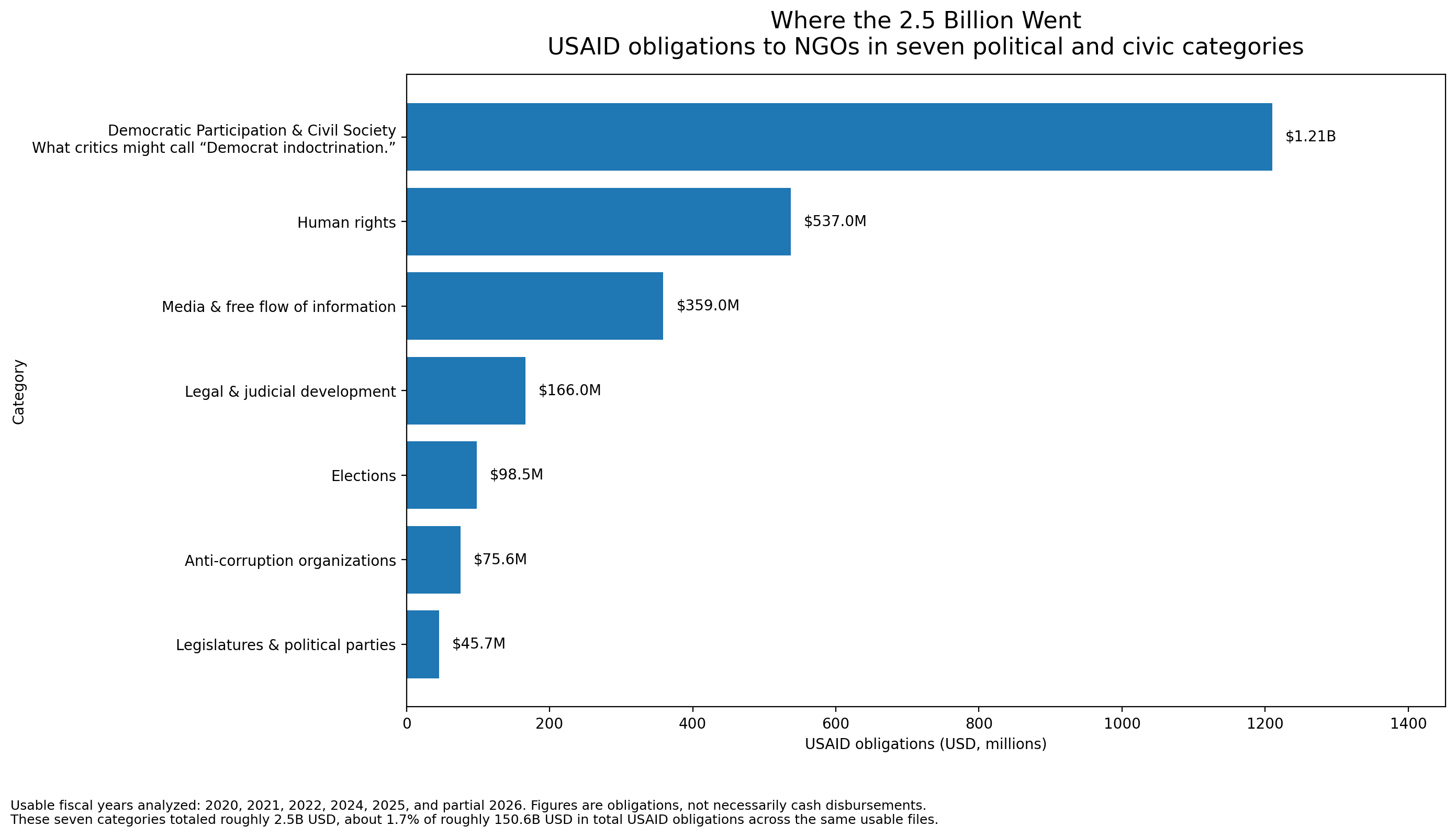
So no, politics was not most of USAID. Not even close. USAID was an enormous agency doing everything from health care and agriculture to food assistance and disaster relief. But 1.7 percent of $150.6 billion is still about $2.5 billion, and this was the portion specifically operating inside civil society, human rights, media, elections, courts, anti-corruption work, legislatures, and political parties.
I did not audit the other 98.3 percent, so I am not giving it a clean bill of health. It may contain perfectly legitimate aid, waste, fraud, ideological spending, or all four. I simply did not examine it.
That does not prove $2.5 billion went to the left. It proves something much simpler. American foreign aid was spending billions of dollars inside the civic and political systems of foreign countries.
This was not a malaria program accidentally bumping into a politician.
We were funding elections, political-party development, media, advocacy groups, labor organizations, judges, civil-society networks, legislatures, political participation, public-policy work, and organizations whose entire purpose was influencing how societies were governed.
Not Democracy. Their Democracy.
Some democracy promotion is exactly what it sounds like. Teach people how elections work. Protect secret ballots. Train poll workers. Help election commissions count votes accurately. Teach political parties how to comply with election law. Help journalists report without being murdered. Fine.
Then you read USAID’s own documents.
In 2014, USAID published a 79-page toolkit on integrating LGBT rights activities into programming in Eastern Europe and Eurasia. One section dealt specifically with political participation.
The toolkit described efforts to increase LGBT participation in political parties and election campaigns, including as candidates. It discussed training delivered by the Washington-based Victory Institute to LGBT candidates, elected officials, and political-party officials. The training covered campaigning, social media, direct mail, and canvassing.
The document went further. It noted that “more progressive political parties,” including Greens and Social Democrats, might be willing to incorporate LGBT rights into their party platforms. USAID and its partners, the toolkit suggested, could help develop those platforms and the materials used to promote them.
This is the United States government discussing taxpayer-financed assistance that could help foreign political parties incorporate a particular social issue into their political platforms. You can support LGBT rights and still understand what just happened.
We are no longer talking about teaching somebody how to operate a voting machine.
The toolkit even suggested measuring how many LGBT people trained through programs later became political candidates and whether LGBT issues appeared more frequently in party platforms.
The National Democratic Institute, one of the major organizations operating throughout the USAID democracy ecosystem, has likewise described programs intended to increase political participation among LGBTQ people and other groups it considers underrepresented. NDI has also discussed social and behavioral change approaches designed to shift norms and behaviors that influence political life.
Those are political and social objectives. They contain judgments about which groups need more power, which norms should change, which identities deserve greater institutional protection, and what a healthier society should look like.
USAID was not merely exporting democracy. It was often helping define what democracy was supposed to become.
And ideology does not always arrive wearing a campaign button. Sometimes it arrives through vocabulary: inclusion, equity, gender, marginalized communities, information integrity, social norms, civil society, human rights, resilience.
Each term can describe a legitimate concern. Over time, institutions can also build political assumptions into the definitions. Nobody inside the system needs to wake up thinking, Today I will advance the left. The vocabulary may already have done most of the work.
You can sincerely believe you are standing in the political center while the center has quietly moved a mile to your left.
Before somebody throws CubaNet or the International Republican Institute at me, yes, USAID funded them too. There were anti-communist programs, religious-freedom programs, and plenty of work that does not fit neatly into a left-wing box. I get to those later, because the question is not whether exceptions existed. They did. The question is what the broader pattern looked like and whether anything comparable existed on the other side.
Follow the Money
Then I wanted to know where the money went.
Within those political and civic categories, approximately $1.65 billion in USAID obligations went to organizations classified in the federal data as U.S.-based NGOs.
That is not all foreign aid. It is not even all USAID spending. It is the narrower political and civic slice described above.
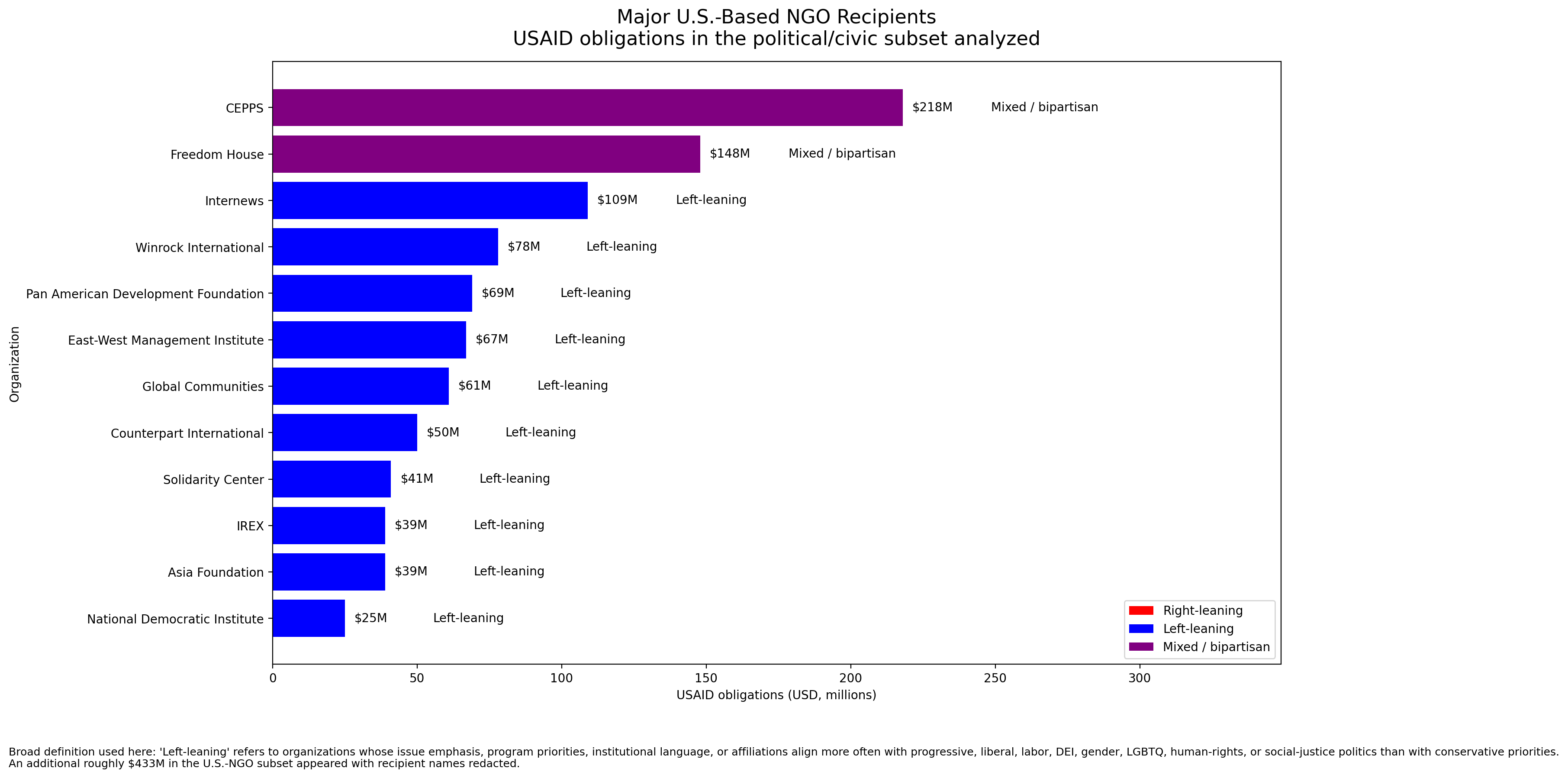
The Consortium for Elections and Political Process Strengthening, usually called CEPPS, received roughly $218 million in the analyzed data. Freedom House received about $148 million. Internews received approximately $109 million. Winrock International received around $78 million. The Pan American Development Foundation received about $69 million. East-West Management Institute received roughly $67 million.
Global Communities received approximately $61 million. Counterpart International received about $50 million. The Solidarity Center received approximately $41 million. The Asia Foundation and IREX each received around $39 million, while the National Democratic Institute received roughly $25 million directly in the subset I analyzed.
Not every organization on that list is formally partisan. But using the broader definition in the chart, most lean left based on their issue priorities, institutional language, labor affiliations, or social-policy agenda. CEPPS and Freedom House are better treated as mixed or bipartisan. The labels describe ideological orientation, not formal party membership.
A substantial portion of American political and civic foreign assistance first traveled through organizations headquartered right here in the United States.
Another roughly $433 million in the U.S.-NGO subset appeared in my export with the recipient name redacted.
Redaction proves nothing sinister by itself. There can be good reasons to protect organizations working in dangerous countries.
It does make following the money harder, especially when the first recipient is often not the last.
Open Air Money Laundering
USAID awards money to a large NGO. The NGO funds regional organizations. Those organizations support local civil-society groups. Those groups finance training, advocacy, media, labor organizing, research, campaigns, or additional partner organizations.
The first transaction is easy to follow. By the fifth, you start wanting aspirin.
CEPPS itself is a consortium whose major partners have included NDI, the International Republican Institute, and the International Foundation for Electoral Systems. Freedom House’s USAID-funded Human Rights Support Mechanism operated through a larger consortium and multiple implementing partners.
Internews works through media partners and subgrants. East-West Management Institute has run grant programs. Counterpart uses local grants. IREX uses subawards. The Solidarity Center works with unions and labor organizations throughout the world.
None of that is inherently improper. Large international programs need local partners. But the public trail gets messy in a hurry.
In 2025, the Government Accountability Office examined 3,680 single-audit findings involving federal prime recipients with subrecipients. Thirty-six percent, or 1,332 findings, primarily involved incomplete subaward reporting, inadequate subrecipient monitoring, or failures to verify eligibility.
GAO said those weaknesses can make it difficult to determine where subaward money is ultimately spent. The federal grant system had rules and audits. What it did not always have was a clean public trail all the way to the bottom.
Money does not become politically irrelevant because it took four legal hops before somebody spent it.
The Receipts
USAID obligations in the data for a Ukrainian program called Responsive and Accountable Politics totaled roughly $41 million. The work involved political parties, democrat actors, electoral processes, and representation.
In Venezuela, tens of millions went into civil-society strengthening and participation programs intended to strengthen independent organizations and democratic governance. Other programs worked with democratic political parties, universities, think tanks, media, diaspora organizations, and civil-society voices.
That makes perfect sense if your foreign-policy objective is weakening Nicolás Maduro. It is also politics.
In Tunisia, roughly $18.5 million went to a political-transition program involving electoral institutions, civil society, media, and government officials. Programs in Jordan sought to strengthen civil society and digital media while increasing citizen engagement and advocacy.
USAID-backed programs in Colombia taught NGOs policy analysis, government oversight, coalition building, and advocacy. A Honduran anti-corruption organization received about $1.76 million, while another civil-society and media program trained NGOs, journalists, and academics to analyze government data and hold officials accountable.
Some of that sounds excellent. Government accountability is a good thing. American tax dollars used to strengthen organizations that pressure foreign governments are still affecting politics.
Then there were the openly ideological programs.
In Guatemala, approximately $746,000 went toward a gender-affirming health program that included strengthening transgender-led organizations, advocacy, gender-affirming services, and economic opportunities.
In Honduras, USAID money reached SOMOS CDC, an LGBT organization involved in political participation and advocacy. The net obligation I found was around $190,000 after a deobligation, meaning USAID later reduced part of the amount it had previously committed. Program materials discussed youth political participation, advocacy toward the National Congress, and engagement with political-party benches.
In Peru, USAID-backed democracy programming brought together political and social actors, media organizations, journalists, activists, and regional stakeholders for political dialogue and civic participation. International IDEA says one USAID-funded political-dialogue project carried a $7.5 million award and worked across at least 16 Peruvian regions. The project ran from June 2023 through December 2024.
East-West Management Institute ran a USAID-funded rapid-response grant program in Georgia that said grants could support initiatives to “expose and limit” malign influence from far-right and Russia-funded groups.
Russian influence in Georgia was a genuine national-security concern. But American taxpayer money was nevertheless available to civil-society organizations to reduce the influence of political groups characterized as far-right or connected to Russia.
Call it good politics if you want. It is still politics.
The Information Machine
Then there is the increasingly fashionable business of deciding what information people should trust.
Searching the obligations for explicit disinformation programs turned up roughly $24.6 million across about eleven core activities in the usable years.
That is not every program touching media or information integrity. It is the smaller set where the language was explicit enough to classify confidently.
Uganda had a media-viability initiative worth about $4.5 million. A youth-resilience program in North Macedonia was also around $4.5 million. Latin America had programs such as CREDIBLE and VOCES. Guyana had a project specifically aimed at reducing disinformation. Ecuador had Ecuador Verifica. Central Asia had an information-integrity program.
Internews and IREX accounted for a large share of these explicit obligations.
Stopping deliberate propaganda can be legitimate. Russia lies. China lies. Political parties lie. Governments lie. Activists lie. People on the Internet lie before breakfast.
But disinformation gives somebody considerable discretion over what deserves suspicion. That gets more uncomfortable when organizations policing the information environment are also part of an ecosystem promoting particular social priorities.
Internews, for example, has published a Gender Equality and Inclusion Strategy that discusses gender-transformative approaches intended to change gender norms and power relationships.
I am not saying Internews journalists fabricated stories. I am saying the organization has an institutional worldview.
People do not stop having political assumptions because their business card says democracy.
The Conservative Dog That Barely Barked
USAID also funded things conservatives would support.
CubaNet, an independent Cuban media organization strongly opposed to the Communist regime, received USAID money. So did the International Republican Institute. There were religious-freedom programs, anti-Maduro organizations in Venezuela, election monitoring, independent journalism, anti-corruption work, and organizations operating against authoritarian governments.
Victims of Communism Memorial Foundation even appears in the data.
CubaNet, IRI, religious-freedom programs, anti-Maduro groups. Those are real too, and pretending otherwise would be dishonest.
Now look for the equivalent on the right.
Where is the USAID toolkit helping pro-life political candidates run for office? Where are the federal programs helping conservative parties insert traditional-family policies into their platforms?
Where are the taxpayer-funded NGOs training activists to campaign for lower taxes, deregulation, gun rights, parental rights, smaller government, or restrictions on abortion?
I could find occasional religious-freedom and market-oriented programs. I could not find anything resembling the institutional scale devoted to LGBT political participation, gender, labor organizing, selected identity groups, advocacy, and social-norm change.
And USAID itself published a toolkit saying that “more progressive political parties,” including Greens and Social Democrats, might incorporate LGBT rights into their platforms and that USAID and its partners could help develop those platforms and outreach materials.
USAID was not exclusively left-wing. What is much harder to find is anything comparable in scale devoted to exporting conservative social and economic ideas.
That is the asymmetry.
They Were Warned
None of this started with Elon Musk. Republicans were raising questions years ago.
In January 2017, Senator Mike Lee asked the State Department about USAID programs in Macedonia and their relationship to organizations connected to George Soros’s Open Society network.
A few months later, Senators Ted Cruz, Mike Lee, Jim Inhofe, Thom Tillis, David Perdue, and Bill Cassidy wrote Secretary of State Rex Tillerson alleging that U.S. government money, including USAID funds, was being used in Macedonia and Albania in ways that benefited left-leaning political interests.
Those were allegations, not proof.
The concern eventually reached USAID’s Office of Inspector General, which examined safeguards against political bias in democracy programs.
Its 2019 audit is worth reading because both sides can quote it. The Inspector General said it did not identify instances of partisanship affecting the programs reviewed. But the same report also said weaknesses in USAID’s acquisition and assistance process and outdated policy could unintentionally expose programs to bias. It recommended expanding the range of organizations eligible to implement political-party assistance and reviewing USAID’s Political Party Assistance Policy.
The report also documented a case in Georgia. CEPPS, through NDI and IRI, attempted to suspend assistance to a Georgian political party partly because of disagreement with the party’s platform and rhetoric. USAID’s mission intervened and ordered that the assistance continue.
In that case, the safeguard worked. But the concern was hardly imaginary. Two major U.S.-funded democracy organizations had reached the point of trying to deny assistance partly because they objected to what a political party believed.
The 2019 audit may simply have been answering a narrower question than the one we are asking. The Inspector General looked for prohibited partisan favoritism. But if USAID officially defines LGBT political participation, gender transformation, selected forms of inclusion, labor rights, information integrity, and particular advocacy priorities as legitimate democracy work, an implementer pursuing those objectives is simply following policy.
Nobody has to falsify anything. The ideology can disappear inside the institutional definition of neutrality.
Where the Hell Were the Republicans?
Republicans do not get to walk away clean from this.
USAID did not operate only under Democrat presidents. Republican presidents administered it. Republican Congresses appropriated money for it. Republican senators sat on committees overseeing it. Republican-appointed ambassadors worked with it. The International Republican Institute participated in its democracy programs.
So where were they?
Some of it is history. During the Cold War, supporting democratic parties, independent media, labor movements, dissidents, civil society, and anti-communist organizations was not crazy. The Soviet Union was actively financing political movements and governments around the world.
If Moscow was funding communists, Washington was going to finance people opposing communists. The machinery remained after the Soviet Union disappeared, while the definitions kept expanding.
Democracy promotion became civil society. Civil society became inclusion. Inclusion expanded into gender and sexual identity. Media assistance became information integrity. Human rights acquired increasingly specific social doctrines.
Generations of Republicans continued voting for the appropriations, perhaps because nobody wanted to be the congressman accused of cutting food for starving children.
That may be the greatest trick in the foreign-aid system.
Put the humanitarian program and the ideological program under the same moral umbrella. Question the agency and somebody puts a sick child on television.
Progressives finding ways to use government money for progressive objectives is not particularly mysterious. Republicans repeatedly helping finance the machinery is harder to explain.
Maybe many never looked closely. Maybe they liked the foreign-policy leverage. Maybe the amounts were too small individually to attract attention. Maybe the vocabulary sounded harmless.
Or maybe conservatives made the same mistake they have made in universities, media, nonprofits, corporate HR departments, and cultural institutions for decades.
They ignored the plumbing because they were busy arguing about the paint. Then one day they turned on the faucet and discovered somebody else had been controlling the water pressure for thirty years.
Elon Musk Opens the Books
DOGE did one thing Washington had managed to avoid for decades. It made millions of people ask:
What are we actually paying for?
Foreign aid quickly became one of the first major targets. The Trump administration froze large parts of the system. Contracts were reviewed. Programs were canceled. Staff were laid off or placed on leave. Rubio later said more than 80 percent of USAID programs were terminated, with the remaining foreign-assistance functions moving into the State Department.
Supporters of USAID described the move as reckless destruction, and sometimes they had a point. Programs involving food, medicine, disease prevention, refugees, and emergency relief were disrupted along with everything else. Tearing apart a sprawling bureaucracy so quickly was always going to cause collateral damage.
DOGE wasn’t above scrutiny either.
By July 7, 2026, its Wall of Receipts claimed approximately $110.3 billion in savings across canceled contracts, grants, and leases.
GAO later found serious weaknesses in the methodology. For grants, DOGE did not provide enough information to verify the method behind roughly 96 percent of the claimed savings. It also found that identifying information was missing for thousands of contracts, including all 3,506 USAID contracts then listed on the Wall of Receipts.
The missing identifiers do not prove those grants or contracts were improper. But they certainly had the effect of muddying the water. The less identifying information attached to an award, the harder it becomes for outsiders to figure out exactly what was canceled, who received the money, and whether the claimed savings were real. Whether that was incompetence or something more deliberate, the records alone cannot tell us.
The bigger change was cultural. Americans suddenly started asking what was buried inside agencies they had spent decades ignoring.
USAID turned out to contain considerably more politics than mosquito nets.
When the Checks Stopped
Then organizations dependent on American foreign-aid money started shrinking.
Freedom House said the 2025 aid freeze and subsequent terminations eliminated more than 80 percent of its programs and activities across more than 140 countries. Staff cuts and program closures followed.
The effects were not abstract. Funding disappeared, staff were cut, grants vanished, partnerships ended, and organizations that had built their operations around American assistance suddenly had to function without it.
That is what happens when money disappears. Staff shrink, subgrants vanish, local partners lose resources, media programs contract, training ends, coalitions weaken, and organizing capacity declines.
None of that tells us who would have won an election had the money continued. But if funding has no political or institutional effect, why spend the money in the first place?
If civil-society grants do not strengthen civil society, stop funding them. If political-participation programs do not increase participation, cancel them. If labor programs do not strengthen unions, they are failures.
The whole justification for these programs is that money changes institutional capacity.
Take away enough money and the ecosystem gets smaller.
That is not ideology. It is arithmetic.
The Latin American Laboratory
Now go back to the countries that first caught my attention.
Within the narrow political and civic NGO categories I analyzed, USAID obligations totaled roughly $32.2 million in Honduras, $13.9 million in Peru, $12.9 million in Colombia, and $8.4 million in Ecuador during the usable years.
More than $67 million across those four countries.
Those are not total USAID expenditures. They are the narrower political and civic NGO subset.
The evidence is stronger in some countries than others.
Colombia gives us perhaps the clearest picture of what the funding shock actually looked like on the ground.
In March 2025, Reuters reported that the USAID suspension was shuttering programs around Colombia. The country had been receiving as much as $440 million a year through more than 80 USAID programs. One youth-resilience program that provided education, mentorship, and alternatives to gangs was forced to close operations. Officials warned that other programs involving peacebuilding, coca substitution, human rights, and vulnerable communities were also at risk.
It is not proof that those organizations were campaigning for Iván Cepeda. Some of the programs being cut were designed to reduce gang recruitment, drug production, and violence. That complicates any simplistic political story. The same funding shock could weaken progressive civil-society organizations in one place while weakening anti-crime programs somewhere else.
Honduras also had USAID-funded programs aimed directly at civil society and political participation, including work involving youth advocacy, public institutions, and engagement with political actors. SOMOS CDC, one of the organizations appearing in the USAID records I reviewed, describes political participation and advocacy as part of its work.
What I cannot show cleanly is that every one of those specific political programs disappeared permanently before the Honduran election. I am not going to pretend otherwise.
Peru offers another piece of the picture.
International IDEA ran USAID-funded work designed to bring political and social actors together across at least 16 regions, collaborate with national and regional media, promote democratic values, and strengthen political dialogue. One USAID-funded political-dialogue project carried a reported $7.5 million award and ran through the end of 2024. International IDEA also describes broader work in Peru involving political institutions, activists, journalists, excluded groups, and political participation.
But this is exactly where dates matter. A program that ended in December 2024 cannot honestly be described as a 2025 DOGE cancellation.
The same caution applies to Ecuador. USAID certainly funded political, civil-society, and information programs there. But some specific programs discussed elsewhere in this essay had already ended before USAID was dismantled.
So the four countries do not give us a clean laboratory experiment.
Then elections happened.
In Honduras, the ruling LIBRE candidate finished third and conservative Nasry Asfura ultimately won. The election itself was messy, with technical failures, delayed counting, manual review, and fraud accusations from losing parties.
In Ecuador, Noboa’s victory came in a country where drug violence and security were enormous political issues. His government had made cracking down on gangs central to its agenda.
In Colombia, De La Espriella ran explicitly as a law-and-order candidate. Reuters described weak economies and rising crime as major forces reshaping voter priorities across Latin America, while De La Espriella promised tougher action against crime, tax cuts, and expanded oil and gas activity.
Peru was extraordinarily close. Fujimori ultimately finished with 50.135 percent of the vote, only about 49,600 votes ahead of Sánchez out of more than 18 million votes cast.
Those domestic factors could explain a great deal of what happened.
Crime, economic conditions, corruption, unpopular governments, and weak candidates can all move elections.
The question I am interested in is whether the sudden loss of American-funded institutional capacity also mattered at the margins.
The infrastructure existed. American taxpayers financed it. We can document organizations losing money, employees, programs, and reach when the funding stopped. What nobody can tell us is exactly how much political weight that capacity carried.
By September 2026, the broader regional change was difficult to miss even in Washington.
Secretary of State Marco Rubio traveled through Colombia, Ecuador, and Peru during a three-country swing involving governments increasingly aligned with the Trump administration. He promised expanded security cooperation with De La Espriella, sought another $45 million in security funding for Noboa’s Ecuador, and visited Fujimori as Peru announced plans to join the U.S.-led Shield of the Americas anti-drug coalition.
That happened after the elections, so it tells us nothing about what caused them. It does show how dramatically the political landscape had changed.
Now reverse the countries. If China spent years pouring money into American NGOs, media organizations, labor groups, political-participation programs, advocacy networks, and party-development projects, then abruptly stopped funding them before a major political shift, would American journalists shrug and tell us the money could not possibly have mattered? Not a chance. We would lose our minds.
What happens when the United States spends decades trying to shape political culture abroad, and then millions of people from those societies migrate to the United States?
Apparently it becomes harmless democracy promotion only when the left does it.
The Evidence That Cuts the Other Way
CubaNet is the cleanest example of why this is not a simple story.
USAID obligations of roughly $1.2 million supported an independent Cuban media organization hostile to the Communist regime.
IRI, the Republican-affiliated counterpart to NDI, participated in USAID political programs. USAID supported religious freedom, opposition to Maduro, independent election administration, anti-corruption work, and journalism in authoritarian countries.
USAID’s Political Party Assistance Policy, at least on paper, required equitable treatment rather than using assistance to engineer election results.
And in the Georgia case discussed earlier, USAID itself stopped implementing partners from withholding assistance because they objected to a party’s platform.
The agency was enormous. Different missions did different things. Different administrations had different priorities. Thousands of employees and contractors were involved.
There was never one giant room where everybody put on a Che Guevara shirt and planned world socialism before lunch. That would actually be easier to expose.
Institutional ideology is usually more boring. It develops through hiring, vocabulary, professional norms, grant criteria, acceptable research, approved partners, and definitions nobody questions because everybody in the room already agrees with them.
So I am less interested in finding a cartoonishly incriminating memo than in asking what the system repeatedly funded.
USAID sometimes supported goals conservatives would applaud. What is much harder to find is anything comparable in scale devoted to exporting conservative social and economic ideas.
That is the asymmetry.
What We Actually Know
I don’t need to make this story bigger than the records allow.
USAID financed elections and political-party development, civil-society advocacy, organized labor, media programs, identity-based political participation, and projects intended to alter social norms.
Its own 2014 toolkit contemplated training LGBT candidates and helping progressive political parties incorporate LGBT rights into their platforms.
The political and civic NGO records I examined contain roughly $2.5 billion in obligations even with 2023 missing, including approximately $1.65 billion to U.S.-based NGOs.
That $2.5 billion represented about 1.7 percent of all USAID obligations in the same six usable files. So this was not most of USAID. It was a comparatively small slice of a huge foreign-assistance apparatus, but a slice operating specifically in elections, civil society, media, political participation, legislatures, courts, human rights, and advocacy.
Large organizations frequently passed federal money farther downstream, while government auditors documented weaknesses in subaward reporting and monitoring that can make federal money harder to trace to its ultimate destination.
I found no evidence in these records of USAID money being paid directly to Democrat candidates, campaign committees, or the Democrat Party. A nonprofit employee making a personal political contribution is not the same thing as federal grant money being transferred into a campaign.
Republican lawmakers were asking questions about ideological bias years before DOGE. USAID’s Inspector General later reported finding no partisanship affecting the democracy programs it reviewed, while the same audit identified vulnerabilities to bias and documented an episode in which major implementing partners tried to withhold assistance partly because they disagreed with a foreign political party’s platform.
Then Trump returned to office, Musk and DOGE started tearing through the spending, and USAID was dismantled.
Programs disappeared. Staffs shrank. Subgrant pipelines were severed. Foreign civil-society organizations, media operations, political programs, and advocacy networks lost American money.
A striking rightward political shift also continued across Latin America. Reuters described the 2026 victories in Colombia and Peru as part of a broader reversal of the region’s earlier leftward “pink tide,” while also pointing to crime and weak economies as major voter concerns.
Nobody can tell you exactly how many votes years of American-funded civil society, media, labor, advocacy, and political-participation programs were worth. But the opposite claim is just as lazy: that because the effect is hard to measure, it must have been zero.
Governments do not spend billions strengthening organizations because they believe money has no effect. They do it because money buys capacity: staff, training, media reach, organization, and influence.
At this point, treating the possibility of political consequences as some fringe conspiracy theory is getting harder to defend.
The surprising thing is that Washington spent decades expecting taxpayers to believe the infrastructure was not political.
Maybe the timing really was one enormous coincidence. Maybe abruptly removing American money from foreign NGOs, advocacy groups, labor organizations, media operations, political programs, and civil-society networks had absolutely nothing to do with any of the political changes that followed.
Maybe.
But “coincidence” is doing an awful lot more work now than it was before we followed the money.
Fight Back
If you want more investigations like this one, there is a very practical way to help: buy back some of the hours I am currently spending doing other work.
This essay meant digging through government databases, audits, grant records, NGO reports, program descriptions, election results, and enough federal bureaucracy to make a sane person close the laptop.
I would rather spend those hours doing this.
Become a Paid Subscriber
If you read regularly and want me to keep digging into stories most people will never have the time or patience to investigate themselves, becoming a paid subscriber is the simplest way to help.
Most of the work will remain open. You are not mainly paying to unlock articles. You are helping finance the time it takes to find the records, follow the money, check the claims, and turn thousands of pages of government sludge into something people can actually read.
Become a Paid Subscriber:
https://mrchr.is/help
Make a One-Time Contribution
If you do not want another subscription but still want to throw something in the jar, a one-time contribution helps too.
Sometimes buying back a few hours is the difference between spending the day digging through USAID databases and spending it driving.
Make a One-Time Contribution:
https://mrchr.is/give
Join the Resistance Core
The standard paid subscription builds the floor. Resistance Core helps carry the roof.
Resistance Core is for the small group of readers who believe strongly enough in this work to help fund it at a much higher level. It is $1,200 per year, charged annually, and that kind of support can buy back a meaningful amount of research and writing time over the course of a year.
I already have a handful of people who have stepped up at this level, and several have gone beyond it with additional contributions. I do not take that kind of commitment lightly.
Join the Resistance Core:
https://mrchr.is/resist
Prefer Venmo?
If you prefer a direct one-time option without starting a subscription or using the gift page:
Venmo:
https://account.venmo.com/u/mrchrisarnell
If You Cannot Give
Keep reading.
Share the essay. Restack it. Send it to someone who still thinks foreign aid is mostly sacks of rice and mosquito nets. Quote the numbers. Argue with the conclusions. Use the research.
There are plenty of ways to help this work travel that do not cost anything.