

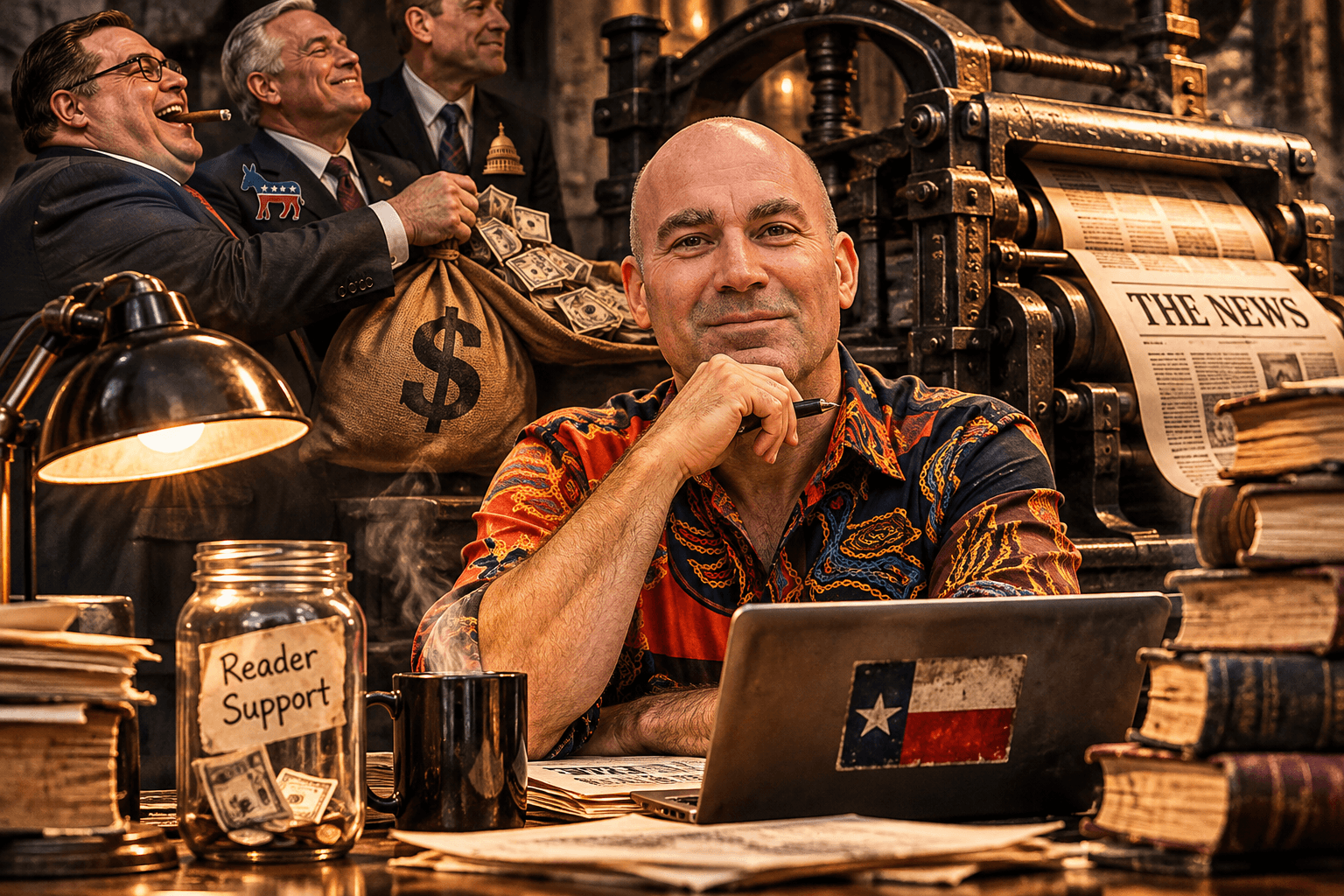
“The people who finance the news have influence over it. The people who refuse to finance it have complaints.”
Americans have spent decades complaining that the news media are bought and paid for. They distrust corporate ownership, billionaire influence, political bias, government funding, and advertisers with enough money to influence what gets published.
They want journalists willing to challenge powerful people, expose corruption, and ask questions that make politicians uncomfortable. They want honest reporting from people who aren’t beholden to a political party, corporate boardroom, or billionaire with a particular vision of how America ought to work.
And apparently, they want all of that for free.
According to a February 2026 Pew Research Center report, only 8% of Americans believe individuals have a responsibility to pay for news. Just 16% had actually paid for news through subscriptions, memberships, or donations during the previous year. Meanwhile, 45% thought advertising and sponsorships should be the primary source of funding for news organizations.
That’s quite an arrangement. Americans complain about the financial interests influencing their news, then propose financing journalism through more of those same interests.
You almost have to admire the ingenuity.
Ask somebody to contribute eight dollars a month toward independent political research and commentary, and suddenly we’re holding congressional hearings on fiscal responsibility.
The Trust Is Gone. The Bills Aren’t.
According to Gallup’s September 2026 survey, only 33% of Americans expressed confidence in newspapers, television, and radio to report the news accurately and fairly. When Gallup began asking the question in the 1970s, roughly seven in ten Americans trusted the media.
Among Republicans, confidence is just 22%. Independents come in at 31%, while confidence among Democrat Party supporters stands at 50%.
Consider how differently two television networks can cover the same political controversy. Depending on which network you watch, you’ll hear from different experts, be presented with different facts, and sometimes come away with an entirely different understanding of what happened.
But the decision about which stories deserve attention can be just as influential as the way those stories are reported.
An investigation that never gets assigned won’t appear on the evening news. A government program nobody bothers examining won’t generate embarrassing questions for its administrators. A politician’s version of events can become conventional wisdom simply because nobody with a substantial audience bothered to investigate it.
Americans have good reason to question the institutions deciding what information they receive. What they’re considerably less enthusiastic about is financing the alternatives.
The Money Has Always Had a Seat at the Table
Political influence over American newspapers didn’t begin with CNN, MSNBC, or Fox News.
In the early nineteenth century, many American newspapers were openly associated with political parties. Friendly politicians helped sustain them through government printing contracts, patronage, and official notices. The newspapers, in turn, promoted their political allies and attacked their opponents.
Imagine the outrage if somebody proposed that arrangement today. Then imagine how many people would quietly ask where to submit their applications.
During the 1830s, a different business model began challenging those partisan newspapers. In 1833, Benjamin Day founded the New York Sun, selling copies for a penny when other newspapers commonly charged around six cents, putting them beyond the reach of many working Americans.
Day understood that lower prices could attract substantially more readers, whose numbers would make advertising space more valuable.
The penny press expanded public access to newspapers while reducing dependence on political patronage. But the financial incentive to increase circulation also influenced the kind of material newspapers published. Crime, scandals, court cases, and sensational stories became popular features.
The Sun demonstrated how far those incentives could go in 1835 when it published the Great Moon Hoax, describing supposed astronomical discoveries that included extraordinary creatures living on the moon.
Apparently, questionable reporting was profitable long before anyone invented clickbait.
Newspapers had reduced their dependence on politicians by giving advertisers a financial stake in their success. Nearly two centuries later, television ratings and website traffic serve much the same economic purpose as newspaper circulation once did.
In October 2024, Patrick Soon-Shiong, the billionaire owner of the Los Angeles Times, blocked his newspaper’s editorial board from endorsing Kamala Harris for president. Editorials editor Mariel Garza resigned, followed by other members of the editorial board.
That same month, Washington Post owner Jeff Bezos ended the newspaper’s practice of endorsing presidential candidates, stopping a planned endorsement of Harris. According to the Post’s own reporting, approximately 250,000 subscribers canceled within days.
Whatever you think of Harris, Trump, or the wisdom of newspapers endorsing political candidates in the first place, those incidents illustrate two competing sources of editorial pressure. The owners exercised their authority over their publications, and hundreds of thousands of readers exercised theirs over their money.
Neither corporate ownership nor reader financing guarantees honest journalism. What deserves consideration is how each arrangement affects the decisions of the people producing it.
Americans Want Independence. Somebody Else Can Finance It.
Pew surveyed 3,560 American adults in December 2025. While advertising and sponsorships were the most popular choices for financing news organizations, just 11% favored subscriptions or memberships. Another 10% preferred government funding.
It’s easy to understand why. The internet has conditioned an entire generation to expect virtually unlimited access to information without paying for it. Why spend money on something when another website appears to offer it free?
The problem is that investigating a government program requires considerably more time than commenting on somebody else’s investigation. Reading legislation, reviewing government contracts, checking statistics, and examining court decisions can consume days before a writer produces a single paragraph worth publishing.
You can distribute the results to another million people on the internet at relatively little additional expense. Producing those results in the first place is another matter.
For an independent writer, the attraction of voluntary subscriptions is the ability to investigate a subject without first having to persuade an editor, corporate owner, or advertiser that it’s worth pursuing.
Of course, a subscription-funded writer can become just as tempted to cater to the prejudices of paying readers as a newspaper publisher can to accommodate the interests of advertisers. I would rather have readers challenge my conclusions than expect me to protect their assumptions.
A Million Words Later
I’ve published 365 essays, somewhere between 250 and 300 of them exceeding 5,000 words. That’s well over a million words of political analysis, historical research, and commentary.
Writing those essays has required thousands of hours investigating subjects that interest me, questioning accepted explanations, and occasionally discovering that the historical record is far more revealing than anything being discussed on television.
An Inconvenient Black Truth has received more than 120,000 views, bringing in 770 free subscribers and 24 paid subscribers. From Minneapolis to “Somaliapolis”: How Incentives Reshaped a City has attracted more than 5,500 views.
Then there’s Message to Islam: We Will Bury You, published August 7, 2026. More than three months later, readers are still discovering and sharing it. As of this writing, it has accumulated 202 likes and 101 restacks, and I continue to see fresh activity in my notifications.
What I particularly enjoy about publishing these longer essays is that their usefulness isn’t necessarily determined by the day’s headlines. Something I researched months ago can help a reader better understand something happening today.
I’m currently working on an essay examining an aspect of immigration that rarely receives much attention: the origins and intended scope of congressional authority over immigration.
The Supreme Court’s 1889 decision in the Chinese Exclusion Case upheld federal authority to exclude foreigners. Nearly 140 years later, Congress’s immigration decisions can place enormous demands on American cities, schools, hospitals, housing markets, and taxpayers who had little say in those decisions.
At what point did the authority to restrict entry into the United States become the authority, in practice, to substantially increase immigration while imposing much of the resulting expense on American communities? And how do those policies square with Congress’s own longstanding declarations that immigrants should be self-sufficient and not depend on public resources?
Those are questions worth investigating, and answering them requires going considerably further back than the last presidential administration. I’m interested in how we arrived at the policies we have today, what was originally intended, and whether anyone adequately considered the economic consequences along the way.
That’s the sort of research I want people to have access to, regardless of whether they can afford a subscription.
The Eight Percent Solution
My primary publication, Mr. Chris Arnell, is where I publish my longer investigations and commentary. I’ve also created Carnell Knowledge, a companion publication that condenses some of those essays into shorter, more accessible pieces and features selected videos, such as If I Wanted America to Fail.
Sometimes an issue deserves 6,000 words of explanation. Sometimes readers want the essential facts and reasoning without spending half an afternoon getting through them.
Both publications remain free because I want the material available to as many people as possible.
Knowledge is power. Especially Carnell Knowledge. LOL.
As of this writing, 197 of my 2,364 subscribers have active paid subscriptions. By an interesting coincidence, that’s approximately 8.3% of my readership helping finance material available to everyone.
I’m enormously grateful to those readers. Their contributions allow me to make the work available without dividing my audience into people who can afford the information and people who can’t.
Another 100 paid subscribers at eight dollars a month would generate $800 in additional monthly subscription revenue, or $9,600 over a year if those subscriptions remained active, before fees.
For a large media organization, those figures wouldn’t cause an executive to interrupt lunch. For an independent writer, they can mean considerably more time devoted to research and writing rather than earning a living elsewhere.
And nobody needs to be a billionaire to make that possible.
The Reader Gets the Final Vote
For much of American history, establishing a publication required expensive printing equipment, a distribution network, and substantial financial backing. Today, an individual with a computer and something worth saying can reach more people than many nineteenth-century newspaper publishers could have imagined.
Americans have an opportunity to influence the media they consume without owning a television network, controlling a corporate advertising budget, or waiting for a politician to do something about media bias. They can help finance the people whose work they consider worthwhile.
The consequences of not doing so are fairly predictable. Independent writers who cannot earn enough to sustain their publications will have less time for research, publish less frequently, put their work behind paywalls, or eventually stop publishing altogether.
I’ve spent years digging into government policy, political history, corruption, immigration, race, and subjects that frequently make polite company uncomfortable. I intend to keep doing it, and I don’t expect every reader to agree with every conclusion.
Actually, I’d be concerned if you did. A readership that agrees with everything its favorite writer says has merely found another person to do its thinking.
I’m struggling financially this month, and I could really use your help. But beyond my immediate circumstances, I want to build something that allows me to devote more of my time to investigating the subjects that brought you here in the first place.
Americans have spent decades complaining about who pays for their news. For perhaps the first time in our history, ordinary Americans have such an inexpensive and direct means of determining whose work gets funded.
We ought to make better use of it.
Chris
Support Independent Media
If you believe my work deserves to continue, please consider supporting it through one of the following options. Your contributions help keep both publications free and accessible to everyone.
Monthly Subscription | $8/month
Help sustain my ongoing research, writing, and publication.
Annual Subscription | $80/year
Support my work for an entire year and save $16.
Resistance Core | $1,200/year
For those who believe strongly in what I’m doing and are financially able to make a more substantial commitment to my work.
Become a paid subscriber:
Prefer to make a one-time contribution?
You can support my work directly through Venmo. Contributions of any amount are genuinely appreciated.
https://account.venmo.com/u/mrchrisarnell
Explore Both Publications
Mr. Chris Arnell
In-depth political analysis, historical research, investigations, and commentary.
Carnell Knowledge
Condensed essays, essential information, and selected videos worth watching and sharing.
https://www.carnellknowledge.com/
Thank you to everyone who reads, shares, restacks, and financially supports my work.