

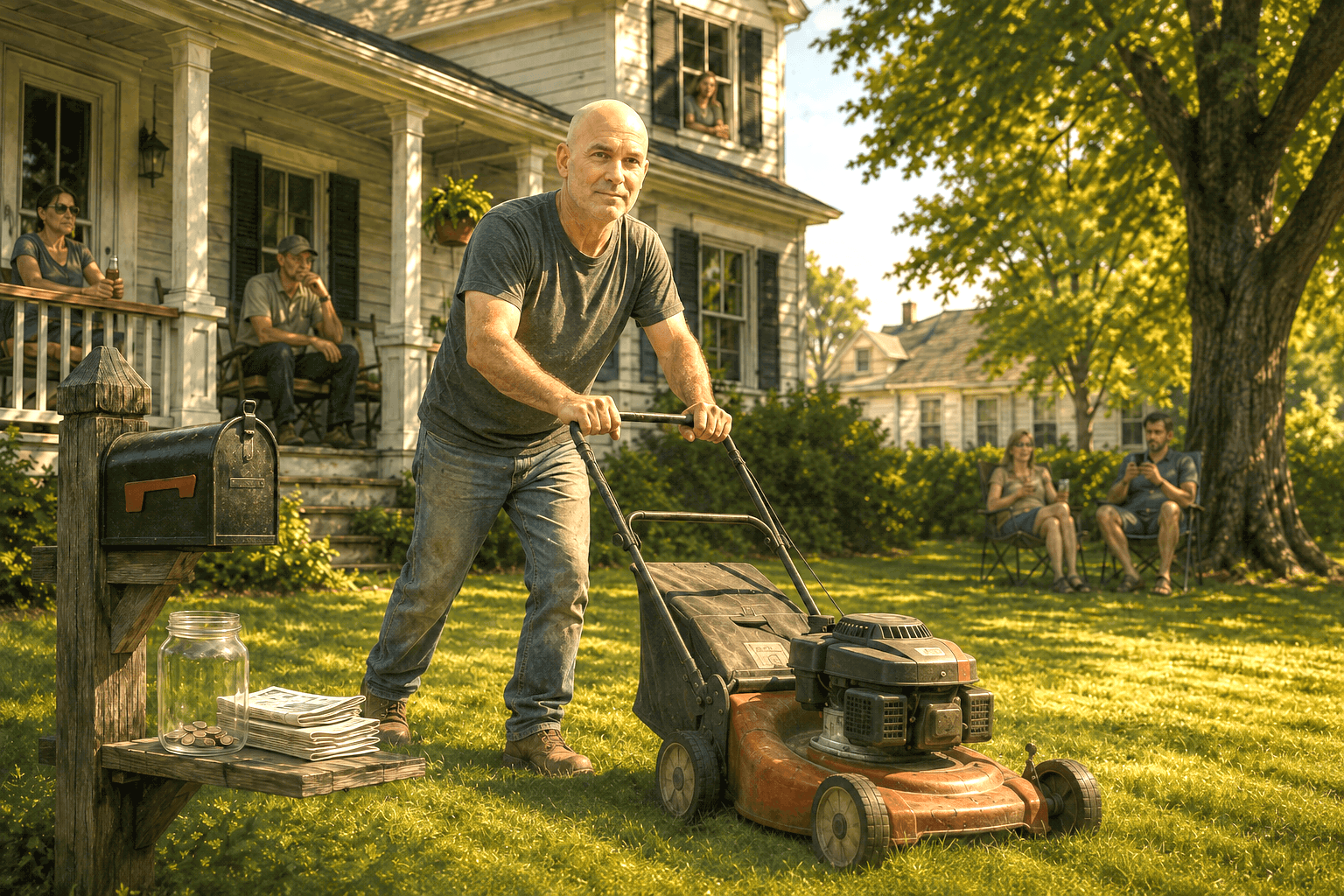
“People clearly still want the lawn mowed. Increasingly, they just seem to believe somebody else should pay the guy mowing it.”
Imagine waking up one Saturday morning and noticing some guy mowing your lawn. You didn’t hire him. You didn’t ask him to do it. You’re not even sure why he’s doing it, but the lawn needed mowing and, from the looks of things, he knows what he’s doing.
He finishes the lawn, edges the sidewalk, cleans up, and leaves. Nice. The following Saturday, he’s back, and then again the Saturday after that.
Before long, this becomes a regular thing. Every week this guy shows up and takes care of your yard. He doesn’t just run a mower over the grass and disappear, either. He notices things, cleans things up and sometimes does a little extra. Every once in a while, he’s out there a hell of a lot longer than you expected.
You get used to it. Maybe you even start looking forward to Saturdays because you know the yard is going to look good when he’s finished. You tell him that, too. You tell him he does great work, mention him to your wife or tell a neighbor about him. Maybe at some point you even say, “Man, I hope you never stop doing this.”
Six months go by. Then a year. Eventually, two years have passed, and the guy is still showing up while you have never paid him a dime.
At some point, wouldn’t that start to feel a little weird?
Maybe even a little like a dick?
I already know the obvious response. You never hired the guy. He volunteered. There was no contract, no agreement and no promise that you would ever pay him, so technically you don’t owe him anything. Fair enough. I’m certainly not suggesting that two years later you suddenly owe him $8,000 in back pay.
That’s not really what I’m asking.
If somebody keeps giving you something you genuinely value, week after week, and you know it takes real time and effort to produce, at what point does enjoying the benefit while leaving the entire cost to somebody else start to bother you?
Most of us understand this immediately when the work is physical because we can see it. You see the guy sweating in your yard. You see him pushing a mower around in August. You see the truck, the trailer, the gas, the equipment and the hours of his Saturday disappearing while he makes your property look better.
Writing is different because almost all of the work happens where nobody can see it. You see the essay when it lands in your inbox, but you don’t see most of what came before it.
You don’t see the research that went nowhere, the source that looked promising until I actually dug into it, the statistic I checked again because something didn’t smell right, or the outline I tore apart halfway through because I realized I was approaching the whole thing wrong. You don’t see me reading something the next morning and thinking, “Well, that sounded a hell of a lot better last night.”
Then there is editing, images, formatting, publishing, promotion, answering comments and all the other stuff that happens after the writing is supposedly finished. None of that shows up in your inbox.
You just open your email and there it is.
Freshly cut grass.
The Internet has done something strange to our perception of work. Because essays, music, podcasts, videos, commentary and research simply appear on a screen, it becomes easy to forget that somebody had to spend part of his life making them. Somewhere along the way, “I can get this for free” became confused with “this costs nothing to produce.”
Those are two very different things.
I’ve intentionally kept my writing available to everyone because I don’t like the idea of spending two or three days researching something I believe is important and then locking it away from somebody who happens to be broke that month. I still don’t like that idea, and I don’t plan to start telling people who genuinely can’t afford a subscription that they shouldn’t be here.
But there is another side to that arrangement that I don’t think we talk about enough. If everybody wants independent work to remain free while almost nobody helps pay for it, eventually the person producing it has to absorb the difference.
For a while, that can work. You squeeze the writing around everything else, steal a few hours here and there and keep telling yourself you’ll figure it out. But eventually time and money start winning the argument.
That’s where the lawn analogy stops being hypothetical for me.
As of this week, there are 2,377 subscribers to this publication, and 216 are paid. Put another way, roughly nine out of every ten people on this list read for free.
That number by itself doesn’t bother me nearly as much as the direction things have been moving.
The audience is still growing. People are still finding the work, joining the list, opening the emails, reading the essays, sharing them, restacking them, commenting on them and sending them to friends. What has changed is the number of people deciding the work is worth financially supporting.
From January through April, 61 people became paid subscribers for the first time. From May through August 21, only 12 have. That’s roughly an 80 percent drop.
The writing didn’t stop during that period. If anything, I’ve been producing more of it. The readership didn’t suddenly disappear either. Thirty-one new people joined this publication just since August 9, yet not one of those 31 became paid.
I don’t say that because I expect every new reader to immediately pull out a credit card. Of course I don’t. People should read for a while and decide whether what I’m doing is worth anything to them.
But when the pattern stretches from weeks into months, it starts telling you something.
People clearly still want the lawn mowed. Increasingly, they just seem to believe somebody else should pay the guy mowing it.
And before any of my paid subscribers wonder whether I’m talking about them, I’m not. You are a huge part of what makes it possible for everybody else to keep reading this work for free. I know that, and I’m grateful for it.
The question is aimed more at the people who have been here for months, sometimes years, who regularly read the work and tell me they value it.
A friend of mine once illustrated this disconnect in a way I’ve never forgotten. He knew a few people who followed my work and thought highly of it, so he asked them a hypothetical question: If Chris got to the point where he simply couldn’t afford to keep writing and was about to give it up completely, would you give him $1,000 to help keep him going?
Every one of them basically said yes. Of course they would. They liked the work. They thought it was important. His response was pretty simple: Then why wait until he’s about to quit?
As far as I know, none of them ever became paid subscribers or donated anything.
I don’t tell that story because I think anybody owes me $1,000. They don’t, and the amount isn’t really the interesting part anyway. What stuck with me was that the work apparently became worth $1,000 the moment they imagined losing it, but while it was still showing up regularly, there was no urgency to support it at all.
That seems to be a very human habit. We rally around the restaurant after it announces it might close. We suddenly find money for things when the alternative becomes watching them disappear. Until then, most of us assume somebody else probably has it covered.
That’s especially easy with something on the Internet because nobody can see what is happening behind the screen. You assume there are subscribers, donors, advertisers, clients or somebody else keeping the whole thing afloat. Most of the time, you have no idea whether that’s actually true.
I’ve had to think about this more seriously over the past month because I lost both of my remaining SEO clients. Roughly $3,000 a month in recurring income disappeared.
That isn’t anybody else’s problem, and I’m not pretending that it is. I can replace the income. I can drive more Uber, find more clients or eventually take a regular job if that’s what I have to do. I’m not above any of those things, and I’m certainly not asking anybody to rescue me from having to work.
The problem is that writing is work too.
Research takes time. Thinking takes time. Writing takes time. If I have to spend another 30 or 40 hours every week somewhere else replacing the income I lost, those hours have to come from somewhere. There isn’t a secret eighth day of the week where I can squeeze all of this in.
Eventually, the writing takes the hit. Maybe I publish less often. Maybe some of the longer pieces I spend days researching become impossible to justify. Maybe I write only when I can find a few leftover hours between everything else.
Or maybe, at some point, the guy just stops showing up on Saturday.
That’s the part I would rather talk about before it happens than afterward. I don’t want people telling me later that they wish I had kept writing or that they would have helped if they had realized how difficult it had become to keep everything going.
I’m telling you now.
If you don’t particularly care about my work, don’t pay for it. I’m serious. Keep the money. If you’re struggling financially, keep reading. Share an essay, send it to somebody else or help however you can. There are plenty of ways to support what I’m doing that don’t involve pulling out a credit card.
But if you’ve been reading me for a year or two, regularly opening these emails, sharing the essays and telling people this work matters, I think it’s fair to ask one uncomfortable question:
At what point should that belief show up somewhere other than the comments?
Nobody owes me a subscription because they read something I wrote. That’s not the argument.
But if somebody mowed your lawn every week for two years, you loved what he did, constantly told him how much you appreciated him and genuinely hoped he would keep coming back, wouldn’t you eventually feel a little strange about never giving him anything?
I think I would.
And to those of you who have stepped up, subscribed, donated, shared the work and helped keep this going, I hope you know how much I appreciate it. You are the reason I’ve been able to keep showing up on Saturdays.
If You Want the Lawn Mowed Next Saturday
If you’ve made it this far, you already know what I’m asking.
I want to keep researching, writing and publishing this work, and I want to keep making it available to everyone. Financial support from readers is what makes that possible.
Become a Paid Subscriber: $80 Per Year
If you read regularly and want me to keep showing up, becoming a paid subscriber is the simplest way to help. It gives me more time to research, write and produce the work instead of spending those hours somewhere else trying to replace the income.
Join the Resistance Core: $1,200 Per Year
Resistance Core is for the small number of readers who want to make a much larger commitment to what I’m building.
It is $1,200 per year, charged annually, and that support goes beyond simply keeping the current essays coming. It helps me grow this into something bigger: more content, more video, better promotion, the upcoming book An Inconvenient Black Truth, and eventually reaching far more people than I can reach today.
Make a One-Time Contribution
If you don’t want another subscription but still want to throw something in the jar, a one-time contribution helps too. Ten bucks, fifty bucks, a hundred bucks, whatever makes sense to you.
Prefer Venmo?
You can also send a one-time contribution directly through Venmo:
https://account.venmo.com/u/mrchrisarnell
If You Can’t Give
If you can’t give, keep reading. Restack the essay, share it, forward it to somebody who might appreciate it or post it somewhere new people might find it. There are plenty of ways to help keep the mower running that don’t require spending money.
And to everyone who already has stepped up, whether through a paid subscription, Resistance Core, a donation or simply helping spread the work, thank you.
Coming next: Be on the lookout tomorrow or Sunday for my next essay, “Borders. Language. Culture.” If you’re anywhere near my age, you’ll probably recognize where I’m going with that title. Cue the Metallica.
I would absolutely feel like a dick. And I’d feel like I was stealing. I have three simple concepts that I live by: I don’t cheat steal or lie. It’s served me well. And it helps me sleep at night.