


People around the world learn English to get ahead. Why should expecting people who choose to live in America to learn it be considered unreasonable?
Michael Savage’s first word was Borders.
In the first essay, I argued that a border is much more than a fence separating Texas from Mexico. It is the entire system through which a country decides who enters, who stays, who works, who becomes permanent and, eventually, who becomes one of us.
Savage’s second word was Language.
At first glance, this one seems easier. Speak English. Problem solved.
Not quite.
There is nothing wrong with a Mexican family speaking Spanish over dinner, an Indian family speaking Hindi with grandparents or a Chinese couple speaking Mandarin in their own home. We as a country have never required immigrants to erase every trace of where they came from, nor should we.
The issue begins outside the home. Can hundreds of millions of people from different countries, races, religions and cultures function as one society if they cannot communicate directly with one another?
Speaking another language is not the problem. Living in America without a shared language is.
English Was Never Just a Language
Think about how much of normal life assumes two strangers can understand one another.
A cop pulls somebody over. A patient explains where it hurts. A boss gives instructions. A teacher talks to a parent. A witness testifies in court. A customer asks a question. A voter listens to candidates explain what they intend to do. A soldier receives an order.
At that scale, language is not simply something people use to chat. It is infrastructure.
A country can accommodate hundreds of private languages. Families can preserve them. Churches can use them. Newspapers can print them. Businesses can advertise in them. None of that requires pretending a nation has no need for one language through which almost everybody can communicate.
A common language does not require everyone to sound alike. It requires everyone to be able to talk to one another.
President Trump made that principle federal policy on March 1, 2025, when he signed an executive order designating English as the official language of the United States. The order revoked a Clinton-era directive concerning limited-English access, although it did not order federal agencies to eliminate every translated document or multilingual service. Agencies retained discretion to continue them when appropriate. The Justice Department followed in July 2025 with guidance telling federal agencies to minimize nonessential multilingual services and put greater emphasis on English acquisition and assimilation.
By 2026, some agencies had begun taking that policy considerably further. HUD announced that departmental business and services would be conducted in English and that the department would end non-English translation services, subject to whatever legal obligations still applied.
Even after English became official, America remained multilingual in practice. So why English, specifically?
The Language the World Chose
There is something strange about Americans being told that expecting immigrants to learn English is culturally insensitive when people all over the planet voluntarily learn it for the exact opposite reason.
It is useful as hell.
Researchers have an entire field devoted to English as a global lingua franca. International business even has an acronym for it, BELF, or Business English as a Lingua Franca. It describes English being used as the common language between people who may not be native English speakers at all.
A Chinese executive and a German supplier may communicate in English because neither speaks the other’s language. An Indian engineer working with an American client uses English. Multinational companies operating across dozens of countries use it because there has to be some way for people from all those places to understand one another.
The same thing happened in science. English was once one of several major scientific languages. Today it dominates. One academic review found that by 2015 roughly 99 percent of publications in the natural sciences appeared in English.
Researchers who grew up speaking other languages obviously face an extra hurdle. But the fact that so many learn English anyway tells you how valuable it has become.
A Brazilian scientist learns it. A German businessman learns it. An Indian engineer learns it. A Korean executive learns it. They are not doing this because Americans forced them. They are doing it because English expands the number of people they can communicate with and the number of opportunities available to them.
English is not just the language Americans speak. It is the language much of the world learns when it wants to get ahead.
If people from countries thousands of miles away learn English to expand their opportunities, why should expecting immigrants living permanently in America to learn it be considered unreasonable?
What America Actually Speaks
Before anybody starts yelling that nobody speaks English anymore, we should look at the numbers.
The 2024 American Community Survey counted about 321.7 million people living in the United States age five and older. Roughly 247.7 million, or 77 percent, spoke only English at home. Another 74.1 million people, about 23 percent, spoke another language at home.
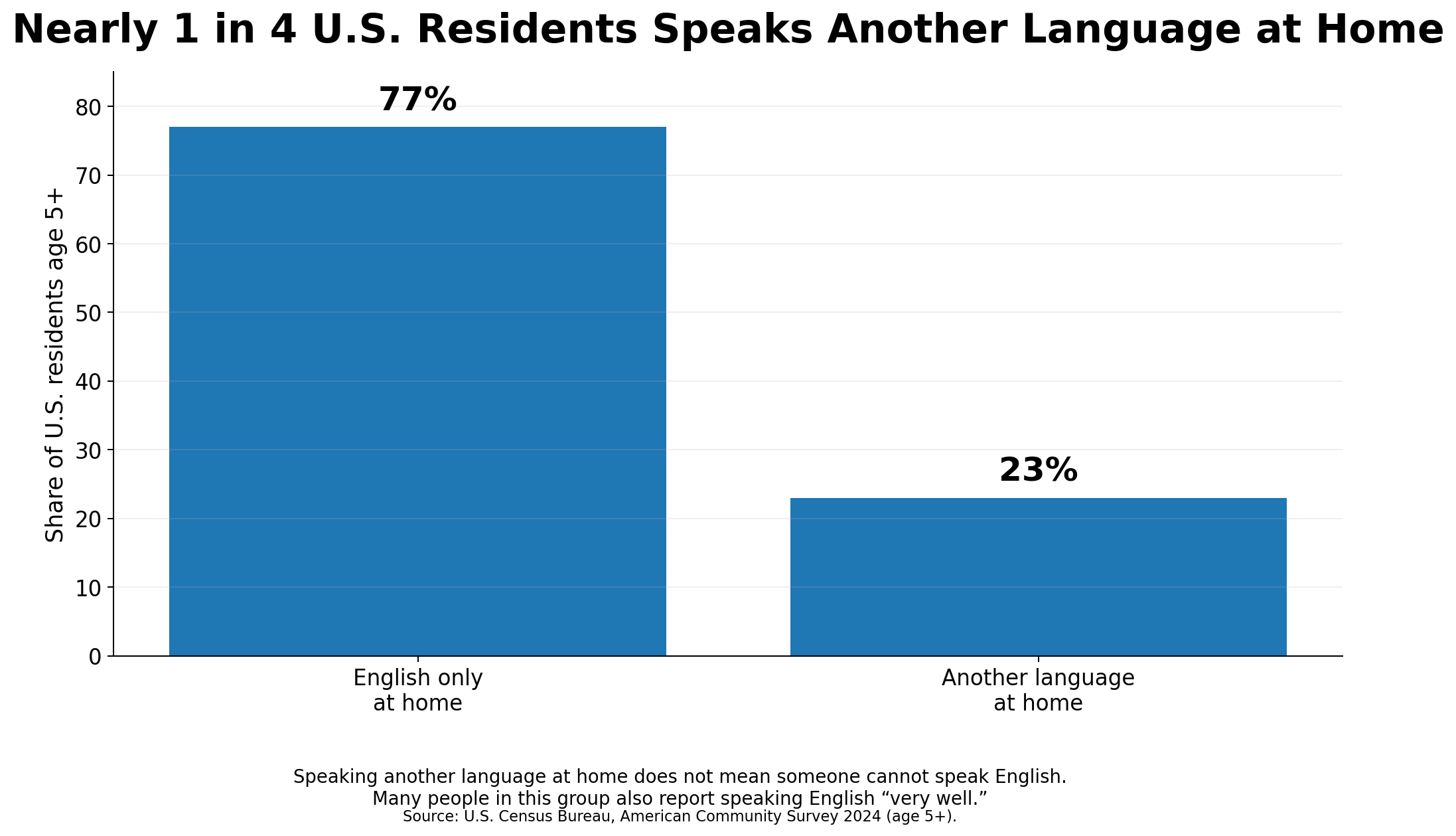
Seventy-four million sounds enormous because it is enormous, but it would be disingenuous to turn those 74 million people into 74 million people who cannot speak English. Most can.
About 45.1 million people who spoke another language at home also reported speaking English “very well.” Put everyone together and approximately 91 percent of U.S. residents age five and older either spoke only English or spoke English very well.
That leaves roughly 28.9 million people, about 9 percent of the population in that age group, who reported speaking English less than very well.
America is still overwhelmingly an English-speaking country, but 29 million people with limited English ability is hardly a rounding error. That is roughly the population of Texas just a few years ago.
Spanish is by far the largest non-English language. About 44.9 million people spoke Spanish at home in 2024, and approximately 18.4 million of them reported speaking English less than very well.
The numbers are less dramatic than some people make them sound, but they are hardly meaningless. America is not some linguistic Tower of Babel where nobody understands anybody. It also contains tens of millions of people who cannot use the country’s common language proficiently.
English and the Economic Ladder
There is another reason to encourage English that has nothing to do with making native-born Americans comfortable. It helps immigrants themselves.
Nearly 91 percent of Asian immigrants say speaking English is necessary to get ahead in the United States. Apparently they understand something parts of our political class find difficult to grasp.
If you speak Spanish, that is useful. If you speak Spanish and English, it is more useful.
Your potential employers, customers, coworkers, schools, business relationships and professional networks are no longer largely confined to one linguistic community. The same principle applies to Hindi, Mandarin, Arabic, Vietnamese or almost anything else.
Bilingualism is an advantage. English deficiency is the handicap.
The economic numbers are consistent with it. A Brookings analysis found lower earnings among limited-English workers at every education level it examined. Among full-time, year-round workers, English-proficient workers had median earnings 39 percent higher than workers with limited English proficiency overall. Even among workers holding bachelor’s degrees, the gap was about 30 percent.
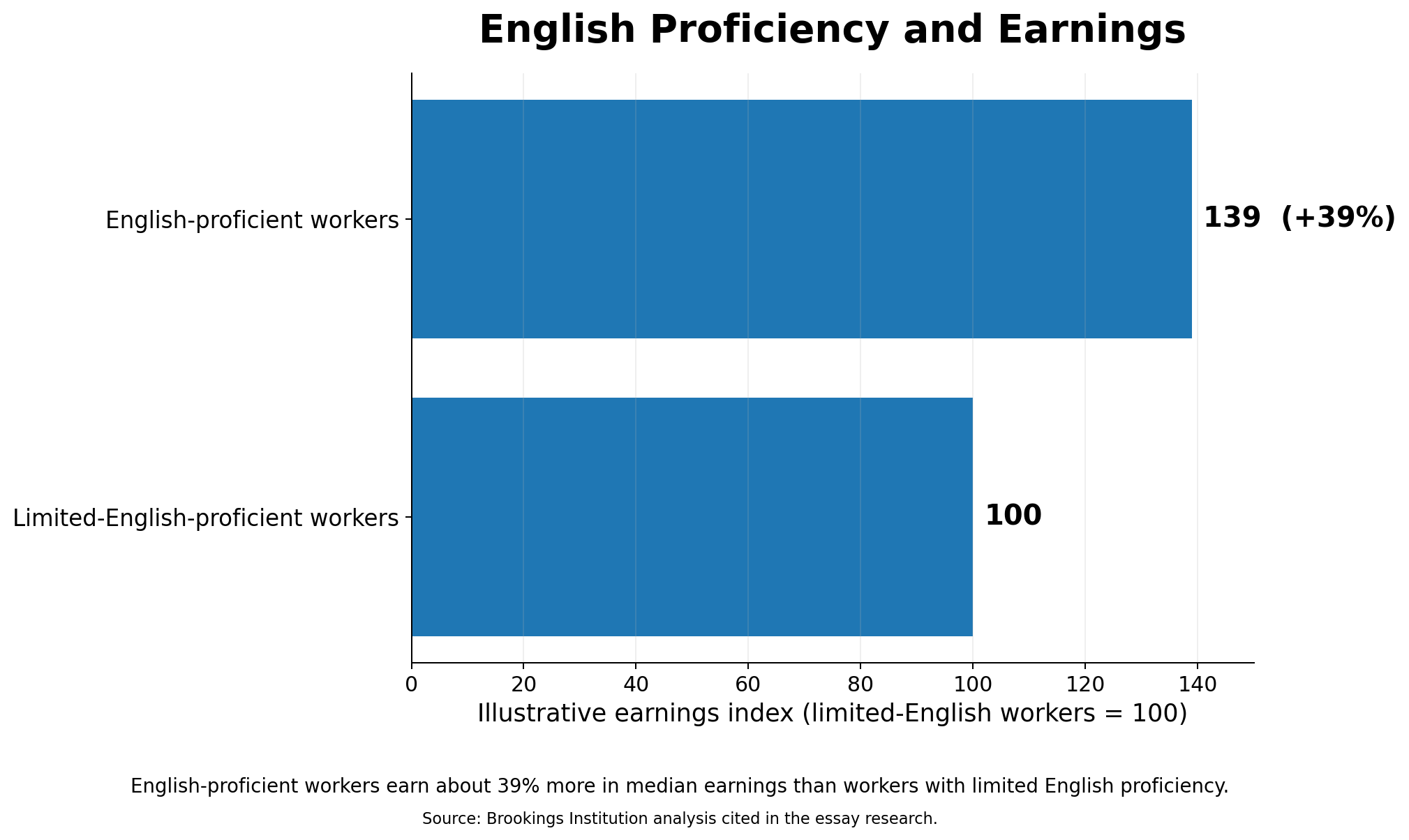
More recent survey data point in the same direction. KFF found that 55 percent of immigrants with limited English proficiency had household incomes below $40,000, compared with 28 percent of English-proficient immigrants.
English alone obviously does not cause that entire difference. Occupation, education, experience, immigration history and plenty of other things affect income too. Still, the relationship keeps showing up.
Spanish-speaking populations also remain disproportionately represented lower on the American economic ladder. In the 2024 ACS, roughly 14.5 percent of adults who spoke Spanish at home were below the poverty line, compared with about 10.6 percent of adults who spoke only English at home.
Spanish obviously does not cause poverty. Education, immigration history, occupation, family structure, age and English ability are tangled together in those numbers. There are rich Spanish speakers and poor English speakers.
Pretending language has nothing to do with economic mobility would be equally silly.
Spanish can connect you to a community. English connects you to the country.
I know something about that from personal experience.
I Was the Immigrant Once
After I got out of the Army, I stayed in Germany for a few years.
I already had the same place I had been living in while I was in the Army, so housing was taken care of. What I needed was a job, and I had a pretty short window to get one.
Before joining the Army, I had worked in printing and was pretty good at it. I knew there was a print shop in the small town where I lived, so I figured I would go talk to the owner.
There was one slight problem: I didn’t speak much German.
I understood a lot more than I could speak, which anybody who has seriously tried learning another language will understand. Hearing something, translating it in your head and figuring out what somebody means is one skill. Building the response fast enough to spit it back out in another language is something completely different.
My girlfriend at the time was German. She spoke only German to me and I spoke only English to her. And basically, this worked. We knew enough about each other that we usually knew what the other person would understand. When things completely went off the rails, we had one of those little pocket translators.
No Google Translate. No smartphone. Just a little electronic device and two people probably sounding like idiots to anyone listening.
So I went to the print shop and talked to the owner. We struggled through the conversation with my lousy German, gestures and the pocket translator until he finally got to the obvious problem: How can I hire you? You don’t even speak German.
Fair enough.
I told him printing wasn’t rocket science. I knew how to do the work. I could follow basic instructions, and I promised him I would learn German. Nobody in the shop spoke English. Not even him.
He told me to go down to the employment office in town and see what could be worked out. And by the way, at least in my experience back then, Germans didn’t screw around with something called an “Unemployment Office.” It was the Employment Office. You went there to get employed.
Imagine that. LOL.
Fortunately, the woman I dealt with spoke English. Even better, she loved Americans and really loved California.
American from California? I checked all the boxes.
She explained that even though I had just gotten out of the Army and my situation was a little unusual, I could apparently qualify under an immigrant employment program. The government could cover half of my wages for a period of time while I got established.
She gave me the paperwork and told me to take the idea back to the print-shop owner. I did, and he hired me.
That is when my real German education started.
For those first months, nobody at work spoke English. My girlfriend spoke German. Television was German, and we had three channels. My coworkers talked to each other in German all day. There was nowhere to hide, and at first it sucked.
I was lonely. A little depressed. In a weird way, I sometimes felt like a prisoner. It probably sounds dramatic unless you’ve lived it.
Imagine being a grown man who has spent his entire life making his own decisions and suddenly needing somebody else’s help to understand the world around him.
What does this letter say? Where am I supposed to go? What did that guy just tell me? What am I agreeing to? Is this apartment any good? What are these people laughing about? What did the government just send me?
You are not physically trapped, but there is always somebody standing between you and part of reality. That wears on you.
As my German got better, something changed. I felt better.
Not just because ordering dinner became easier. I could joke with my coworkers. I could argue with people. I could understand what everybody was laughing about. I could deal with problems myself and ask questions without rehearsing the sentence in my head for five minutes.
Eventually I could ramble in German the same way I ramble in the videos I post now.
Poor Germans.
The depression faded. Bavaria stopped feeling like somewhere I happened to be stuck and started feeling like a place where I could actually participate in life. I never did get my own lederhosen, but I was immersed in the society around me, and Bavaria was a hell of a place to live.
Learning German did not make me less American. It made me less helpless.
There was another reason I learned German so quickly: I really did not have much choice.
At least where I lived at the time, the ATM wasn’t offering me an English option. The people inside the bank didn’t speak English. Neither did the people I dealt with at the doctor, dentist, grocery store, hardware store or veterinarian. My coworkers didn’t speak English. My girlfriend didn’t speak English to me. Turn on the television and, congratulations, more German.
Nobody passed a law ordering me to learn the language. Germany didn’t need to. If I wanted to function on my own, I had to learn, so I did.
Within roughly six months to a year, I could speak enough German to handle my own life. Would I have learned that quickly if every ATM offered English, every government form came translated, every office had an interpreter available and I could conduct most of my daily life inside an English-speaking community? Probably not. Why would I?
People respond to incentives, including incentives nobody consciously designed. Germany gave me an enormous incentive to learn German simply by conducting ordinary German life in German.
I think America increasingly gets that backward. We tell immigrants that learning English is important while simultaneously building more ways for them to function without it.
Some of those accommodations are helpful. Some are humane. I am not suggesting we let somebody bleed out in an emergency room until he learns the difference between an adjective and an adverb. But every accommodation also makes English a little less necessary.
There is a huge difference between learning enough of the language to function on your own in six or twelve months and spending six or twelve years relying on other people to bridge the gap.
That experience is probably one reason I have so little patience for the idea that expecting immigrants to learn English is somehow cruel. I think the opposite can be cruel.
Dependency Is Not Compassion
Last year I wrote an essay called Press 2 for Enslavement: Why the Democrat Party Prefers You Never Learn English.
The title was intentionally brutal. The argument underneath it was more basic.
If you cannot independently understand the language being used around you, somebody has to stand between you and the information. Maybe it is a translator, nonprofit worker, government employee, family member, community activist, political organizer, or simply an acquaintance.
My argument was that those intermediaries can become gatekeepers and permanent language dependency can become politically useful. The essay focused heavily on Los Angeles, where I looked at translation spending, government language programs, community organizations and voter outreach.
I am not going to rehash that essay here, but one idea from it belongs in this discussion:
Are we measuring how many people we help, or how many eventually stop needing our help?
In the Los Angeles programs I examined, public reporting emphasized things such as enrollments, workshops, materials distributed and people served. Those are easy numbers to collect and they sound impressive. What was harder to find was equally prominent reporting showing how many people became proficient enough in English that they no longer needed the service.
Suppose a program serves 50,000 people this year and 100,000 people ten years from now. The organization can say it doubled the number of people it helped. Someone else might wonder why twice as many people still need help.
Which interpretation is correct depends largely on what the program was supposed to accomplish.
Helping someone communicate with an ER doctor is obviously useful. So is helping a crime victim talk to police or helping somebody who arrived six months ago understand government paperwork while learning English.
But if someone can live in America for twenty years without acquiring enough English to navigate ordinary American life on his own, I am not convinced that adding another translator is necessarily kindness.
Translation should be a bridge to English, not an alternative to it.
My old essay opened with another line:
“Whoever controls your language, controls you.”
“Controls” may be too absolute in some circumstances, but the basic principle is difficult to escape. The less information you can obtain firsthand, the more power you surrender to whoever interprets it for you. I know what that feels like because I lived it.
The Good News Nobody Should Hide
There is one rather large problem with claiming immigrants simply refuse to learn English: the evidence says otherwise. Their English generally improves, and their children’s English improves even more.
Pew’s analysis of 2024 data found that 71 percent of Latinos age five and older were English proficient, up from 59 percent in 2000. The share speaking Spanish at home also declined from 78 percent to 68 percent over that period.
Census data make the generational difference even clearer. In 2024, roughly 91 percent of U.S.-born Hispanics were English proficient, compared with about 36 percent of foreign-born Hispanics.
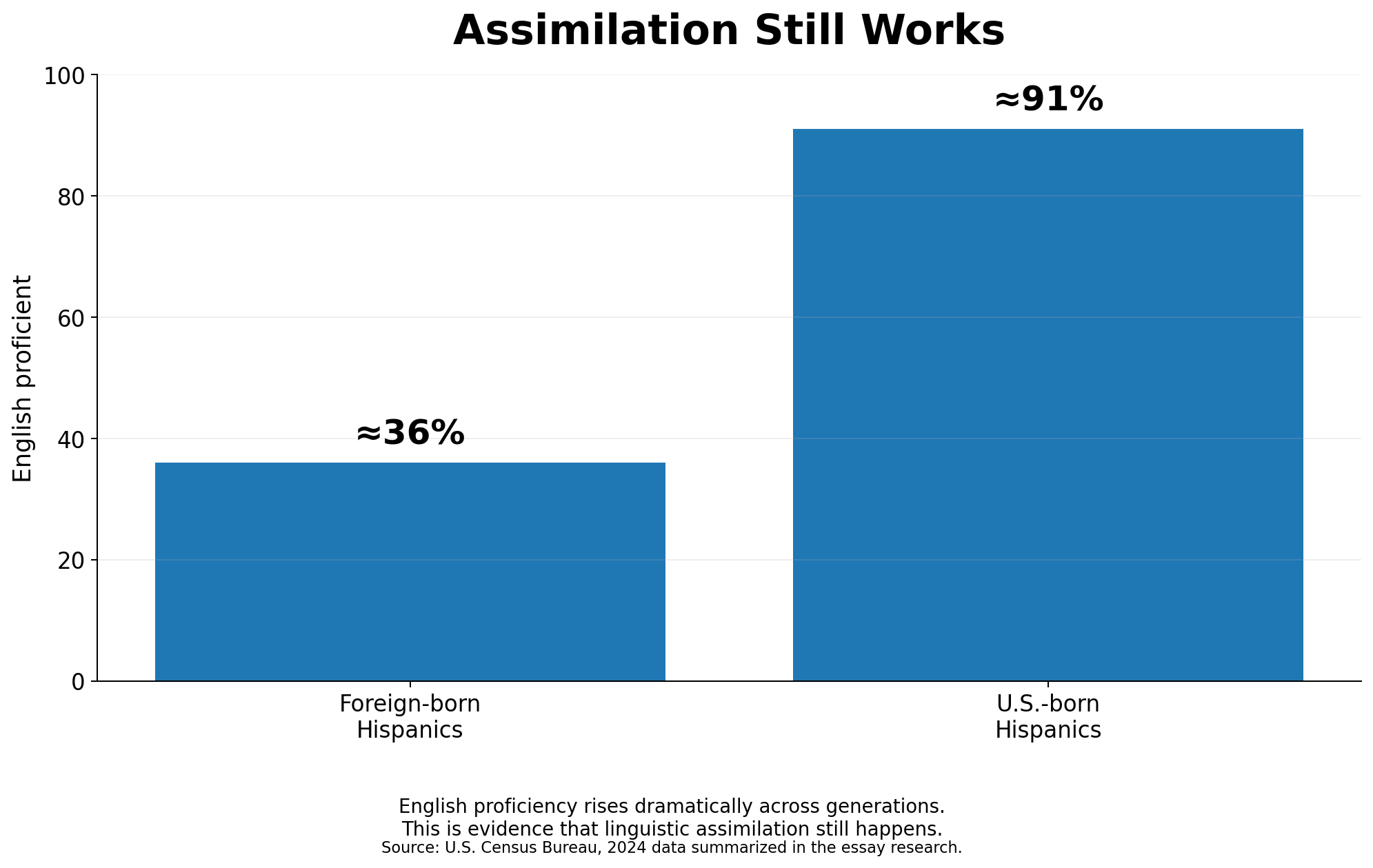
Everyday behavior moves the same direction. Pew found that 73 percent of second-generation Hispanics got their news mainly in English. By the third generation or higher, it was 92 percent. Only 1 percent of that latter group said they mainly got their news in Spanish.
Asian immigration shows substantial English acquisition too. Pew reports that 84 percent of Indians age five and older are English proficient, including 79 percent of Indian immigrants and 96 percent of U.S.-born Indians.
There is broader evidence as well. A major 2024 study by economists Ran Abramitzky and Leah Boustan found that modern immigrants and their children continue to assimilate economically and culturally at rates comparable in many respects with earlier immigrant waves.
Good. If the evidence complicates my argument, then my argument needs to get better.
Yes, assimilation still often works, but “often” matters.
Generational statistics tell us what tends to happen across large populations. They do not tell us that every immigrant learns English, how long each person takes or whether the process could happen much faster under different conditions.
If English overwhelmingly wins by the third generation, that is good news. But I am also interested in what happens during the first generation. Does someone learn enough English to handle ordinary American life on his own in a year or two, or does he spend ten or twenty years relying on relatives, interpreters, government agencies and community organizations to bridge the language gap?
Those are very different experiences. My concern is not that linguistic assimilation has stopped. It hasn’t. My concern is that we have built a system that may make it work more slowly than it needs to.
The goal should not merely be that an immigrant’s grandchildren eventually speak English. We should want the immigrant himself to reach that point much sooner.
Several things have changed since earlier waves of immigration, and not all of them push in that direction.
Distance Used to Do Some of the Work
I touched on this in BORDERS.
Picture an Italian immigrant arriving in New York in 1900. His mother is in Italy. His cousins are in Italy. His old friends are in Italy. The newspaper from his hometown is in Italy. Italian radio does not exist yet. Italian television does not exist. WhatsApp, FaceTime and YouTube are a century away.
Maybe he writes letters. Maybe he eventually travels home. But most days, America is in his face.
His employer speaks English. His children’s school uses English. Government operates in English. Businesses operate mostly in English. His kids hear English everywhere, and his grandchildren hear even more.
Distance helped sever the immigrant from the daily life of the place he left. It did some of the work of assimilation.
Now imagine an immigrant living in Texas in 2026.
He can wake up and read news from India before getting out of bed. He can spend lunch scrolling social media populated mainly by people from India. He can FaceTime relatives every night, watch Indian television, listen to Indian podcasts, follow Indian politics, join dozens of WhatsApp groups and fly back home in about a day.
A Mexican immigrant can maintain even tighter physical connections because Mexico is next door.
None of this is wrong. If I lived overseas again, I would probably be doing much of the same thing. The difference is technological.
Immigration still moves the body. Technology can leave much more of the mind behind.
Distance used to do some of the work of assimilation. It does much less of that now.
It does not stop people from learning English. It can make the home language easier to preserve and the larger American society somewhat less unavoidable.
When an Enclave Becomes a World
The other change is scale.
Ethnic neighborhoods are nothing new. Little Italy was real. Chinatown was real. Germans clustered together. Poles clustered together. Jews clustered together. New immigrants understandably move near relatives, friends, churches, employers and businesses they already know.
But size can change how an enclave functions.
If a linguistic community becomes large enough, you may be able to find a doctor who speaks your language, hire a lawyer from your community, buy groceries from your homeland, find an employer inside the community, use a realtor from the community, attend a religious institution serving the community and socialize almost entirely within that network.
English becomes less urgent, and this is no longer limited to New York, Miami or Los Angeles.
The Census Bureau reports that 26.5 percent of Cedar Park residents age five and older speak a language other than English at home. Right next door in Leander, the figure is 28.4 percent.
That does not mean one-quarter of Cedar Park or Leander cannot speak English. Many probably speak it perfectly. Some were born here. It does show how quickly linguistic diversity has become normal in American suburbs that were nowhere near the country’s traditional immigration gateways a generation ago.
Spanish presents the largest test because no other foreign language in modern America has anything close to its scale.
Nearly 45 million people speak Spanish at home. Mexico sits directly across the border. Immigration from Latin America continually brings new Spanish speakers. Spanish television, radio, websites, businesses and advertising markets are large enough that someone can function extensively in Spanish for years.
And yet Spanish still tends to lose ground to English by later generations. To me, that is where the real issue starts.
Researchers Rubén Rumbaut and Douglas Massey found that when mass European immigration slowed, languages such as German, Italian, Polish and Yiddish declined across subsequent generations. Their research also found that modern immigrant languages usually weaken sharply across generations, including Spanish.
That leaves two forces pulling in opposite directions. Generational assimilation pushes toward English. Continuing immigration replenishes the language population from the other direction.
There is no magic percentage at which an ethnic neighborhood stops functioning as a landing place and becomes something closer to a parallel society. But there is no reason we should be afraid to ask when that can happen either.
India Complicates My Argument
India creates another problem for anyone who wants to turn this into a simple “foreigners won’t learn English” essay.
Indians often arrive already speaking it.
Pew found that 64 percent of Asian immigrants overall said they could read or speak English before moving to America, and Indian and Filipino immigrants were the only major Asian groups in which a large majority reported having those skills before immigration.
Among Indians living in America today, about 84 percent are English proficient, including 79 percent of Indian immigrants and 96 percent of those born here.
So if learning English were the entire assimilation problem, Indians would have solved a large part of it before their plane landed.
But imagine an immigrant who speaks flawless English, earns $180,000 a year, has an American graduate degree and works for an American technology company. He may be completely assimilated.
Or maybe most of his social life remains inside his ethnic community. Maybe he follows the politics of the country he came from intensely. Maybe nearly all his close friends share his background or his family strongly prefers marriage within the group.
I am not saying that describes Indian immigrants generally. It would be silly to infer those things from somebody’s nationality. My point is narrower than that.
Speaking English and becoming American are not necessarily the same thing.
English gets people into the same conversation. It cannot determine what they believe once the conversation begins. That belongs to Savage’s third word.
Learning English Is Not Cultural Erasure
There is an objection to all of this that I understand. Why should immigrants have to give up who they are?
They shouldn’t.
Learning German did not require me to stop being American. I still liked American music. I still thought like an American. I still had an American accent and missed American food.
German didn’t erase any of that. It gave me access to Germany.
Had I moved there permanently and spent twenty years demanding that Germans conduct my life in English, most Germans would probably have thought I was an asshole. They would have been right.
If you choose to build your life inside another society, learning enough of its language to function independently seems like one of the most basic responsibilities imaginable.
Asking immigrants to learn English is not asking them to forget where they came from. It is asking them to participate fully in the country they chose.
There is another part of that bargain Americans have become strangely reluctant to say out loud. Immigration is a choice.
If you choose to leave Mexico, India, Somalia, China or anywhere else and build your life in the United States, you are coming here for a reason. America offers access to one of the largest economies in the world, American schools and universities, American infrastructure, American courts and legal protections, American labor markets, American capital and, for those who eventually qualify, American citizenship.
That cannot reasonably be a one-way transaction.
If your goal is to come here, recreate a mini-India, mini-Mexico or mini-whatever, speak only your old language, live almost entirely inside your old community and make no serious effort to become part of the country around you, then I have a pretty basic question: Why immigrate here in the first place?
America should not be treated merely as an economic platform where somebody collects the advantages while regarding assimilation as an unreasonable burden.
Nobody is asking immigrants to burn the family photographs, stop eating the food they grew up with or pretend their grandparents never existed. Keep the language at home. Keep the recipes. Keep the family stories. Keep the traditions that fit comfortably within American law and liberty.
But there ought to be some movement in both directions. America welcomes you in. You make an effort to become American. That seems like a pretty good deal.
If you want everything America offers but want nothing to do with becoming part of America, maybe America was the wrong place to immigrate to.
America already recognizes part of this principle in citizenship law. Most applicants for naturalization must demonstrate an ability to speak, read and write basic English in addition to passing the civics requirement. USCIS provides exceptions, including the long-standing 50/20 and 55/15 rules for older permanent residents who have lived here for many years, along with disability-related exceptions. Applicants age 65 or older who have been permanent residents for at least 20 years also receive special consideration on the civics portion.
So America already accepts the basic idea. The real argument is over how seriously we take it.
The Language of Citizenship
Citizenship should eventually turn strangers into countrymen. That is much bigger than changing the document in your wallet.
Citizens vote, sit on juries, argue over laws, fund governments, decide what schools teach and determine what kind of country the next generation inherits.
In the Census Bureau’s most recent published Section 203 determinations, 331 jurisdictions were required to provide election-language assistance for qualifying language-minority populations. Those jurisdictions contained a covered voting-age citizen population of more than 24 million people. That does not mean all 24 million personally needed translation. It describes the voting-age population within the covered jurisdictions.
I understand why those rules exist. A citizen’s vote is important.
But if someone has lived in America long enough to become an American citizen, shouldn’t we also want him to reach the point where he can evaluate political arguments without another person translating them?
Not because he owes English speakers a favor, but because independence is better.
Once I learned German, I did not need somebody constantly standing between me and the information around me. I could listen, read, argue and decide for myself.
For a country as racially, ethnically, religiously and culturally diverse as the United States, a shared language is one of the few things capable of crossing almost every dividing line.
A black mechanic in Detroit and an Indian programmer in Austin may have completely different backgrounds. If they both speak English, they can at least talk. That sounds like a small thing until they cannot.
Michael Savage’s second word was Language, singular. Not because every other language should disappear, but because a country this diverse needs some mechanism through which diversity becomes a society rather than merely a collection of groups occupying the same piece of land.
And even that is not enough.
Imagine tomorrow morning that every person in America wakes up speaking flawless English. Would our arguments over assimilation disappear?
Of course not.
We could understand every word coming out of one another’s mouths and still disagree completely about free speech, religious authority, women, marriage, race, individual liberty, law, loyalty, family, citizenship and what America itself is supposed to be.
Learning German allowed me to understand the people around me. It did not make me German.
That may be the simplest way to understand why Savage needed a third word.
Borders determine who comes in. Language allows us to speak to one another. But speaking the same language does not guarantee that we believe in the same things.
That brings us to the third word.
Culture.
Coming next: Borders, Language, and Culture: CULTURE
Help Keep This Work Independent
Borders. Language. Culture. is taking three essays to work through because none of these subjects can be reduced to a slogan.
For Language, that meant digging into Census data, English proficiency, income and poverty differences, assimilation across generations, government translation programs, citizenship requirements, voting-language rules and the ways modern technology can change how quickly immigrants are pulled into the broader culture.
It also meant going back to something I experienced personally when I lived in Germany and learned what it feels like to be surrounded by a language you do not fully understand.
If you think this kind of independent work is worth having around, there are a few ways you can help me keep doing it.
Become a Paid Subscriber
A paid subscription is the simplest way to support the writing on an ongoing basis. It helps me keep researching, writing and publishing work that does not depend on advertisers, corporate sponsors or somebody else’s approval.
Become a paid subscriber:
https://mrchr.is/help
Make a One-Time Gift
If you would rather contribute without another subscription, a one-time gift helps too.
Make a one-time gift:
https://mrchr.is/give
Prefer Venmo?
Venmo is simply the fastest direct option for readers who want to contribute without creating another account or recurring commitment.
Venmo:
https://account.venmo.com/u/mrchrisarnell
Join The Resistance Core
Resistance Core is for the small group of readers who want to provide a much larger level of support for where I am trying to take this work.
It is $1,200 per year, charged annually, which works out to the equivalent of $100 a month.
That support is meant to help me grow beyond essays alone, produce more content including video, continue building An Inconvenient Black Truth into a book, and eventually develop some of the educational projects I have talked about.
Join Resistance Core:
https://mrchr.is/resist
If You Cannot Give
Keep reading.
Share this essay. Restack it. Send it to somebody who thinks expecting immigrants to learn English is somehow cruel or unreasonable.
That helps too.
And thank you for reading.
Chris - I had a work associate in central PA 25 years ago who was ethnically Chinese, born and raised in the Bronx. Her English was very limited, and she only lasted a few years with us as there was no local Chinese community of much substance. I suspect that she grew up in a Chinese enclave and had little pressure to learn English.
Another associate was married to a woman born in Taiwan but raised in upstate NY. Her English was perfect though she was fluent in Mandarin courtesy of her parents, who in their 80s, still had very limited English skills.
Assimilation is always a choice. Social cohesion benefits more from it, while families often see more benefit from maintaining their cultural heritage and customs. We shouldn't discourage families from this, though we should not be entertaining divisions in the public square. Diversity simply for the sake of diversity is most definitely NOT our strength.