

“The N-Word has power because we keep treating it like a legal defense.”
Every society has its taboos, but modern America turned one of them into something almost religious. It is a single word; two syllables forbidden to utter, repeat, or even hint at without risking a social and sometimes physical explosion. That word, the infamous N‑Word, carries a power few could have imagined even half a century ago. It dominates public morality as though it were a sacred incantation or a curse whose mere mention can collapse the normal boundaries of right and wrong.
We often hear of fights, riots, or celebrity scandals that turn on this simple storyline: “He said the N‑Word.” The script has become too familiar. A word is alleged, tempers rise, violence follows, and the crowd immediately divides itself into the “understanding” and the “unforgivable.” The act of aggression is recast as righteous anger. The attacker becomes the victim of a psychic injury, and the actual victim becomes an afterthought. The discussion rarely asks a simple question: When did a word, however ugly, become an acceptable reason to hit someone?
That is not just a moral question. It is also a social one that can be measured in numbers. Because even emotional phenomena leave statistical tracks. So before we explore why this superstition took hold, let’s quantify what it looks like in the real world.
How We Get to 30,000
The scale of the problem surprises even people who think they’ve seen everything. According to the Bureau of Justice Statistics, the United States recorded roughly 6.7 million violent victimizations in 2024. That covers everything from assault to robbery, rape, and aggravated incidents. Around five million of those were simple assaults: altercations sparked by arguments, insults, or personal disputes rather than organized crime. In other words, these are the situations where emotions run high, and words become weapons.
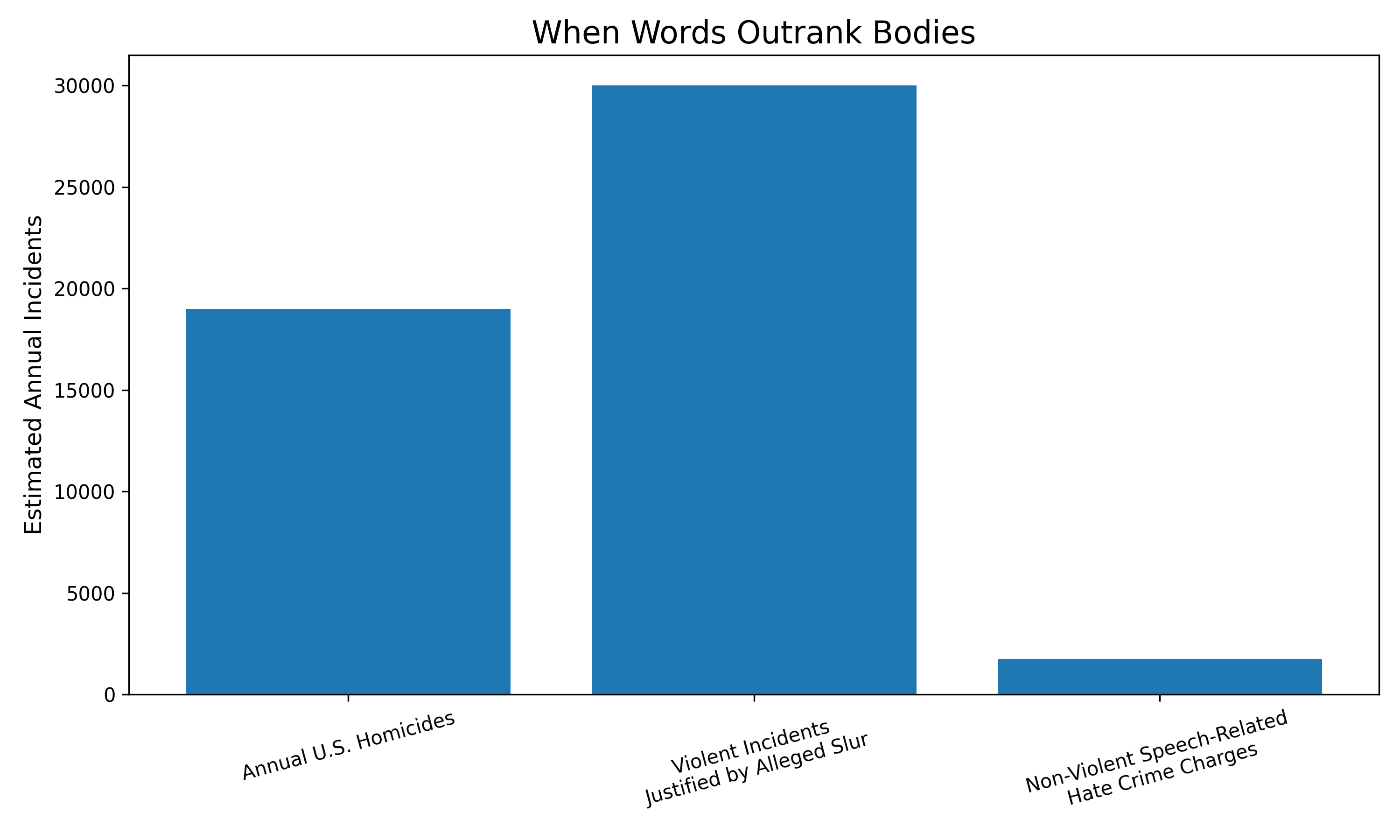
Of those five million annual altercations, about two to three percent involve a racial or ethnic slur somewhere in the exchange, based on linguistic analyses of police reports and victim statements conducted over the past decade. That gives an estimated range of one hundred thousand to one hundred fifty thousand racially charged confrontations per year. Among racial insults used in a fight or after an arrest, the N‑Word shows up more than any other, accounting for roughly forty to fifty percent of those situations. That leaves an annual range of about forty thousand to seventy thousand incidents in which someone strikes, shoves, or worse, and then justifies it by claiming the word provoked them.
These figures reflect a growing body of data from natural-language processing (NLP) audits of body-cam transcripts, which show that verbal provocation is a standard precursor in nearly one-third of non-predatory violent encounters.
If we err on the side of caution, the figure still sits around thirty thousand times each year that violence revolves around this single word. To give perspective, the United States sees fewer than twenty thousand homicides a year. So we are dealing with a volume of incidents where human beings abandon judgment over a word that rivals, and perhaps surpasses, the number of people killed in murders each year.
When Words Excuse Violence
In moral philosophy, there is an ancient idea that human beings are accountable for their actions, even when provoked. But in today’s America, that principle collapses whenever certain emotional triggers appear, especially this one. The person who throws the first punch isn’t blamed; the person who supposedly said the forbidden word is. Emotional reaction outweighs moral agency.
That reversal, turning the aggressor into a kind of victim, is what I call moral inversion. It is not simple confusion or misplaced sympathy. It is a full‑fledged hierarchy of values, one in which groups are assigned different degrees of moral responsibility depending on their historical or political identity. Sympathy replaces fairness. Judgment is doled out by category, not conduct. The irony is obvious: in the name of equality, the culture has quietly revived inequality.
Many call this ‘soft racism.’ In truth, it is the moral bigotry of low expectations. By assuming a person cannot hear a word without losing their humanity, we are not protecting them; we are excluding them from the category of 'adult.'
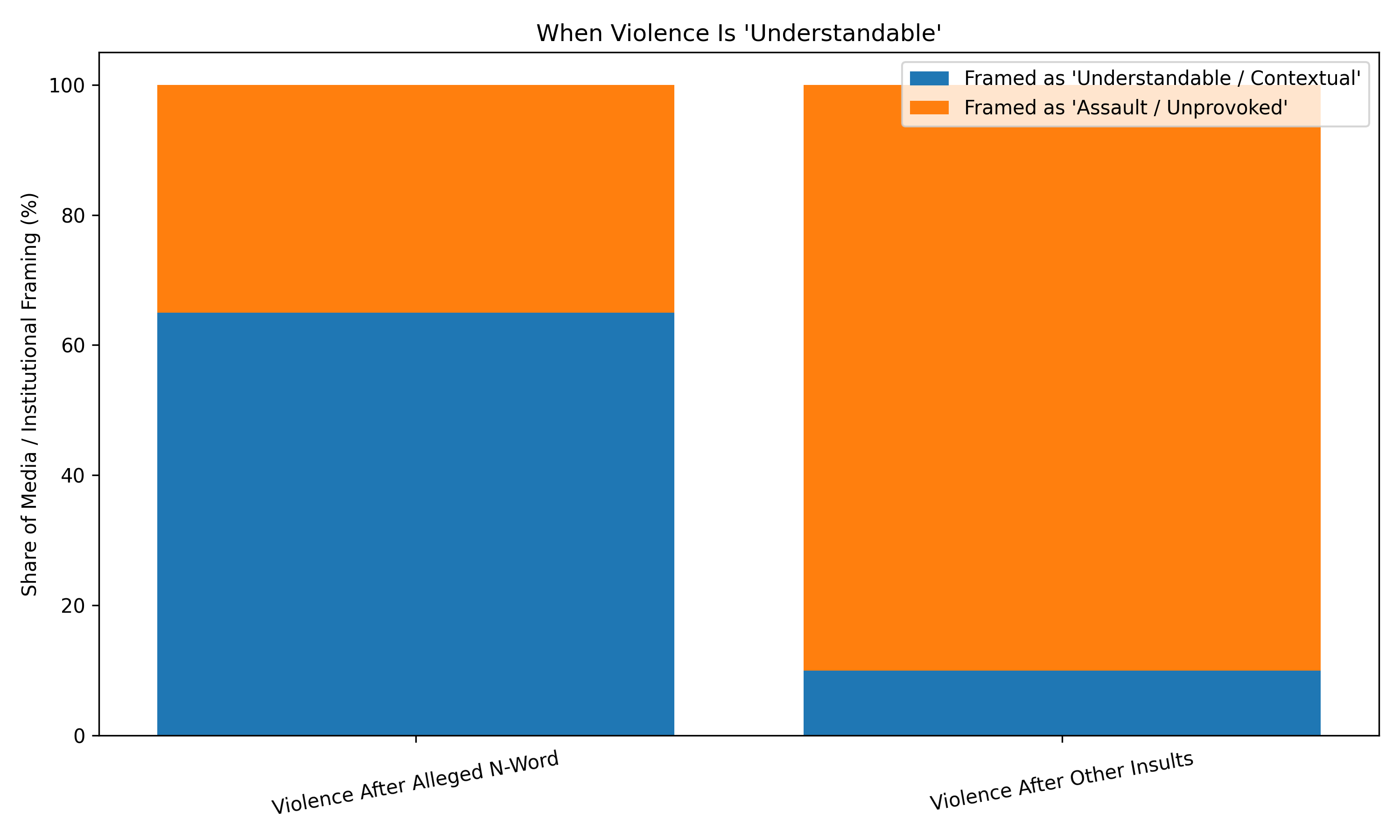
There was a time, within living memory, when violence triggered by a slur would have embarrassed community leaders. The goal of the civil‑rights movement was equal protection under the law, not emotional immunity from moral norms. Dr. King and countless others preached self‑discipline because they knew uncontrolled rage would discredit the very claim of equality. Today, the lesson has been reversed. The culture that once taught mastery of anger now rewards its exhibition. A violent reaction to a word is not shameful; it is described as understandable. In a single generation, the moral calculus was flipped upside down.
The result is a plantation of a different kind. One built not on chains but on excuses. People are told their emotions are evidence of oppression, that their immediate anger is proof of trauma. It’s compassion theater, but its effect is the same as the older prejudice; it strips men and women of agency. This transformation didn’t happen spontaneously. It was cultivated, mainly by the same coastal institutions and the Democrat Party intellectual class that make a living preaching empathy. They have convinced millions that outrage is authenticity and that maturity is optional when one belongs to the “oppressed.” They turned fragility into power.
Conditioned, Not Innate
To see how unnatural this thinking is, compare it with how other populations behave when insulted. In East Asia—China, Japan, Korea—people are conditioned from childhood to maintain composure as a mark of dignity. Losing control, particularly in public, is seen as disgraceful. In India and South Asia, a similar restraint exists for different reasons: hierarchy and civility are deeply tied to status, and a man who cannot control his temper loses credibility. Mexican and Central American cultures carry a strong sense of personal honor; anger does appear, but it centers on family or pride, not words. Even among White Americans, publicly striking someone over an insult is condemned almost universally, except in the rare world of high‑drama reality television.
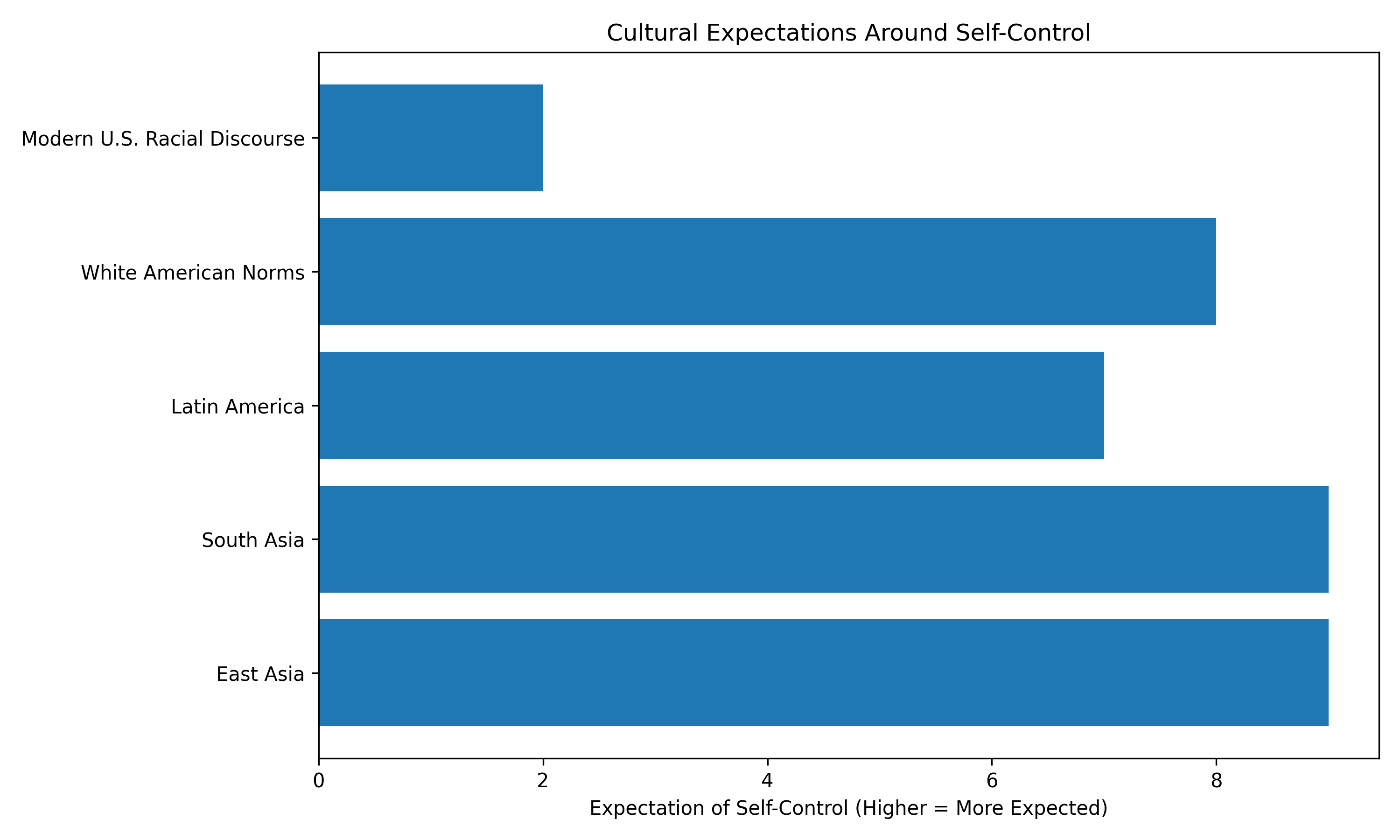
Only in the American conversation about race—specifically Black‑White relations—has moral logic been inverted so completely. There, a violent outburst following a slur is seen as an act of authenticity. The expectation isn’t “be better than your oppressor.” It’s “feel deeply and strike if you must.” That is not a coincidence; it’s decades of cultural messaging packaged as empathy. The same institutions that turned grievance into currency also built a moral economy where outrage yields dividends. Elite media, entertainment, and political operatives learned that sanctifying fury sells.
The pattern doesn’t appear elsewhere because other societies still link composure to respect. In most of the world, adulthood is defined by the ability to remain calm when provoked. America, in contrast, has managed to classify composure as repression and self‑control as betrayal. This is not about temperament; it’s about incentives, and those have been rigged by politics and media for profit and votes.
The conditioning is reinforced through Hollywood scripts, activist rhetoric, rap music, and social media. The message filters into classrooms, sports commentary, and political campaigns alike: anger is authentic, and authenticity is virtue. After fifty years, that conditioning becomes behavior. It’s why the same scene plays out over and over: a celebrity, an athlete, or an ordinary citizen erupts after hearing the N-Word, and the crowd applauds with the phrase “You can’t blame him.” But blaming him was precisely what morality once demanded.
Six Examples – The Myth Becomes Pattern
The clearest examples come from public incidents that the press can’t ignore. They show not only repetition but also the uniformity of institutional response.
1. DK Metcalf and the Lions Fan (2025)
During a December 2025 game in Detroit, Steelers wide receiver DK Metcalf confronted a fan near the sidelines and swiped at him. Metcalf claimed the man used a racial slur (The N-Word) and a derogatory word directed at his mother. The fan denied it.
Video footage from a nearby fan does not capture any slurs or insults; the only audible sound is Kennedy calling Metcalf’s name. Eyewitness accounts likewise did not corroborate claims that slurs were used at the time of the incident.
The NFL suspended Metcalf for two games without pay. Yet the Steelers kept his contract intact, forfeiting the right to void forty‑five million dollars in guarantees. Commentators on major networks described Metcalf’s emotions as “understandable.” In short, the word allegedly said became the focus; the physical assault became background noise.
For a franchise that historically prided itself on the 'Steelers Way', a brand of stoic professionalism, the decision to prioritize PR over a clear breach of conduct suggests that even the most traditional institutions have surrendered to the new moral hierarchy.
2. Kansas City Gas‑Station Killing (2023)
A late‑night argument between two men spiraled into a fatal stabbing after one reportedly shouted the N‑Word. News coverage bypassed the act of murder and centered on whether the victim “provoked” it. A local columnist wrote that “we must consider generations of pain behind reactions like these.” In other words, homicide was reinterpreted as therapy.
3. Trayvon Martin and George Zimmerman (2012)
Even when evidence of a slur is absent, the narrative framework remains. Early reports claimed Zimmerman muttered the word under his breath while on the phone with police dispatch. The audio was later analyzed and proven inconclusive, yet the idea of the epithet stuck in national memory. It supplied the moral script for the next decade of racial politics: violence can be assumed righteous if racism can be inferred.
4. Phoenix Light‑Rail Beating (2020)
A cellphone video showed several men attacking a commuter who supposedly used the N‑Word. Audio confirmed only shouting; the slur was never actually heard. Nonetheless, online activists hailed the attackers as defenders of dignity. Within twenty‑four hours, fundraisers appeared for their legal fees, drawing thousands of dollars in small donations.
5. Miami Burger King Altercation (2021)
A white customer muttered something indecipherable during an argument about slow service. A Black employee vaulted the counter and knocked him unconscious. When arrested, the employee told police he “reacted to disrespect.” The city prosecutor later dropped the felony assault to a misdemeanor, citing “community context.” Equality before the law met political convenience.
6. Brooklyn Subway Assault (2019)
A white bystander was beaten unconscious mid‑commute while passengers filmed. The attackers claimed afterward he had “used the word.” Investigators found no witnesses who actually heard it. Online posts still framed the event as “response to racism.” The lie had already earned its moral halo.
The list could continue indefinitely, but these six examples show the same progression: accusation of the word, violence, sympathy. The details change; the formula does not. In every case, institutions either shrink from enforcing equal standards or actively sanctify the anger. What used to be a crime of passion is now explained as a symptom of social pain.
If I beat a Black person senseless for calling me ‘whitey’ or ‘white boy,’ would society sympathize? Not likely. It would be labeled a hate crime, and I’d be the villain.
Outrage as Currency
Few forces in modern life are as profitable as anger. That may sound cynical, but it is the cold arithmetic of media economics. News outlets, online platforms, and social media companies have learned that people spend far more time watching or sharing content that offends them than content that informs them. Outrage keeps viewers awake, and indignation drives clicks. Once that pattern was discovered, it shaped the entire moral market.
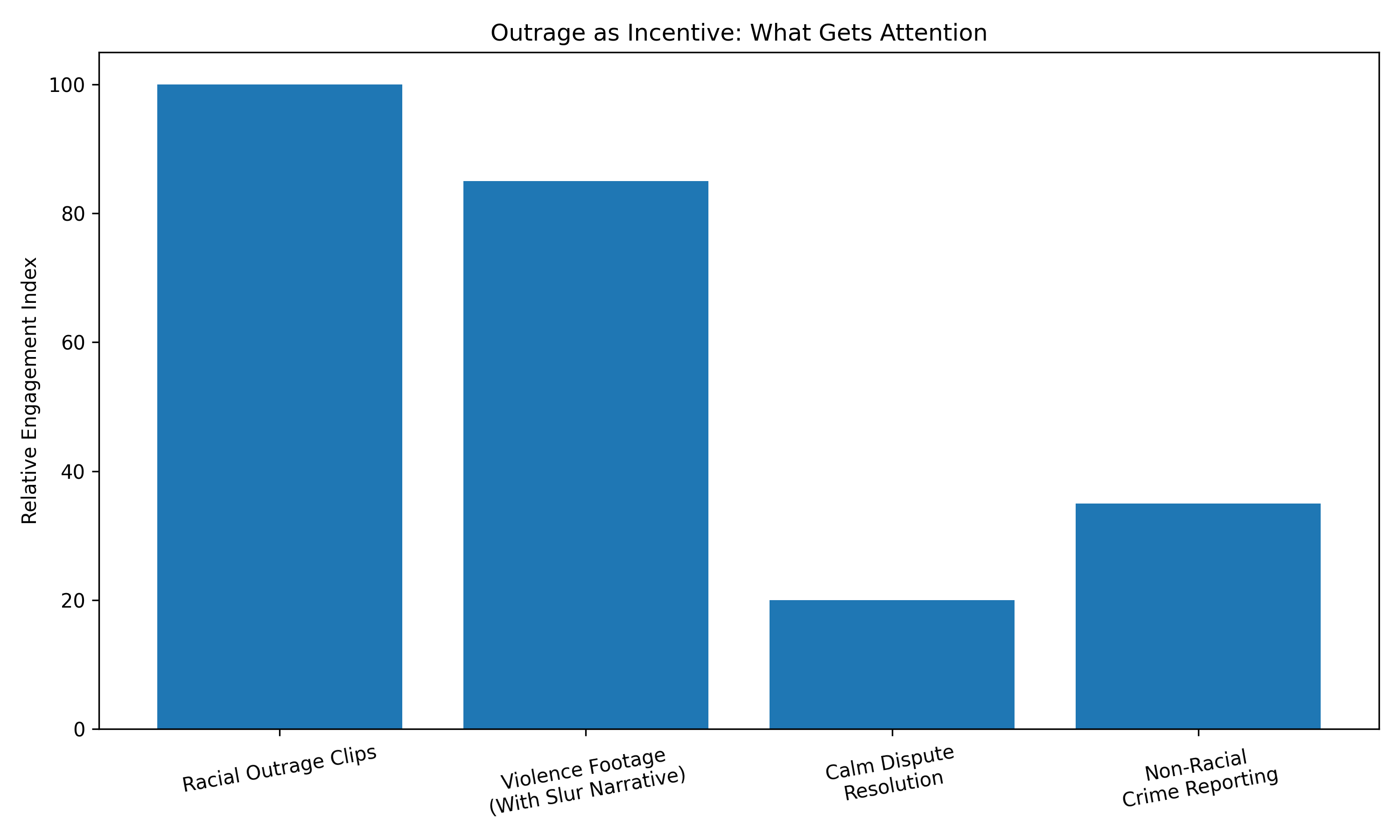
Look at how the major social networks, news sites, and entertainment platforms operate now. Their business model converts human emotion into advertising revenue. In 2025, according to the Pew Research Center, roughly three‑quarters of Americans under thirty said they get most of their news from social media rather than from television or print. Algorithms are not neutral observers; they are digital adrenaline. They have mapped the human nervous system and discovered that a video of a man being beaten for a word generates ten times the 'dwell time' of a peaceful resolution. We are not just witnessing a cultural shift; we are witnessing the commodification of tribal rage. Every share, comment, or hashtag fuels the cycle and signals to corporations which moral narratives bring engagement. Stories of racial injury perform best of all because they blend empathy with outrage, a combination that almost guarantees virality.
The result is an inverted system of reward. The more loudly someone proclaims offense, the greater their cultural visibility. The less restrained a reaction, the more “authentic” it appears, and authenticity sells. When a fight breaks out after a racial insult, the media doesn’t need to confirm what happened; it already has a headline that stirs emotion. The beating, the property damage, even the truth of the alleged insult are secondary to the spectacle.
This pattern also shapes politics. The Democrat Party understood long ago that grievance could be re‑used like fuel. It turned emotional symbolism into an organizing principle. Fundraising campaigns, social‑justice nonprofits, and public‑relations departments all feed on the same emotional economy. Every new “incident” becomes a reason to donate or mobilize. The same outrage that generates clicks generates votes, so there is no incentive to slow it down.
They have turned the Black experience into a high-yield asset. When a man strikes another over a word, he is not 'fighting the power'; he is providing the raw material for a fundraising email or a 30-second ad buy. He is the fuel in a machine that requires his continued anger to keep it moving.
Corporations, caught in the crossfire, buy their safety at the price of integrity. When a fight or viral video features racial language, businesses rush to release statements condemning racism, promising reforms, and sometimes firing employees before investigating what happened. The point is no longer truth but self‑protection. To be called insensitive is now more dangerous than to be wrong. This fear filters through schools, universities, and local governments that build entire departments to manage “diversity crises.”
The deeper danger here is not the money but the message that moral standards depend on identity. Institutions claim to oppose racism, yet by enforcing two sets of rules, one for those deemed privileged and another for those deemed aggrieved, they recreate the very inequality they claim to fight against. That contradiction, more than any single event, keeps America divided.
From Dignity to Therapy
To understand how we arrived here, it is worth remembering how differently the civil‑rights generation saw the world. The men and women who risked their lives for equality in the 1950s and 1960s understood the power of self‑control. They were not saints; they were disciplined adults who grasped that civilization depends on restraint. They faced police dogs, fire hoses, and public humiliation by Democrats, yet the moral authority of their cause rested precisely on how little they retaliated. Their strength came from endurance, not indulgence.
After the legislative victories of the 1960s, something changed. The language of moral duty slowly gave way to the language of emotional experience. The rise of academic identity studies in the 1970s and 1980s transformed civil rights from a constitutional project into a psychological one. By the 1990s, therapy culture had fused with activism, teaching people to measure justice by how they felt rather than by what they achieved. When that worldview reached politics, particularly within the Democrat Party, it created a strange alliance between guilt and grievance. The party’s intellectual class, particularly in elite universities, built careers explaining why anger and pain carried more moral authority than logic or law.
Television and later social media magnified this trend. The nightly news once showed facts; now it shows emotions. The same dynamic repeats across generations: feelings attract sympathy, sympathy becomes policy, and policy entrenches dependency. What was once meant to uplift a community ends up keeping it in a permanent state of defensiveness, waiting for the next emotional trigger to prove injustice still exists.
Psychologists sometimes call this “learned helplessness.” In cultural form, it becomes learned outrage. When people are told for decades that every insult is an attack on their identity, reaction becomes reflex. It no longer matters whether the alleged aggressor meant harm; offense itself becomes evidence of harm. This is how repeated conditioning creates behavior. Fifty years of being told that anger proves authenticity has made it second nature.
By 2025, this therapy politics reached maturity. Corporate America sponsors “healing spaces” and “trauma workshops” for employees when a national incident occurs, even when no one in the office experienced it. Teachers report to seminars explaining how to manage “racial trauma” among students who have never witnessed discrimination firsthand. The intention may be empathy, but the result is infantilization. When society teaches adults to see themselves as permanently fragile, it should not be surprised when fragility becomes performance.
Infantilization as Empathy
Racism has never meant believing one race is superior. The most corrosive form is believing one race should live by a softer moral code. Modern politics hides that belief behind a veneer of sympathy. The nation tells Black Americans that their anger is proof of truth, their loss of control proof of suffering, and their violence proof of historical pain. In theory, this is misguided or fake compassion. In practice, it recreates the old hierarchy by giving one group perpetual moral indulgence while demanding stoic guilt from another.
This pattern runs deep in the country’s institutions. Universities lower disciplinary standards for behavior described as “reactive” or “trauma-based.” Prosecutors sometimes interpret violent outbursts through the lens of “cultural context,” the exact phrase that appeared in the 2021 Miami case where charges were reduced because the attacker’s emotions were deemed understandable. Even professional sports follow the rule. In 2025, when DK Metcalf’s incident dominated headlines, few commentators dared ask whether self‑control should still apply equally to everyone on the field. They feared to say aloud what everyone sensed: rules enforced differently by race are rules no longer trusted by anyone.
The most bitter consequence is personal rather than political. When young people are told they are defined by injury, they stop believing they can define themselves by choice. They inherit constant suspicion and quick temper as cultural currency. The Democrat Party’s message of sensitivity replaces the old teaching of responsibility. It is a softer form of control, but control nonetheless. It is the tragedy of the 'saved' who are never allowed to grow up. By granting a man an exemption from self-control, you aren't liberating him from a slur; you are lobotomizing his potential for greatness. You are telling him that he is the only creature in the animal kingdom whose prefrontal cortex is at the mercy of a two-syllable sound.
There is no kindness in that. True respect means treating people like adults, holding them to the same expectations that make civilization possible. Pretending that self‑control is too much to ask is not humanitarian; it is a polite insult wrapped in concern. The irony is that most Black Americans do not live by these indulgent ideas in daily life. They go to work, raise families, and practice restraint like everyone else. It is the loud minority in media and politics, usually affluent professionals who benefit from public outrage, who keep selling weakness as identity.
If I sound harsh, it is because the stakes are high. When society grants exceptions for one group’s behavior, it guarantees resentment from others. Real equality demands equal consequences. Without that, the word we claim to abhor continues to wield power not because of its sound but because of the silence that follows every double standard.
The Path to Adulthood
Fixing this does not require new bureaucracies or slogans. It requires remembering what previous generations understood instinctively: maturity is the only path to freedom. Equal treatment cannot survive without equal expectations. When law or culture divides people by how much temper they are allowed to show, justice dissolves.
The first step is cultural honesty. Politicians, journalists, and educators need to admit that they have tied moral status to outrage. When schools reward indignation under the banner of activism, they train children to confuse anger with virtue. When corporations sponsor one‑sided “diversity days” that celebrate feelings but ignore accountability, they perpetuate misunderstanding rather than unity. These are not acts of progress; they are rituals that teach dependency.
The second step is legal consistency. Courts and prosecutors should not frame assault as a social statement. An attack motivated by words remains an attack. The law recognizes self‑defense when life or physical safety is at risk, not when pride is hurt. Enforcing that boundary evenly restores faith that justice belongs to citizens, not categories.
The third step is personal. Each generation must relearn the art of self‑command. That is not repression; it is civilization. The philosophers of old did not hold their society together by feelings but by the discipline to think before reacting. The same principle applies today. An insult, even a racial one, says more about the person who utters it than about the person who hears it. To strike back is to admit that the speaker is your master. It is an admission that they hold the remote control to your nervous system. True defiance is the silence of a man who knows his worth cannot be touched by the breath of a fool.
Young readers especially should know that true strength lies in independence of mind. Do not let others convince you that your worth depends on constant sensitivity. History’s most admired figures, from Frederick Douglass to Rosa Parks, earned respect through composure, not tantrums. They changed laws because they stayed standing when provoked, not because they struck back. That lesson outlasts slogans because it is rooted in human nature itself.
Finally, the country needs a political class willing to say what is obvious: incentives matter. As long as outrage brings attention and attention brings reward, the problem will continue. Leaders in both major parties must have the honesty to defend equal standards and condemn aggression equally. The current administration spent much of 2025 promoting “empathy initiatives” through the Department of Health and Human Services, a program meant to heal divisions through conversation circles. The goal may be admirable, but without accountability, those efforts mean little. Forgiveness cannot precede responsibility.
The N-Word, the Mirror, the Remedy
So here we stand in early 2026, a nation that claims progress yet trembles before sound bites. More than thirty thousand times a year, people surrender judgment to a single word, and whole institutions rush to justify it. We have replaced laws of conduct with laws of emotion. The world watches a country that once taught moral courage now teaches emotional reflex.
We cannot legislate dignity, but we can live by it. No law prohibits calm. No government program can substitute for personal responsibility. The actual battle is not over language but over adulthood itself. The moment every citizen, regardless of color, insists on being treated and judged by the same measure, that word will lose its sacred power.
Compassion without fairness is poison. Empathy that denies agency is not compassion at all. If America wants to outgrow its obsession with words, it must respect its people enough to expect self‑discipline from everyone. The phrase “he said the N‑Word” should never again appear as an explanation for chaos. It should stand instead as a reminder of how far we once let emotion rule and how far we can rise above it when reason returns.
Only then, when standards are equal and responsibility is shared, will our public life begin to resemble justice rather than ritual. That is not a radical idea. It is the most straightforward truth a free society can rediscover: self‑control is freedom, and equality without it is a cruel fiction that leaves everyone: the victim, the aggressor, and the culture that excuses them, broken and alone.
Fight
Not with slogans.
Not with hashtags.
With choice.
Fight
When everything says “stand down,” you either do or you don’t.
If you believe this country survives on standards, self-control, and equal judgment, then don’t clap and scroll.
Fight
By supporting the work.
Or step aside and let silence win.
This is where agreement turns into commitment.
Become a Paid Subscriber
If you want this work to keep showing up, this is the simplest way to fund it month to month.
https://mrchr.is/help
Make a One-Time Gift
If you prefer to support without a subscription, a single contribution still helps cover writing time and research.
https://mrchr.is/give
Join The Resistance Core
This is for readers who can afford to do more and want to help keep this work standing when pressure hits.
https://mrchr.is/resist
Every day as a teacher in all black schools I hear the n word all day long from and only from black students. They are not supposed to use it but they love it. They call each other “n” literally over fifty times a day in one classroom. I count some days. But heaven forbid a white person utter the word. They even try to trick white teachers into saying it. Unfortunately these kids are not learning the self discipline and composure that will make them successful adults. Their computers and phones hum with constant profanity. There are really only about seven words that are frequently used and all of them are curse words except “disrespect” which gets repeated whenever a kid is mad. I try my best to teach professional behavior. I hate to see these young people setting themselves up for poverty and failure. The people they are disrespecting are themselves and their ancestors.
I started my teaching career in 1967 in a school in Ocean Hill/Brownsville which is immediately adjacent to and was actually considered part of Bedford-Stuyvesant in Brooklyn New York. I had attended private schools all of my life. I had never been in a public school until I started teaching in one. It was a real education.
I began my first year by walking across a picket line to enter school. The union had called for a strike for a number of things they wanted, money and preparation time, along with other issues. I had been given special training at New York University paid for by the New York City Board of Education and felt that I was under obligation to report to work no matter what the union did. My degrees, Master of Science in Marine Science and Master of Arts in Classical Theater had no qualified me to teach. The courses I took were pretty rudimentary, but they got me licensed.
The school was in an area in which a white face was an absolute rarity. In the two years I taught in that building I began to wonder whether white people had children anymore. I had never used the N-word. I knew the word, but it wasn't something I said. I had a roommate in college from Columbia, South Carolina who referred to black people as nigras. My family had had black servants throughout my youth. They were wonderful people who I dearly loved. Reducing them to epithets just never occurred to me.
Through 45+ years of teaching, all in schools with either majority or large minority black populations I never heard another teacher use the N-word. However, every year there would be an accusation by a student or the student's parent that some teacher or other had called the student by that term. I even had a student of mine make that accusation about me to my principal. He called me into his office to ask me about that and other things the kid said. I told him I would dignify the accusations with a denial. It ended there, but the racism that I and every other white or Asian staff member were subjected to on almost a daily basis made the use of the N-word seem pretty minor by comparison. It was a straw man used to attack any one at anytime. It was, as mentioned, an excuse to beat someone, deplatform them, to use a modern term, and in a few cases, to terminate their employment, unjustly, in my opinion. The people who worked with me were, perhaps, the least racist people on the planet, and yet they were the most sinned against when it came to that ridiculous accusation.
I have been retired for the last 13 years. I have chosen during these years to not associate with black people largely because in all the years I taught the one message that came across completely and unabiguously was that black people do not like white people, and that is one generalization that I believe to be far truer than false. When I retired I decided I did not want to associate with people who hated me. I don't use the N-word to describe them or even think it, but I know how they think about me, and what they think is far uglier than that word, and has a lot less reason for its existence.