

kleptocracy
noun
klep·toc·ra·cy \ˈklep-ˌtä-krə-sē\
Government by thieves pretending to be moral stewards; rule by those who cloak organized plunder in the language of compassion.
A regime in which laws, taxes, and social programs serve as laundering mechanisms for power — transferring wealth from the productive to the politically connected.
A terminal stage of democracy in which corruption becomes the system itself, not merely a symptom of it.
— see also: bureaucratic rot; legalized theft; the democrat party.
The American System in Terminal Capture
Strip the American government to its moving parts, and you find a machine that perpetuates itself while wearing democracy as camouflage. The Founders built a system of delegated and reversible power; what remains is a bureaucracy that answers to itself. Citizens can name the President, but not the deputy secretaries and administrators who write the rules that govern their lives. That is not self‑rule, it’s managed consent.
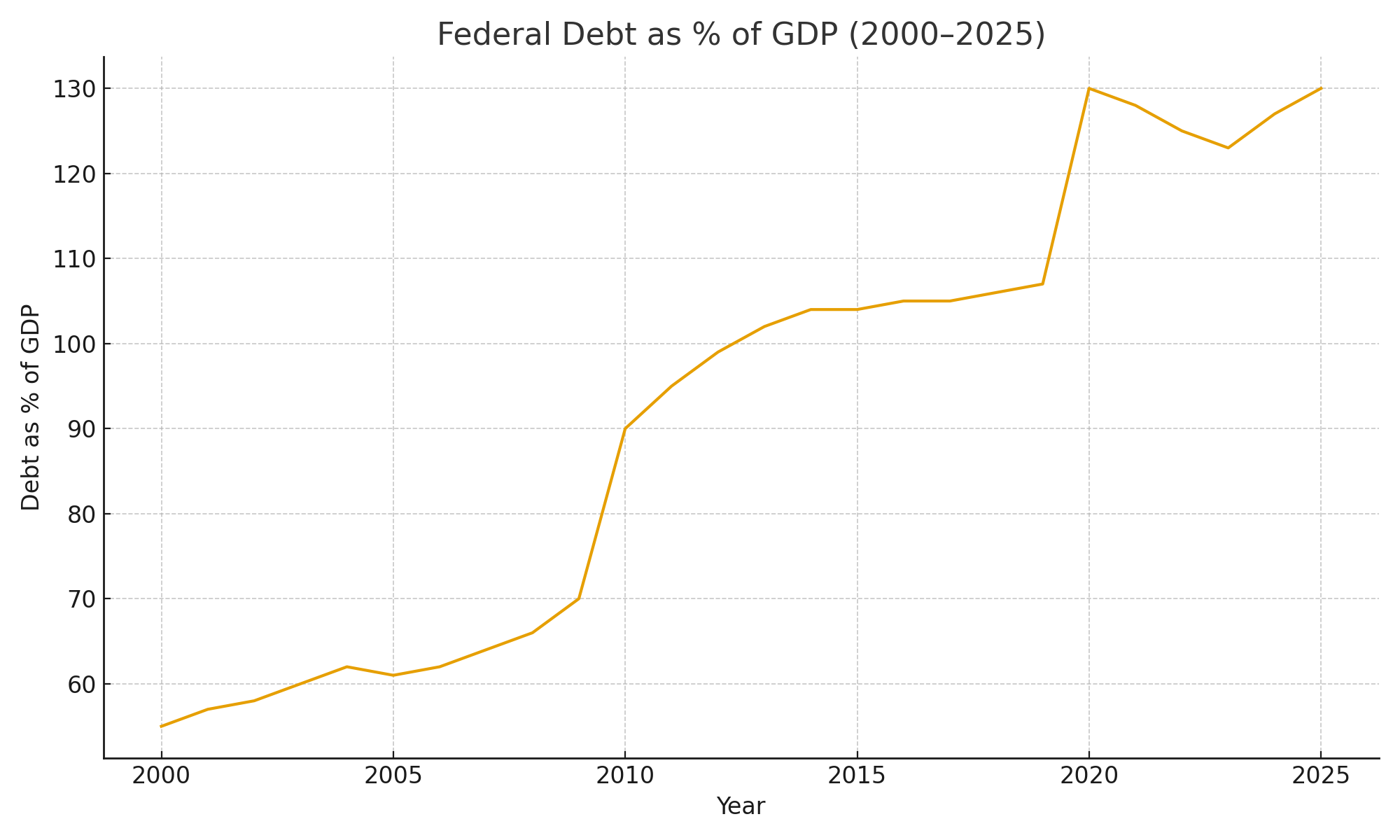
Money tells the story. At the turn of the century, Washington spent about 18 percent of the economy. By 2025, it absorbs over 25 percent, with federal debt surpassing $35 trillion, nearly 130 percent of GDP, and projected to hit $40 trillion before the decade ends. Interest payments now exceed defense spending. No nation sustains that trajectory without either inflation or breakdown. Two million federal employees appear on payrolls, but the real workforce hides among contractors and “nonprofits.” Roughly 40 percent of the budget, nearly two trillion dollars annually, moves through outside “partners.” They are private in name, political in function.
This is what a modern kleptocracy looks like. The old world had generals who stole gold; ours has consultants paid for “equity outreach.” The dictator’s nephew once owned the oil concession; now former staffers run climate‑resilience firms that feed on perpetual grants. Taxpayer money travels through layers of intermediaries until accountability dissolves. The Democrat Party,commanding the bureaucratic class that controls those streams,has turned the flow itself into ideology: bigger government as moral virtue. When programs fail, the answer is always expansion, addiction disguised as compassion.
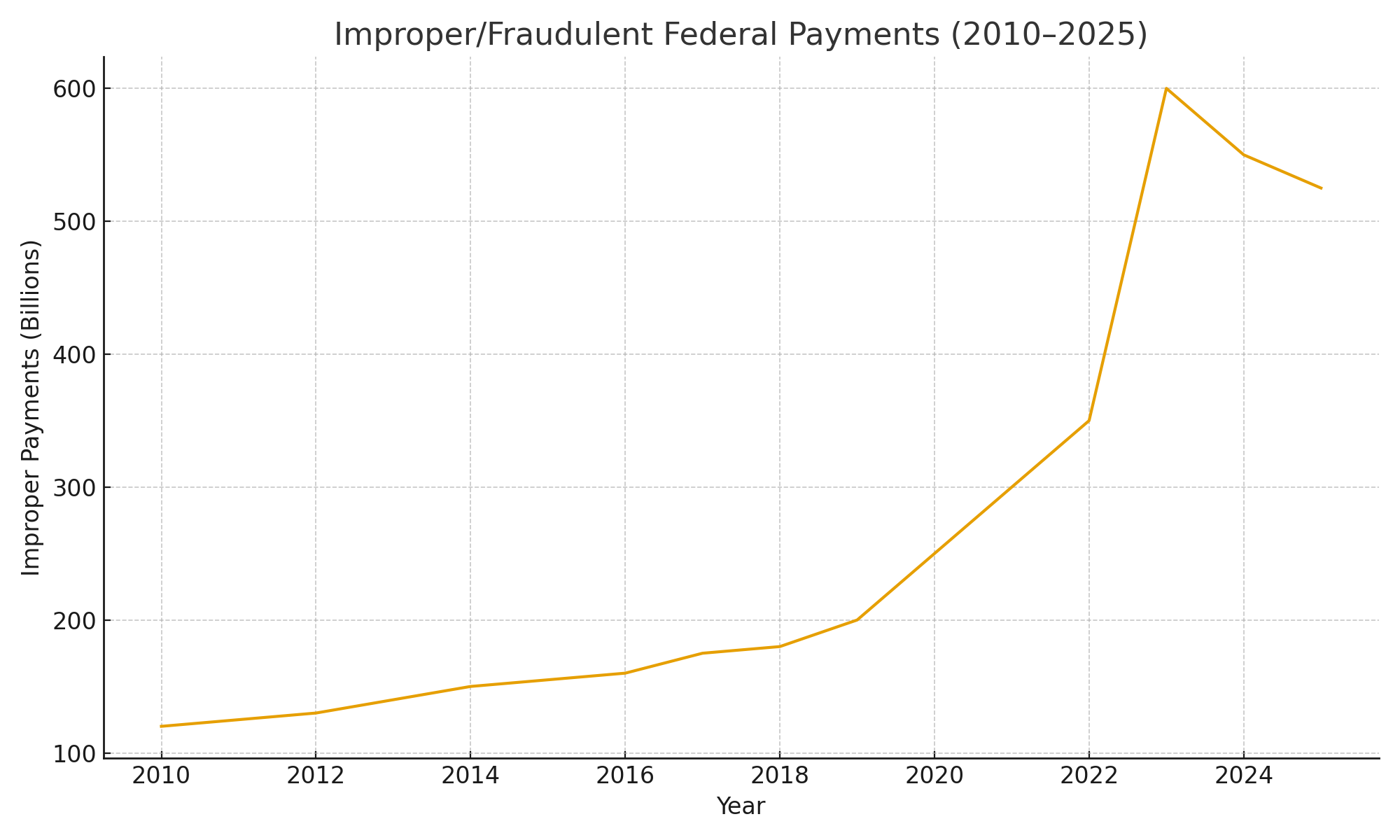
Oversight has collapsed. During the pandemic, watchdog agencies documented over $600 billion in improper or fraudulent payments, most from unemployment and childcare programs deliberately stripped of safeguards. In Minnesota alone, one “child‑feeding” nonprofit looted about $250 million before investigators noticed the addresses were parking lots. Even then, almost no supervisor was punished; Washington called it a management failure. When theft of hundreds of millions becomes a paperwork glitch, the law has lost authority.
Regulation completes the capture. The Code of Federal Regulations now runs beyond 190 thousand pages. Small firms spend nearly one‑fifth more per employee on compliance than multinationals, ensuring monopoly by attrition. Agencies that boast of fairness hold private meetings with their largest donors. Of the top hundred corporate contributors in 2024, eighty sent two‑thirds of their funds to Democrats, proof that “progressive” policy has become the best investment on Wall Street.
Justice has followed suit. Non‑violent January 6 defendants receive extended prison terms while the Biden family’s influence peddling draws polite shrugs. Identical crimes yield opposite outcomes depending on allegiance. Once prosecution tracks affiliation instead of evidence, legitimacy evaporates, and voluntary compliance with law goes with it.
Control of information cements the system. From 2020 to 2024, lawsuits pried loose internal communications showing federal agencies coordinating with major platforms to throttle disfavored speech, over twenty million posts suppressed. Even after leadership changes, the censorship engine persists through grants and joint task forces. Every regime that fears judgment begins by policing words.
Add these strands together, financial dependency, regulatory favoritism, selective law, narrative management, and the pattern resolves into a single organism: a self‑defending administrative empire. Elections still occur, but they swap personnel, not policy. The permanent state continues regardless of who wins. The Democrat Party acts as a priesthood and beneficiary, translating bureaucracy into moral theater.
The Republic has not yet fallen, but it no longer listens. A people who watch officials commit crimes without consequence soon stop believing in consequence itself. That is how constitutional republics fade: not through invasion, but through the quiet conviction that laws apply only to the weak.
Minnesota as Microcosm:
The Welfare‑to‑Votes Pipeline
Minnesota shows what happens when moral vanity meets federal money. The state ranks among the nation’s most affluent yet operates one of the most bloated welfare systems. Over the past decade, federal transfers to its Department of Human Services have more than doubled, spawning a web of nonprofits that live entirely off grants and political sponsorship.
The Feeding Our Future scandal exposed the model in miniature. Starting in 2020, after Democrat Congresswoman Ilhan Omar pushed for and succeeded at getting regular fraud checks and balances softened or removed, the group claimed to fund children’s meals and quickly collected hundreds of millions in pandemic aid. Investigators later found that “meal sites” were parking lots, warehouses, and apartments. Nearly $250 million vanished; the largest single welfare fraud in state history, and insiders estimate the broader corruption network may exceed $1 billion.
Whistleblowers surfaced as early as 2019, warning of fake paperwork and shell organizations. Instead of listening, supervisors punished them. Regulators were told not to take actions that might “discriminate against specific communities,” a euphemism that paralyzed oversight. Fraud thrived not because it was unseen, but because exposure violated the etiquette of “equity.” Fear replaced professional judgment.
When federal charges finally arrived, state officials called the theft a “cultural misunderstanding.” The phrase has since become a bureaucratic reflex: excuse ideology with politeness. Most of the implicated actors were tied through community networks, particularly recent Somali immigrant associations, yet criticism of those links was condemned as racist. The result was predictable: no reform, only rhetoric.
Governor Tim Walz faced the defining test of a captured executive: confront the fraud and lose his political bloc, or ignore it and keep power. He chose preservation. His administration weakened the Office of the Legislative Auditor even as welfare spending exploded. Whistleblowers were reassigned, and audits were minimized. The local press, fed by government ads, played defense rather than watchdog. It was Chicago politics re‑branded as benevolence.
Beneath the moral varnish lies a simple economic law: paying for participation instead of performance breeds systemic theft. Agencies and NGOs collect funds by headcount, not by outcome; expenditures, not improvement measure success. In that structure, corruption is indistinguishable from compliance.
The human cost isn’t just dollars. Honest citizens watched criminals become civic heroes and learned that virtue is a handicap. Businesses face heavier audits than nonprofits caught fabricating children. Such betrayal dissolves the emotional contract that keeps a society lawful. People stop confusing decency with self‑destruction and start protecting themselves instead.
Minnesota’s scandal is no provincial absurdity; it is the operating system of modern kleptocracy: subsidies wrapped in compassion, managed by intimidation, and justified by fear of moral judgment. What Somalia once did with foreign aid, Minnesota’s bureaucrats now do with federal grants. Only the accent has changed.
The Psychology of Kleptocratic Power
Every corrupt order eventually develops a psychology to justify itself. In competent societies, corruption hides in the shadows; in decadent ones, it becomes a creed. America’s professional political class has reached that stage. Theft is no longer perceived as a vice but as governance carried out with good intentions.
Most officials begin as sincere idealists. What changes them is not sudden greed but exposure to an ecosystem that rewards conformity and punishes conscience. The newcomer who questions a spending line is told to consider the “optics.” The supervisor who avoids controversy earns promotion. Within a few years, the language of rationalization becomes second nature: success is measured not by outcomes but by how failures are framed.
Psychologists have a term for this mindset: pathological altruism, using compassion to sanitize control. When programs collapse, administrators insist that the failure only proves the need for more authority. During the COVID years, the same agencies that crippled schools and small businesses were rewarded with record budgets. In the private world, error demands correction; in government, it guarantees expansion.
Moral narcissism completes the cycle. Bureaucrats measure virtue not by results but by the slogans they recite. One can preside over homelessness, addiction, or failing schools and still feel righteous for championing “equity” or “sustainability.” This inversion turns every disaster into another funding opportunity. So long as the thief sounds pious, the theft becomes charity.
Once insiders share enough secrets, honesty itself becomes a threat. The whistleblower who tells the truth may expose everyone’s rationalizations. Punishment no longer requires violence or death, only reassignment, demotion, or withdrawal of funding. Over time, the state that once enforced law rebrands itself as a protection racket. The revolving door between cabinet offices and consulting firms is simply the visible tip of that moral bargain: the Republic as franchise.
The culture surrounding the bureaucracy seals the illusion. Media and academia now judge integrity by ideology instead of truthfulness. Falsified grants or inflated contracts are dismissed as “good‑faith errors,” but disagreement with the reigning dogma ends careers. Falsehood becomes rewarded behavior; truth becomes insubordination.
When citizens finally see the scandal, its perpetrators already feel vindicated. Inside the moral echo chamber, they think they are saving humanity.
The reaction to the Minnesota welfare investigations exposed this reflex vividly: officials met evidence not with reform but with accusation, branding critics as bigots for noticing statistical patterns. In a captured system, exposing corruption is recoded as moral trespass. The instinct to defend virtue has replaced the will to tell the truth.
That psychological lockdown explains why reform from within rarely succeeds. Individuals can repent; institutions justify. Each rationalization, someone else is worse, stability must be preserved, moral optics outweigh legality, erodes responsibility another inch. The official still performs the procedure, the politician still invokes compassion, but the Republic drifts without a moral pilot.
Late Soviet bureaucrats once managed decay while chanting about equality. Today’s American administrators repeat the same ritual with updated vocabulary. The logic is unchanged: confession equals betrayal. When the keepers of virtue fear self‑knowledge more than corruption itself, moral collapse is complete.
Money can be stolen only after the conscience is rewritten. Modern kleptocracy rewrites conscience in the dialect of benevolence: protecting the vulnerable, saving the planet, defending democracy. Each phrase converts power into holiness and rebellion into sin. That is how ordinary officials commit extraordinary crimes and walk away convinced they’ve served justice.
A state can survive inefficiency, even corruption. It cannot survive when its rulers mistake deceit for virtue.
Trump’s Second Term: The Temporary Reprieve
Donald Trump’s return to the White House in January 2025 broke the illusion that the managerial state was untouchable. His victory reminded skeptical Americans that power could still change hands lawfully, and reminded the bureaucracy that its permanence was not guaranteed.
The second Trump administration has been less ideological and more surgical: reverse decay before inventing anew. Since February 2025, the Department of Homeland Security has deported hundreds of thousands of ineligible migrants, cutting illegal crossings in key sectors by over sixty percent. Frozen pandemic and climate slush funds redirected tens of billions toward the deficit. These steps slowed the bleeding but did not heal the wound.
Trump governs a fortress with saboteurs in every corridor. Every order must traverse a maze of career officials appointed decades earlier. He can replace appointees, not entrenched civil servants, and “cause for removal” is defined by the very people being challenged. Reform meets resistance not through rebellion but procedure, government by memo. Each initiative triggers another round of “reviews” and “stakeholder consultations.” To citizens, this appears as activity; inside Washington, it functions as a delay.
The administration’s audit of pandemic relief funds exposed at least $450 billion in unrecovered improper payments, yet the Justice Department produced only token prosecutions. The citizen sees theft; the bureaucracy cites “complexity.” The paperwork never ends, only the accountability does.
Still, Trump’s presence has shifted the psychological climate. Governors once timid toward federal mandates now form interstate compacts on education, energy, and healthcare. More than twenty states are quietly rebuilding local governance networks, the seeds of lawful decentralization the Constitution envisioned.
The media terrain has also fractured beyond institutional control. Legacy networks, once gatekeepers, are collapsing under audience rebellion. Independent digital outlets now reach tens of millions daily. Only one in five Americans still professes trust in national news, a collapse of monopoly masquerading as cynicism but functioning as liberation. Information pluralism, not censorship, is freedom’s natural defense.
Yet the resistance remains formidable. Courts stall executive orders with nationwide injunctions; unelected boards veto industrial projects; federally funded universities continue as ideological patronage networks larger than some states. One presidency cannot dismantle a century of administrative accretion. At best, it can expose it.
Even so, exposure alters behavior. Agencies that once expanded unopposed now tread carefully. Contractors compete on merit, not guaranteed renewal. Border integrity, however partial, reaffirms that sovereignty still exists. Symbolism matters: a country reminded of its boundaries remembers it has one.
Still, this moment is an intermission, not salvation. The same bureaucracy awaits another administration willing to restore its privileges. If Democrats regain unified power before decentralization becomes irreversible, the censorship boards will return under gentler names, the NGO pipeline will reopen, and political prosecutions will resume. Bureaucratic immunity, once challenged, will solidify forever.
Trump’s second term, therefore, functions less as a revolution than as a reprieve, a brief armistice in a slow civil war. The republic has a narrow window to relearn self‑government before inertia reclaims it. Whether Americans seize it depends not on his persistence, but on their courage.
The Re-Capture Scenario:
If Democrats Regain Power
Every reforming moment in a decaying republic meets its counter‑revolution. In America, that would arrive the instant Democrats regained unified federal control. Such a victory would not mean a mere change of managers; it would mark the restoration of the administrative empire that Trump’s reprieve briefly stalled.
Shock and Restoration
Within months, dormant bureaucratic programs would reappear under new names. The Disinformation Governance Board would be reborn as a “Digital Safety Council.” Frozen grants to environmental and “equity” contractors would surge back through emergency appropriations. New justifications, election security, climate resilience, and digital citizenship would sound high‑minded, but the aim would be the same: control the narrative and the money flow.
Retaliation
The Party’s activist core would demand punishment of reformers. Political prosecutions, once camouflaged, would become policy. Expect selective IRS audits, revived “extremism” task forces, and criminal referrals for anyone who challenged bureaucratic power. Funding, permits, and contracts would again serve as ideological filters: loyalty as currency.
Consolidation
After vengeance comes permanence. Federal control of election logistics, much like the dormant For the People Act, would move voting authority from states to Washington in the name of access. Simultaneously, the pilot central‑bank digital currency would advance as an “efficiency tool,” quietly converting financial privacy into political leverage. Once every transaction and donation is traceable, dissent becomes paperwork away from extinction.
Economic Overreach
Debt, already above $35 trillion, would accelerate to $40 trillion or more as budgets exceed 30 percent of GDP. Inflation or confiscation would follow. “Wealth equity” taxes on property and digital assets would be sold as moral progress, while Federal Reserve “liability bonds” would stealthily monetize debt. Middle‑class savings would dissolve by arithmetic rather than revolution.
Social Division
Speech codes would return, embedded now in employment law and education grants. Corporations dependent on federal contracts would reinstall compliance software to track ideological purity. Children would study activism before literacy; opposition would be labeled hate. Diversity re‑established as the state religion, enforced by HR priests.
Fragmentation
When half the nation views the other as illegitimate, enforcement fractures. Some states would quietly refuse federal directives on guns, energy, or immigration; Washington would answer with fiscal sanctions. The outcome wouldn’t be formal secession but selective obedience, a soft civil war waged through economics instead of arms.
The timeline would be rapid: three years to erase safeguards, five to spark regional defiance, seven to normalize paralysis and retaliation. Collapse would not arrive with banners but with silence, the moment citizens conclude that votes change nothing and legality means submission. At that point, order endures only where power can touch; elsewhere, America governs itself in pieces.
The conclusion is not partisanship but physics: if the administrative machine reclaims unchecked command, it will never allow another real challenge. The republic will persist in form but not in substance, a democracy in costume, oligarchy at the core. When law becomes a tool and truth becomes trespass, history’s next chapter always reads the same: disintegration disguised as progress.
Mechanics of Collapse
Civilizations rarely die in a blaze; they drift into meaninglessness while their institutions still pretend to live. The titles remain: Congress, courts, currency, but the purpose drains out until what survives is machinery without soul. America has entered that stage. The unraveling will begin not with armies or declarations, but with the quiet breakdown of the social contracts that once bound citizen and state: work for pay, law for protection, tax for service, consent for governance.
Economic Exhaustion
Arithmetic is the first executioner of empires. Federal debt now exceeds $35 trillion, about 130 percent of the national economy, and will near $40 trillion before the decade’s end. Interest payments have already surpassed defense spending. Washington borrows to finance yesterday’s promises while inventing new ones for tomorrow. Inflation has slowed since 2022, but cumulative price increases have erased real wage growth. The United States still appears wealthy, but its prosperity now runs on nostalgia and credit.
Institutional Illegitimacy
When citizens stop believing that public offices act in good faith, legality turns ceremonial. Gallup’s 2025 data show barely 8 percent of Americans trust Congress, 14 percent trust the press, and 16 percent trust the courts. Only the military hovers above half, and even there, internal political division grows. A constitutional order cannot survive when four out of five citizens assume that its laws serve power rather than principles.
The Redistribution Trap
Roughly 60 percent of U.S. households now receive more in direct or indirect benefits than they pay in income taxes. The top fifth finances almost the entire discretionary budget. In times of expansion, that imbalance is tolerable; in stagnation, it breeds resentment. Builders begin to feel they are subsidizing their own dispossession. They respond rationally by withdrawing effort or moving it beyond reach. Productivity falls, taxes tighten, coercion replaces gratitude.
Informational Decay
A democracy cannot govern what it can no longer describe. Years of coordinated “fact‑checking partnerships” between news outlets and federal agencies have produced a managed reality rather than a shared one. Disinformation units may fade in name yet persist through grants and algorithms. The nation now lives inside overlapping echo chambers that no longer debate policy, but reality itself. Once truth becomes tribal, cooperation is mathematically impossible.
The Politicization of Justice
Major cities show the pattern clearly: homicide still over 30 percent above pre‑pandemic levels even as reporting falls. District attorneys refuse to prosecute theft and trespass while pouring resources into ideological show‑trials. The message is unmistakable: street crime may be tolerated, dissent will not. Citizens receive the lesson and form alliances outside the law. Localism becomes both refuge and seed of fragmentation.
Psychological Withdrawal
Patriotism once disciplined appetite; comfort has replaced it. In 1998, seven in ten Americans called patriotism “very important.” By 2025, fewer than four in ten do. The same surveys show “money” and “comfort” outranking faith, family, and country. A people that loves comfort more than liberty cannot defend either; to them, obedience is easier than responsibility.
Convergence
Each mechanism feeds the next. Debt erodes faith; faith abandonment fuels inequality; inequality destroys shared identity; and the loss of identity completes the moral collapse.
Eventually, law remains only where enforcement is possible; elsewhere, citizens govern themselves through informal alliances, parallel economies, and digital bartering beyond federal reach. The conflict will look less like 1861 and more like the final Soviet years, a bureaucratic civil war waged with injunctions, regulations, and selective arrests rather than muskets.
The signs are already here: unstable currency, censored speech, selective prosecution, civic boredom, and a spreading instinct to simply withdraw. A state can survive almost any hardship except disbelief in itself. When honesty no longer rewards and power no longer restrains, civilization idles on fumes until conscience or collapse forces it to stop.
The Path of Survival:
Decentralization and Moral Restoration
Every civilization that has avoided collapse has done so by re‑anchoring itself to first principles before exhaustion became final. In the United States, that would mean returning authority to the smallest level capable of governing justly, restoring honesty as a requirement for power, and reviving the idea that freedom is a moral discipline, not an indulgence. The alternative is to continue drifting toward centralized corruption that destroys everything it tries to control.
The most practical first step is political decentralization. The Founders designed the federal system to divide power horizontally among branches and vertically between Washington and the states. That vertical division has eroded for more than a century as federal agencies have turned state governments into administrators of national programs rather than representatives of their citizens. The Constitution never authorized that dependency. It grew out of fiscal enticements. Washington collects income taxes, distributes grants, and uses those grants to dictate policy. States that refuse lose funding. The solution is not rebellion but lawful reassertion of sovereignty. Governors and legislatures can simply decline grants that require unconstitutional conditions. Several states have begun doing so in small ways: rejecting federal education spending tied to ideological curricula or declining energy subsidies that prevent local control. Each act of refusal restores a small measure of self‑government.
Fiscal integrity must follow. The national debt is not only an economic issue but a moral one. Every dollar borrowed without intent to repay is a claim on the labor of children who have never consented. Reforming it requires transparency that the current system cannot resist forever. Congress could mandate a public accounting of all off‑budget liabilities in one consolidated report, something private corporations have been required to publish for decades. It could also end automatic budget baselines that cause spending to rise regardless of performance. None of these steps would be glamorous, but each would strike at the habit of deceit that defines bureaucratic life.
Cultural restoration must move alongside structural reform. For decades, the American school system has taught self‑esteem without excellence and resentment without context. It has confused compassion with surrender and replaced civic literacy with ideological obedience. Reclaiming education begins with separating instruction from activism. Parents are already forming associations to remove political materials from classrooms and to emphasize history, mathematics, and language. The results are early but promising. Charter and classical schools that reject ideological content now have waiting lists in nearly every major city. That tells us the public appetite for sanity is strong. It only needs alternatives.
Moral restoration cannot happen through policy alone. It requires a change in the meaning of virtue. Wealth, comfort, and technology have sheltered Americans from the consequences, allowing irresponsibility to masquerade as kindness. The rediscovery of virtue will begin when people accept that freedom requires limits, that charity begins with personal accountability, and that no government can enforce decency. Communities that reward work, marriage, and discipline thrive even in bad economies. The data remains clear. Households with two parents, regardless of race, have lower poverty rates than single-parent households by more than fifty percentage points. For instance, recent US Census data shows that the poverty rate for married-couple families is approximately 5.1% for White households, 5.5% for Asian households, and 9.9% for Black households. Conversely, the poverty rate for female-headed households (no spouse present) is dramatically higher: 18.7% for White households, 22.5% for Asian households, and a staggering 36.9% for Black households. The lesson does not need moral preaching. It requires honest observation.
Faith, in whatever form it takes, must also return to the center of civic life. A society that treats faith as a private eccentricity loses the restraint that conscience provides. Public virtue once came from a shared understanding that human authority is limited. When citizens no longer believe in limits above the state, they begin to worship the state itself, and politics becomes their only religion. That transformation has always preceded tyranny. To avoid it, belief must again act as a bound on ambition. Churches, synagogues, and mosques that focus on repentance rather than ideology can help reverse the moral confusion that has turned compassion into a justification for theft.
Technological independence forms the final pillar of survival. Energy policy dominated by central planners invites both corruption and vulnerability. Local and regional energy production, small‑scale agriculture, and community water systems reduce the leverage of distant bureaucracies. The same principle applies to information. Citizens who rely on centralized digital platforms for all communication are subjects, not participants. Decentralized networks, encrypted media, and local journalism provide resilience when censorship reappears. The same tools that allowed citizens to bypass corporate news after the pandemic can build a permanent foundation for freedom of speech if people choose to use them responsibly.
Reform will succeed only if it becomes a habit rather than a campaign. Americans need to rediscover the discipline of daily self‑governance: charity without coercion, education without indoctrination, and dissent without hatred. None of that requires utopian change. It requires only the courage to stop cooperating with deceit. The historical record is unambiguous. Empires recover when truth becomes contagious. They perish when lies remain polite.
If the republic can relearn that lesson, its best years may yet lie ahead. But time is short. The longer corruption masquerades as virtue, the harder it will be to restore honesty. Freedom is not a reward for prosperity. It is the condition that makes prosperity possible. America will remain free only as long as its citizens value truth more than comfort and responsibility more than power.
7-Phase Breakdown of America’s Political Unraveling
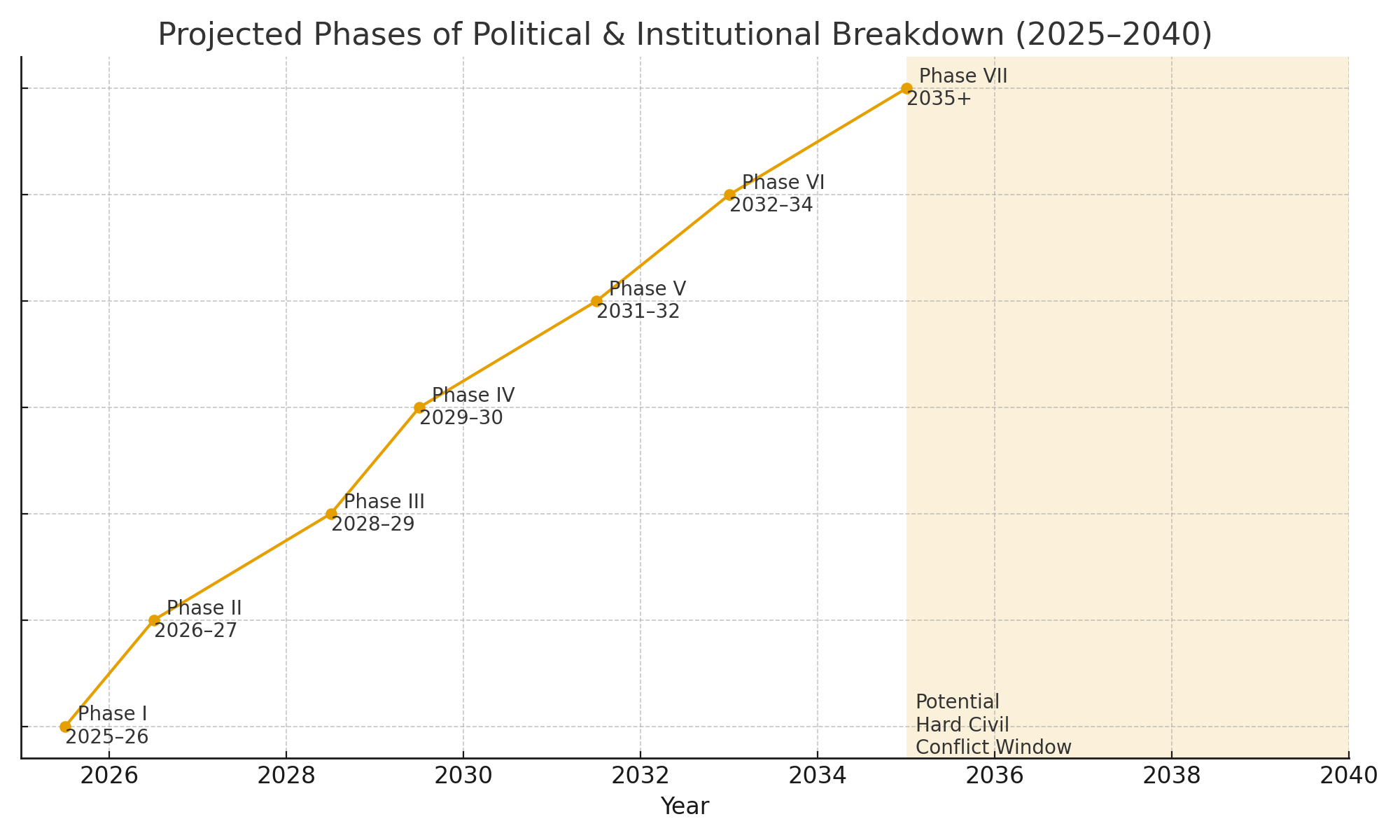
Phase I — Short Reprieve (2025–2026)
Temporary stabilization under Trump’s second term.
Border enforcement improves, corruption is exposed, and independent media grows.
Bureaucracy resists through delays and procedural obstruction.
Phase II — Bureaucratic Counter-Resistance (2026–2027)
Courts and permanent officials slow reforms with injunctions and reinterpretations.
Contractors, NGOs, and donor networks regain influence.
Public frustration rises as the “shadow government” becomes visible.
Phase III — Re-Capture Period (2028–2029)
Democrats regain federal power.
Censorship boards and administrative programs reappear under new branding.
Spending surges past 30% of GDP; debt nears $40 trillion.
Several states quietly refuse federal directives.
Phase IV — Retaliation and Consolidation (2029–2030)
Federal agencies target reformers with selective audits and prosecutions.
Digital surveillance integrates with platform compliance.
Economic pressure drives relocations; national elections lose legitimacy.
Phase V — Fragmentation Threshold (2031–2032)
States openly defy federal rules on immigration, education, and energy.
Washington retaliates with funding freezes and legal pressure.
Parallel legal systems emerge; regional identity replaces national cohesion.
Phase VI — Soft Civil War / Digital Cold Conflict (2032–2034)
Federal authority becomes symbolic.
Cyberattacks, currency freezes, and selective enforcement replace open warfare.
Violence becomes localized; the country splits into functional administrative zones.
Phase VII — Civil War (2035 and beyond)
The nation either reforms into a decentralized confederation
or slips into coercive reunification under emergency powers.
A true civil war becomes possible if trust and solvency aren’t restored.
Forecast and Final Warning
Every era thinks itself too enlightened to repeat the past. Rome trusted its laws to outlive its virtue, France believed reason would sustain liberty, and the Soviet Union mistook control for progress. Each collapsed the same way, when corruption became habit and truth became treason.
America now stands at that threshold. The choice is not between left and right, but between truth and illusion.
If current trends hold, the next decade will decide whether the Union remains real or merely ceremonial. Federal debt will cross $40 trillion by the decade’s end, with interest already exceeding defense. Inflation will continue siphoning the middle class into dependency. Regulations and monopolies will smother local enterprise, converting citizens into clients. The Republic will keep its architecture but lose its pulse.
More dangerous than debt is distrust. Political polarization has reached levels unseen since the nineteenth century; most Americans now view the opposite faction as a threat, not an opponent. A nation can survive hostility but not mutual unbelief. When half the people refuse to accept the other’s legitimacy, law becomes a cease‑fire, not a principle.
Technology will deepen this fracture unless reclaimed by conscience. Artificial intelligence already curates the citizens’ reality; algorithms obey their designers’ ideology. Within a few years, political content will be tailored to individual psychology in real time. A population shown only what its rulers allow cannot give meaningful consent. Truth becomes custom, consent becomes illusion.
Meanwhile, the dollar’s global dominance is dissolving. Competing digital settlement systems allow rivals to trade outside American reach. When the world stops fearing our currency, Americans will stop trusting it. Once a government’s promises lose purchasing power, its laws lose moral power. Legitimacy, finally, is arithmetic wearing a flag.
Unless structural reform and moral renewal take root by the early 2030s, the Republic will drift into soft disunion, regional coalitions shaping their own economies and jurisdictions, federal authority surviving mostly on paper. The breakdown may begin quietly, with selective obedience, digital censorship, and economic isolation, but each step will make the next unavoidable. Violence becomes only a matter of patience.
And yet, redemption remains possible. History’s survivors, Britain after the 1970s, Israel after the Intifadas, America after the Civil War, endured because a remnant valued honesty more than conformity. Our crisis is more straightforward but more complex: to remember that freedom is not the reward for prosperity, it is the precondition for it.
The fate of the nation will not hinge on the next election, but on whether its citizens can still tell the difference between mercy and manipulation, sacrifice and surrender, truth and comfort.
If they can, the Republic will rebuild itself.
If they cannot, liberty will fade, as quietly as every civilization that forgot why it once shone.
Help Keep This Work Alive!
I do not have a university, a network, or a donor class behind me. It is just me at a desk trying to do the kind of work that dies when one person falls, and no one else is there to carry it. If you want voices like this to keep going, they have to be able to survive rent, groceries, and real life, not just outrage and applause.
If you are able, you can help in three ways: become a paid subscriber so I can keep writing instead of scrambling for other work, make a one-time gift to keep the basics covered, or join The Resistance Core so I can plan bigger projects that last.
Free Boost Page (for creators who want to help widen the reach)
A society that treats faith as a private eccentricity loses the restraint that conscience provides.”
Good piece. Any recapture is scary.