

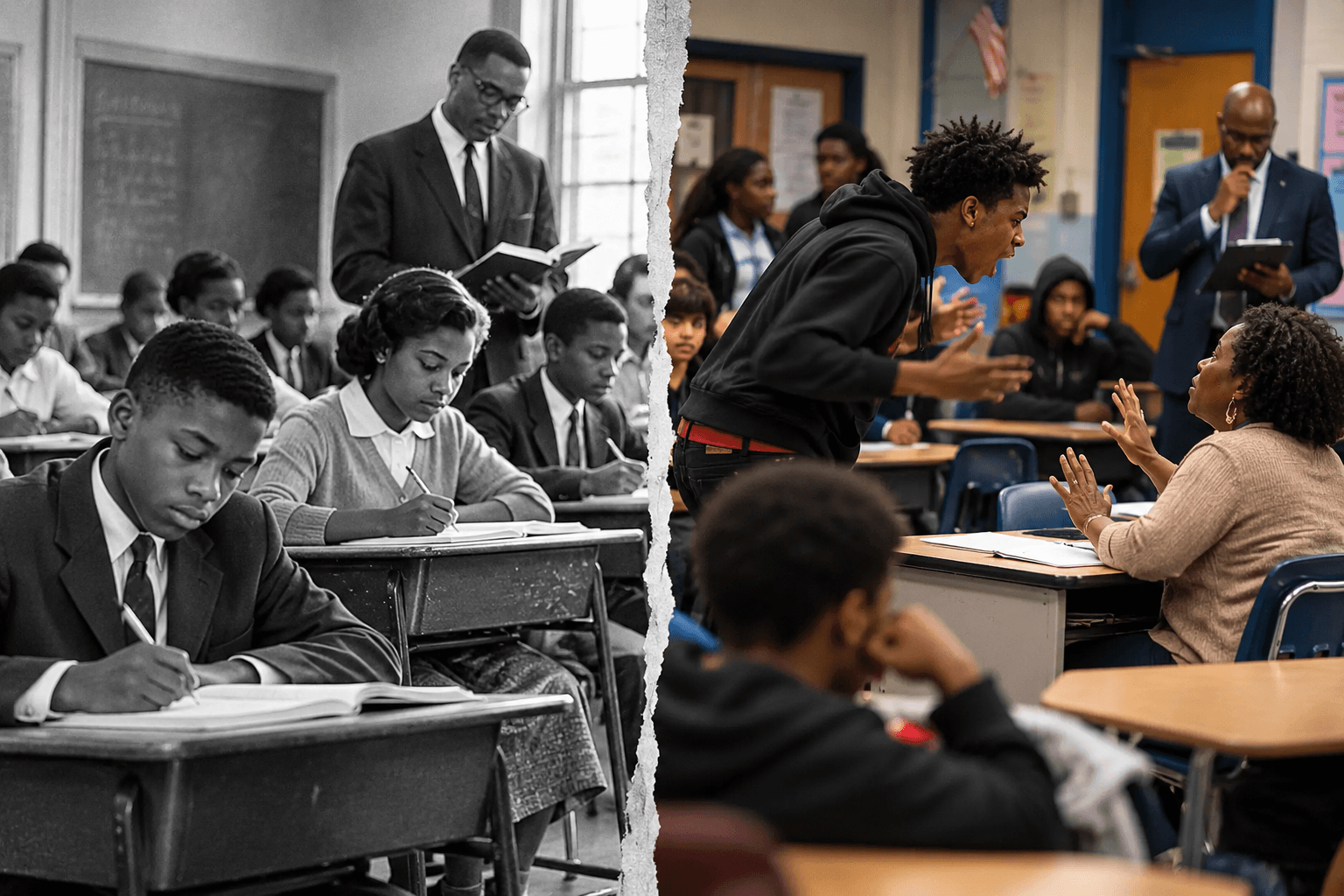
“We spent generations fighting racial double standards, then created a new one and called it culture.”
Imagine a principal sitting in his office after another classroom incident. He knows what happened. He knows the school rule, and he knows what punishment the same conduct would normally bring. But there is another number sitting in front of him too: the racial breakdown of suspensions.
So he hesitates. The behavior has not suddenly become acceptable, and the other students are not safer if he ignores it. But enforcing the rule may make the racial numbers look worse, and somewhere along the way the racial numbers themselves became part of the problem. The hesitation does not stay in the office. It shows up later as a dropout, a beating, or a body.
Most Black Americans do not live by the destructive street code described below. But culture does not stop at neighborhood lines. Ideas about respect, retaliation, toughness, authority, and what it means to back down can travel far beyond gangs and high-crime neighborhoods without everyone who absorbs pieces of them becoming a criminal.
The great irony of modern race relations may be that, after generations of fighting against lower expectations imposed on Black Americans by racism, some of America’s most influential institutions began imposing lower expectations in the name of fighting racism. As legal discrimination declined, schools, universities, government agencies, media institutions, and other cultural authorities increasingly treated unequal outcomes as possible evidence of unequal treatment. That made it harder to criticize or punish some of the behaviors producing those disparities without wandering into a racial minefield.
In some cases, destructive subculture itself became entangled with racial identity. Criticizing the behavior could be portrayed as criticizing Black people, while some of the behavior itself could be defended as authentically Black. This did not create every problem in Black America, but it amplified some of the worst ones by turning accountability into prejudice and normal standards into racial controversy. The people supposedly being protected from judgment were never protected from consequences. Black Americans themselves have often paid the highest price.
Everything I publish is free. If you value independent work that applies the same standard no matter who gets uncomfortable, a paid subscription helps fund the time it takes to research and write it.
Become a Paid Subscriber: https://mrchr.is/help
The Part of the Timeline Nobody Wants to Explain
There is something peculiar about the history of Black America that deserves a lot more attention than it gets.
Slavery was brutal. Slave marriages had no dependable legal protection. Husbands and wives could be separated, and children could be sold away from their parents. The National Park Service estimates that between 1820 and 1860, approximately 30 percent of enslaved children born in the Upper South were taken from their families and sold into the Deep South. Yet Black Americans worked hard under slavery to keep family ties intact, and after emancipation many traveled great distances trying to find relatives from whom they had been separated.
Slavery had the legal power to tear Black families apart, yet Black Americans repeatedly fought to preserve them. A century after emancipation, with slavery gone and Jim Crow collapsing, the Black family began deteriorating at a rate slavery itself had never managed to accomplish as a voluntary pattern.
We do not have modern household surveys for enslaved Americans, and a child being forcibly sold away from his mother is obviously not the same measurement as a modern one-parent household. But look at what happened after slavery.
In 1960, 67 percent of Black children lived with two parents. Only 21.9 percent lived with one. By 1970, the two-parent figure had fallen to 58.5 percent. In 1980 it was 42.2 percent, and by 1990 it had reached 37.7 percent. The one-parent figure moved in the opposite direction, rising to 54.8 percent by 1990.
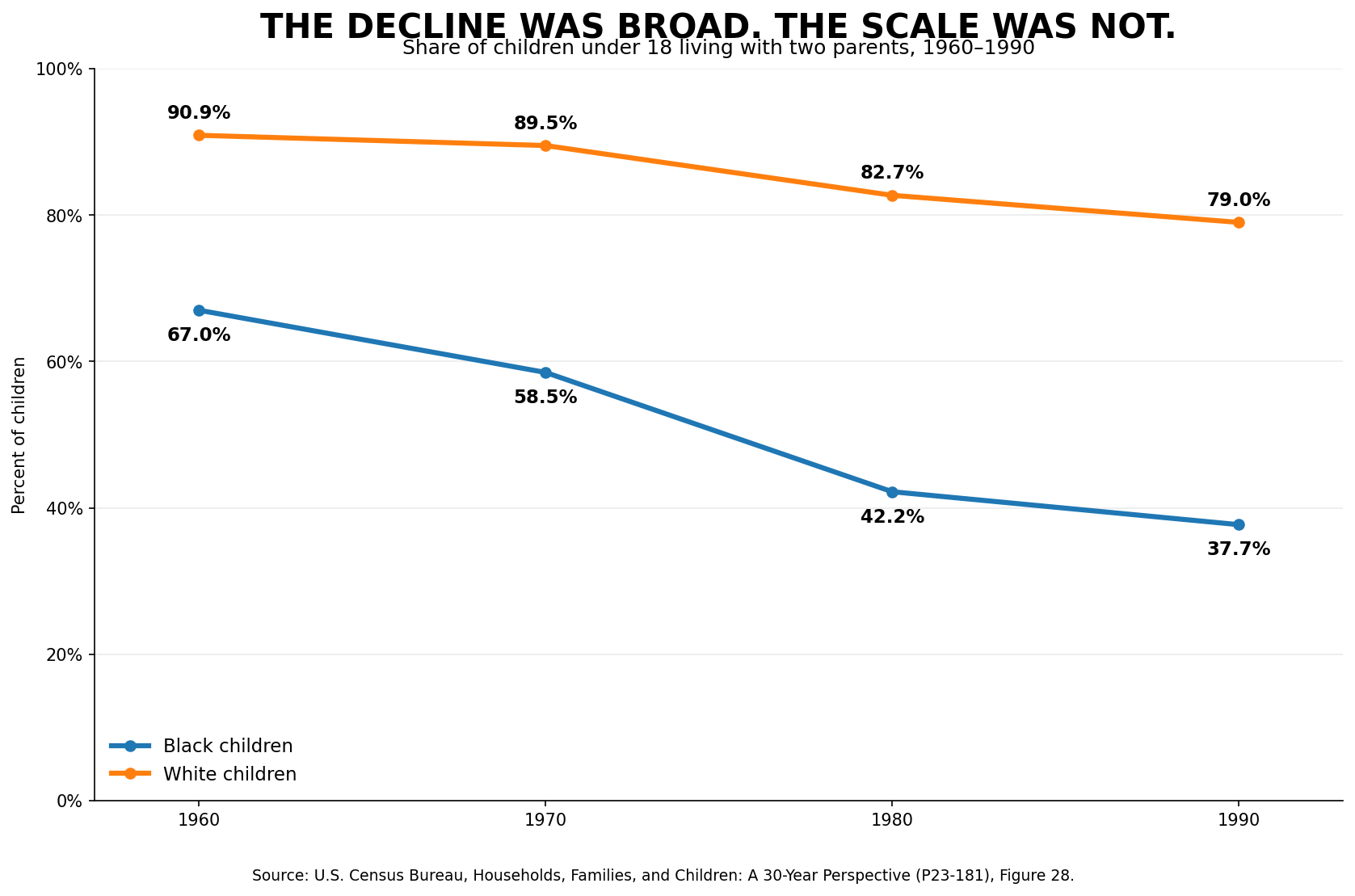
That did not happen because slavery came back, and Jim Crow was not expanding either. These changes accelerated during the same broad period in which America’s legal racial barriers were being torn down.
Poverty adds another wrinkle. Census data put the Black poverty rate at 55.1 percent in 1959. By 1964, the Census category then reported as “Negro and other races” was at 49.6 percent. The categories are not perfectly identical, but the direction was already down before most of the Great Society machinery was in place.
Those numbers do not tell us what caused the later family collapse. They tell us the standard explanation is incomplete. If slavery and Jim Crow are enough to explain today’s Black social problems, why did some important measures deteriorate so dramatically after slavery had been gone for generations and Jim Crow was finally being defeated?
Something else happened too.
What Got Worse?
In 2024, 63 percent of Black children lived in what the Annie E. Casey Foundation defines as single-parent families, compared with 23 percent of White children. Its definition includes children living with an unmarried parent even when a cohabiting partner is present, so this is not an apples-to-apples continuation of the 1960 Census series.
In the same 2024 data, 27 percent of single-parent families were below the federal poverty line, compared with 6 percent of married-couple families. Some of that relationship runs the other way because higher-income and better-educated people are also more likely to marry and remain married. The difference remains enormous.
Then there is violence. In 2023, the Black homicide victimization rate was 21.3 per 100,000 people. The White rate was 3.2. Black Americans were being murdered at more than six times the White rate.
Much violent crime is intraracial, as it is among Whites. That changes the moral picture. When violent street culture takes hold in a Black neighborhood, the main victim is usually not some white guy living fifty miles away. It is another Black person trying to live there.
Education and employment show persistent gaps too. NAEP continues to report substantial racial differences in academic performance. In 2024, fourth-grade math scores for Black students improved from 2022, but large group differences remained.
In August 2026, the seasonally adjusted Black unemployment rate was 6.0 percent. The White rate was 3.7 percent.
These outcomes have more than one cause. The question is why culture and behavior became increasingly difficult to discuss as part of the answer.
When Equal Treatment Became an Unequal-Outcome Problem
The civil-rights principle most Americans understand is simple: the rule should not change because of your race.
A Black child should not be punished more severely than a White child for the same behavior. An employer should not reject someone simply because he is Black. A court should not impose a different standard of justice because of skin color.
Then another idea gained considerable institutional power. If the same rule produced sharply different racial results, the result itself could become evidence that something was wrong with the rule or the way it was being enforced.
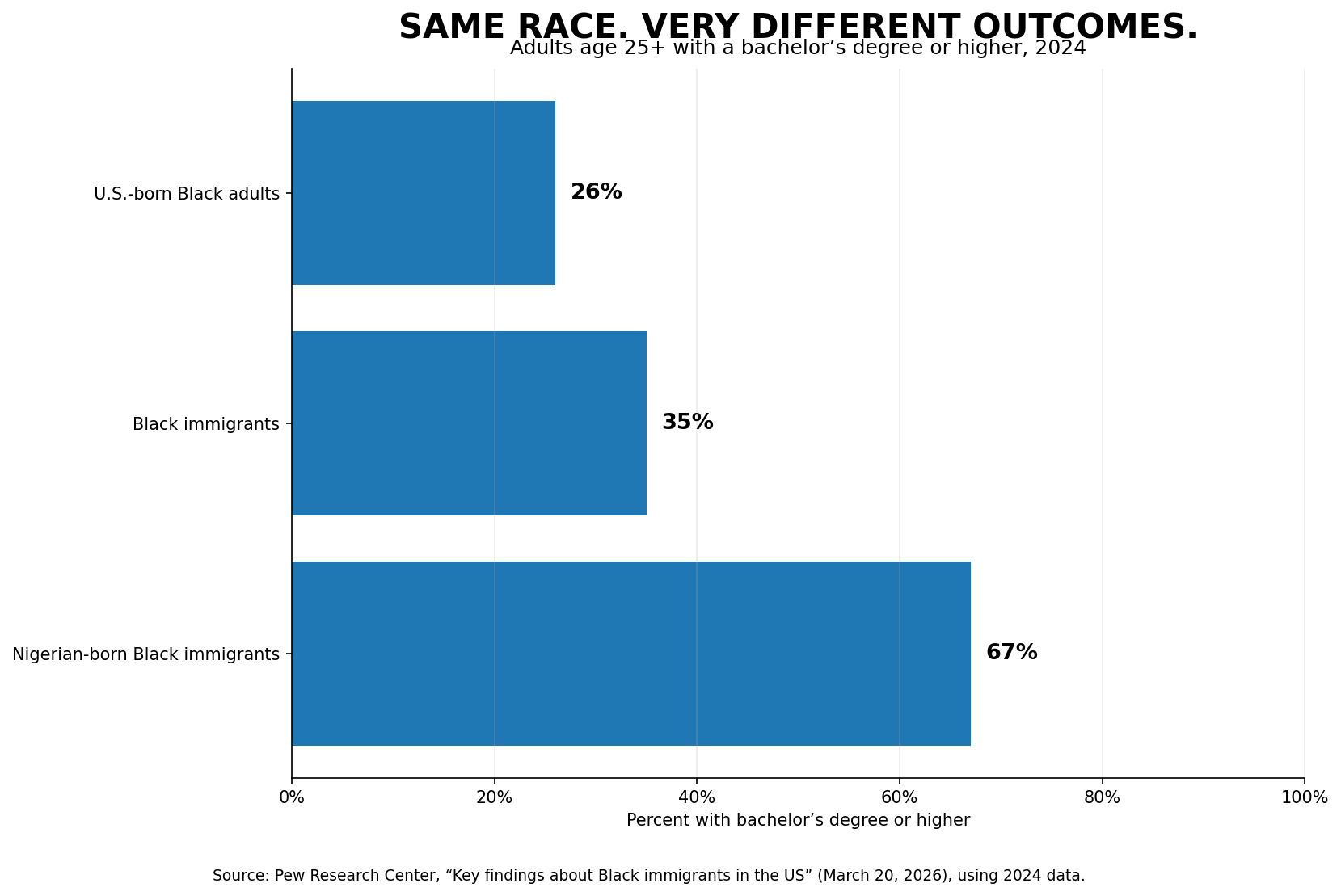
In January 2014, the Obama administration’s Departments of Education and Justice issued a Dear Colleague letter on school discipline. Part of it addressed cases in which similarly situated Black and White students were disciplined differently.
But the guidance went further. It said a policy could create a federal civil-rights problem even when it was neutral on its face and “administered in an evenhanded manner” if it produced an unjustified disparate racial impact. Significant racial discipline disparities could also become part of the basis for a federal investigation.
Put yourself in the principal’s chair. The school rule says fighting brings suspension. Nothing in it mentions race, and you believe you are applying it fairly. But Black students are being suspended at a much higher rate than White students.
Maybe you have a discrimination problem. Look for it. But what if the behavior itself is not occurring at the same rate?
The administrator is no longer thinking only about what Jaquavious did. He is thinking about what Jaquavious’s punishment does to the spreadsheet.
That is where equal rules and equal outcomes start pulling in different directions.
The 2014 guidance said research suggested the large racial disparities then appearing in federal data were not explained by more frequent or serious misbehavior among students of color. Critics challenged that conclusion and warned that schools would respond by managing suspension numbers. Either way, racial outcomes had explicitly become part of the federal discipline framework.
Then Washington changed direction several times. The 2014 guidance was rescinded in December 2018. The Biden administration issued a new student-discipline resource in May 2023 dealing with racial discrimination, though it did not simply reinstate the old letter. That resource has since been rescinded. In February 2025, the Education Department issued a Dear Colleague letter directing federally funded institutions to cease using racial preferences and stereotypes in sanctions and discipline. That directive was later vacated by a federal court, and by February 2026 the Department had agreed not to rely on it. On July 23, 2026, the Department announced it was rescinding several disparate-impact provisions from its Title VI regulations.
Forget which administration you like and look at the problem facing the school. A racial disparity can be evidence of discrimination. It can also reflect differences in behavior, circumstances, reporting, discretion, or several of those at once. If an institution decides in advance which explanation is morally acceptable, it has stopped investigating and started protecting a narrative.
A racial disparity can tell you what happened. It cannot, by itself, tell you why.
Policing presents the same tension in a more dangerous setting.
I have been pulled over plenty of times. My rule is simple. Keep my hands where the cop can see them. Don’t start digging underneath the seat. Don’t scream, threaten anybody, or physically resist. If the officer is wrong, the shoulder of the highway is a remarkably stupid place to conduct the trial.
A 2020 study examining nearly 100 million traffic stops found that Black drivers made up a smaller share of stops after sunset, when their race was harder to see, and that Black and Hispanic motorists appeared to face lower thresholds for vehicle searches. The researchers interpreted those patterns as evidence of racial bias. But even they acknowledged that racial differences in overall stop rates can also reflect differences in driving behavior and time spent on the road. With equipment violations such as broken taillights or expired registration, researchers often do not even know whether the underlying violation rates are the same.
Behavior during the encounter affects what happens too. Roland Fryer’s police-use-of-force study found significant racial disparities in nonlethal force. In the shooting data he examined, he found no racial difference, either in the raw data or after accounting for context. That does not settle every police shooting in America, but population percentages alone tell us very little about what happened during an individual encounter.
Police can treat Black citizens unfairly, and citizens can turn an already tense encounter into a far more dangerous one. Someone does not deserve to get shot because he is obnoxious, frightened, angry or stupid. But predictable and justified are not synonyms.
When Ghetto Culture Became Black Culture
Somewhere along the way, America began confusing a destructive street subculture with authentic Black culture.
Sociologist Elijah Anderson described a “code of the street” in which respect, toughness, retaliation and avoiding the appearance of weakness take on enormous importance. Later research has found connections between adherence to street-code beliefs and violent behavior. Under that system, an insult can become something that has to be answered because refusing to retaliate makes a person look weak.
That is a cultural norm, not melanin.
Perhaps nothing was more insulting to Black America than deciding its worst behavior was its most authentic behavior.
The problem begins when criticizing the norm gets confused with criticizing Black people themselves. The kid glorifying violence can somehow look “authentically Black,” while the kid spending Saturday with a textbook ends up being accused of acting White.
Roland Fryer and Paul Torelli found racial differences in the relationship between academic achievement and popularity in their student data. The effect grew among high achievers and in schools with more interracial contact, but disappeared among students in predominantly Black schools and private schools.
The pattern moved with the school. That is enough to kill the idea that it is baked into Blackness.
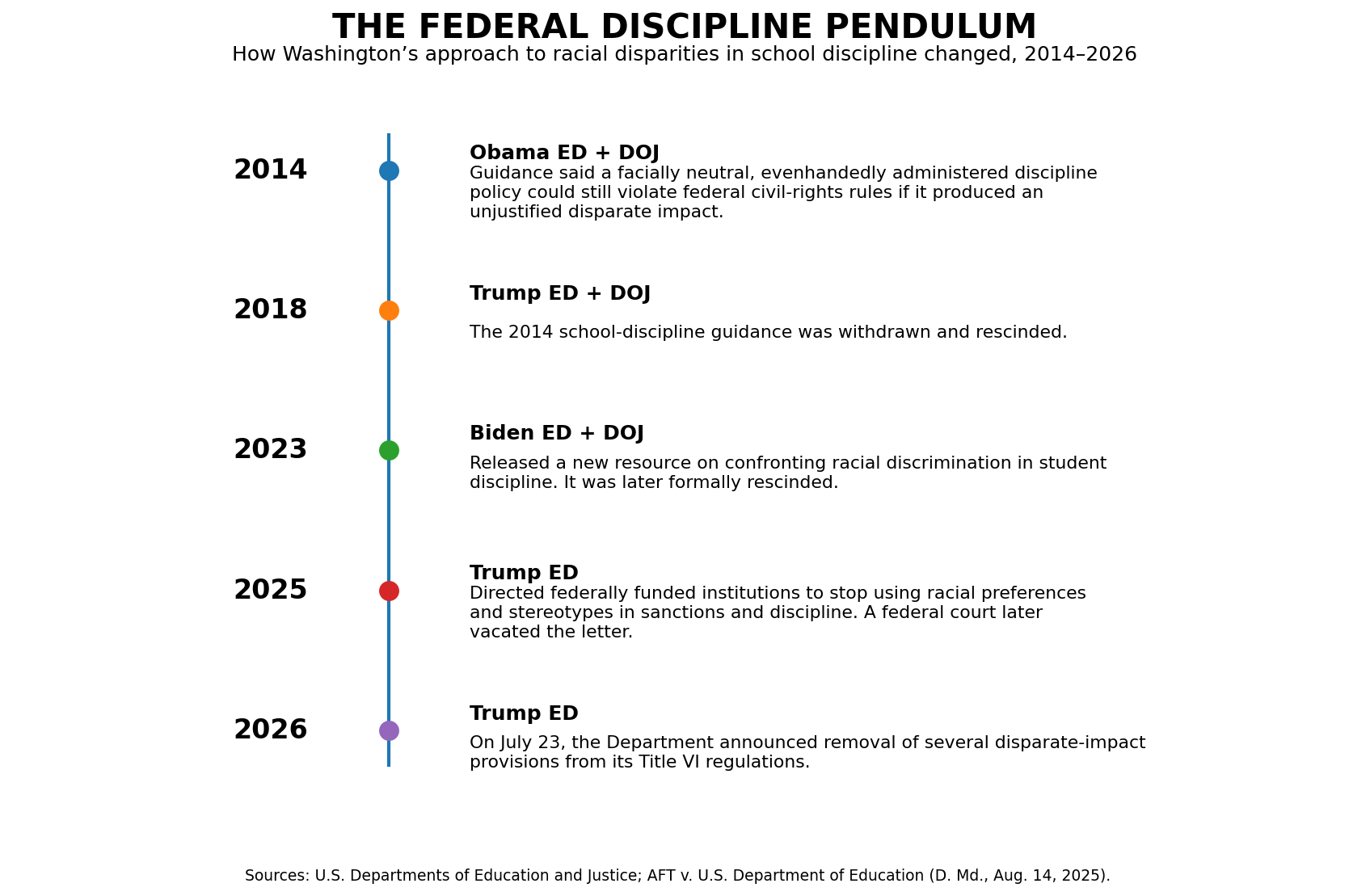
Black immigration offers another useful contrast. Immigrants are not a random sample. Even so, the spread inside the Black population is huge.
Pew reported in 2026 that 35 percent of Black immigrants age 25 and older had at least a bachelor’s degree in 2024. Among Nigerian-born Black immigrants, the figure was 67 percent.
So when somebody says “Black culture,” I want to know which one. Do they mean the Nigerian doctor? The Baptist grandmother who hasn’t missed church in thirty years? The father working two jobs and telling his son to pull his damn pants up? The Black kid catching hell because he actually did the reading assignment? The business owner who closes early because somebody got shot around the corner last week?
Or do they mean the guy ready to stomp somebody into the pavement because he “looked at him wrong”?
They may check the same racial box on a government form. That does not make them culturally interchangeable.
Perhaps nothing was more insulting to Black America than deciding its worst behavior was its most authentic behavior.
Popular entertainment did not invent gangs, street violence, fatherlessness or instant gratification. But it learned how to package some of that imagery, sell it, imitate it and make a fortune from it. An existing street aesthetic acquired cultural prestige, and once that aesthetic became tangled up with racial authenticity, criticizing the behavior became much harder.
Amplification, Not Original Sin
Welfare rules may have affected marriage incentives. Crack devastated already fragile neighborhoods. Deindustrialization wiped out many jobs for men without college degrees. Incarceration removed huge numbers of men from communities. Marriage declined throughout American society, not only among Blacks.
People make choices too. Black Americans are not pieces being moved around a board by White politicians. They have agency, which means they can make smart decisions, stupid decisions and everything in between, exactly like everyone else.
Small consequences are often how people learn. Your teacher throws you out of class. Your father chews you out. Your coach benches you. Your boss tells you to get your shit together before he has to replace you. These are not catastrophic events. They are information.
Take away enough of those small consequences and the lesson does not disappear. It gets more expensive. One day the teacher is an employer. The principal is a police officer or judge. What could have cost you an afternoon eventually costs you a job, a criminal record, a marriage or years of your life.
Life has no disparate-impact office.
Who Paid the Highest Price?
This is what bothers me most about the whole thing. The bureaucrat studying suspension statistics probably does not have to spend fifth-period algebra next to the kid screaming at the teacher. Another Black kid often does.
The academic explaining street violence through structural forces probably does not hear gunfire outside his daughter’s bedroom at two in the morning. A family living in that neighborhood does. The people with the most sophisticated explanations are frequently insulated from the behavior they are explaining.
The 2023 Black homicide rate of 21.3 per 100,000 is not primarily a statistic about White suffering. Those are Black sons and daughters, fathers, mothers, friends and neighbors who are dead.
Calling that compassion does not make it compassion.
It does not help the kid trying to learn in a chaotic classroom. It doesn’t help the mother trying to keep her son away from the street. It does nothing for the Black business owner trying to keep good employees and customers in a deteriorating neighborhood.
And it certainly does not help the millions of ordinary Black Americans who live by the same basic standards of civilized behavior everyone else does, yet continually find themselves racially associated with people who don’t.
When people inside the same racial category have radically different outcomes, we should probably spend less time treating race as destiny and more time asking what else differs between them.
The Same Standards
What I am arguing for is simple: stop changing expectations according to race.
If fighting brings a three-day suspension, the same fight should bring the same suspension. If the rule is stupid, change it for everybody. A lateness policy does not become racist simply because one racial group violates it more often.
Dress codes are another obvious example. If I showed up to work wearing six-inch fake nails, enormous eyelashes, and a bonnet, my boss would probably wonder what the hell happened to me. Partly because I am a man, admittedly. But even if I were a woman, an employer might reasonably decide that some of those choices do not fit the workplace. The standard does not become racist because employees of one race violate it more often. If a rule is reasonable, enforce it equally. If it is unreasonable, change it for everybody.
Murder, robbery, assault, classroom disruption, abandoning children, and intimidation do not become healthy behaviors because historical injustice exists.
If a Black student and a White student do the same thing and the Black student receives the harsher punishment because he is Black, deal with the discrimination. If police are searching Black motorists on less evidence, deal with that too.
A disparity can expose unequal treatment. It can also reflect unequal behavior or circumstances. The worst approach is deciding which explanation is compassionate before looking at the evidence.
For generations, racism told Black Americans that they could not meet the same standards as White Americans. Then parts of supposedly enlightened America came dangerously close to telling them they should not have to. Those messages sound very different, but they share an ugly assumption: both begin by expecting less.
Racism once denied Black Americans equal treatment because they were Black. Racial paternalism risks denying them equal expectations for the same reason. The intentions changed. Reality did not.
Institutions can suspend judgment. They cannot suspend consequences.
Don’t Lower the Standard
This essay took hours of digging through Census tables, federal discipline guidance, crime statistics, academic research, policing studies, and decades of social data.
Those hours have to come from somewhere. Right now, many of them come out of the time I spend doing other work.
If you want me spending more of those hours doing this, there are two practical ways to help.
Become a Paid Subscriber
Everything I publish is free to read. A paid subscription is not about unlocking articles. It is about supporting the work, funding the research, and buying back the time it takes to keep doing it. If you believe this kind of independent writing is worth having out there, becoming a paid subscriber is the most direct way to help keep it going.
Become a Paid Subscriber:
https://mrchr.is/help
Make a One-Time Contribution
If you do not want another subscription, a one-time contribution helps too.
Sometimes a few funded hours are the difference between spending the day buried in Census tables and government reports and spending it driving.
Contribute:
https://mrchr.is/give
Venmo:
https://account.venmo.com/u/mrchrisarnell
If You Cannot Give
Keep reading.
Share the essay. Restack it. Send it to someone who needs to see the argument. Argue with it if you disagree. Check the numbers yourself.
But do not lower the standard because the truth makes somebody uncomfortable.
There are plenty of ways to help this work travel that do not cost anything.
P.S. If you want to support this work at a much higher level, Resistance Core is the annual option. It is $1,200 per year and is designed for the small group of readers who want to buy back a meaningful amount of research and writing time.
Join the Resistance Core:
https://mrchr.is/resist
What an excellent essay. Thank you.