

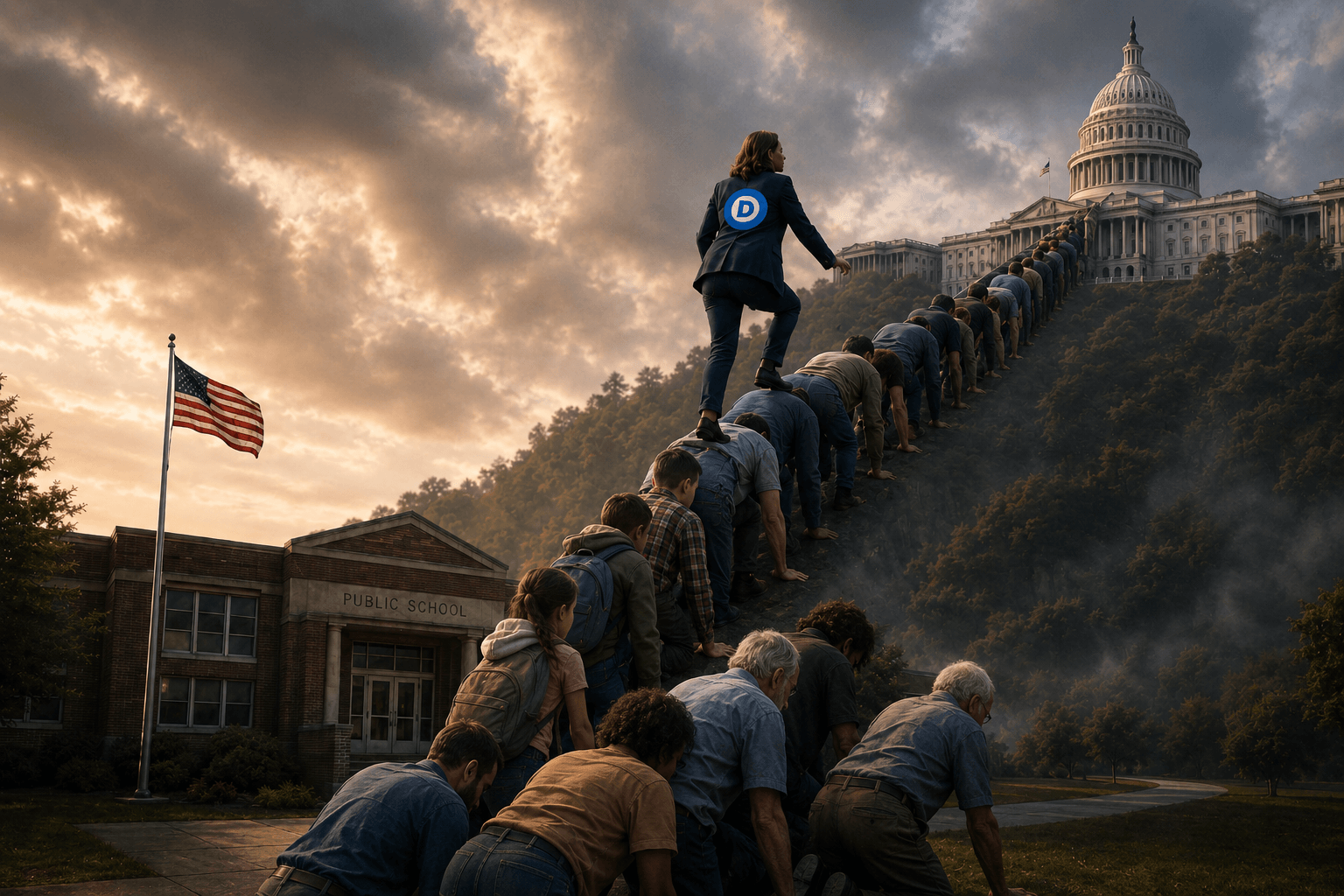
You may ignore it when it is “only” a school board race.
You may ignore it when it is “only” local.
You may ignore it when it is “only” noncitizen parents.
But once the citizenship line is broken, the next election may be your city, your taxes, your children, your representation, and eventually your country.
The Democrat Party understands gradualism very well. A policy that would be rejected if stated plainly can often be introduced as a small exception, especially when the exception involves children, immigrants, schools, or some other object of public sympathy.
That is what makes local noncitizen voting so revealing.
Nobody begins by saying, “Let us erase the political difference between citizens and noncitizens.” That would be too direct. Instead, the public is told it is only local. Only school board. Only parents. Only legal residents. Only taxpayers. Only people with children in the district. Only people with a stake in the community.
The word “only” does a remarkable amount of political labor.
Local noncitizen voting is being sold as compassion. It is better understood as a political pilot program. It tests whether Americans will accept the idea that voting is no longer tied to membership in the nation, but merely to residence near one of its institutions. Federal law already bars noncitizens from voting in federal elections, but the fight keeps returning through state and local rules, where activists can make the issue sound smaller than it is.
The first door they knock on is the school board. That choice is not accidental. Children make the argument emotional. Schools make it sound local. Local makes it sound harmless. Harmless makes it easier to sell.
But if a noncitizen can vote in a school board election because his child attends the school, why stop there? The mayor affects schools. The city council affects housing, policing, budgets, transportation, sanctuary policy, and the agencies that surround schools. Local ballot measures affect taxes. County offices affect services. State lawmakers affect education funding and curriculum mandates.
Once the argument becomes “I am affected by government, therefore I should vote,” citizenship has already been pushed aside. After that, the fight is mostly over timing.
The Trojan Horse Called “Only Local”
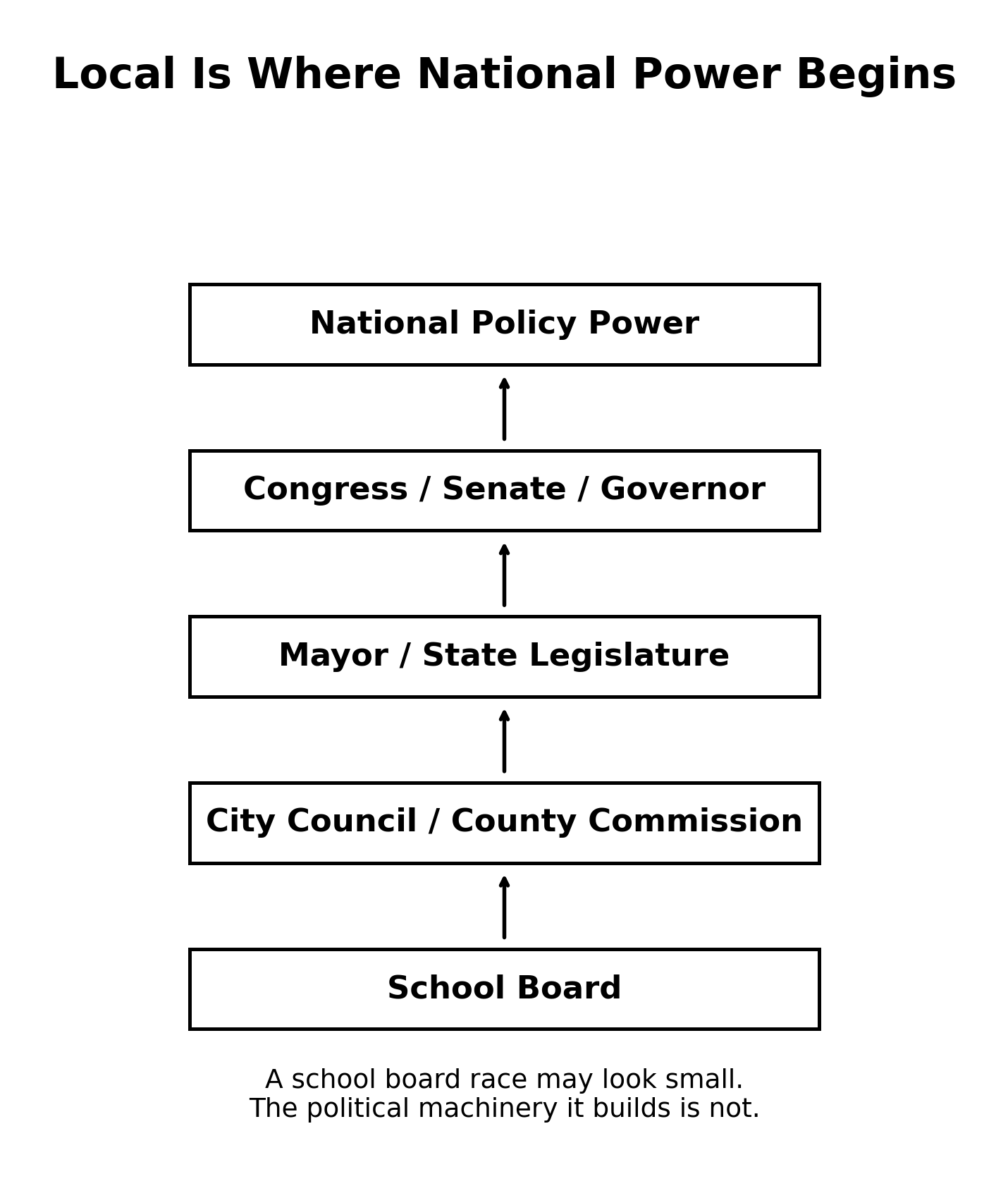
One of the more insulting phrases in politics is “only local.” It asks citizens to believe that local offices do not feed state power, and state power does not feed national power. Washington does not usually begin in Washington. It begins on a school board, a city council, a county commission, a mayor’s office, a prosecutor’s office, or some obscure local position most people ignore until the person trained there shows up on television pretending to have appeared from nowhere.
Local politics is not the kiddie table. It is the farm system.
Candidates learn how to organize there. They learn how to raise money. They build relationships with unions, advocacy groups, local reporters, nonprofits, churches, professional activists, and party organizations. They discover which neighborhoods turn out, which messages work, which interest groups can deliver volunteers, and which voters can be moved by fear, benefits, identity, resentment, or habit.
This is why the phrase “local democracy” deserves suspicion when it comes from people trying to change who gets to vote. Local elections are where future power is trained. A school board member can become a state legislator. A mayor can become a member of Congress. A city council race can produce the voter file, donor list, activist network, and name recognition that later becomes a statewide campaign.
When Democrats say local noncitizen voting is “only local,” they are hoping citizens do not notice where political careers begin.
The School Board Is the Door They Think You Will Not Guard
School boards are the perfect starting point because they sound too modest to fight over. Most Americans do not follow school board elections closely unless something outrageous happens. Turnout is often low. Candidates are not always widely known. Many races are technically nonpartisan, which allows the party machinery to operate without carrying the party label in plain sight.
San Francisco currently allows certain noncitizen parents or guardians to vote in Board of Education elections. The city says this local law does not allow those voters to participate in any other local, state, or federal election. That limitation is part of the sales pitch. It makes the policy sound narrow, contained, and neighborly.
But the principle does not stay narrow for long.
The argument is not really about schools. It is about the boundary. If citizenship is not required to vote for the people who govern your child’s school, then citizenship is no longer the hard line. It becomes one factor among many. The language changes accordingly. Citizen becomes resident. Resident becomes stakeholder. Stakeholder becomes community member. Community member becomes taxpayer. Taxpayer becomes parent. Parent becomes anyone affected by policy.
Political language often works this way when the left wants to move a boundary. The hard word is replaced with a soft one. The legal category is replaced with an emotional category. “Noncitizen voting” sounds radical. “Parents having a voice” sounds neighborly. The legal issue did not disappear. It was simply covered in warmer language.
A noncitizen parent may be a decent person. He may work hard, pay rent, love his children, respect his neighbors, and care more about the local school than many citizens do. None of that answers the citizenship question. Love for your child does not give you political authority in a country you have not joined.
Citizenship Is Being Replaced by “Stakeholder”
A citizen has a country. A stakeholder has a claim.
That is why the word “stakeholder” is so useful to the modern left. It sounds civic, but it has no natural boundary. A tenant is a stakeholder. A foreign student is a stakeholder. A visa holder is a stakeholder. A legal permanent resident is a stakeholder. A temporary worker is a stakeholder. An asylum applicant is a stakeholder. A nonprofit that serves immigrants is a stakeholder. A union that wants more members is always a stakeholder. An activist group that wants power will never fail to discover its stake.
Once citizenship gives way to stakeholder status, the country stops being a country in the old sense. It becomes a managed zone where various populations make claims through institutions. That arrangement suits the Democrat Party very well. Citizens have rights, memory, borders, obligations, and the authority to say no. Stakeholders can be multiplied by policy and organized by need, identity, grievance, benefit, and fear.
This is why the language matters. Democrats are not merely changing election rules. They are changing the moral vocabulary around voting. Voting is being separated from citizenship and attached to residence, schooling, taxation, and claimed impact. That sounds compassionate until one notices what is being cheapened.
The vote is not a welcome basket. It is an act of sovereignty.
The Future Democrat Pipeline
The Democrat Party does not need every immigrant to become a citizen before beginning political formation. A political machine does not wait until the final step to shape behavior. It starts early. It introduces people to the city agency, the school district, the legal aid nonprofit, the tenant organization, the immigrant services group, the teachers union, the local activist coalition, and eventually the ballot.
By the time citizenship arrives, political loyalty may already be formed.
The machine wants names, addresses, languages, neighborhoods, issue preferences, trusted messengers, turnout habits, and community validators. It wants to know who can be reached, who can be moved, who responds to benefits, who responds to fear, which neighborhoods can be organized, and which organizations can deliver votes.
Local noncitizen voting becomes a vetting system. It is not just about the election in front of you. It is about building the voter who will be useful later.
A newly arrived immigrant may need help with housing, school enrollment, translation, legal status, paperwork, benefits, transportation, health care, and local government. The organizations that provide that help become trusted interpreters of American life. Some are sincere. Some provide useful services. But politics does not require every participant in the ecosystem to be cynical. It only requires the ecosystem to point in the same direction.
In Democrat cities, it often does.
The same network that teaches someone how to navigate the city can also teach him who supposedly protects him and who supposedly threatens him. By the time voting is introduced, the moral map may already be drawn. This is not democracy in the old American sense. It is onboarding.
The Numbers Explain the Incentive
There is a reason the Democrat Party is more interested in softening the citizenship line than Republicans are.
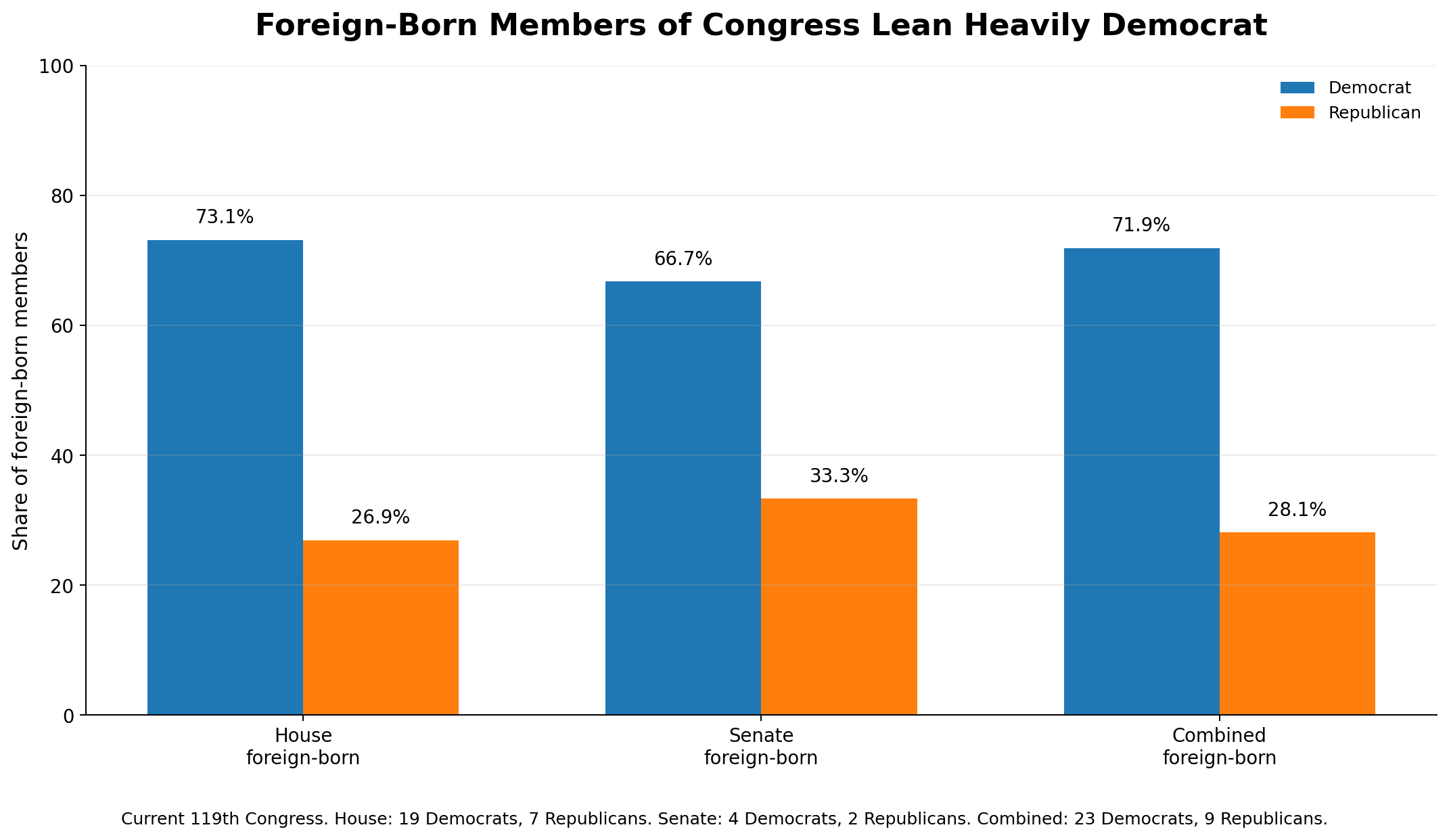
In the current 119th Congress, foreign-born members lean heavily Democrat. The House Clerk lists 26 foreign-born members of the House as of May 1, 2026. Nineteen are Democrats. Seven are Republicans. That means foreign-born House members are about 73 percent Democrat.
The Senate tells a similar story. The current foreign-born senators are Michael Bennet, Ted Cruz, Tammy Duckworth, Mazie Hirono, Bernie Moreno, and Chris Van Hollen. Four are Democrats and two are Republicans, which makes the foreign-born Senate group about 67 percent Democrat.
Combined, the current foreign-born members of Congress are roughly 72 percent Democrat.
This does not mean every foreign-born politician is a Democrat. It does not mean every immigrant votes Democrat. It does not mean foreign-born Americans are incapable of independent political judgment. That would be a crude argument, and it is not the one being made here.
The point is simpler. Incentives explain behavior.
If a political party looks at foreign-born officeholders in Congress and sees a pool that leans more than two-and-a-half to one in its favor, that party has a powerful reason to expand the political pipeline that produces more of them. It has a reason to cultivate immigrant communities early. It has a reason to build relationships through schools, nonprofits, city agencies, translation services, legal aid groups, tenant organizations, and local elections. It has a reason to blur the line between resident and citizen wherever it can get away with it.
That is not compassion. It is arithmetic.
Democrats understand that political habits form before Election Day. They form in schools, city offices, nonprofit waiting rooms, public meetings, school-board fights, tenant disputes, and immigration-service networks. By the time citizenship arrives, the political map may already be drawn.
This is why local noncitizen voting matters. It is not just about giving a small group of noncitizen parents a voice in a school-board race. It is about building the next electorate before the legal status catches up.
Republicans may look at noncitizen voting and see a violation of citizenship. Democrats look at it and see a future voter file.
That difference explains nearly everything.
Schools Are Political Formation Factories
People like to pretend schools are neutral ground. They are not. A school teaches more than math and reading. It teaches language, memory, authority, habits, social expectations, and what children are supposed to think is normal. That does not mean every teacher is a political activist. Many are not. But institutions shape people even when the people inside them do not think of themselves as political operators.
School boards govern that environment. They influence curriculum, library policy, discipline, parental rights, hiring priorities, administrative culture, spending, ideological climate, and the relationship between parents and the district. That is why school boards became such a battleground.
The politics of school boards are not evenly distributed in the way casual observers might assume. A Fordham Institute national survey found that raw school board membership was 41 percent Democrat, 47 percent Republican, and 12 percent Independent. On the surface, that does not look like Democrat domination. But when the numbers were weighted by the students those board members represent, board members representing 55 percent of students identified as Democrats, compared with 35 percent who identified as Republicans and 10 percent as Independents.
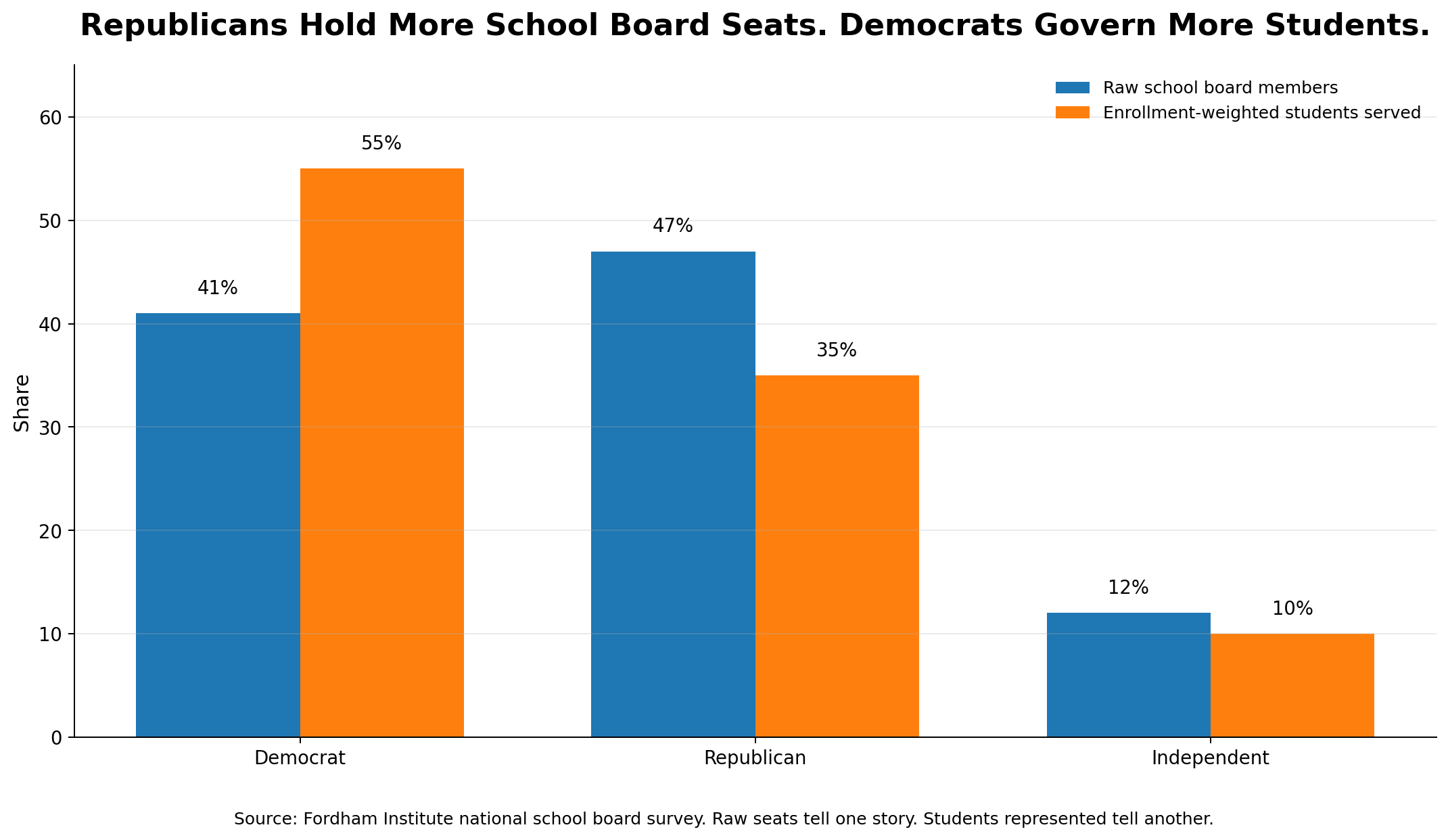
That is the difference between counting chairs and counting power.
Republicans may hold more small school board seats. Democrats govern more students.
This distinction is crucial. Noncitizen school board voting is not likely to begin in tiny rural districts where Republicans hold many small boards. It is far more likely to appear in dense urban and suburban districts where the students are, where the unions are, where immigrant service nonprofits operate, where activist groups have staff, and where Democrat political machines already know how to work the system.
The school board door matters because it is not merely education policy. It is political formation at scale.
New York City Showed the Real Ambition
San Francisco shows the soft entry point. New York City showed the ambition.
New York City passed a law that would have allowed more than 800,000 legal noncitizens to vote in municipal elections. These were not federal elections. They were city elections. But city elections in New York are not minor civic housekeeping. The law covered offices such as mayor, public advocate, comptroller, borough president, and city council. The state’s highest court ultimately struck the law down, holding that the New York constitution restricts voting to citizens.
That case strips away much of the innocence surrounding the argument. This was not merely a handful of parents voting for a local school board. This was America’s largest city trying to add a massive new bloc of municipal voters before citizenship. More than 800,000 people is not a civics lesson. It is political power.
A city does not try to add that many noncitizen municipal voters because it suddenly became sentimental about participation. It does it because numbers rule politics.
Supporters of these measures usually say such residents live in the city, pay taxes, raise children, and are affected by city policy. Some of that is true. It still does not answer the citizenship question. It replaces the citizenship question with a sympathy test. The Democrat Party wants the public to ask, “Are these people affected by policy?” The constitutional question is simpler: “Are these people citizens?”
Those are not the same question.
The First Demand Is Always Modest
The first demand is always modest because the final demand would lose if stated honestly. That is the old trick of modern Democrat politics. Do not ask for the whole institution. Ask for one exception. Do not announce the new rule. Ask for one carveout. Do not tell citizens the boundary is being moved. Tell them only cruel people would object to such a small and compassionate adjustment.
That is how boundaries move in a country too distracted to guard them.
This pattern has shown up again and again. The public is first told that no one is trying to change anything fundamental. No one is trying to reach children. No one is trying to punish disagreement. No one is trying to redefine old words. No one is trying to make private beliefs into public obligations. The first demand is always framed as tolerance, recognition, kindness, fairness, or local control. Then the institutions absorb it, the language changes, the schools adjust, the bureaucracy follows, and the people who remember the original promise are treated as if they invented it.
Local noncitizen voting follows the same script. First it is only school board. Then only parents. Then only local. Then only legal residents. Then only municipal elections. Then only people who pay taxes. At every step, the public is told the concern is exaggerated. At every step, the argument expands. By the time citizens object to the larger principle, the activists have already changed the moral vocabulary.
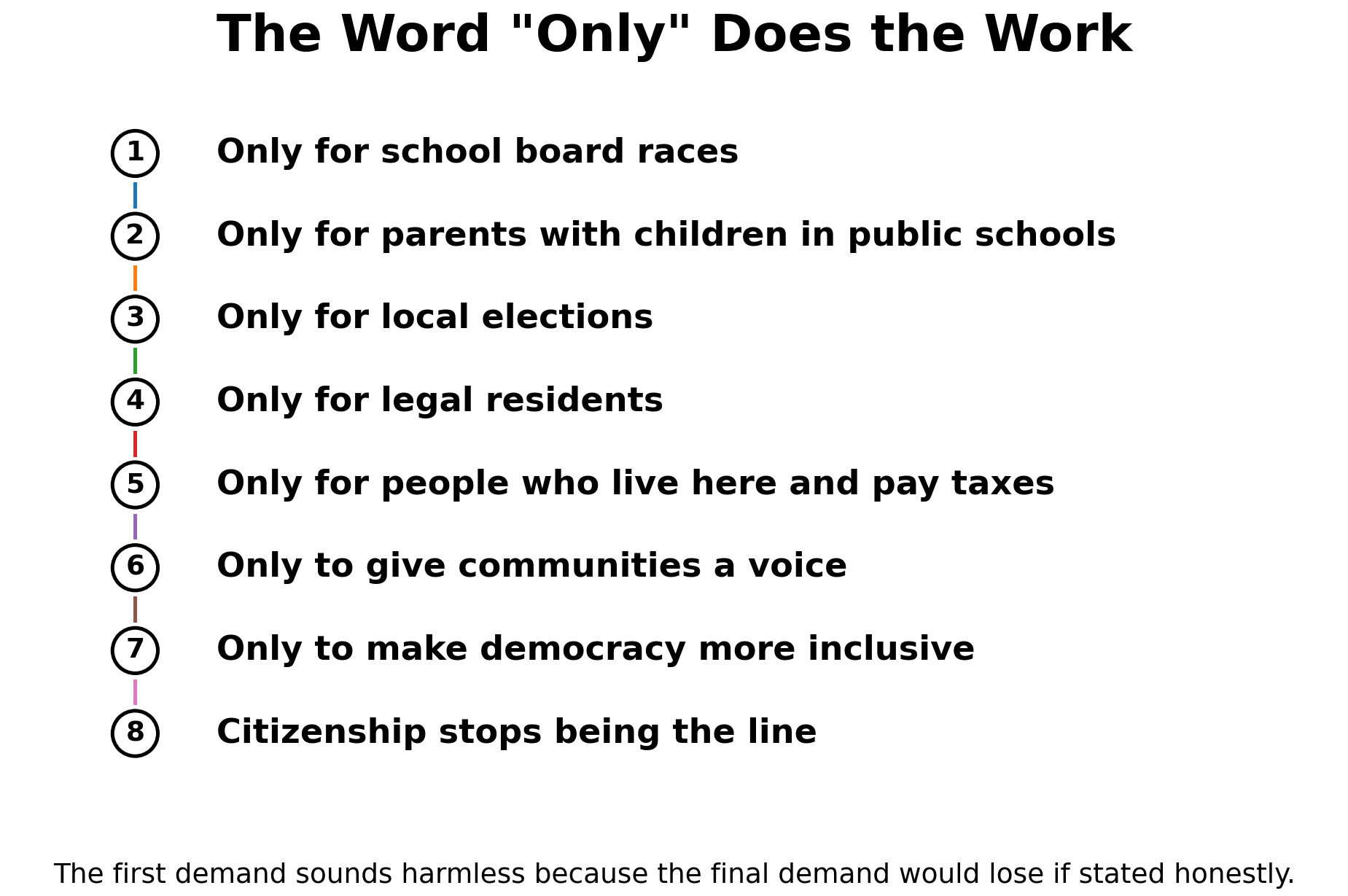
Suddenly the issue is not whether citizenship should remain the line between voters and nonvoters. The issue becomes whether citizens are “excluding” people, “silencing” parents, or “denying representation” to residents who are affected by local policy. In other words, the citizen defending citizenship is turned into the suspect. The noncitizen seeking political power is turned into the victim.
That inversion is not an accident. It is the method.
If the Democrat Party said plainly, “We want to loosen the connection between citizenship and voting because the voters we expect to gain will help us build permanent power,” the public would reject it. So they say school board. They say parents. They say community voice. They say local democracy. They take the hard political question and wrap it in the softest language available.
The words change. The machinery does not. Democrat politics is a staircase disguised as a sidewalk. The public is told it is only taking one harmless step, while the people building the staircase already know where it leads.
“No One Is Talking About Federal Elections” Is a Dodge
One predictable response is that noncitizens are not being allowed to vote in federal elections. True, and beside the point.
Federal power is built locally. Presidents, senators, governors, mayors, congressmen, state legislators, county officials, school board activists, union backed candidates, and party operatives do not emerge from nowhere. They rise through lower levels of political life, where donor lists are built, activists are trained, reporters are cultivated, and voters are sorted.
Changing the electorate at the bottom changes the pipeline above it.
You do not need noncitizens voting for president tomorrow if you can begin normalizing their voting in school board races today. You do not need to win the national argument immediately if you can win the moral premise locally. Once the public accepts that citizenship is not necessary in one election, the next argument becomes easier.
This is how precedents work. The left knows it. That is why it rarely fights only for today’s policy. It fights for tomorrow’s premise. The premise here is simple and dangerous: voting can be separated from citizenship if the emotional case is strong enough. Once that premise is accepted, every remaining limit becomes negotiable.
Why Democrat Cities Want This First
Democrats are not pushing this first where it hurts them. They are not trying to expand noncitizen voting in places where the likely result is a Republican advantage. They are trying it in dense urban areas where the institutions already lean left, the schools already lean left, the nonprofits already lean left, the unions already lean left, the local press often leans left, and the political class already knows how to harvest grievance and dependency.
Then they call it local democracy.
“Local democracy” sounds noble when the locality is already theirs. Democrat run cities become laboratories for policies that would be rejected if introduced nationally all at once. The local experiment creates the precedent. The precedent creates the moral claim. The moral claim becomes the national talking point.
This is how soft revolutions work in bureaucratic societies. They do not usually arrive with banners and uniforms. They arrive through forms, committees, pilot programs, court fights, local ordinances, nonprofit grants, and pleasant language. By the time most citizens notice, the argument has moved from “Should we do this?” to “Why are you trying to take this away?”
The pushback from the states has been defensive and structural. As tracked by the National Conference of State Legislatures, a wave of states has moved to explicitly amend their constitutions to prevent this creep. But note the language. While the left uses the word “only” to minimize the erosion, as in only school boards, the states are using it to fortify the boundary by passing measures to ensure that only citizens can vote. These state-level firewalls are designed to stop progressive municipalities from fracturing the electorate from the bottom up.
The Real Victims Are Citizens
The left wants this debate framed as cruelty toward immigrants. That framing is dishonest.
Decent treatment of immigrants is not in dispute. Neither is the fact that many legal residents work, pay taxes, and care about their children’s schools. But none of that creates a right to govern a political community they have not formally joined.
Every noncitizen vote dilutes the vote of a citizen. That is arithmetic, not rhetoric. If the voting pool expands to include people who are not citizens, then the citizens’ share of political authority shrinks.
Democrats do not want that stated plainly. They dress the policy in compassion because the underlying transaction is ugly. They are taking part of the political inheritance of citizens and handing it to noncitizens before those noncitizens have joined the nation.
That is not generosity. It is a transfer of power.
This Is Not Anti-Immigrant. It Is Pro-Citizenship.
A country can welcome immigrants without pretending citizenship is meaningless. In fact, if citizenship means anything, it should be valuable enough to require. Naturalization should matter. The oath should matter. The distinction between a visitor, a temporary worker, a student, a legal permanent resident, an asylum applicant, and a citizen should matter.
That distinction is not hatred. It is order.
The left often describes order as cruelty because blurred boundaries give it more room to maneuver. Clear categories limit the machine. Blurred categories empower it. The citizenship line tells everyone, including immigrants, that joining the country has meaning. There is a difference between living in a place and belonging politically to that place. Voting is not merely a service benefit attached to residence. It is the political act of a citizen.
If that sounds harsh, then Americans have been trained to treat the basic requirements of nationhood as moral embarrassments.
The Endgame Is Citizenship as a Technicality
The goal is not merely to let a few noncitizens vote in school board elections. The goal is to weaken the public’s instinctive connection between citizenship and voting.
Once that connection is weakened, the debate changes. Instead of asking whether noncitizens should vote, activists start asking which noncitizens should vote first. Legal permanent residents? Work authorized residents? Parents? Taxpayers? DACA recipients? People waiting on asylum claims? People who have lived in a city for 30 days, six months, or a year?
The categories can always expand because the principle has already been surrendered.
That is why New York City’s attempted law was so revealing. It would have allowed legal permanent residents and certain work authorized noncitizens to vote in municipal elections after meeting residency requirements. The law was struck down, but the ambition was visible.
School board is the soft opening. Municipal elections are the next room. After that, the argument becomes a matter of political appetite. The Democrat Party has a very large appetite for voters it believes it can control.
The Country Belongs to Citizens or It Does Not
Citizens vote. Noncitizens do not. That is not cruelty. It is the minimum definition of a nation.
A country that cannot distinguish between citizens and noncitizens is no longer governing itself in any serious sense. It is merely administering populations. That is exactly the direction the modern Democrat Party prefers. Citizens are inconvenient. They have inherited rights, local memory, national attachment, and the authority to say no. Managed populations are easier. They can be sorted by need, fear, identity, benefit, and grievance.
Local noncitizen voting is part of that shift. It begins where people are least likely to see the danger: school board races, city elections, and sentimental phrases about parents and community voice. Beneath the softness is a hard political project. The Democrat Party is building a future electorate before citizenship arrives, using schools as the emotional entry point, local offices as the training ground, and immigrant service networks as the organizing system.
First they vote for school board. Then they ask why citizenship was ever required at all.
Inclusion is the sales language. Power is the product.
Help Restore the Meaning of Citizenship Before They Reduce It to Paperwork
If this essay hit a nerve, it is because the issue is bigger than school boards.
It is about whether citizenship still means anything.
The people pushing these policies have institutions, nonprofits, legal groups, foundations, city governments, school districts, media allies, and activist networks behind them. They know how to move a boundary slowly. They know how to make a radical idea sound harmless. They know how to call power compassion and call resistance hatred.
I do not have that machine.
I have this platform, the readers who share it, and the people who decide this work is worth keeping alive.
Every paid subscription helps me keep digging, writing, documenting, and putting these arguments in front of people who may not hear them anywhere else. The goal is not just to preach to people who already agree. The goal is to make these ideas visible enough that ordinary Americans can see the pattern before the pattern becomes policy.
Become a Paid Subscriber
If you want this work to continue, the most important thing you can do is become a paid subscriber.
Paid subscriptions keep the writing free for everyone else, including the people who cannot afford to pay but still need to read it.
They also help this publication grow inside Substack’s rankings and recommendations, which means more readers, more reach, and a better chance of breaking through the fog.
Become a paid subscriber here:
https://mrchr.is/help
Make a One-Time Gift
If a subscription is not the right fit, a one-time gift also helps. It gives this work immediate breathing room and helps cover the time required to research, write, edit, source, and publish essays like this.
Make a one-time gift here:
https://mrchr.is/give
Join The Resistance Core
For readers who understand what this project is really about, The Resistance Core is the top supporter level.
This is for people who do not just want to read the work. They want to help build the infrastructure behind it.
The left has its pipeline. Its NGOs. Its activist class. Its donor networks. Its media protection. Its institutional muscle.
This publication is one small counterweight. But small things become larger when serious people decide to back them.
Join The Resistance Core here:
https://mrchr.is/resist
What Your Support Builds Right Now
Your support helps build independent political writing that is not filtered through corporate media, party consultants, activist nonprofits, or donor-approved language.
It helps fund the time to do the research, check the numbers, track the patterns, write the essays, create the visuals, publish the follow-ups, and keep the work free enough to reach people outside the usual bubble.
That matters because the other side does not win only by passing laws. It wins by controlling the words, softening the boundaries, and training people not to notice until the change is already normal.
This essay is one example.
The larger project is making sure more Americans notice sooner.
If You Cannot Give
If you cannot give right now, I understand.
You can still help by liking this post, restacking it, leaving a comment, sending it to someone who needs to read it, or sharing it outside Substack.
That really helps.
Reach is part of the fight.
The citizenship line does not defend itself.
Neither does independent writing.
If this work matters to you, help keep it moving.
Non-citizen voting? Hell NO!
People scoffed and called the "Great Replacement" a conspiracy theory. It's real. The Democrats are doing everything they can to destroy what it means to be a "citizen."
This is all designed to bring about the Democrat's promised "fundamental transformation" of the United States.
Living in a 30,000ish resident Texas city, and also having previously served as a volunteer (paid) election clerk and election judge, I can say with certainty that everyone on the ballots of local elections here have been U.S. citizens.
I cannot actually say how the vetting of U.S. citizen status for our local election candidates is performed. It might be a formal process, such as submitting a required valid birth certificate when registering as a candidate. It might be as informal as election officials having other citizenship status documents based on known family genealogy going back 5 - 6 generations as Texas residents.
This is an interesting and very important point of discussion you bring to attention, Chris. I’ll now want to do some more fact-finding regarding election candidate certification in Texas. Valid U.S. citizenship for all candidates is certainly a critical issue for city, county, state and national elections in the U.S..