

“Blackness did not create the disorder. Ghetto culture did. The tragedy is that too many institutions learned to protect the disorder and call that protection compassion.”
A fight breaks out at McDonald’s. Someone starts screaming in a restaurant. A group of teenagers turns a movie theater into a public nuisance. A mall closes early because a crowd gets out of control. A video starts making the rounds online before most people know the city, the names, or the facts.
Yet before the clip even plays, many people already have a guess about what they are about to see.
That is one of the more uncomfortable facts of American life. White people have that thought. Hispanics have it. Asians have it. Many Black people have it too, but from the other side. For non-Black people, the thought is often suspicion. For respectable Black people, it is dread. They hope it will not be Black people this time because they know that if it is, the reputational bill will not be sent only to the people in the video.
This is not because Blackness causes disorder. It does not. Millions of Black Americans go to work, raise children, serve in the military, run businesses, attend church, care for patients, teach classrooms, sell houses, drive trucks, fix homes, and live decent lives without turning every public space into a stage for dysfunction.
Blackness is not the problem. Ghetto culture is.
The tragedy is that low-restraint street culture has attached itself so tightly to Black public identity that many Americans now have to pretend they do not notice what repeated experience has taught them to notice. The media tells people not to notice race. Ghetto culture keeps making race impossible not to notice.
The Suspicion Everyone Shares
Riots are only the loudest version of the problem. Most people encounter it in smaller doses: the ruined movie, the tense restaurant, the school hallway that feels more like crowd control than education, the airport gate where one passenger turns a delay into a performance, or the shopping mall that now needs a chaperone policy because unsupervised teenagers have made ordinary commerce feel like risk management.
In late April 2026, ICON Park in Orlando became one of the latest examples. More than 1,000 teenagers reportedly gathered for a social-media-promoted “takeover” on April 25. Fights broke out. Two deputies were injured. Nine teenagers, ages 13 to 16, were arrested. ICON Park then adopted a chaperone policy requiring guests under 18 to be accompanied by an adult 21 or older.
Something similar happened around the same weekend at Six Flags St. Louis, where a large altercation involving about 100 youths led the park to reinstate its chaperone policy. Beginning May 2, 2026, guests 16 and under had to be accompanied by an adult 21 or older. Businesses do not create these rules because they enjoy restricting paying customers. They create them when ordinary parental and civic restraints are no longer sufficient to protect the experience of everyone else.
What looks like a rule against teenagers is often a rule against failed adults. A society that will not discipline children at home eventually gets chaperone policies at malls, theme parks, theaters, and restaurants. Private businesses become the last line of defense against behavior that families, schools, and local authorities were supposed to correct long before anyone bought a ticket.
John McWhorter’s Warning
John McWhorter saw much of this coming more than two decades ago. In Losing the Race: Self-Sabotage in Black America, he argued that after the civil-rights victories, too much of Black America became trapped by three cultural habits: victimology, separatism, and anti-intellectualism. McWhorter was not writing as a conservative. He has generally been liberal or center-left on many issues, which makes his honesty on this subject more valuable. He was willing to say something many people had learned not to say: legal racism was no longer the main thing holding many Black Americans back. Internal cultural sabotage had become a major source of damage.
Victimology turns every failure into racism. Separatism treats ordinary standards as White standards. Anti-intellectualism makes education, formal speech, discipline, punctuality, and achievement suspicious because they supposedly resemble “acting White.” Put together, these habits create a machine that converts opportunity into excuse-making.
Civil rights removed many legal barriers. Ghetto culture then helped destroy many of the habits required to make use of that opportunity.
That is the central point. This is not an argument against Black people. It is an argument against the underclass culture that has been allowed to masquerade as Black authenticity. It is about how a loud, aggressive, irresponsible subculture damaged a century of Black progress, turned sympathy into suspicion, and made ordinary Black Americans pay a reputational bill they did not create.
The Lie of “Mostly Peaceful”
The phrase “mostly peaceful” became famous during the 2020 Black Lives Matter riots. Technically, there was data behind part of the claim. Most demonstrations were not violent. Most people at most protests were not burning buildings, looting stores, attacking police, or smashing windows.
But that statistic never meant what the media wanted it to mean.
If 93 percent of flights landed safely, but the remaining 7 percent produced fires, deaths, assaults, evacuations, and billions in damage, no serious person would say the airline had a mostly successful safety record and move on. The next questions would be obvious: what happened in the 7 percent, why did it happen, who paid the price, and why are so many people trying to minimize it?
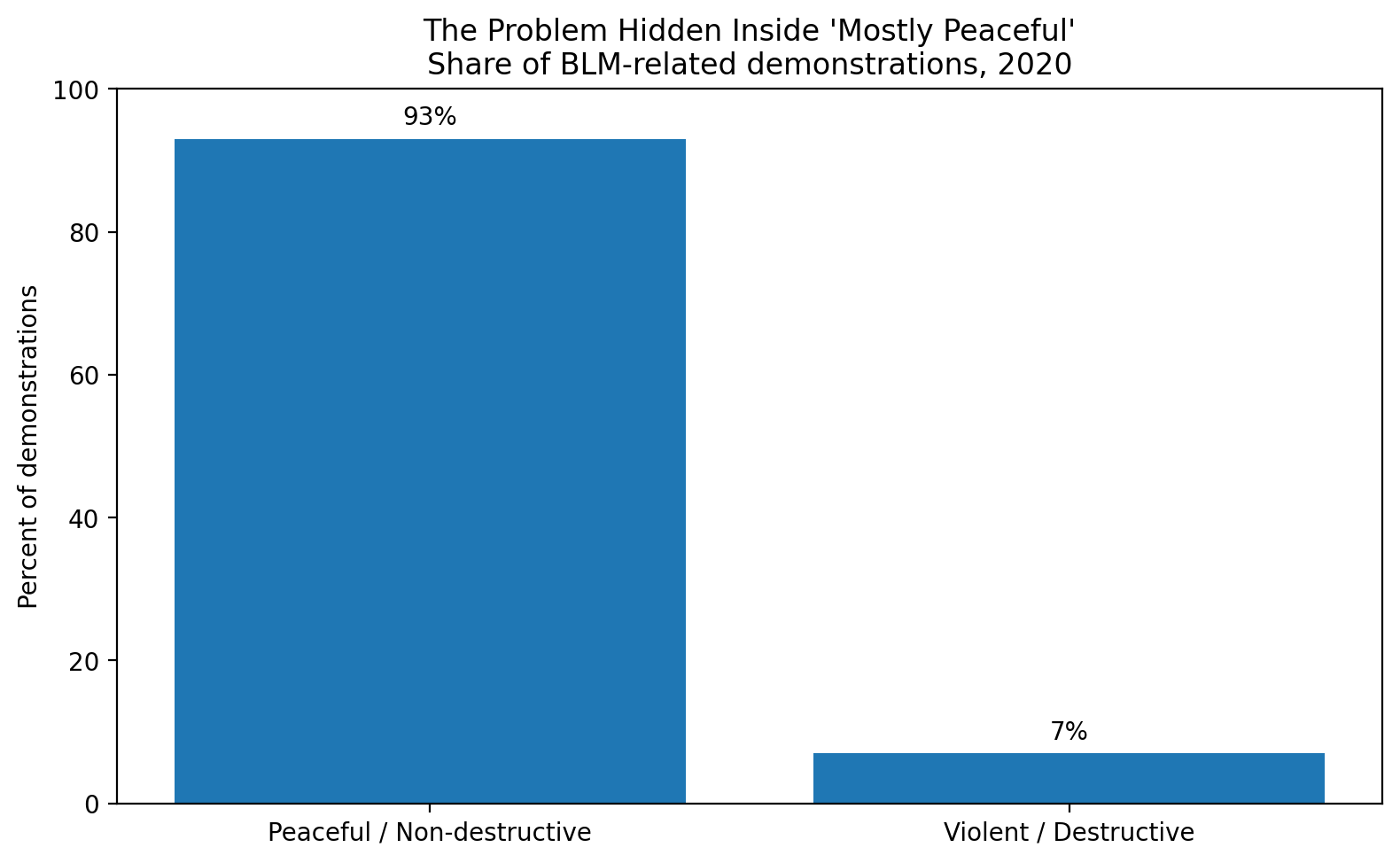
The “mostly peaceful” phrase was not merely a description. It became a method of shifting attention away from the costs imposed on innocent people. Americans were told to focus on the peaceful march somewhere else instead of the burning building in front of them, the smashed store window, the beaten driver, the torched police precinct, the terrified business owner, the looted pharmacy, and the immigrant shopkeeper cleaning glass off the floor.
Many protests were peaceful. That is true. But the violent minority shaped the public meaning of the movement.
The arson, vandalism, and looting after George Floyd’s death produced insurance losses estimated in the billions. That was not an abstraction. That was someone’s business, someone’s inventory, someone’s job, someone’s neighborhood grocery store, someone’s prescription counter, someone’s rent money. Many of the people harmed were not rich White conservatives hiding behind gates. They were small business owners, workers, immigrants, minorities, and residents of the very cities activists claimed to be defending.
The media said mostly peaceful while the public saw disorder. Trust is destroyed when institutions tell people not to believe their own eyes. Americans were not watching spreadsheets. They were watching cities burn, police stations overrun, and businesses looted while commentators explained how complicated everything was.
“Mostly peaceful” was not reporting. It was a demand that people treat selective statistics as a substitute for moral judgment.
The Culture They Refuse to Name
The deeper problem was not only the violence. It was the moral protection around the violence. BLM did not invent ghetto culture, but it provided political language that could disguise it. Looting became rage. Violence became uprising. Criminality became expression. Resisting arrest became trauma. Destroying businesses became the language of the unheard. The same behavior that would be condemned if it happened at a county fair became sociologically sophisticated when wrapped in racial grievance.
Liberal guilt did not eliminate the behavior. It eliminated much of the language by which the behavior could be criticized.
The Democrat Party has spent decades benefiting from this confusion. It depends on Black loyalty, but it rarely demands Black improvement. It speaks endlessly about systems, history, oppression, representation, trauma, equity, and root causes. Some of those subjects are real. History happened. Discrimination existed. Segregation was not imaginary.
But a past can explain without excusing. That distinction has been deliberately blurred.
If a teenager is running wild in a mall in 2026, Jim Crow did not make him do it. If a group of people jump someone outside a fast-food restaurant, redlining did not throw the punch. If someone screams at a cashier because she cannot control herself, slavery is not in charge of her mouth. History may shape conditions, but it does not remove agency. Civilization depends on that line.
A society that forgets the difference between explanation and excuse will eventually be governed by those most willing to exploit the confusion. Low-restraint culture has learned that public aggression works. Loudness works. Intimidation works. Accusations work. Group pressure works. Racial guilt works. The more responsible people retreat, the more the disorderly learn that the world can be made to accommodate them.
This is not unique to Black people. Every group has its own trash culture. White trash culture exists. Hispanic gang culture exists. Immigrant clan culture exists. Drug culture exists. Trailer-park dysfunction exists. Academic leftist dysfunction exists. Human beings are perfectly capable of destroying themselves in many accents.
The difference is that, in modern America, ghetto Black culture receives a level of elite protection that most dysfunctional subcultures do not get. It is amplified through music, excused through politics, softened through journalism, marketed through fashion, defended through academia, and translated into moral grievance by activists. The thug becomes authentic. The scholar becomes corny. The absent father becomes normal. The criminal becomes misunderstood. The police become the enemy. The teacher becomes oppressive. The victim becomes whoever has the right skin color, not whoever was actually harmed.
A culture cannot glorify the thug, mock the scholar, excuse the criminal, and then act surprised when ordinary people change their expectations.
McWhorter’s warning about anti-intellectualism fits here because the issue was never simply whether children were smart. It was whether the culture around them respected the habits that make intelligence useful. No group can thrive if its children are taught that discipline is betrayal, or if speech, study, punctuality, marriage, fatherhood, restraint, and ambition are treated as suspicious because they resemble someone else’s standards.
Rights can be won in law while the habits needed to benefit from those rights are lost in culture. The loss is not proof that Black people are incapable. It is proof that opportunity can be squandered when freedom is used to normalize the habits that destroy freedom.
Look at the numbers with clear eyes. Black Americans are about 13 to 14 percent of the U.S. population. Black household median income is far above the cartoon version of Black America presented by people who imagine the whole group as one giant underclass. There is a Black middle class. There are Black professionals, homeowners, business owners, veterans, engineers, nurses, teachers, pastors, real estate agents, truck drivers, and millions of people doing exactly what respectable people in every group do.
But public perception is not shaped by the quiet majority. It is shaped by the visible minority. The Black accountant does not go viral for paying his mortgage. The Black nurse does not trend for getting to work on time. The married Black couple raising disciplined children does not shut down a mall. The Black church elder does not make the news for telling teenagers to stop acting like fools. Ordinary decency is not theatrical. Disorder is.
The Bill Decent Black People Pay
Crime numbers matter because they show that the damage is not merely reputational. Black Americans are dramatically overrepresented among homicide victims. That fact should not be used only to talk about offenders. It should also force a discussion about victims. The communities most damaged by street disorder are often Black communities. The grandmother afraid to sit on her porch is Black. The child who cannot concentrate in a chaotic classroom is Black. The store owner dealing with theft and threats may be Black. The mother raising a son around street influence is Black. The worker who has to explain, avoid, apologize, and distance himself from the worst behavior is Black.
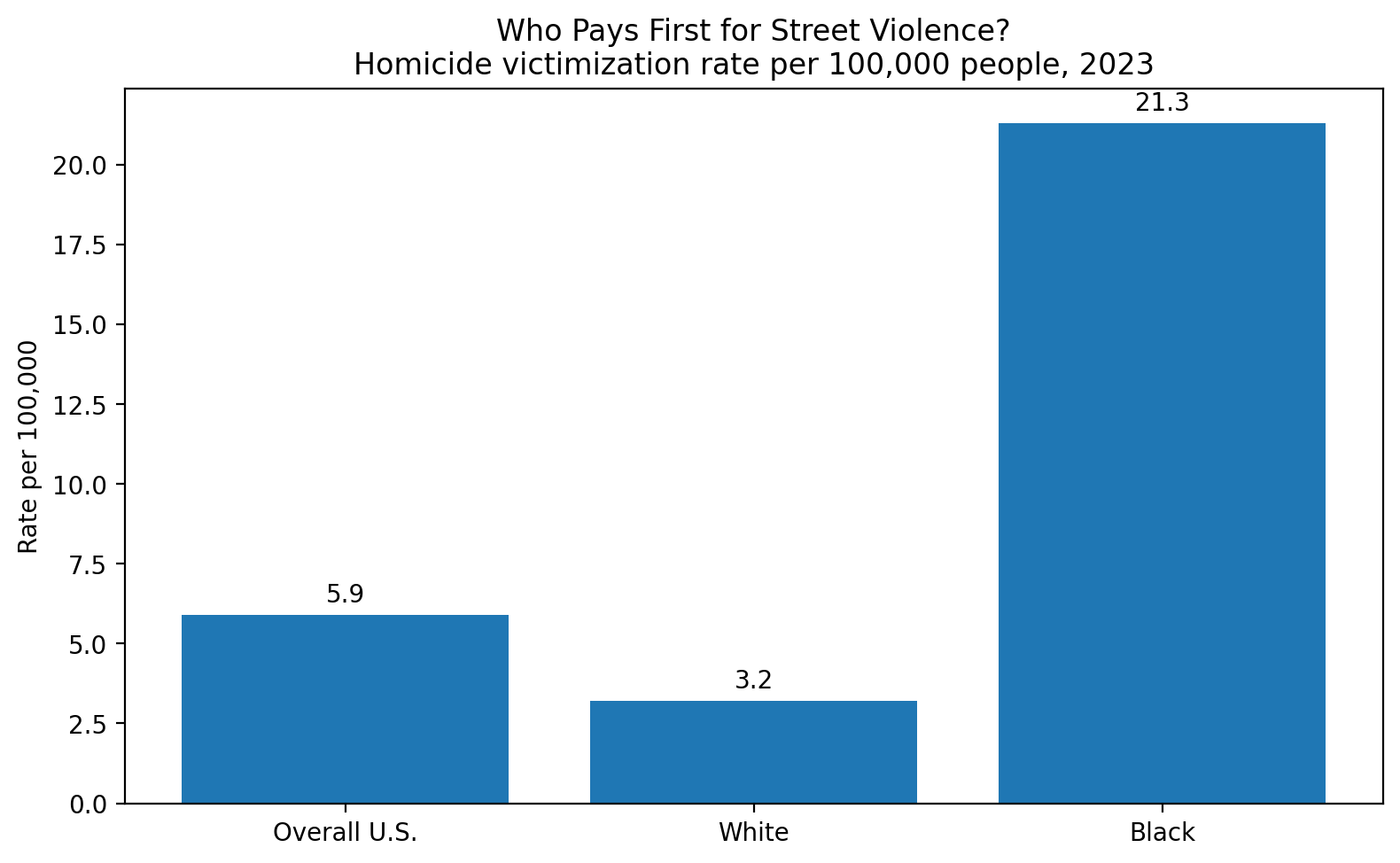
No one is more harmed by ghetto culture than the Black people forced to live near it, work around it, explain it, and be mistaken for it.
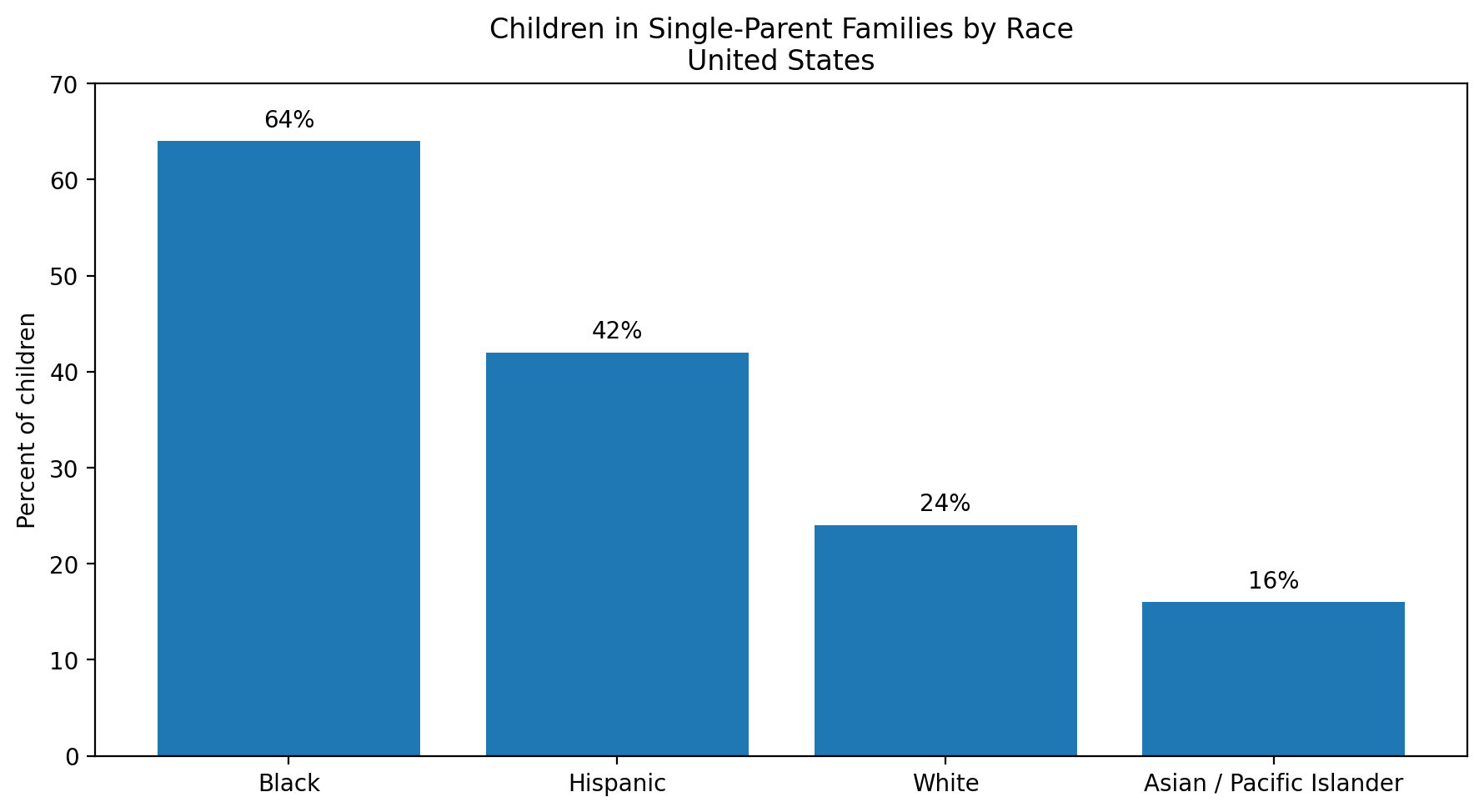
Family structure belongs in this discussion too, not because every child from a single-parent home is doomed, and not because every married home is healthy, but because household control matters. Black children are significantly more likely to live in single-parent homes than children in several other racial groups. That does not automatically mean “ghetto.” But father absence, economic strain, and weak household discipline create conditions where street culture can become a substitute authority.
Nature hates a vacuum. So does culture. When fathers are absent, the street offers models. When schools are chaotic, the peer group becomes the classroom. When the church weakens, the rapper becomes the preacher. When adults stop correcting children, social media corrects them into something worse. When consequences disappear, status moves to whoever is loudest, most aggressive, most feared, or most willing to humiliate someone in public.
Most racial impressions are not formed by policy papers. They are formed in daily life. A person is sitting in a restaurant and hears a disturbance. A parent takes his child to a movie and cannot enjoy it because another group refuses to be quiet. A cashier is screamed at for enforcing a basic rule. A crowd forms at a gas station, and everyone feels the mood change. Someone watches a viral video of a fight at Popeyes. Someone sees a mob swarming a convenience store. Someone sees a school hallway brawl that looks less like childhood misbehavior and more like a prison yard.
These moments teach people. Sometimes they teach unfair lessons. Sometimes they teach accurate lessons. But they teach.
Elites pretend not to understand this because understanding it would require them to admit that racial suspicion is not created only by racist ideas. Sometimes it is created by repeated public behavior that teaches ordinary people to anticipate disorder. That does not make every suspicion fair. It does not make every Black person guilty. But it explains why private pattern recognition exists. Ghetto behavior creates racial suspicion where racial suspicion did not need to exist.
Respectable Black Americans understand that better than anyone. They know the look, the pause, the embarrassment, and the feeling that comes when a video goes viral and the thought is, “Please, not again.” Every public fight, teen takeover, transit assault, restaurant meltdown, or mob robbery adds one more charge to a bill they did not run up.
White liberals do not pay that bill. They can live far away from the consequences. They can write essays about empathy from safe neighborhoods. They can defend defunding police while hiring private security. They can call discipline racist while sending their own children to schools where discipline still exists. They can romanticize “the community” without living under the rules of the street.
Much of what passes for liberal compassion is really distance. The people who actually suffer are the people close enough to the disorder to hear it, smell it, and make decisions around it. The elderly Black woman who wants more police in her neighborhood does not need a lecture from a White graduate student about abolition. The Black father trying to keep his son away from street culture does not need a nonprofit activist telling him about root causes. The Black business owner who had his store damaged during a riot does not need a journalist explaining that the protest was mostly peaceful. He needs the window fixed.
The Democrat Party’s role is destructive because the party has positioned itself as the political owner of Black grievance. It gains votes from Black fear, moral leverage from Black victimhood, and rhetorical power from Black suffering. Solving the cultural problems would make the constituency healthier, but a healed constituency is less politically useful than a frightened one.
That is why the language rarely changes. Systemic racism. Trauma. Equity. Over-policing. Disinvestment. Marginalization. Those words may describe some realities in some contexts, but they also function as fog. They make direct questions sound crude. Where are the fathers? Why are schools chaotic? Why are violent repeat offenders still on the street? Why are children being raised to hate the police before they can read properly? Why is speaking standard English mocked? Why are criminals turned into martyrs? Why do politicians show up for funerals but not for discipline? Why does a whole media system become curious only when the victim and offender fit the preferred narrative?
Those questions threaten the arrangement, so slogans replace answers.
“Mostly peaceful” was one of those slogans. It softened reality, but it also revealed the larger problem. The media was not merely defending protest. It was defending a worldview in which Black anger, even when destructive, must be treated as morally profound. Anger is not wisdom. Rage is not policy. Grievance is not character. A mob does not become noble because it chants the right slogan.
Black Is Not the Same as Ghetto
The civil rights movement understood something that modern racial activism has forgotten. The best of that movement was not merely angry. It was disciplined. It understood optics, morality, restraint, church structure, formal dress, language, and sacrifice. It forced America to see dignity under pressure.
That is why it worked.
The lunch-counter protesters did not win sympathy by behaving like the people who opposed them accused them of being. They won sympathy because they were civilized while others were cruel. Their moral power came from contrast.
Modern grievance politics often inverts that standard. A store is looted, and activists explain it. A suspect resists arrest, and activists sanctify him. A city burns, and journalists contextualize it. A criminal dies during a police encounter, and politicians treat him like a civil-rights hero before the facts are known. A Black conservative speaks hard truths, and he is called a sellout. A Black scholar questions the narrative, and he is accused of serving White supremacy.
That is not progress. It is regression with better public relations.
The old civil-rights generation fought to prove Black Americans deserved equal treatment under the standards of civilization. The new grievance class fights to lower the standards and call the lowering justice. It won access but rejected discipline. It won representation but rejected responsibility. It won sympathy but converted too much of it into suspicion. It won political power but often used that power to protect the worst elements from consequences. It won a seat at the table and then let the loudest fool speak for the group.
This is self-sabotage, not liberation.
Predictably, some will say this blames Black people. It does not. It blames a culture that has been allowed to hide inside Black identity. Some will say it ignores racism. It does not. It says racism does not explain enough to justify the excuses built around it. Some will say most protests were peaceful. Yes, and the destructive minority still mattered. Some will say most Black people are good people. Correct. That is exactly why ghetto culture is such a betrayal.
The fact that most Black Americans are not rioters, criminals, or public nuisances does not weaken the argument. It strengthens it. The majority should not be forced to live under the reputation created by the worst segment. But that is exactly what happens when nobody is allowed to name the problem.
The problem is also harder to measure than income, crime, or education alone because ghetto culture is not always visible from fifty feet away. Some people are obviously shaped by the street the moment they enter a room. Others function normally until race, authority, correction, accountability, or group loyalty enters the situation. A person may dress normally, work a job, speak politely, and seem reasonable in casual settings, while still carrying pieces of the worldview underneath.
That worldview says a criminal is a victim if he is Black. Standards are racist when applied to Black behavior. A White victim is less sympathetic. Correction is oppression. Police are guilty before the facts are known. A Black offender is automatically misunderstood. The group must be defended, even when the group is wrong.
That is not always full street behavior. It is the residue of the street’s moral code. It is what happens when ghetto assumptions travel farther than ghetto conduct. A person can be polite at work and still defend chaos when the chaos is racialized. A person can have a degree and still interpret every setback through victimology. A person can condemn crime privately but defend the criminal publicly because group loyalty kicks in.
McWhorter’s framework remains useful because victimology, separatism, and anti-intellectualism are not always worn like a uniform. Sometimes they hide under respectable clothing. The deeper problem is not only the Black man who looks ghetto from across the room. It is the respectable-looking person who carries the ghetto’s moral assumptions under a clean shirt.
The goal here is not insult. It is separation. Black culture at its best is not ghetto culture. It is not public tantrums, mob violence, baby mama chaos, school contempt, street worship, racial paranoia, or hatred of standards. Black culture at its best includes faith, music, family, entrepreneurship, military service, neighborhood pride, learning, manners, discipline, and moral seriousness.
Ghetto culture feeds on that inheritance while claiming to be the inheritance.
That is why entertainment matters. The gangster became authentic. The disciplined student became corny. The absent father became normal. The baby mama became a trope. The criminal became a martyr. The police became the enemy. The teacher became irrelevant. The church lost ground to the street. The rapper replaced the elder.
Culture is not decoration. Culture teaches. It tells young people what is admirable, what is shameful, what is masculine, what is feminine, what is funny, what is weak, what deserves respect, and what deserves contempt. If a culture repeatedly rewards aggression, vulgarity, sexual chaos, criminal swagger, and contempt for authority, it should not be shocking when some young people absorb the lesson. The surprise would be if they did not.
This is not an argument for censorship. It is an argument for honesty. A society that markets poison should not pretend to be shocked when people get sick.
There is also a class issue here that people often avoid. Many Americans of all races are working class, poor, or struggling without being ghetto. Poverty does not automatically produce public disorder. Many poor people are proud, disciplined, polite, churchgoing, family-oriented, and deeply offended by the idea that poverty is an excuse for behaving like a fool.
That distinction matters because liberals often use poverty as a moral shield for behavior that many poor people themselves reject. Poor is not the same as ghetto. Working class is not the same as ghetto. Black is not the same as ghetto. The ghetto is not a bank balance. It is a code of conduct.
It is a way of carrying yourself in public. A way of handling correction. A way of treating authority. A way of defining respect. A way of excusing failure. A way of making other people responsible for your lack of self-control. It can exist in public housing, suburbs, college campuses, airport terminals, restaurants, and corporate offices. The clothes may change. The reflexes do not.
Ordinary Americans recognize it quickly, even when they do not use the same words or say it in public. They recognize the volume, the posture, the sudden escalation, the group performance, the refusal to be corrected, the instant accusation, and the demand that everyone else adjust. They recognize the moment when one person’s lack of self-control becomes everyone else’s problem.
The media can deny that pattern forever. It will not stop people from noticing. In fact, denial makes the private judgment harsher. When people are told that noticing a pattern is worse than the pattern itself, they stop talking honestly. They do not become less suspicious. They become more suspicious and less willing to say so.
A country cannot run on public lies and private truths forever. Eventually, private truths shape behavior. People avoid certain places. They pull their children out of public schools. They leave neighborhoods. They stop going downtown. They stop enforcing rules. They lock doors sooner. They hire security. They choose restaurants, theaters, stores, airlines, and vacation spots based not only on price or quality, but on who they expect to be there.
That is the market speaking quietly.
The same thing happens inside Black America. Responsible Black people learn to manage the reputational risk created by others. They alter their tone, clothing, speech, neighborhood choices, social settings, and public behavior because they know the stereotype is waiting. They know they are being measured against the last viral video. They know the ghetto segment has made everyone else’s life harder.
That is not White supremacy. It is group reputation. Every group has one. The question is who gets to define it.
For too long, the loudest, angriest, least disciplined segment has been allowed to define Black public identity while responsible Black Americans are expected to remain loyal to the fiction. They are told that criticizing the behavior gives ammunition to racists. But silence also gives ammunition to racists because it lets the worst behavior continue uncontested.
There is nothing pro-Black about defending what destroys Black people. Rejecting ghetto culture is not anti-Black. It may be one of the most pro-Black things a person can do.
That means saying obvious things without apology. Speaking properly is not acting White. Studying is not acting White. Being on time is not acting White. Getting married is not acting White. Raising your children is not acting White. Respecting public spaces is not acting White. Obeying the law is not acting White. Telling the truth about Black criminals is not betrayal.
No group can build civilization by treating civilization as someone else’s property.
What Was Lost
The cure is not for Black America to become less Black. The cure is for Black America to become less ghetto. There is nothing White about civilization. Every successful group discovers the same basic rules sooner or later. Children need fathers. Schools need order. Businesses need safety. Public spaces need manners. Communities need consequences. Young men need discipline. Women need protection from chaos, not lectures about root causes. Standards are not oppression. They are the price of survival.
A people who forget that will lose ground no matter how many rights they possess on paper. That is what McWhorter meant by self-sabotage. The wound was not only external. It had become internal. A culture can win legal equality and still teach its children habits that destroy equality in practice.
The civil-rights generation handed down legal victories bought with courage, patience, organization, faith, and moral discipline. Too much of modern racial politics replaced that inheritance with resentment, excuse-making, anti-police rhetoric, anti-school attitudes, street worship, and theatrical anger. Then the media came along and called the result mostly peaceful.
But America saw what it saw. It saw the riots, looting, arson, mall fights, restaurant fights, school fights, airport fights, viral beatdowns, flash mobs, teen takeovers, and public tantrums. It saw the difference between Black people trying to live right and the ghetto culture dragging their name through the street.
The public may not be allowed to say all of that out loud, but silence is not disbelief.
When public language becomes dishonest, private judgment becomes harsher. People stop debating and adjust their behavior. They avoid certain places. They leave public schools. They stop trusting institutions. They stop believing the official story. Once that happens, the damage is already done.
“Mostly peaceful” was never the real issue. The real issue was whether America would keep pretending that ghetto rage was justice, that public disorder was progress, and that noticing the pattern was worse than the pattern itself.
Black America won rights that previous generations bled to secure. The question now is what those rights are for. Are they for building families, businesses, schools, churches, neighborhoods, and futures? Or are they for excusing a culture that turns freedom into disorder and then demands applause for the wreckage?
That is not a question White liberals can answer. They have done enough damage already. It is a question for Black America, especially responsible Black America.
The ghetto does not speak for all Black people. It has simply been allowed to speak too loudly, for too long, with too much protection. Until that changes, suspicion will remain. Videos will keep confirming what official language denies. Ordinary Black Americans will keep cringing at behavior they did not commit. The media will keep sanitizing. The Democrat Party will keep benefiting from the grievance. And the culture that claims to be defending Blackness will keep damaging Black people.
John McWhorter called it Losing the Race because self-sabotage is still sabotage, even when it comes wrapped in pride, grievance, and political protection. The title was uncomfortable because the truth was uncomfortable.
Black America won the rights, but what was lost was not legal equality. What was lost was the habits and standards without which legal equality produces far less than its advocates promised.
Help Keep the Truth Sayable
The easiest thing in America is to pretend.
Pretend people do not notice patterns. Pretend public disorder is compassion. Pretend “mostly peaceful” was an honest description. Pretend the people harmed most by ghetto culture are not often the very Black Americans liberals claim to defend.
This publication exists because pretending has become its own kind of corruption.
I do not write these essays because they are safe. I write them because somebody has to say plainly what millions of people already know privately. That takes time, research, and independence. It also takes readers willing to help keep the work alive.
Become a Paid Subscriber
Paid readers are what make this possible. They keep the essays free for everyone else and help me continue writing without corporate sponsors, party money, or institutional permission.
Subscribe here:
https://mrchr.is/help
Make a One-Time Gift
If a subscription does not fit right now, a one-time gift still helps. It keeps the lights on, buys time, and helps push this work farther than the people protecting these narratives would prefer.
Give here:
https://mrchr.is/give
Join The Resistance Core
The Resistance Core is for readers who want to put real weight behind this work. Not just read it. Not just nod along. Help build the platform that keeps these arguments in circulation.
Join here:
https://mrchr.is/resist
If You Cannot Give
Share it. Restack it. Send it to the person who says these things in private but never sees them written in public.
The people who benefit from lies do not need everyone to believe them. They only need enough people to stay quiet.
I can't speak to all of the reasons for what is going wrong, but I can speak to what went wrong in the public schools. One word covers a multitude of sins, Disproportionality. The concept that because black represent a relatively small minority of students that they should only represent as small proportion of those students disciplined for disruptive behavior, and also be less notably listed in the bottom of every class academically.
I worked in a building pretty typical of Seattle Public Schools in which a very large number of disruptive to criminal behaviors were ignored or left undisciplined. This was because the principal had to report every disciplinary action listing the race of the student so treated. When blacks were responsible for more than 75% of those actions but less than 50% of the population that was considered disproportional and, therefore, RACIST. Simple solution, don't discipline chronically disruptive students. When more blacks were failing or disproportionately at the bottom of their classes two possible causes were projected, the teacher was incompetent or the teacher was a racist. The solution: grade inflation and simultaneous degradation of the curriculum. This, of course, doesn't just effect black students. It effects everyone, and, so, we now have students graduating from high school who cannot read, write, or do simple arithmetic. Minority students admitted into colleges who are required to take remedial classes in what should be basic skills, and consequent grade inflation in colleges, lest they be accused of failing to properly educate minorites, and thus be accused of, say it altogether: DISPROPORTIONALITY.
Start here: "For too long, the loudest, angriest, least disciplined segment has been allowed to define Black public identity while responsible Black Americans are expected to remain loyal to the fiction" is anyone within this community listening to Denzel Washington? Why are they not interested in his story, his wisdom?