


“Their politics is news. Yours is discrimination.”
At 2:15 Saturday afternoon, August 15, I decided to stop wondering whether Nextdoor was politically biased and run a little experiment. Nothing elaborate. No fake account, no undercover operation, and no attempt to bait the moderators into doing something stupid. I simply posted one of my existing essays.
The article was One Little, Two Little, Three Million Indians, a heavily researched piece about Indian immigration, H-1B visas, foreign students, assimilation, ethnic clustering, and the extraordinary growth of the Indian population in the United States. It is also partly about where I live.
I am in the Cedar Park and Leander area north of Austin, where Indian immigration is hardly theoretical. You can see the demographic change in neighborhoods, schools, stores, restaurants, professional networks, housing patterns, and even the growing popularity of cricket. The essay contains an entire section titled “From the Bay Area to Central Texas,” comparing patterns I watched while growing up in California with what I now see around me in Texas.
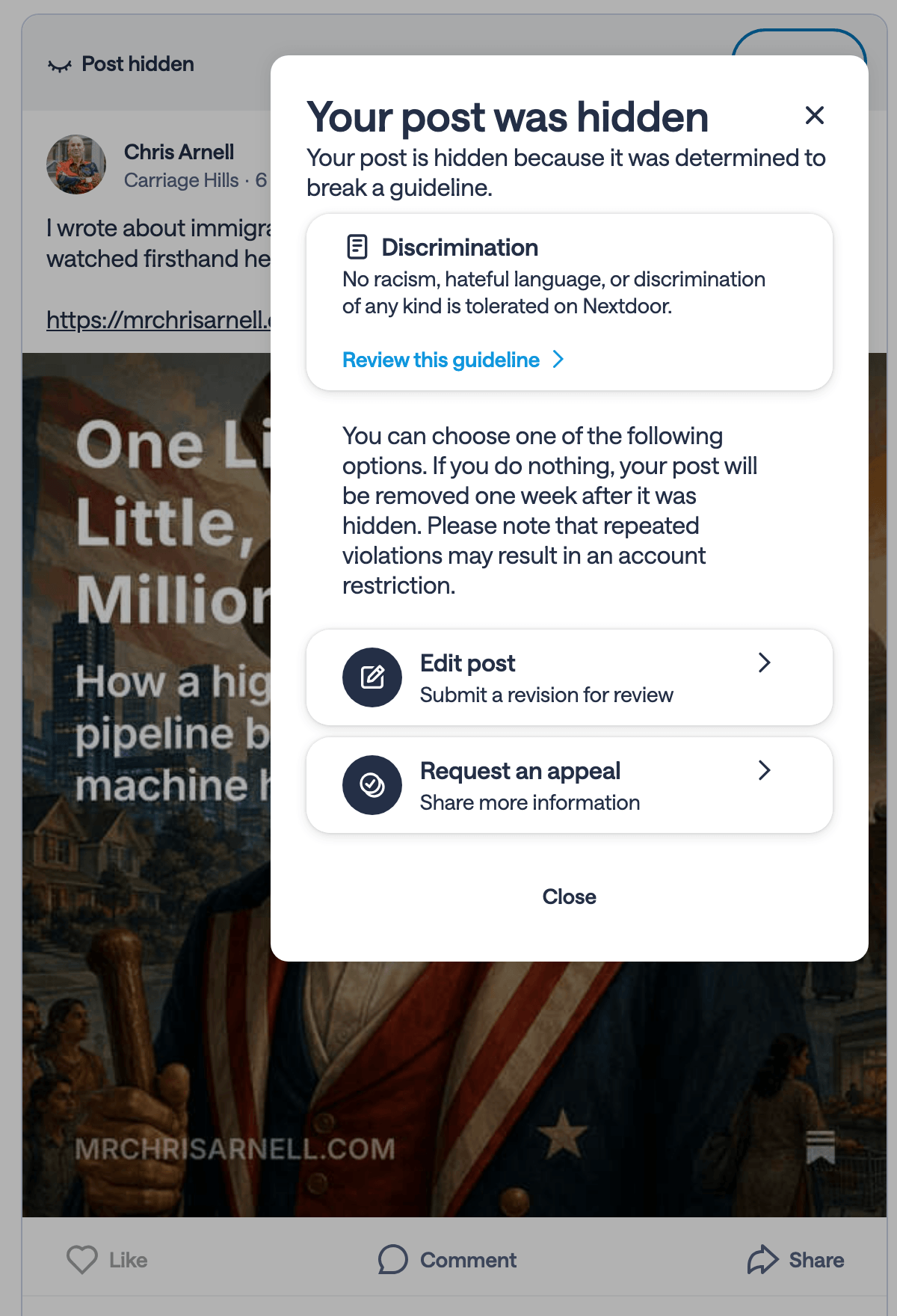
So when I shared it on Nextdoor, I kept the introduction deliberately dull: “I wrote about immigration and some of the demographic changes I’ve watched firsthand here in Cedar Park and Leander.”
That was all I wrote. I did not mention Republicans or the Democrat Party. I did not accuse Nextdoor of censoring conservatives. I did not insult Indians. I did not even make a political argument in the Nextdoor post itself. I linked to an existing article and explained why I thought it was relevant to the area.
Within roughly two hours, Nextdoor hid it. Curiously, the reason was not “national politics,” which would at least have fit the subject matter. Nextdoor classified the post as Discrimination.
For anyone who has never used Nextdoor, imagine Facebook after it joined an HOA. The app connects people according to where they actually live, and much of the feed is exactly what you would expect from a neighborhood bulletin board: lost dogs, suspicious cars, garage sales, recommendations for roofers, complaints about teenagers, questions about garbage collection, and the occasional person wondering why six police cars just flew down the street.
At its best, Nextdoor is genuinely useful. It is also enormous. As of August 2026, Nextdoor says it has 110 million verified neighbors across 350,000 neighborhoods, reaches one in three U.S. households, and includes more than 4,000 local news publications.
Nextdoor has also been changing what those neighbors actually see. The company describes a product transformation that expanded the app beyond neighbor-generated posts into a broader feed containing news, alerts, and other locally relevant information. In its 2025 Transparency Report, released in March 2026, Nextdoor said publisher articles represented about 7 percent of items in neighbors’ feeds. That works out to roughly one out of every fourteen items.
The publisher operation is substantial. Nextdoor says 96 percent of U.S. cities on the platform have news coverage and more than 100,000 publisher articles are delivered every week. Publishers can give Nextdoor RSS feeds, which the company turns into posts containing headlines, excerpts, thumbnails, and links to the original stories. They can also create posts and polls and participate in comments and discussions.
Giving local newspapers another way to reach readers is not the problem. Local journalism has been getting crushed for years, and another source of readers might actually be a good thing. The problem is that publishers and ordinary users do not appear to play by quite the same rules.
Politics Is Fine With the Right Badge
Nextdoor restricts political discussion, and the basic idea is not unreasonable. Local political issues belong in the neighborhood. National political warfare generally does not. Its own guidance specifically lists immigration when discussed as national policy among the subjects that belong in Groups rather than the regular neighborhood conversation.
I understand why. Most people do not join Nextdoor because they have been sitting around thinking, You know what my life needs? More arguments about Congress.
Yet politics keeps arriving anyway, often with a little label saying Local publisher.
One example that appeared in my feed came from the Austin American-Statesman. The story concerned ICE activity in Austin and Congressman Greg Casar demanding answers about federal immigration enforcement.
Casar represents the area, so the story is legitimate local news. But nobody could seriously pretend the underlying subject is apolitical. Immigration enforcement is one of the biggest national political fights in America. ICE is a federal agency. Casar is a Democrat congressman and currently chairs the Congressional Progressive Caucus.
Add the word Austin, however, and the subject becomes local news.
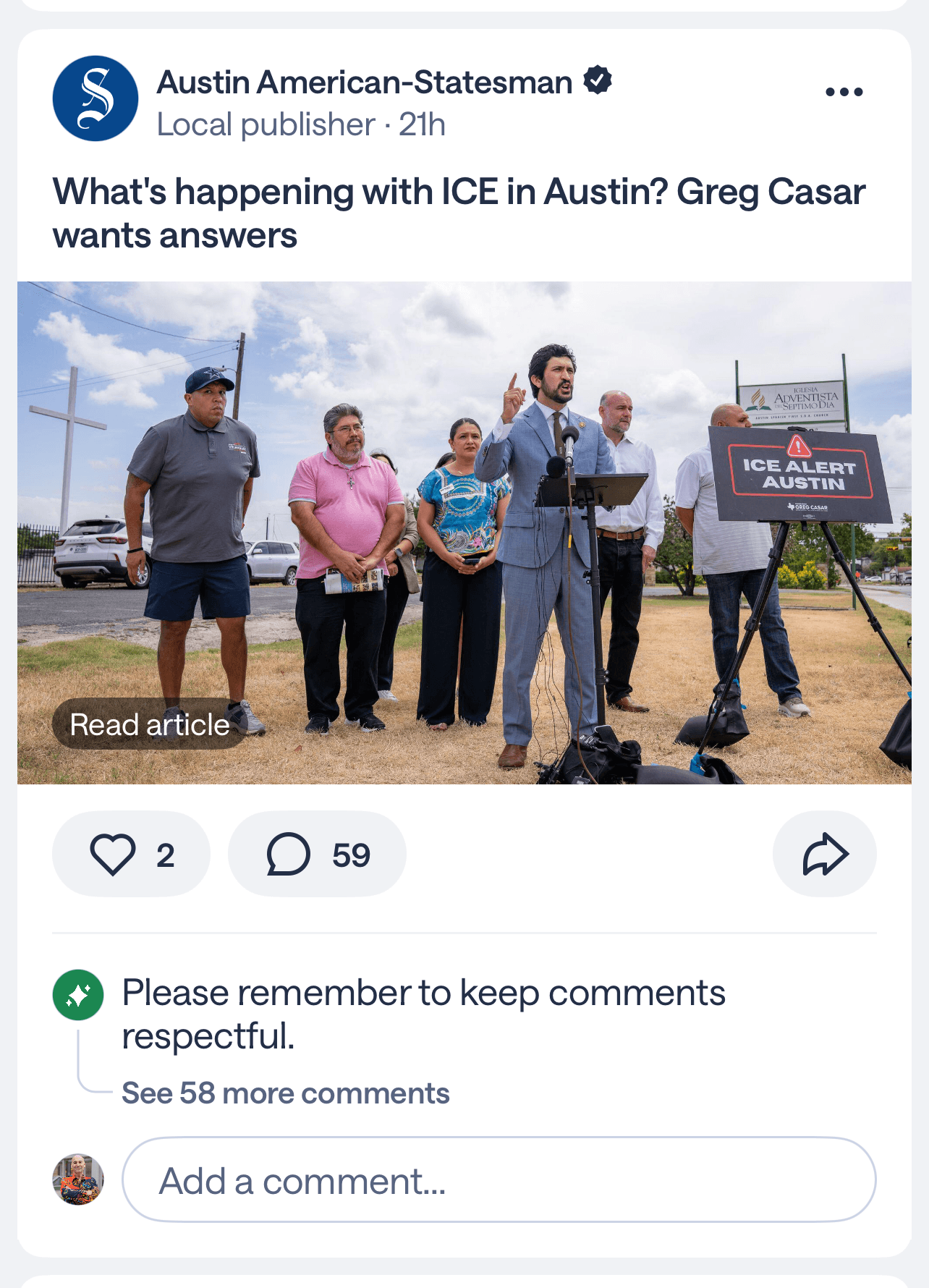
Nextdoor’s own Publisher Policy complicates that distinction because it says news publishers are prohibited from sharing national or non-local news. The practical result is strange. Immigration as national policy is too national for an ordinary neighborhood discussion, and national news is supposedly too national for publishers. Yet a national immigration fight becomes legitimate local content as soon as something happens in Austin.
Fair enough, if the same principle applied to everyone.
My article dealt with national immigration policy too, but it also discussed what I was seeing in Cedar Park and Leander. The Statesman used Austin as the local connection. Mine used Cedar Park and Leander.
The professional publisher entered through the front door. Mine disappeared within hours.
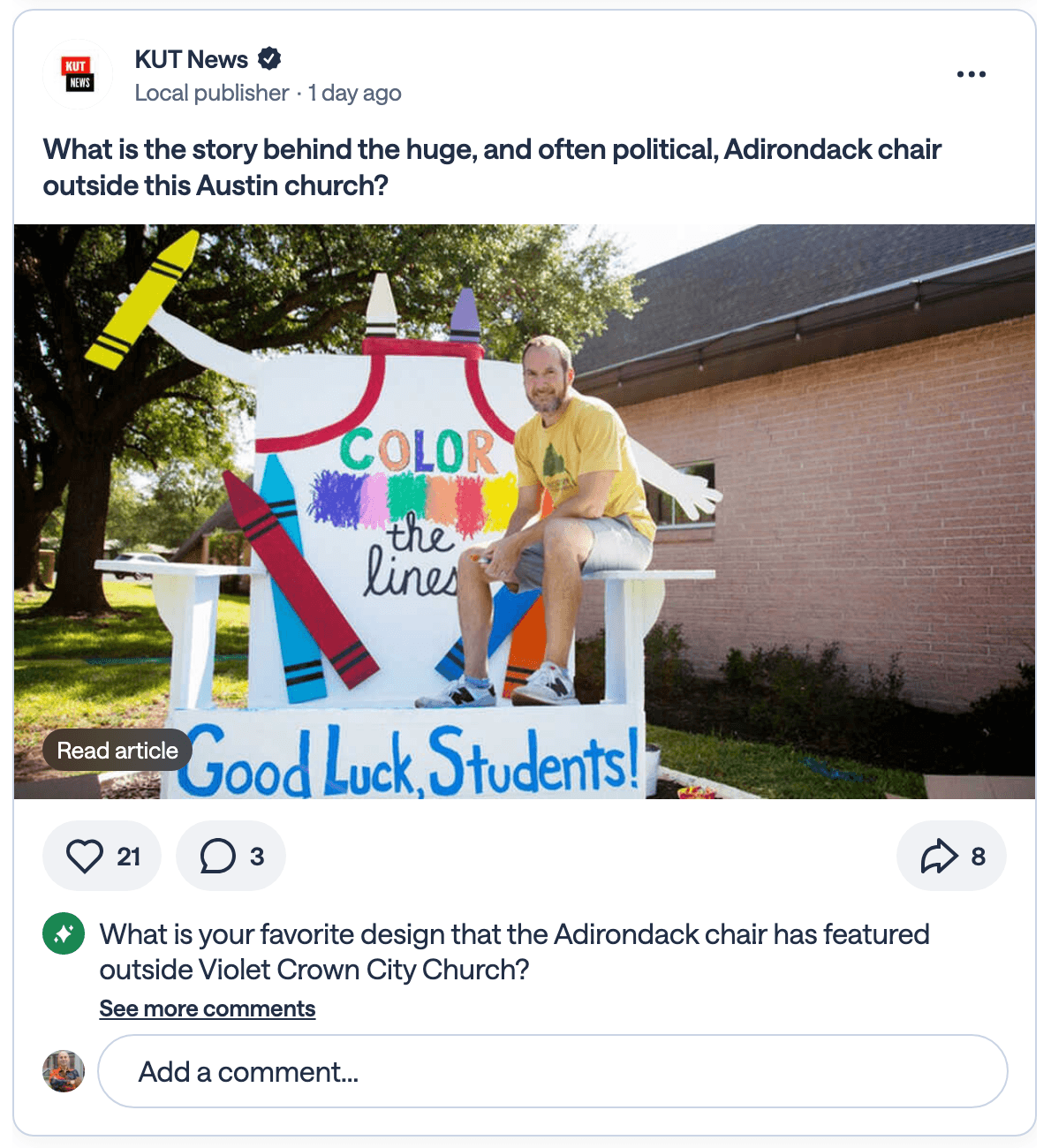
ICE was hardly an isolated example. A KUT story that appeared on Nextdoor concerned a giant Adirondack chair outside Violet Crown City Church in Austin. At first glance, it is exactly the kind of quirky local feature I like. Someone wondered about the enormous chair, a reporter went to investigate, and there was a fun history behind it.
Then the politics began. KUT’s own headline called the chair “often political,” and that description was accurate. Over the years, the pastor has painted it with messages promoting Pride Month, Black Lives Matter, gun reform, marriage equality, banned books, opposition to ICE, and criticism of the current administration. One design read, “We want snow, not ICE.”
The pastor explained that some of the messages respond to things the president says and told KUT that his church believed ICE tactics had become dangerous enough that it needed to respond. KUT also reported that critics had complained to the church and, on a few occasions, vandalized the chair.
KUT has every right to publish that article, just as the pastor has every right to paint whatever he wants on his enormous chair. If he wants to cover the thing in rainbows, denounce ICE across the back, and staple a picture of Bernie Sanders to the armrest, knock yourself out.
Nextdoor then takes an article whose own headline describes the subject as political and delivers it directly into the neighborhood feed. It is not sent off to some special politics group or treated as an intrusion into peaceful neighborhood discussion. It arrives as news, complete with the institutional blessing of the Local publisher label.
So politics alone clearly isn’t the problem. Who is speaking seems to change the outcome.
A Little News, a Little Politics
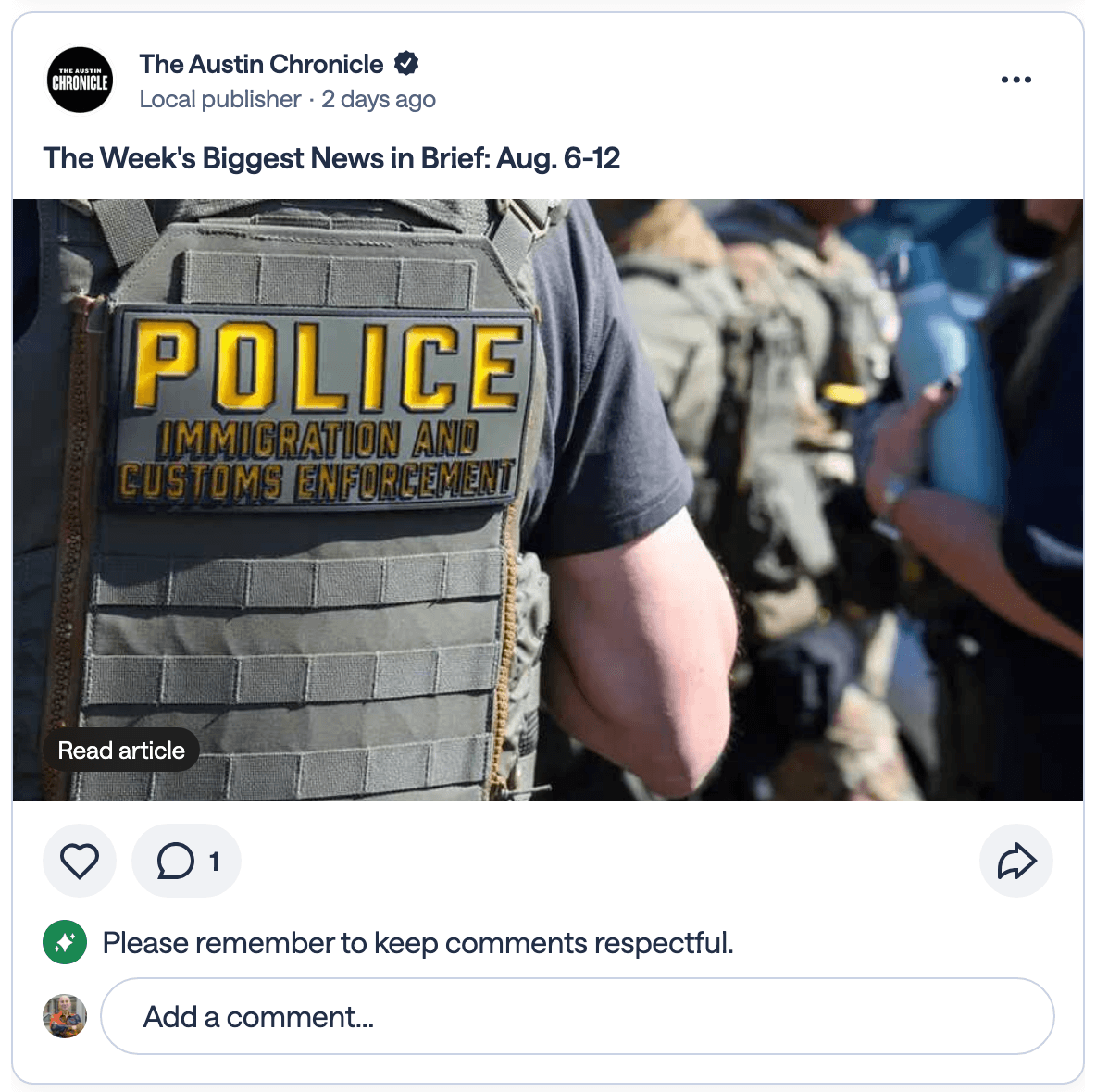
The Austin Chronicle gave me an even cleaner example.
One of its recent weekly news roundups contained plenty of ordinary local reporting. Burn bans, school transportation, swimming pools, fires, CapMetro service, vaccinations, Austin Energy. Exactly the sort of material a local news roundup should contain.
Mixed among those stories, however, the political framing became much more obvious.
The Chronicle reported that ICE had detained four construction workers after Texas DPS stopped a vehicle traveling the wrong way on a one-way street. DPS determined that everyone in the vehicle was in the country illegally and held them until ICE arrived. The Chronicle then highlighted Austin officials condemning ICE and DPS, including calls to “abolish and prosecute ICE.”
Another item concerned proposals to reduce polling locations. Rather than simply reporting that opponents believed the changes would make voting more difficult, the Chronicle stated in its own narration that the proposal would make it harder for residents to exercise their right to vote, then followed that statement with objections from voting-rights advocates.
A few paragraphs later came a story about the new Travis County Democrat Party chairman and the party’s hope that he could help produce a “blue November.” The roundup also directed readers to another Chronicle article carrying the wonderfully restrained title, “The Right-Wingification of the University of Texas Continues.”
Then, after everything from wildfires to school lunches, the Chronicle ended with its Quote of the Week. The chosen quote came from the Caldwell County Democrat Party chair: “Let’s call this what it is: voter suppression, plain and simple.”
Most of the roundup is ordinary local reporting. You get a burn ban, a bus route, a pool closing, ICE abolition, a fire, school lunches, voter suppression, another transit update, a “blue November,” and then back to ordinary neighborhood concerns.
Nobody has to plaster VOTE DEMOCRAT across the screen. A feed can be overwhelmingly neutral and still tilt politically if most of the political material that does appear points in one direction.
Neutral plus Left is not neutral when Right is missing.
By missing, I mean missing from what I have actually seen, not absent from every Nextdoor feed in America. I have not audited every feed in the country, and I am not saying that no conservative publication has ever been approved by Nextdoor. The network is too large for that. Nextdoor says it works with more than 4,000 publications across the United States, United Kingdom, and Canada.
I am describing what I keep seeing in my own Central Texas feed. The political publisher content I encounter is routinely neutral or left-of-center. What I do not see is anything resembling a matching stream from the other direction.
I have not been seeing sympathetic stories about why local residents support ICE enforcement. I have not been seeing friendly features about churches fighting progressive gender ideology, or stories presenting gun-rights activists the way the KUT chair article presented gun reform, Pride, and anti-ICE activism. I have not seen a giant church display painted with TRUMP WAS RIGHT followed by a warm local feature about all the important conversations it inspires.
Perhaps those stories are there and I simply have not encountered them. If so, a larger sample should show it.
The Neighborhood Was Handling It Just Fine
Before Nextdoor intervened, people were already reacting. There were six reactions, four of them hearts. One commenter called the article racist. Another essentially called it smart. Someone else called it bigotry.
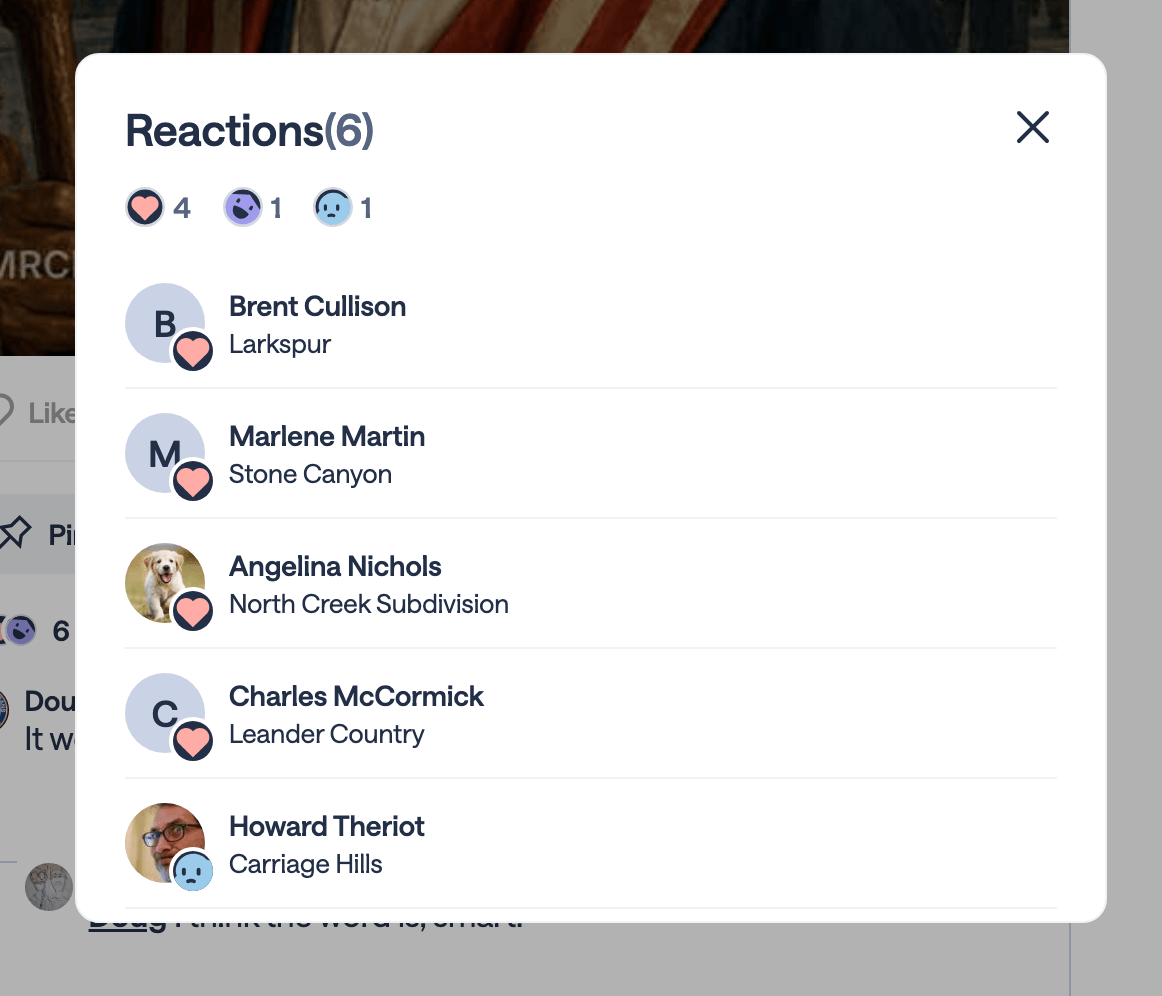
The neighborhood, in other words, was doing something human beings used to call disagreeing. The positive reactions did not prove the essay was right, just as the accusations of racism did not prove it was wrong. People were reading an argument and reaching different conclusions. For several thousand years, adults somehow survived this experience without a smartphone application stepping between them.
Nextdoor’s first notification said the post had been hidden because it “may have broken” the discrimination guideline. That wording caught my attention because it left open the possibility that the initial decision was wrong, so I appealed.
I kept the appeal almost as boring as the original post. I did not complain about liberals or accuse Nextdoor of censorship. I simply wrote: “My article discusses immigration policy and local demographic change. It contains no slurs, threats, or calls for discrimination. Please identify the specific statement that violates Nextdoor’s discrimination guideline.”
The following day, August 16, Nextdoor returned its decision. The post was removed, and the reason remained Discrimination.
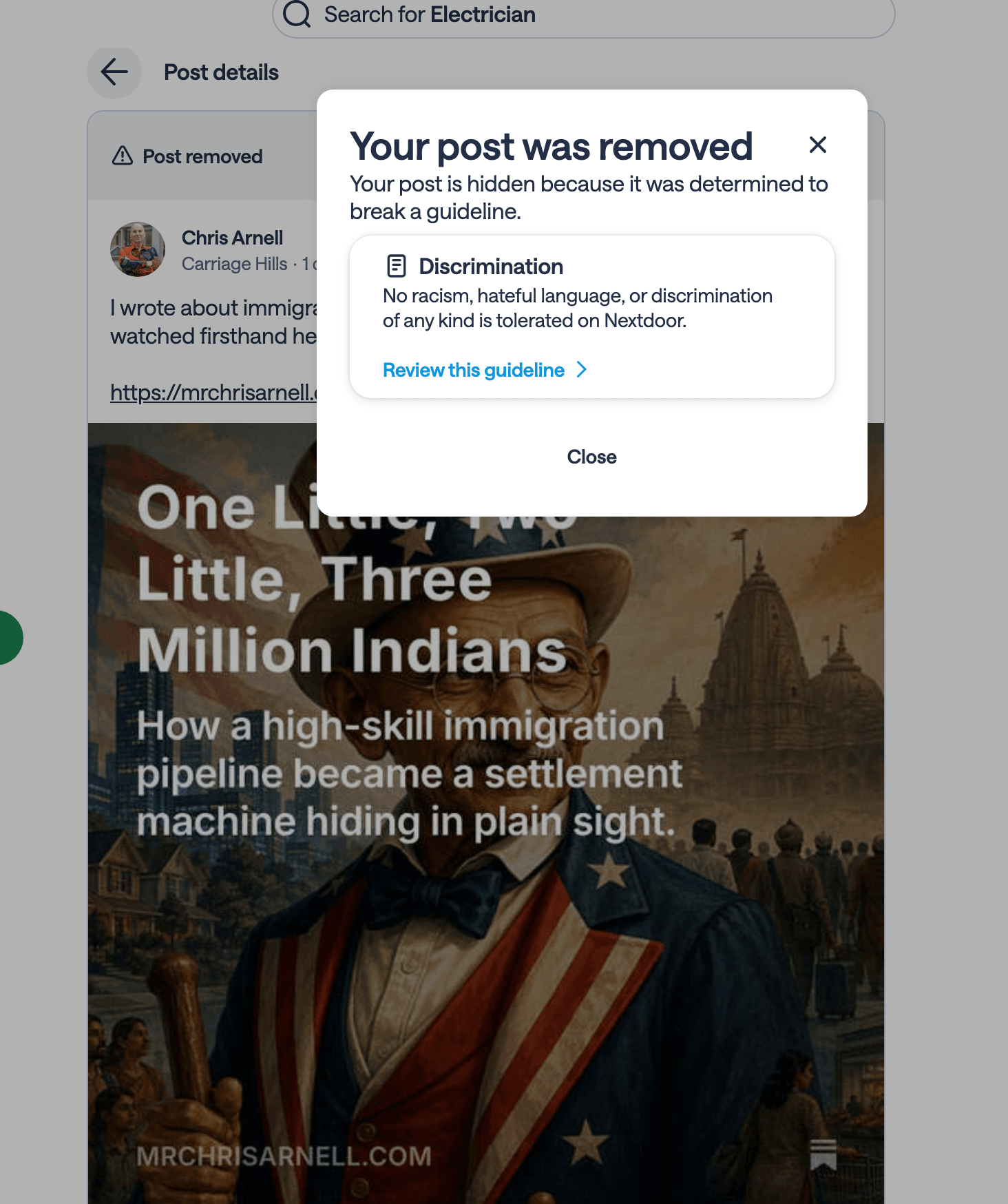
Nextdoor’s discrimination policy is broad. It bans not only slurs and threats, but also negative stereotypes, caricatures, and generalizations about protected or marginalized groups, including ethnicity, immigration status, and national origin.
My article discusses Indians collectively, including assimilation, ethnic clustering, marriage patterns, immigration, and private social circles. That gives Nextdoor a policy hook for its decision. It does not make the decision correct.
What it did not do was tell me which passages crossed that line. I specifically asked for the offending statement and never received one.
The policy says something else too. Nextdoor explicitly welcomes discussions supporting movements such as Black Lives Matter and Stop Asian Hate, along with conversations and celebrations involving LGBTQIA+ issues. More revealing, it says disagreement over policy or tactics is acceptable, but posts or comments intended to undermine what it calls the core messages of equality are not.
That is not a neutral rule. Once Nextdoor gets to define the “core message of equality,” it also gets to decide which disagreements merely challenge policy and which ones supposedly challenge equality itself. On race, immigration, gender, sexuality, and other political fault lines, that distinction gives the company enormous room to enforce a left-wing view of what equality means while classifying competing arguments as discrimination.
Whether every moderator consciously thinks of it that way is almost beside the point. The discretion is built into the rule. Nextdoor has chosen which ideas receive an explicit presumption of legitimacy and given itself the authority to shut down arguments it believes undermine them.
It is their app. They can write the rules that way. But nobody should confuse those rules with political neutrality.
This was not my first encounter with Nextdoor moderation. I have shared roughly a dozen essays from my Substack on the platform, and every one has eventually been removed. That history is why I wanted this particular test to be so uneventful. I did not want to hand Nextdoor an easy explanation based on some inflammatory sentence added above the link. I wanted to know what would happen if I simply shared an existing article and explained its local connection. Now I had an answer.
Suppose Nextdoor Was Right
The obvious response is that Nextdoor may have been right to remove my article. Fine. Suppose it was.
Suppose a moderator read the entire essay, compared it with Nextdoor’s rules against negative group generalizations, and concluded that I crossed the line. I may disagree with that judgment, but it is not an absurd reading of the policy.
That still leaves the larger question: Why are approved media organizations allowed to distribute explicitly political advocacy into a neighborhood feed where ordinary users face much tighter restrictions on political speech?
You can despise my essay and still ask that question. In fact, the argument is stronger if it does not depend on anyone liking my writing.
Nextdoor has effectively created two classes of political speaker. A publisher begins with institutional status and access to a system designed specifically to distribute its material. Nextdoor advertises publisher accounts as a way to reach what it calls a 100 percent verified audience in relevant areas. Publishers can provide RSS feeds, track impressions and clicks, create posts and polls, and engage in comments. The ordinary neighbor gets a text box and the moderation system.
Publishers are still bound by Nextdoor’s rules, but they start from a very different position. Distribution is already built into the product. The ordinary user begins as an individual whose material can be reported, hidden, appealed, and removed.
The discrimination policy adds another layer. Black Lives Matter discussions are expressly welcomed. LGBTQIA+ celebrations are expressly welcomed. Posts judged to undermine Nextdoor’s chosen “core messages of equality” can be prohibited.
Combine that with a publisher system that, in my Central Texas feed, repeatedly supplies political stories from the left, and nobody at Nextdoor headquarters needs to write a single partisan sentence.
By the time the feed reaches me, much of the political sorting has already happened.
How National Politics Becomes Local News
Almost any national political issue can be localized.
Immigration becomes immigration in Austin. ICE becomes ICE in Austin. Trump becomes how Austin is responding to Trump. Gun control becomes an Austin church demanding gun reform. Pride becomes an Austin church celebrating Pride. Federal education policy becomes what Washington’s decisions mean for Austin schools.
The national argument has not suddenly stopped being political. Someone added a ZIP code.
Local newspapers should explain how national policy affects their communities. The trouble comes when attaching a place name changes who gets to discuss the underlying issue.
Nextdoor tells ordinary users that national political subjects, including immigration as national policy, belong in Groups. It separately tells publishers not to share national or non-local news. Yet publishers obviously can report on national political controversies when those controversies have a sufficiently local connection.
Journalistically, that makes sense. It also leaves a very convenient doorway.
An approved publisher can take a national immigration fight, connect it to Austin, and put it in my neighborhood feed. I can take the same national argument, connect it to Cedar Park and Leander, and discover that my article violates a different set of rules.
Politics is already in the neighborhood. The question is what happens to it depending on who is speaking and which side of Nextdoor’s cultural boundaries the argument lands on.
The newspaper gets to be political because Nextdoor calls it news. The neighbor gets moderated because Nextdoor calls his contribution something else.
Propaganda does not require fabrication. Facts can be accurate while the way they are selected and presented still pushes an ideological message.
Selection shapes the story. So does who gets quoted, which side gets sympathetic treatment, how often a message is repeated, and where it appears. Sometimes what never makes it into the feed tells you as much as what does.
Consider the giant chair again. Every political design KUT described could exist exactly as reported. The pastor could sincerely believe everything he said. The reporter did not need to manufacture a single fact.
Yet the story still points the reader in a clear moral direction. Pride represents inclusion. Gun reform is associated with moral concern. Anti-ICE activism becomes protection of vulnerable neighbors. Opposition appears largely through complaints and vandalism. KUT closes the political portion with a neighbor explaining how a marriage-equality design gave him an opportunity to discuss the issue with his nephew.
Now reverse the politics.
Imagine an Austin church with a giant display supporting ICE, opposing abortion, defending gun rights, criticizing transgender ideology, and praising Trump. Imagine a friendly local feature in which the pastor explains that he is standing up for people ignored by the left, followed by a father saying one of the messages helped him teach his nephew about the sanctity of unborn life.
Would Nextdoor put that story in my feed? I don’t know. If Nextdoor routinely distributes both versions, my criticism weakens. If one version keeps appearing while the other rarely does, the criticism gets stronger. What I care about is what keeps showing up in the feed, and what doesn’t.
Why This Is Different From Cable News
Political bias is easier to recognize when it looks political. Nobody turns on MSNBC or Fox News without understanding that he has entered a national political media environment. Whatever else you think of either network, the viewer knows what room he walked into.
Nextdoor feels different because its greatest asset is not journalism. It is locality.
The company describes itself as a network rooted in “real people, real locations, and real communities” and says it reaches one in three American households. Its pitch to publishers is access to verified local audiences interested in what is happening around them.
The app is built around your street, your schools, your police department, your restaurants, your neighbors, your traffic, and your missing pets. A publisher article does not arrive looking like some foreign object from the national media ecosystem. It appears beside people you may actually know and events happening a mile away.
The institutional source is not your neighbor, but it sits next to your neighbor. After enough exposure, a particular political framing can start to feel less like a media position and more like part of the local atmosphere. Nextdoor never has to announce that everyone around you agrees. Nobody is dumb enough to put up a banner saying YOUR NEIGHBORHOOD IS LIBERAL NOW.
The feed does the quieter work.
Publisher articles account for about 7 percent of feed items. Suppose thirteen items concern weather, lost pets, restaurants, road construction, and garbage pickup while the fourteenth contains ideological framing. The first thirteen do not magically neutralize the fourteenth.
If anything, the ordinary neighborhood material may make the political piece easier to absorb because you did not open the app expecting an argument. You wanted to know why the power was out. Five minutes later, you are also being told who is suppressing voters.
Cable news at least has the decency to look like cable news.
The Better Test Is to Count
After my post disappeared, I ran across another local Nextdoor user’s post. His graphic said NEXTDOOR IS A BIASED LIBERAL PLATFORM and CENSORSHIP. The comments on his post had been closed.
I laughed when I saw it, but it does not prove anything. I do not know what happened in his earlier discussions, whether people began attacking one another, which rules may have been cited, or why Nextdoor closed the comments. Without those details, his experience is only another anecdote, and mine is an anecdote too.
A pile of anecdotes won’t settle it. A larger sample might.
Every political or cultural publisher article that appears in my feed can be logged by publisher, date, subject, headline, and actual framing. Not the reputation of the newspaper. The article itself.
Some will be neutral. Some will lean left or center-left. Some may lean right or center-right. If conservative pieces appear, count them. If they dominate, I have to change my argument. If the numbers turn out roughly balanced, then the system is more balanced than it presently looks from my feed.
If dozens of political publisher articles appear and nearly every ideological one leans in the same direction, however, we are no longer arguing about whether I had a vague feeling that Nextdoor seemed liberal.
We counted.
One reason I want to count is simple: don’t say always or never when the evidence only supports usually or rarely. Say “never” after sampling six stories and someone only has to produce a seventh to make you look foolish.
If the political imbalance on Nextdoor is real, there is no need to exaggerate it. The evidence should eventually show it.
Yes, It Is Their App
The easiest objection is also the least interesting: Nextdoor is a private company and, yes, it is their app.
They can make rules, choose publishers, prohibit subjects, remove my article, and remove me. The First Amendment does not require Nextdoor to distribute Chris Arnell’s Substack. I have never claimed otherwise.
But “they are allowed to do it” is not an answer to “are they doing it?”
Private ownership does not make political bias vanish. It simply means the government is not responsible for the decision. If Nextdoor presents itself as a trusted neighborhood information network, users are perfectly entitled to examine how that network is constructed, who gets preferred access, which publishers appear, and whether political messages are treated differently depending on their source.
The discrimination policy makes that point clearer, not weaker. Nextdoor is openly telling users that some movements and messages fit within the kind of neighborhood conversation it wants to encourage while others may be removed if they conflict with boundaries the company has drawn.
Nothing about that is illegal, but nothing about it is neutral either.
McDonald’s is legally allowed to sell me a terrible hamburger too. I am still allowed to mention that the hamburger sucks.
For years, one of the great promises of the internet was that ordinary people would no longer need permission from a newspaper editor to publish an argument. For generations, a relatively small number of institutions controlled distribution. Editors decided what deserved attention, which voices counted as legitimate, and which opinions never reached the page.
The internet broke much of that system. Anyone could publish, and social media went even further by allowing ordinary people to reach one another directly.
Nextdoor has created an odd hybrid. The neighbors are still there, but professional media organizations have been reintroduced as a privileged class inside the neighborhood conversation. Their content can arrive automatically with institutional branding and geographic distribution built into the product, while the resident remains subject to a moderation system shaped not only by rules against hatred and threats, but by Nextdoor’s own stated ideas about which cultural messages deserve protection.
In my case, I posted an article about immigration and demographic change in the community where I actually live. Neighbors began arguing about it. Nextdoor stopped the conversation, I appealed, and the company upheld the removal as discrimination without identifying the specific passage I had asked it to identify.
Meanwhile, publisher stories involving anti-ICE activism, Pride, gun reform, a “blue November,” voter suppression, and the “right-wingification” of the University of Texas continued to qualify as neighborhood information.
Any one of those decisions can probably be defended in isolation. Taken together, they raise a more interesting question: Did the old information gatekeeper really disappear, or did it simply get an app?
Back to the Neighborhood
Tonight, somebody will open Nextdoor because a dog got loose. Someone else will need a roofer. A woman will ask whether anybody else lost power. A man will complain that nobody knows how to use the new traffic circle. Somebody will report a suspicious teenager who turns out to live three houses away.
Then an article from a local publisher will appear. Most likely it will be completely ordinary. Maybe a restaurant opened, a school-board meeting ran late, or a road is closing. Every so often, though, the subject will be ICE, Trump, guns, Pride, voting, immigration, Republicans, or the Democrat Party.
The reader may barely notice that the source has changed. The political material is embedded in ordinary neighborhood information, carrying the same visual familiarity as the school notice, police alert, lost dog, and plumber recommendation.
Then a neighbor tries to answer. In my case, it took about two hours before Nextdoor decided the neighborhood needed protecting from the conversation.
By now, whether Nextdoor “allows politics” is the wrong question. Obviously it does. I can see it in my feed.
The better questions are who gets to publish it, what views the platform itself has decided deserve special protection, and whether the rules operate the same way when the politics runs in the opposite direction.
Propaganda does not always arrive waving a political flag. Sometimes it arrives between a missing Labrador and a recommendation for a plumber, surrounded by so much ordinary neighborhood life that eventually it stops looking like politics at all.
It just looks like the neighborhood.
Don’t Let Them Own the Microphone
If there is a larger point buried underneath all the Nextdoor nonsense, it is this: publishing something is only half the battle.
The other half is getting it in front of people.
For decades, newspapers, television networks, editors, and other institutions decided which ideas reached an audience. The internet was supposed to break that monopoly. In many ways it did. Now some of the same gatekeeping is creeping back in through algorithms, moderation systems, approved publishers, and platforms that quietly decide who gets the microphone.
I have no intention of asking their permission.
But independence only works if enough readers are willing to support it.
I want to keep growing this publication, reach far beyond the people who already agree with me, produce more content, get back into video, support my upcoming book, An Inconvenient Black Truth, and build something large enough that a moderator, algorithm, advertiser, or gatekeeper cannot decide whether an argument lives or dies.
That takes more than writing the essay.
Become a Paid Subscriber: $80 per Year
Paid subscribers are the foundation that keeps this independent.
Eighty dollars a year from one reader does not build much. Enough readers doing it creates the stable base that lets me spend more time researching, writing, publishing, and expanding the audience instead of constantly trying to replace the income needed to keep doing it.
Join the Resistance Core: $1,200 per Year
Resistance Core is different.
It is not really a premium subscription tier. It is a very small group of readers who have decided they want to help build this into something much larger than one guy writing essays.
There are only five members right now. Most paid the full $1,200 annual membership and have also stepped up with additional contributions during the year.
I do not take that lightly.
Resistance Core helps create room for the next stage: more content, video, An Inconvenient Black Truth, a larger audience, and eventually an operation capable of getting these arguments in front of people who would never find them on their own.
Because that is ultimately how you get around the gatekeepers.
You build something they do not control.
Resistance Core is $1,200 per year, charged annually.
Make a One-Time Contribution
Maybe another subscription is not what you want. A one-time contribution still helps keep the work moving and gives me more time to research, write, and get it in front of people.
Prefer Venmo?
For readers who would rather send something directly, Venmo is the simplest option.
https://account.venmo.com/u/mrchrisarnell
And if money is not in the cards, there is something especially useful you can do with this particular essay.
Share it somewhere I cannot.
Restack it. Post it. Email it. Text it to somebody. Put it in front of the neighbor who thinks Nextdoor is perfectly neutral. Send it to the person who will probably disagree with half of it.
If platforms are going to decide who gets the microphone, then we have to get better at passing the microphone ourselves.
They can control their feed. They do not have to control our reach.
Curious how many of you have noticed the same thing on your own Nextdoor feed. Does anyone here actually use Nextdoor? Keep an eye on which political stories get pushed as “local news” and which opinions get moderated. ;-)
I have been suspended numerous times from Nextdoor for responding to a preponderance of Ohio “acton for governor” nonsense advocacy from real or phantom leftists. The local mSM is clearly leftard but gets free freight across the platform.
My latest response to a useful idiot “ live by the libtard, die by the libtard” was deemed offensive enough for suspension yet no left leaning anti conservative dialog is ever shut down.
Conclusion: what we have here is another thought police MSM extension service impersonating a local utility.
Fuck em I’m out!