

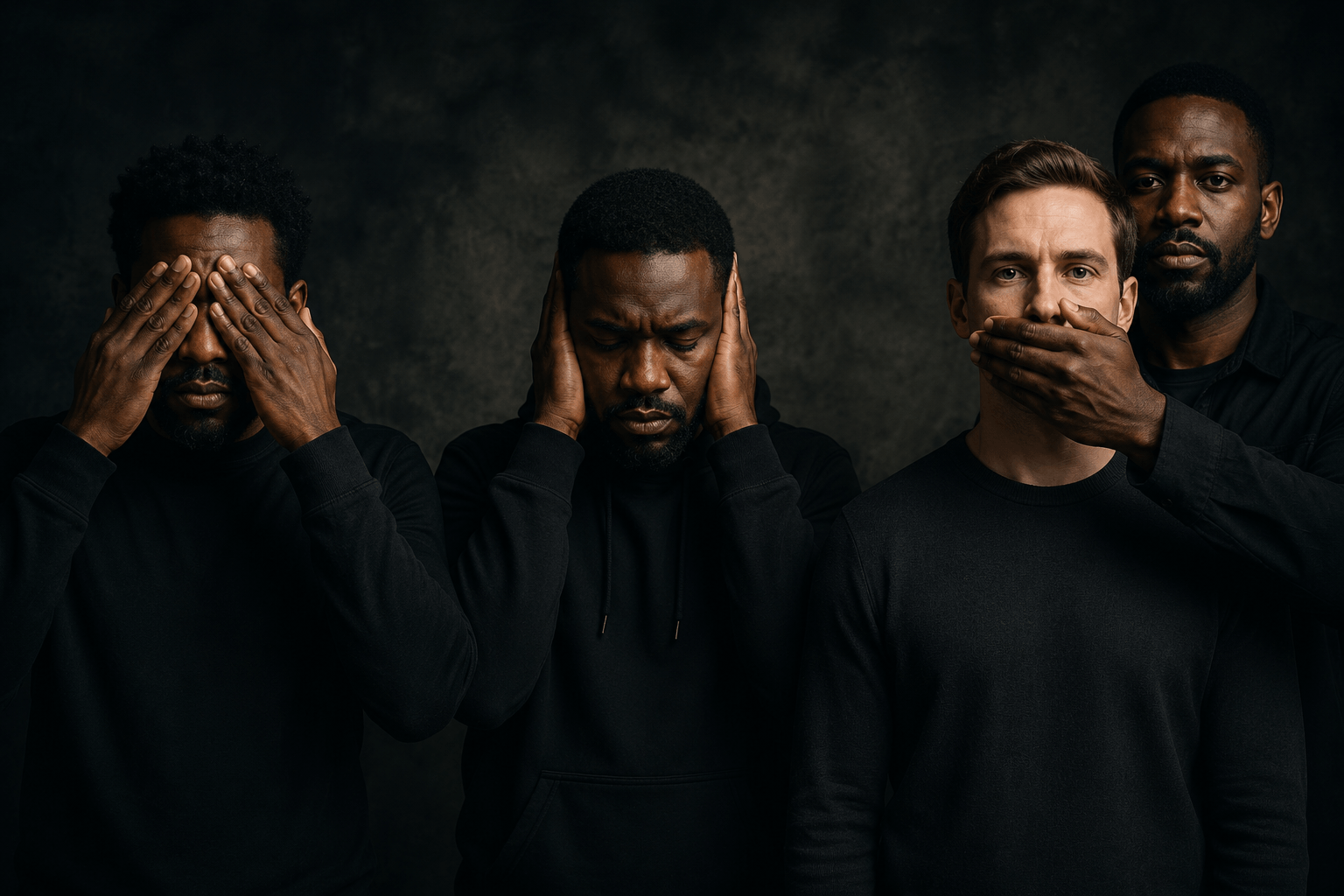
“How equal are we if Americans are assigned different vocabularies according to race?”
The strangest rule in modern racial language is that the morality of a word often depends less on what was said than on the color of the person who said it.
The same word can be affectionate when spoken by one person, hateful when spoken by another, culturally important when sold in a song, and professionally ruinous when repeated by someone discussing that song. Meaning, intent, and context have not disappeared, but all three can be pushed aside by the one characteristic modern America claims it wants to make less important: race.
This is not an argument for insulting people. Anyone who deliberately uses a racial slur to degrade another human being deserves condemnation. Cruelty does not become admirable merely because the Constitution may protect it from government punishment.
But condemning cruelty is not the same as creating separate racial speech codes.
America once had laws that distributed rights according to skin color. Today, we increasingly tolerate cultural and institutional rules that distribute linguistic permissions according to skin color. These rules are rarely written into statutes. They are enforced through employers, universities, media organizations, activists, celebrities, social pressure, public humiliation, and sometimes physical violence.
The result is a system in which one racial group may claim the right to use a word while demanding the authority to punish members of another group for saying the same word.
The system can also alter moral responsibility after the word is spoken. The person accused of saying it becomes the central wrongdoer even when another person responds with violence. Attention shifts from the punch, stabbing, or shooting to the insult that supposedly caused it.
The issue is therefore larger than whether anyone should use an ugly expression. Can a country committed to equal citizenship maintain separate vocabularies for different races and separate expectations for how each race responds?
Three Words That Do Not Mean the Same Thing
The title contains three words because the distinctions among them expose how confused the modern debate has become.
“Nigger” has a long history as one of the most degrading racial insults in the English language. It was used to express contempt, reinforce racial inferiority, and remind black Americans of a time when their legal and social status was beneath that of white Americans.
“Nigga” developed as a modified pronunciation. Depending on the speaker, setting, and relationship, it may be used as an insult, greeting, term of affection, expression of solidarity, verbal filler, or commercial entertainment. Its meaning is not fixed because the people who use it do not all use it in the same way.
“Niggardly” is something else entirely. It means stingy, miserly, or unwilling to spend. Its origin is unrelated to the racial slur despite the similarity in spelling and sound. Merriam-Webster traces it through Middle English to Scandinavian roots and explicitly notes that it has no etymological relationship to the N-word.
Words are defined by meaning, history, and usage, not by which unrelated word they happen to resemble. Yet racial controversies are not always governed by meaning. They are often governed by emotional association and institutional fear.
A dictionary may say the word is not racial, its history may confirm that, and the sentence may clearly concern money rather than race. Someone hears a familiar collection of sounds, becomes offended, and an institution begins to panic.
That is not racial understanding. It is the abandonment of understanding.
When Race Becomes the Definition
Most words change meaning according to context.
The word “kill” means one thing in a police report, another in a football locker room, another in a comedy routine, and something very different when spoken during a robbery. Rational adults recognize those differences without pretending every use carries the same intention or moral weight.
Racial language is increasingly judged by a different standard. The race of the speaker can outweigh the purpose of the sentence. A black speaker may use the word lovingly, angrily, commercially, humorously, or repeatedly. A white speaker may be condemned for quoting it from a book, repeating it from a song, reporting what someone said, or asking a question about its use.
A 2019 Pew Research Center survey found that 70 percent of Americans believed it was never acceptable for a white person to use the N-word. Views of black use were far more divided: 38 percent said it was never acceptable, 15 percent said rarely, 20 percent said sometimes, and 13 percent said always. Black and white respondents expressed broadly similar views in the survey.
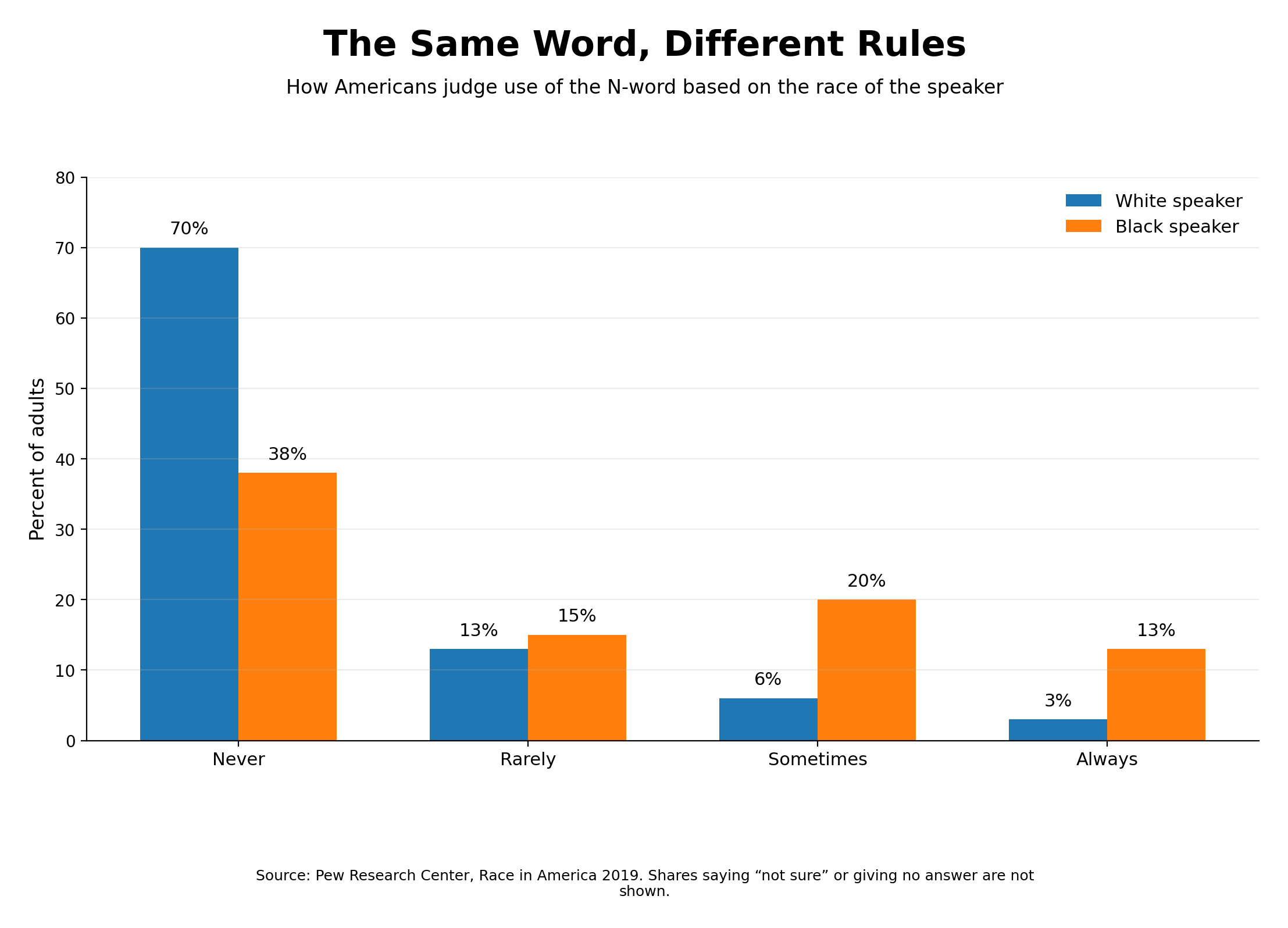
The public clearly applies different standards according to the speaker’s race, but there is no single black position on the subject. Some black Americans see the altered form as a sign of familiarity or solidarity. Others regard both forms as degrading. Some tolerate it privately but dislike its public use. Others use it routinely.
A racial group is not a government. It does not hold elections to determine vocabulary policy, and there is no official black commission empowered to decide who may say what.
Who makes the rule? Is it decided by rappers, activists, university administrators, corporate human-resources departments, journalists, or simply the loudest person in the room?
The strongest defense of selective use is reclamation. The theory is understandable. A group takes a word once used to degrade it and changes its meaning. What was intended as humiliation becomes familiarity, solidarity, defiance, or humor.
Language does develop that way. Communities reshape words, invent meanings, and sometimes turn insults into expressions of identity. But reclamation does not answer the most important questions.
If the word has truly been stripped of its power, why can its use by the wrong person destroy a career? If meaning depends on context, why is the speaker’s race sometimes treated as more important than context? If the word remains so dehumanizing that hearing it may supposedly explain violent retaliation, how can its constant repetition be defended as harmless entertainment?
The word has not been disarmed. Its power has been redistributed. One group receives broad permission to use it while another is warned that even quotation may be professionally dangerous. It becomes casual vocabulary for approved speakers and a racial tripwire for everyone else.
Selective reclamation can turn a supposedly disarmed word into a weapon with an authorized-user list. That arrangement may be culturally accepted and understandable given the history, but it is not equal.
Not Just Another Reclaimed Slur
Other racial and ethnic groups sometimes use insults, stereotypes, or private expressions among themselves that would sound hostile coming from an outsider. Jewish people may make jokes about Jews that would be offensive coming from a non-Jew. Latino, Asian, Arab, Irish, Italian, and other communities have their own internal humor, nicknames, and ethnic insults.
The examples are not equal simply because all involve in-group language.
The more useful questions are how widespread the practice is, how publicly it is promoted, and how aggressively the racial boundary is enforced.
The available evidence suggests that use of the N-word among black Americans extends far beyond a handful of rappers, comedians, activists, or young people in one subculture.
Political scientist Michael Tesler included a question on N-word usage in a nationally representative sample of 1,000 participants in the 2012 Cooperative Congressional Election Study. Almost two-thirds of black respondents and almost one-third of white respondents said they had used the word at least once or twice during the previous five years.
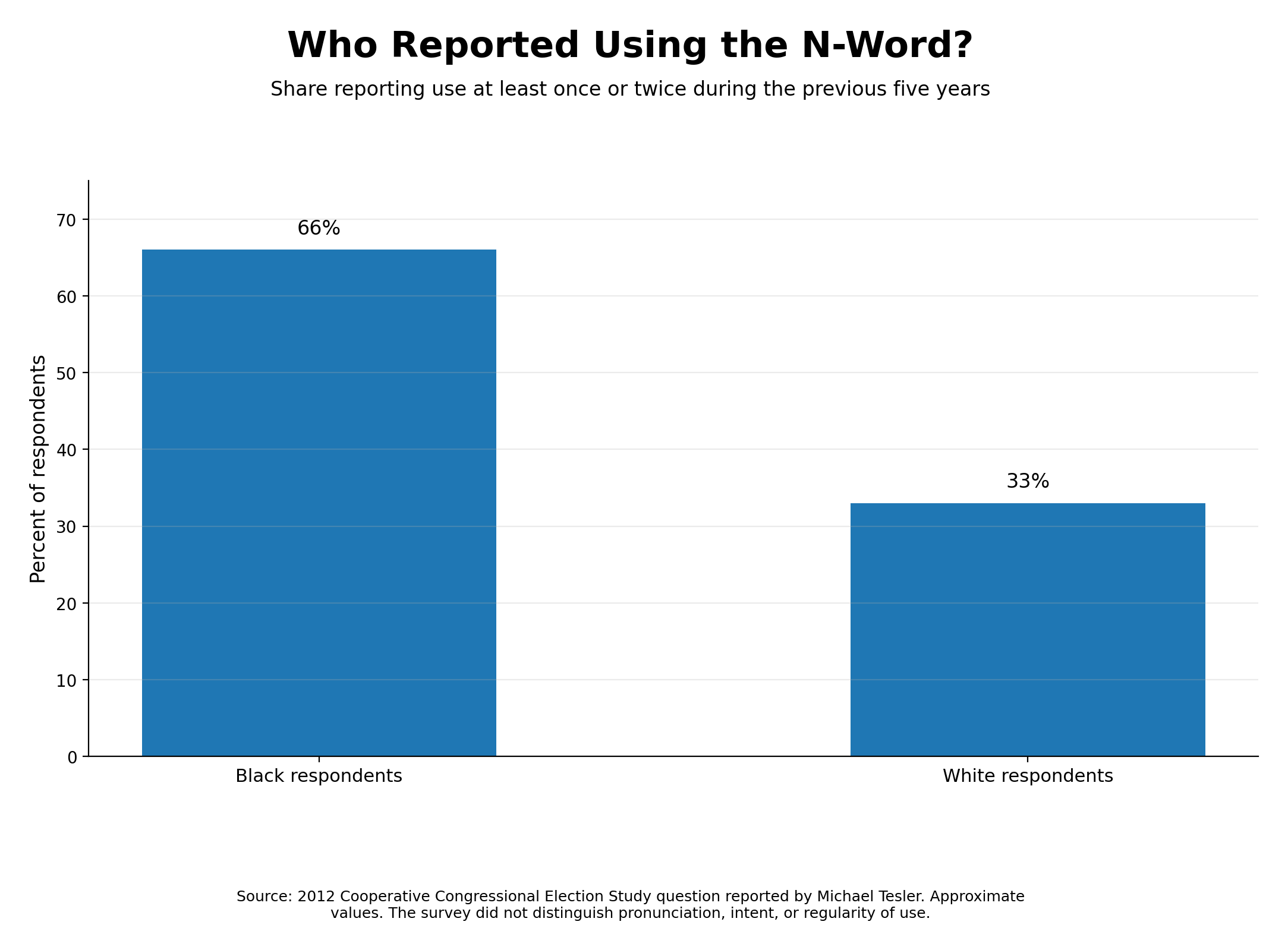
The survey did not clearly distinguish between “nigga” used colloquially and “nigger” used as an insult. Nor did it show that two-thirds of black Americans used either form regularly. Saying a word once or twice over five years is not the same as making it part of everyday speech.
Even with those limitations, the result shows that the practice was widespread rather than confined to a small fringe.
That scale weakens the vague reply that “other groups do it too.” Other groups may reclaim insults or tolerate private ethnic humor, but no comparable racial term appears to combine widespread use within the group, constant repetition in mainstream commercial entertainment, an openly stated rule forbidding another race from saying it, and serious professional or social punishment when that rule is violated.
A few members of an ethnic group privately using an insult is one thing. Millions of people using a word, entertainers selling it to the entire country, and institutions enforcing different rules according to the race of the speaker is something else.
The N-word may be the only racial term in modern American culture that is widely used within one group, commercially broadcast to everyone, and socially governed by an explicit racial permission system.
Many black Americans reject the word completely, while others object to its use in music, schools, and ordinary conversation. The point is not that all black Americans think alike. It is that the practice is too widespread to be dismissed as the behavior of a small cultural fringe.
One race is permitted to use the word according to context, while another is often told that context does not count. That is the unequal rule under examination.
The Concert Where the Customer Could Not Sing the Product
The contradiction became impossible to miss during Kendrick Lamar’s 2018 appearance at the Hangout Music Festival in Alabama.
Lamar invited a white fan onstage to perform his song “m.A.A.d city.” She began rapping the lyrics as written, including the N-word. Lamar stopped her and told her she needed to censor it.
The fan had not invented a racial insult or climbed onto the stage to attack Lamar. She repeated lyrics written by the artist, recorded by the artist, sold by the artist, and marketed to listeners of every race.
The customer may buy the song, memorize it, enrich the performer, attend the concert, and even be invited onto the stage. But the customer’s race determines whether she may sing the product accurately.
Lamar later defended the boundary in an interview. He argued that white people had spent generations telling black people what they could not do. If he claimed this one word as belonging to black people, he asked white people to let them have it.
That is an honest statement of the racial-ownership argument. It is also an admission that the rule is based primarily on inherited racial status.
The fan’s intention was participation. Her context was a concert performance. The word came directly from Lamar’s lyrics. Her offense was saying it while white.
Lamar had every legal right to stop his own performance. The larger issue is whether the rule he enforced is compatible with the principle that Americans should not receive different permissions based on ancestry.
The word is not confined to private conversations. It has been recorded, streamed, broadcast, downloaded, purchased, and marketed around the world. That commercial success creates a contradiction that cannot be resolved by pretending context applies only when convenient.
If a word is so dehumanizing that hearing it can supposedly justify violence, why is repeating it hundreds of times in entertainment considered culture?
One possible answer is that the word is so destructive that responsible people of every race should stop normalizing it. Another is that words carry different meanings according to intention, relationship, and context. A third is that one race owns the word and may grant or deny permission according to the identity of the speaker.
Modern racial culture often tries to hold all three positions at once. Context transforms the entertainer’s repetition into art but may become irrelevant when a white professor quotes literature. Racial identity overrides both meaning and intent when a white fan repeats purchased lyrics. Black critics who want the word abandoned by everyone complicate the cleaner argument that one race owns it and are therefore easily ignored.
The word is treated as powerless when defending its profitable use and unimaginably powerful when punishing an unauthorized speaker. That is not a consistent moral principle. It is a selective arrangement of permissions.
Mentioning a Word Is Not the Same as Using It Against Someone
Civilized judgment requires distinctions.
Directing a racial slur at a black employee during an argument is not the same as reading the word from a historical document. Quoting James Baldwin is not the same as degrading a student. Reporting that a defendant used a slur is not the same as endorsing it. Asking whether a teenager quoted a song or directed an insult at someone is not the same as directing the insult yourself.
These distinctions are simple enough for a young adult to understand, yet major institutions have repeatedly behaved as though they are impossibly complicated.
In 2018, Augsburg University professor Phillip Adamo led a classroom discussion of James Baldwin’s The Fire Next Time. A student read a passage containing the word. Adamo then used it once while leading a discussion about whether the word should be spoken, even in quotation. The university suspended him from teaching and began disciplinary proceedings arising from that classroom discussion.
In 2019, New School professor Laurie Sheck was investigated after discussing the difference between the title of the James Baldwin documentary I Am Not Your Negro and the original Baldwin quotation from which it came. The New School cleared her after determining that she had not violated its discrimination policies.
A professor should not have to endure a racial-discrimination investigation before an institution recognizes that quoting Baldwin is not the same as insulting a student.
James Baldwin was one of America’s most important black writers. His work dealt directly with race, hatred, identity, alienation, and the language Americans use to avoid reality. Yet professors found themselves in professional danger for accurately discussing language Baldwin himself used.
The institutions were not protecting Baldwin from racism. They were protecting the taboo from Baldwin.
The Reporter Who Asked About Context
In 2021, veteran New York Times science reporter Donald McNeil Jr. left the newspaper after controversy over his use of the word during a Times-sponsored student trip to Peru.
McNeil said a student had asked whether another student deserved to be suspended for using the word in an old video. To understand what had occurred, he asked whether the girl had directed the slur at someone or whether she had been rapping or quoting a book title. In asking the question, he spoke the word itself.
There were other complaints about McNeil’s manner and conduct during the trip. The Times investigated complaints about his behavior and placed a disciplinary letter in his file. After the controversy became public, more than 150 employees demanded further investigation and an apology. McNeil eventually negotiated his departure after 45 years with the newspaper.
The newspaper’s leadership announced that it did not tolerate racist language “regardless of intent.” That sounds firm until one considers what it means.
Intent helps distinguish a threat from a warning, fraud from error, and an insult from a quotation. It is not the only relevant fact, but a system that declares it irrelevant has abandoned one of the foundations of moral judgment.
McNeil apologized and said he should have used the euphemism. Perhaps he showed poor judgment. Yet his underlying question was reasonable: Was the original speaker attacking someone, quoting a title, or reciting a song?
A rational institution should determine that before imposing punishment. When an organization cannot distinguish analysis from abuse, it is no longer merely protecting people from racism. It is protecting a taboo from examination.
The Man Who Lost His Job Over a Word That Was Not Racial
In January 1999, David Howard, an aide to Washington, D.C. Democrat Mayor Anthony Williams, used the word “niggardly” during a discussion about managing a tight budget.
Some colleagues took offense because they mistook the word for a racial term. Howard resigned, and Williams initially accepted the resignation while acknowledging that Howard had not actually said anything racist. After national criticism, the mayor said he had acted too hastily and offered Howard another position.
The incident should have become a permanent warning against allowing ignorance to determine guilt.
The word was legitimate, the meaning was clear, and the discussion concerned money. Its linguistic history had nothing to do with race. A rational response would have taken less than a minute: look up the word, explain the misunderstanding, and move on.
Instead, the person who understood the English language nearly lost his career because someone else did not.
That reverses the normal relationship between knowledge and authority. The uninformed person makes the accusation, the informed person must defend himself, and the employer becomes frightened. Public-relations officials begin preparing statements while an innocent speaker considers apologizing merely to preserve his livelihood.
The dictionary loses to the accusation because the accusation creates more fear. Once emotional resemblance outranks meaning, language stops being a tool for communicating thought and becomes a minefield governed by whoever claims to be most offended.
Workplace Rules and Unequal Enforcement
The workplace presents a more difficult question because employers have a legitimate duty to prevent racial harassment.
A black employee should not be forced to endure racial abuse as the price of keeping a job. A supervisor who repeatedly directs slurs at employees is not conducting a seminar on linguistics. He is creating a hostile workplace.
But even workplace law recognizes that context and equal treatment can affect whether discipline is fair.
In Burlington v. News Corporation, white television anchor Thomas Burlington alleged that he was fired after using the full word during an editorial discussion about an NAACP campaign against it. A federal court refused to dismiss his racial-discrimination claim, holding that an employer could potentially violate federal law by punishing a white employee for using the word while allowing black employees to use it.
That ruling did not decide that Burlington had been illegally fired. The case later went to trial, and a jury ruled against him. It did establish, however, that racially selective enforcement could create a legally recognizable discrimination claim.
The court did not declare the word harmless. It recognized that an employer’s disciplinary system may itself become racially discriminatory when similar conduct is treated differently according to race.
An employer may reasonably prohibit a word, but it has a harder time defending a rule in which the prohibited conduct changes according to the employee’s skin color.
Employers can prohibit everyone from directing racial slurs at colleagues, consider context when the word appears in reporting, teaching, quotation, or discussion, and apply the same standard to employees of every race. That requires judgment. Judgment is harder than zero tolerance, but a slogan is not a substitute for fairness.
When Accusations Create Power
A deliberate racial insult can reveal contempt, provoke conflict, poison a workplace, and destroy trust. Employers do not have to tolerate employees targeting one another, and schools do not have to permit students to harass classmates continually. The First Amendment limits government punishment. It does not force private citizens to admire offensive speech or require private employers to accept every form of conduct.
There is still a large difference between punishing harassment and punishing discussion.
Racial accusations carry enormous social weight. An employer may become more afraid of appearing insensitive than of treating an employee unfairly. A university may suspend first and determine context later. A newspaper may protect its reputation by sacrificing someone whose conduct was ambiguous.
The accused person then faces a familiar trap. A defense is taken as proof that he does not understand the harm. An apology is treated as proof that the accusation was true. An explanation becomes an excuse, while silence allows everyone else to define what happened.
This is how a reasonable rule against cruelty can become a system of social control. The power lies not only in deciding what was wrong, but also in deciding whose explanation will be heard, whose intentions count, and whose fear controls the institution.
Not every offended person is dishonest. Racial slurs have real histories, and people may experience them as genuine humiliation. But genuine pain does not make every accusation accurate, every punishment proportionate, or every administrator morally infallible.
Complicated taboos also create opportunities. Activists gain authority by identifying violations and demanding punishment. Universities gain administrative power by investigating language. Employers gain discretion by treating ambiguous speech as misconduct. Media organizations gain attention by turning private conversations into national racial trials.
Entertainers profit from selling language much of their audience is forbidden to repeat, while consultants, trainers, and administrators earn a living explaining rules that can never be fully settled. Many may be sincere, but sincere motives do not erase incentives.
Outrage also has economic value. A resolved misunderstanding produces little traffic. A racial scandal can generate days of headlines, clips, reaction videos, donations, corporate statements, and political fundraising. Once anger becomes profitable, institutions acquire an incentive to prolong it.
As people grow more frightened of saying the wrong thing, power flows toward those who define what “wrong” means. Every taboo produces enforcers, and racial taboos are especially powerful because the accusation carries the weight of American history.
When a Word Becomes a Moral Defense
A racial insult can be cruel, enraging, and deliberately provocative. But the person who hears it does not acquire a license to assault or kill.
The N-word has acquired much of its power because society sometimes treats it like a moral defense. The familiar sequence is accusation, retaliation, and reversal. Someone is alleged to have said the word. Another person responds with violence. Public discussion then shifts away from the punch, stabbing, or shooting and toward the insult that supposedly caused it.
The aggressor becomes the victim of emotional injury, while the person physically attacked becomes almost incidental. That is moral inversion. It does not deny that the insult was ugly. It changes who is held responsible for the physical act.
In August 2023, Jekierin Walker shot and killed Stefan Volkmann during a confrontation at a San Antonio gas station. Walker said Volkmann had attacked him and used racial slurs. Prosecutors argued that Walker shot Volkmann after being subjected to the slurs, while Walker testified that he feared for his life and acted in self-defense. In March 2025, a jury acquitted Walker of murder but convicted him of manslaughter.
Physical aggression and Walker’s claimed fear were central issues at trial, so the killing cannot honestly be attributed to the slur alone. But the reported slurs were part of the confrontation and part of the explanation offered for its escalation.
This is where careless rhetoric becomes dangerous. Americans are repeatedly told that words are violence. Universities and activists speak of harmful language as though speech and assault belong on the same moral scale. People are taught that hearing a forbidden word is not merely offensive but a form of personal injury.
Then society acts surprised when someone answers speech with force.
A culture that repeatedly calls words violence should not be surprised when people begin treating actual violence as an acceptable answer to words.
The law does recognize a narrow category of unprotected “fighting words.” The Supreme Court originally described them as personally abusive words likely to provoke an immediate breach of the peace. Later decisions narrowed the doctrine, and the Court has not upheld another conviction under it since Chaplinsky v. New Hampshire in 1942. Offensive or hateful language does not automatically lose First Amendment protection merely because listeners find it enraging.
More importantly, the fighting-words doctrine concerns when government may punish a speaker. It does not create a private right to beat or shoot someone.
There is nothing compassionate about suggesting that a black adult cannot be expected to hear an insult without losing control. That is not respect for historical suffering. It is the bigotry of low expectations applied to self-command.
Equal citizenship requires equal rights, but it also assumes equal moral agency. A white man who assaults someone over “white boy” is still responsible for the assault. A black man who assaults someone over the N-word should be judged by the same standard. Anything less quietly removes one group from the expectations placed on every other adult.
The deepest answer to a racial insult is not fragility but independence. To strike someone because he uttered a word is to admit that he controls your temper. He says two syllables, and you surrender your freedom, perhaps your career, and possibly years of your life to the criminal-justice system.
That is not power. It is submission disguised as defiance.
Many of the most effective civil-rights demonstrators understood this. Organizations including the Student Nonviolent Coordinating Committee conducted nonviolent-resistance training, while activists deliberately prepared themselves to endure insults, arrests, and physical attacks without retaliating. Their restraint exposed the brutality of the system opposing them and strengthened their claim to equal citizenship.
Not every civil-rights leader agreed on strategy, and not every protest remained peaceful. But disciplined nonviolence became one of the movement’s most powerful moral weapons because it denied segregationists the excuse they wanted.
That history creates an uncomfortable contrast with a culture that treats loss of control as proof of authenticity. The civil-rights movement demanded that black Americans be recognized as full adults. Modern racial paternalism sometimes treats adult self-command as too much to expect.
No one is liberated by being told that an insult can control his hands, ruin his future, or erase his responsibility. A person who cannot govern himself is not free, regardless of how righteous his anger feels.
True defiance is refusing to let a fool’s breath govern your conduct.
Rules That Depend on Who Is Judging
Can a white person read the word aloud from a historical document? Can a professor quote it while teaching Baldwin? Can a reporter repeat the exact language used during a crime? Can a lawyer say it while questioning a witness? Can a teenager sing it when it appears in his favorite song? Can someone speak the full word while condemning its use?
There is no universally accepted answer because the rules change according to institution, audience, politics, relationship, and the identity of the person judging.
White Americans are often told that the rule is simple: never say it. That may be sensible personal advice, but it is not an adequate intellectual principle. History, journalism, literature, criminal trials, music, education, and ordinary conversation sometimes require people to discuss a word rather than direct it at someone.
An institution that refuses to recognize that difference has not solved the problem. It has simply decided that avoiding controversy is more important than determining the truth.
A taboo does not require people to understand the rule. It requires them to fear the enforcers.
Equal Citizenship or Separate Vocabularies
The choice is not between racial insults and racial censorship. A decent society can reject both.
It can condemn someone who intentionally uses a slur to degrade a stranger while also condemning an institution that destroys a person for quoting literature or using an unrelated English word. It can recognize that black Americans have understandable historical reasons for reacting strongly to racial language without pretending every reaction is rational or every punishment justified.
It can ask white Americans to exercise courtesy without declaring that their skin color makes them permanently unqualified to discuss certain sounds. It can recognize cultural differences without converting them into hereditary rules.
The questions should be the same for everyone. What was meant? What was actually said? To whom was it directed? Was it an insult, quotation, report, lyric, threat, or act of harassment? What harm was intended, and what response is proportionate?
Those questions require judgment. Judgment is harder than outrage, but it is also more just.
Private groups will always develop customs, expressions, humor, and ways of speaking that outsiders may not fully understand. The problem begins when private custom becomes a broad system of racial permission and institutional punishment.
One group claims the right to use a word. Another is told it must never use the word, even when quoting the first group. Employers enforce the difference, universities investigate it, celebrities profit from it, and activists defend it.
The same system can grant one group greater permission over the word while demanding less self-control in response to it. One rule calls that power. The other quietly treats them as children.
At that point, the issue is no longer merely etiquette. It is racial authority.
Equal citizenship cannot mean equal protection under the law but separate vocabularies under the culture. Nor can it mean equal rights combined with unequal expectations of personal responsibility.
No one has a moral need to use racial slurs, and life does not become poorer because people choose courtesy. But there is a profound difference between freely choosing courtesy and accepting that one race has permanent authority over the speech of another. One is manners. The other is hierarchy.
The best argument against racial insults is not that one group owns certain words. It is that human beings should not deliberately degrade one another, and that standard should apply to everyone.
A word does not become moral because an approved race said it. It does not become violence because an unapproved race quoted it. Meaning, intent, context, conduct, and proportionality should determine the judgment.
The old racial system determined where people could live, work, study, sit, and vote. The modern linguistic system is nowhere near as oppressive. Jim Crow was enforced through law, government, and violence, while modern speech taboos are usually social, cultural, and institutional.
That distinction keeps the comparison historically honest.
But an unequal principle does not become equal merely because the penalties are less severe. Skin color should not decide who may speak, who must remain silent, who is permitted to punish whom, or who is excused from the self-control expected of everyone else.
Otherwise, America has not defeated the logic of racial hierarchy.
It has merely changed who gets to enforce it.
Help Keep This Work Independent
If you believe America should judge people by conduct instead of race, apply the same standards to everyone, and allow difficult ideas to be examined without fear, please support this work.
These essays remain free to read because the truth should not stop halfway down the page and demand a credit card. But free to read does not mean free to research, write, edit, and publish.
Become a Paid Subscriber
Support independent writing that refuses to surrender reason to outrage, racial double standards, or institutional intimidation.
Make a One-Time Gift
Help fund the research and time required to produce essays like this one.
Join The Resistance Core
Provide a higher level of support for writing that challenges the ideas most institutions are too frightened to question.
If You Cannot Give
You can still help by liking this essay, leaving a comment, sharing it with someone who will read it honestly, or restacking it on Substack.
Independent ideas survive only when readers refuse to let them disappear.
This essay is not an argument that people should use racial slurs.
It is an argument that equal citizenship cannot survive separate racial speech codes.
Meaning, intent, context, and conduct should determine judgment. Skin color should not decide who may speak, who must remain silent, or who is excused from the standards applied to everyone else.
That is the question I want readers to confront honestly.
Good to know that "niggardly" is etymologically distinct; I will begin using it liberally in my casual conversations, as an ice-breaker to educating the general public on its actual origin.
Something interesting struck me about this paragraph you wrote:
'The word “kill” means one thing in a police report, another in a football locker room, another in a comedy routine, and something very different when spoken during a robbery. Rational adults recognize those differences without pretending every use carries the same intention or moral weight.'
I realized when I used to watch The Sopranos that there are linguistic social conventions used by different sorts of people in order to add or reduce drama around their business affairs: Finance bros use a lot of warlike, violent, and heroic metaphors to describe market actions, in order [I think] to conceal the fact that financial speculation seems like a rather banal activity, with some negative social implications. Mobsters, conversely, soften the language they use to describe violence; not only due to legal implications, but to disguise the ugly nature of their work from themselves. One of many ways in which groups use linguistic conventions for camaraderie or inclusion/exclusion.
In this context, I see the "n-word" as more of a class signifier than racial. It's juvenile as a means of in-group/out-group solidarity. Adult group solidarity looks more like the social networks available to Stanford alumni, for one example; or the linguistic conventions and gallows humor shared by combat veterans. Forbidden words and deliberately unequal language taboos are for defending weak social bonds between groups that don't have anything beneficial to unite them.
Similar to words like "Islamophobia", or even "antisemitism", I would argue. Because a Semite is a Jew or an Arab; although it's only used one way--like the word "populism" is only used to mean right-wing populism. I don't think it's good to have a word that specifically refers to people who hate your ethnic group, because it reinforces the obvious. I'm Jewish, and I happen to think that Jew-hatred is a recurring theme throughout history, mostly undeserved. I regard Islamophobia as both a recent contrivance and thoroughly deserved. But in both cases, these words are not going to perform the intended function.
Taboos against speech should be differentiated from taboos against thought, which are very real but much harder to talk about: For instance the taboo against killing an in-group member of any society, versus killing an out-group member in wartime. Or against killing a "pet" animal versus killing a "food" or "pest" animal. Or many irrational schisms between political humor and actual political behavior. These are uncomfortable on a different level than the "n-word", because any attempt to question them undermines the foundation of civilization itself.
Gramsci & Marcuse were very familiar with thought taboos.