

The first piece, ‘People Will Die’ and Other Democrat ‘Call to Actions’ - Part I, examined how Democrat rhetoric turns politics into life or death. This one looks at who amplifies that panic, who profits from it, and who pretends to be shocked when it becomes permission.
“You cannot spend years calling your opponents fascists, killers, and threats to democracy, then pretend the lunatic who believed you came from nowhere.”
The Incentive Machine
The question is not only why this language exists. The more important question is why it keeps getting worse. The answer is not hard to find: modern politics rewards escalation.
A politician who explains an issue carefully may be right, but being right is not always enough to be heard. A politician who says the other side is dangerous, cruel, authoritarian, or willing to let people die has a much better chance of breaking through. That does not make the claim true. It makes the claim useful, and in modern politics, usefulness is often valued more than accuracy.
Political language is not only about describing reality. It is also about producing a response. The response might be donations, votes, outrage, fear, clicks, shares, volunteers, or pressure on other politicians. Once the language produces those rewards, the people using it have very little reason to become more careful.
The media does not need a conspiracy meeting with politicians to know which sentence makes better television. “The bill changes Medicaid eligibility standards” is not much of a segment. “Republicans are going to make people die” is. One requires explanation. The other supplies drama immediately.
That is why panic spreads so easily. It already contains the story. There are villains, victims, danger, urgency, and a demand for action. That is much easier to package than a serious discussion about competing assumptions, projected outcomes, or fiscal tradeoffs.
A sober debate over healthcare financing might require explaining how Medicaid is funded, why states administer it differently, how rural hospitals depend on reimbursements, what happens when eligibility changes, and whether projected losses in coverage translate directly into projected deaths. That kind of discussion can be important, but it is not built for television. It requires patience. Panic requires almost nothing from the viewer because the feeling has already been supplied.
This is why the most dramatic phrases get clipped and repeated. “People will die” is short. “Threat to democracy” is short. “Clear and present danger” is short. “Fascism” is short. “Eliminate the president” is short. Each phrase carries more emotional force than factual detail, which is exactly why it travels.
Long explanations get shortened. Sharp warnings get amplified. The emotional part survives the trip. A politician may give a long speech with qualifiers, context, and policy details, but the part that circulates is the part that hits. The strongest line becomes the headline. The headline becomes the social media post. The post becomes the thing people remember. The caveat dies early, while the outrage travels.
That is not accidental. It is how modern information works. Cable news, online news, social media, fundraising emails, and activist messaging all reward the same basic traits: speed, simplicity, emotion, and conflict. A message that has all four travels well. A message that lacks them usually does not.
A serious argument is often slower than a slogan. That is its structural disadvantage.
The Democrat Party understands this. So do its media allies. So do activist groups. So do the consultants who write fundraising emails and the staffers who cut clips for social media. The point is not that they all need to be coordinated in some cartoonish way. They simply operate in the same ecosystem and respond to the same rewards.
A politician says Republicans are threatening democracy. A friendly network books a segment on democratic backsliding. An activist group sends an email warning that rights are under attack. A social media account cuts the strongest thirty seconds. A donor sees the clip and gives money. A voter shares it because it confirms what he already believes.
The arrangement works because everyone in the chain gets something. The politician gets attention. The network gets content. The activist group gets urgency. The donor gets moral satisfaction. The viewer gets a simple story in which his side is decent and the other side is dangerous.
A normal policy argument cannot compete with that very easily.
This also explains why the language tends to escalate over time. Once “threat to democracy” becomes routine, it loses some of its power. Once “extremist” is used every day, it becomes background noise. Once every election is described as the most important election of our lifetime, the next election requires even stronger language.
There is a kind of inflation in political rhetoric. The more a phrase is used, the less force it has. To produce the same emotional effect, the next phrase has to be stronger. That is how “wrong” becomes “dangerous,” “dangerous” becomes “authoritarian,” “authoritarian” becomes “fascist,” and “bad policy” becomes “people will die.”
Nobody has to order the escalation. It is built into the incentive structure.
This is also why corrections rarely amount to much. If a claim is exaggerated, the correction usually arrives after the emotional effect has already done its work. The audience that heard the original claim may never see the correction. Even if they do, the correction is usually weaker than the accusation. A correction says, “The situation is more complicated than first reported.” An accusation says, “They are killing people.” The accusation sticks; the correction sounds like paperwork.
Politics is not processed only through facts. It is processed through stories. People remember who was cast as the villain and who was cast as the victim. They remember the feeling of the story long after they forget the details. A complicated budget fight becomes “Republicans cut healthcare and people died.” A court nomination becomes “women’s lives were on the line.” A regulatory change becomes “the planet is being sacrificed.” An election becomes “democracy barely survived.”
Once a story becomes that simple, opposing it becomes morally difficult. That is the real power of the incentive machine. It does not merely spread information. It arranges information into a moral script.
And the script almost always points in the same direction.
Republicans are not simply wrong. They are cruel. Conservatives are not simply mistaken. They are dangerous. Trump is not simply a president with policies Democrats oppose. He is a fascist, a dictator, a threat to democracy, and now, in the casual language of an official hearing, someone to “eliminate”.
The word “office” may be added later, stressed later, or explained later. But the first impact of language does not wait for the legal defense. It lands as heard.
This is why atmosphere matters. A phrase that might have been dismissed as careless in a calmer time lands differently after assassination attempts, shootings, doxing, threats, and years of language telling people that one side represents existential danger.
The machine does not need to tell anyone what to do. It only needs to keep repeating the story of danger, emergency, and moral obligation until enough people believe they are living inside it. Most will respond politically. They will vote, donate, volunteer, argue, or post. That is normal. The concern is the small subset that hears the same story and decides normal politics is inadequate.
That is why the incentive machine is so reckless. It keeps producing urgency because urgency works, while treating the consequences of that urgency as someone else’s problem.
The people who profit from panic rarely pay the bill when panic spills over.
When It Stops Being Theory
At some point, this stops being a discussion about rhetoric and becomes a discussion about what is happening in the country.
Political violence is not new in America. That needs to be said because people often talk as if the present invented everything. It did not. This country has seen assassinations, riots, bombings, ideological violence, and attacks on public officials at different points in its history. Anyone who thinks American politics was once a gentle seminar has not read much American history.
But the fact that political violence is not new does not mean every period is the same. Some periods are more volatile than others. Some produce more threats, more plots, more attempts, and more excuses for escalation. The question is not whether America has always had violent people. It has. The question is whether the current environment is making political violence easier to imagine, easier to justify, and easier to absorb into the normal news cycle.
In 2017, a gunman opened fire on Republican members of Congress during a baseball practice in Alexandria, Virginia. Representative Steve Scalise was seriously wounded. Others were injured. The shooter had political motives and targeted Republicans. That event should have sobered the country more than it did. Instead, it became another item in the long list of incidents the MSM conveniently forgot.
In June 2022, after the leaked Dobbs opinion signaled that the Supreme Court might overturn Roe v. Wade, Nicholas Roske traveled to Justice Brett Kavanaugh’s Maryland home intending to kill him. Federal authorities said he carried a handgun, ammunition, a knife, zip ties, pepper spray, and other items before being arrested near Kavanaugh’s house. That was not an abstract threat. It was political violence reaching the home of a conservative Supreme Court justice, after weeks of rhetoric warning that the Court was putting lives and rights in danger.
The media largely moved on. Imagine, for one minute, if an armed conservative had shown up outside Justice Ketanji Brown Jackson’s home with a gun, knife, zip ties, pepper spray, and an admitted intent to kill her. That would not have been allowed to disappear. It would have become a permanent exhibit in the case against the right. But because the target was Brett Kavanaugh, a conservative justice who had become a symbol of the left’s rage over abortion, the story was treated like an unfortunate incident rather than a warning sign.
Then came 2024.
On July 13, Donald Trump was shot during a campaign rally in Butler, Pennsylvania. A bullet struck his ear. Corey Comperatore, a firefighter and father, was killed. Two others were seriously wounded. Whatever one thinks of Trump, that moment should have been treated as a national warning sign. A former president and major party nominee was nearly assassinated on live television in front of thousands of people.
Just over nine weeks later, on September 15, Ryan Wesley Routh was arrested near Trump International Golf Club in West Palm Beach after authorities said he had positioned himself with a rifle while Trump was golfing. Routh was later convicted of attempting to assassinate Trump and, in February 2026, sentenced to life in prison plus seven years. One attempt can be dismissed by careless people as an aberration. A second attempt in the same year becomes harder to wave away.
Then, on September 10, 2025, Charlie Kirk was shot and killed while speaking at Utah Valley University. The FBI described it as the murder of Charlie Kirk. Utah officials called it a political assassination. Whether one liked Kirk or not is irrelevant. He was a political figure speaking publicly when he was killed. In a serious country, that fact should be enough to make people stop and think.
The same atmosphere has shown up at street level too. Savanah Hernandez, a Turning Point USA contributor, was attacked while covering an anti-ICE protest in Minneapolis. This was not an assassination attempt, and it should not be treated as one. But it belongs in the same conversation about political panic, activist escalation, and the growing belief that conservative voices are fair game.
Savanah Hernandez, a Turning Point USA contributor, was attacked while covering an anti-ICE protest in Minneapolis. This was not an assassination attempt. It was a street-level example of the same atmosphere: political panic turning conservative presence into provocation.
That is what panic looks like when it leaves the studio and enters the crowd. A reporter shows up with a camera, the crowd identifies her politics, and suddenly journalism becomes provocation. That does not require a manifesto. It only requires an atmosphere where one side has been told, over and over again, that the other side is not merely wrong, but dangerous.
If men on the left are willing to put hands on a woman because she is conservative and carrying a camera, what comes next? That is not a small question. Political violence does not usually begin with assassinations. It begins with permission.
By April 2026, Trump was no longer merely a candidate or former president. He was the sitting president of the United States. A sitting president is not just another political personality. He is the elected head of the executive branch, commander in chief, and a central figure in the constitutional order. To speak loosely about “eliminating” him in that environment is not the same thing as some anonymous crank making a bad joke online.
That is the context in which the White House Correspondents’ Dinner attack happened on April 25, 2026. Federal prosecutors have now charged Cole Tomas Allen with attempting to assassinate President Trump. Authorities say he tried to rush past security near the ballroom while armed, triggering an exchange of gunfire with Secret Service agents. This was not merely “shots fired” near a political event. It was, according to the charge, an attempt to kill the sitting president.
The larger point no longer depends on waiting for every detail to settle. When a sitting president faces another assassination attempt after Butler and West Palm Beach, after a major conservative figure has been murdered, and after years of language describing Trump and his supporters as fascist threats to democracy, the atmosphere cannot be treated as irrelevant.
That does not mean rhetoric alone caused any one of these events. It does not mean every attacker listened to the same speeches, watched the same networks, or absorbed the same political messages. Real life rarely works that neatly. But real life also does not work in the opposite direction, where language exists in some sealed container separate from the minds of people who hear it.
Political violence occurs among human beings who consume messages, absorb narratives, develop grievances, and decide what kind of world they think they are living in. That is why the “small subset” argument means something. Most people heard years of anti-Trump rhetoric and did nothing violent. That is true. It is also beside the point. Most people can walk past a cliff and not jump. That does not mean there is no danger for those already unsteady on their feet.
Political rhetoric provides meaning. It tells people who the villains are, who the victims are, what is at stake, and what decent people are supposed to oppose. When that meaning is repeated often enough, it becomes part of the mental furniture of the age.
If the message is that Trump is wrong, voters should defeat him. If the message is that Trump is dangerous, citizens should stop him. If the message is that Trump is a fascist, a dictator, a threat to democracy, and someone whose policies will cause people to die, then a small number of unstable people may decide that ordinary politics is not equal to the threat they have been told exists.
Again, most will not. But a country does not need most people to cross that line in order to suffer the consequences.
Many of the same people who speak fluently about radicalization, dehumanization, online ecosystems, and stochastic violence suddenly become strict literalists when the rhetoric comes from their own side. They understand that language can radicalize when the accused source is on the right. They understand that online narratives can shape unstable interpretations of reality. They understand that repeated dehumanization can matter. But when the language comes from Democrats, liberal media figures, or left-wing activists, the standard changes.
Suddenly, words are just words. Suddenly, “fascist” is merely commentary. Suddenly, “eliminate” is just a figure of speech. And suddenly “threat to democracy” is just normal political language. The same people who can locate harm in silence when it suits them cannot locate risk in open declarations when it does not.
That double standard is part of the problem.
A serious country cannot apply one theory of rhetoric to one side and another theory to the other. If words shape climate, they shape climate. If repeated language can make certain actions more imaginable, then that principle does not stop working when the speaker has a “D” after his name or works for a liberal network.
The baseball shooting, the planned attack on Justice Brett Kavanaugh, the Trump assassination attempts, the Charlie Kirk killing, and the White House Correspondents’ Dinner incident are not identical. They should not be flattened into one story. Each has its own facts, motives, failures, and consequences. But they all show that the distance between political language and physical danger is not as large as polite society would like to believe.
The country has entered a period where political figures face more threats, public events require heavier security, families of officials are more vulnerable, and unstable people can absorb extreme messages at high speed. That is not a partisan talking point. That is the reality of modern public life.
In such an environment, language should become more careful, not more reckless. Instead, much of the political class has moved in the opposite direction. The rhetoric becomes hotter. The accusations become broader. The stakes become more apocalyptic. The words become less restrained precisely when the environment demands more restraint.
That is not courage. It is negligence disguised as moral clarity.
The Accountability Gap
When political violence happens, the country knows how to talk about the individual who committed it. His name is released. His background is examined. His writings, online activity, weapons, motives, and mental state are picked apart. That is how it should be. The person who commits the act is responsible for the act.
But that is not the only question worth asking.
A society can hold an individual responsible for violence while still asking what kind of atmosphere helped make that violence more imaginable. Those two ideas are not in conflict. In fact, a serious society has to be capable of holding both at the same time.
The problem is that we rarely do.
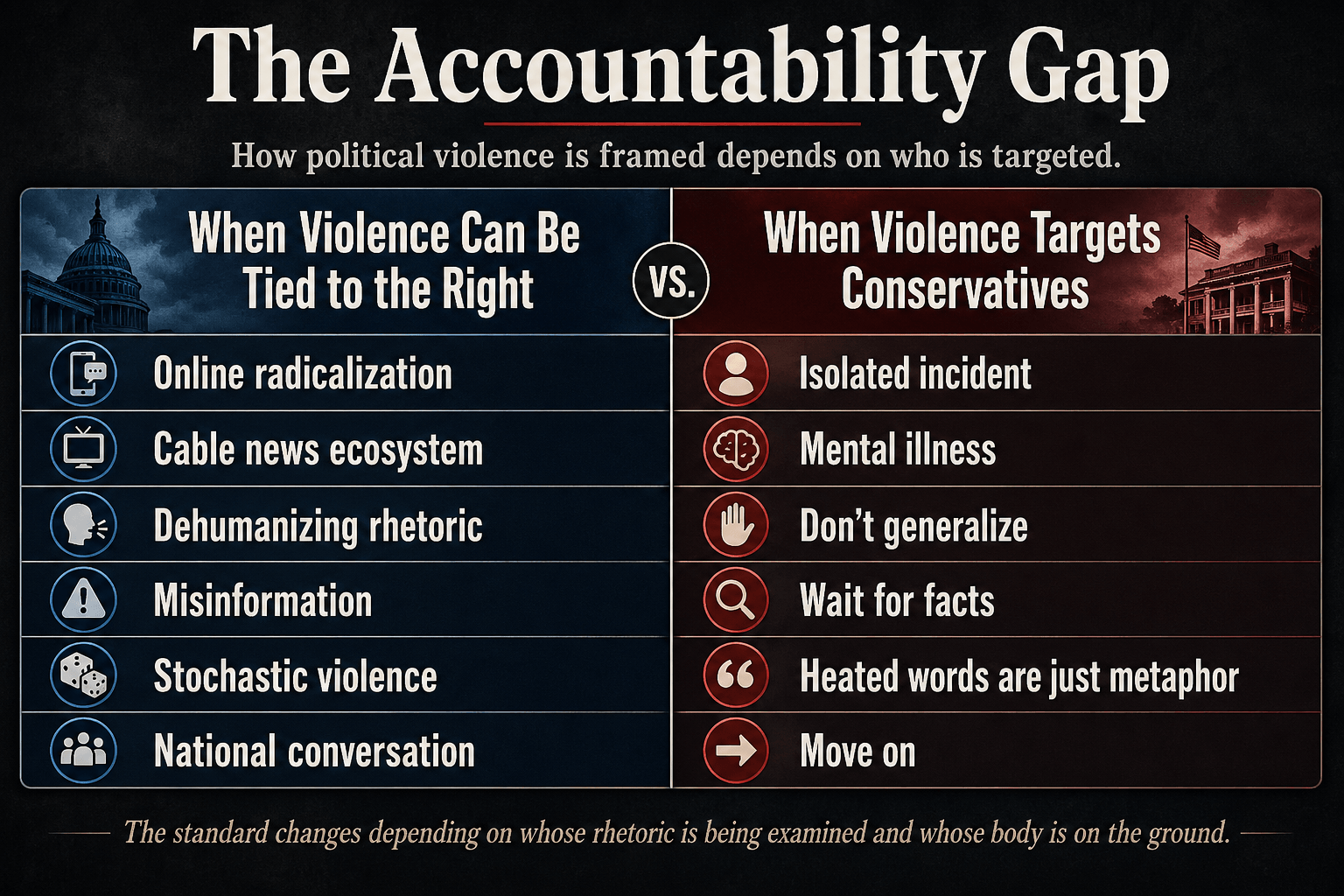
If the attacker can be tied to the right, the conversation immediately expands. Suddenly, the discussion is not just about one individual. It is about online radicalization, misinformation, dehumanization, conspiracy theories, cable news, podcasts, talk radio, social media, and the broader ecosystem that supposedly shaped him. Every phrase, every meme, every post, every influence is placed under a microscope.
But when the rhetoric comes from the Democrat Party, liberal media, activist groups, or left-wing institutions, the rules change. Then we are told to be careful. We are told not to generalize. We are told not to connect dots too quickly. We are told that heated language is just metaphor, that “fascist” is just criticism, that “threat to democracy” is civic concern, and that “people will die” is only compassion expressed strongly.
In other words, one side gets ecosystem analysis. The other side gets isolated incident analysis.
That double standard is not sustainable. Either rhetoric matters or it does not. Either repeated language can shape the atmosphere, or it cannot. Either dehumanization and emergency framing can influence unstable people, or they cannot. These principles do not change depending on whether the speaker is a Republican, Democrat, cable host, activist, professor, or member of Congress.
This is where much of the public discussion becomes dishonest. People do not actually disagree about whether language can shape behavior. They disagree about when they are willing to admit it.
The same commentators who can spend days explaining how a right-wing phrase might radicalize someone suddenly become strict First Amendment literalists when a Democrat says something reckless. The same people who warn that online jokes can create danger suddenly insist that “eliminate the president” must be interpreted only in the most charitable possible way. The same media class that sees “stochastic terrorism” everywhere on the right becomes remarkably incurious when the atmosphere of panic comes from its own side.
At that point, what is being protected is not truth, but the narrative.
The narrative protects the institutions, the media habits, the activist groups, and the political figures who benefit from the current style of politics. Most of all, it protects the incentive machine that keeps turning disagreement into emergency.
The accountability gap works because responsibility is divided in a convenient way. The violent individual is treated as fully responsible for his action, which he is. But the people who spent years raising the temperature are treated as having no relationship to the temperature at all. They get the benefits of panic when it mobilizes voters, raises money, generates headlines, and keeps audiences engaged. When panic spills over, they step back and insist they were only speaking metaphorically.
Adults understand that words do not have to be direct commands to be reckless. A person who yells “fire” in a crowded theater may not intend for anyone to be trampled. A person who falsely accuses an innocent man of threatening children may not intend for a mob to appear at his house. Intent matters legally and morally, but it is not the only thing that matters. Foreseeability does too.
By now, the risks are foreseeable.
America has already seen assassination attempts, targeted shootings, attacks on families of officials, doxing, threats against judges, threats against election workers, and violence around political events. No one in public life can honestly claim not to know that the atmosphere is volatile. The people using emergency language today are not speaking into a calm room. They are speaking into a country already full of gasoline fumes.
That does not mean they caused the match. It means they know what kind of room they are standing in.
This is why the demand for responsibility is not censorship. It is not an argument that politicians should whisper or avoid hard truths. It is an argument that powerful people should stop pretending they are powerless over the language they choose.
A senator knows the difference between saying, “This bill could have serious consequences,” and saying, “People are going to die.” A member of Congress knows the difference between saying, “The president should be removed from office,” and saying, “We should eliminate the president.” A cable host knows the difference between saying, “This policy is wrong,” and saying, “This is fascism.”
They choose the stronger language because the stronger language works.
Then, when challenged, they retreat into technical meanings, charitable interpretations, and demands for context. But the time for context is before the phrase goes viral, before the clip spreads, before the unstable listener hears only the sharpest part.
Responsible people don't assume everyone is calm, informed, charitable, and emotionally healthy. They know better. They know the country better. They know the internet better.
The accountability gap survives because no one wants to give up the tools that work. Panic works. Accusation works. Moral emergency works. “Threat to democracy” works. “People will die” works. “Fascism” works. That is why these phrases keep returning.
But tools have consequences, especially when they are used in a volatile country by people who know exactly how volatile it has become.
That is the part our political class avoids. They want the mobilizing power of emergency language without the burden of asking what emergency language does to unstable minds. They want to define opponents as threats while insisting no one should treat them like threats. They want to call politics life or death while being astonished that someone takes politics as life or death.
At some point, that stops being innocence. It becomes negligence.
The Cost of Permanent Crisis
A country cannot live forever in a state of emergency without becoming something different.
That does not mean people stop going to work, raising families, paying bills, or living ordinary lives. Most people still do those things because life demands it. But beneath the surface, the way people interpret politics changes. Opponents stop looking like opponents. Disagreement stops feeling like disagreement. Elections stop feeling like elections. Everything becomes a test of survival.
That is not a healthy condition for a republic. A republic depends on the ability to lose an argument today and try again tomorrow. It depends on the belief that political defeat is not the same as destruction. It depends on the idea that the other side may be wrong, foolish, corrupt, or self-interested, but still within the boundaries of ordinary politics.
Permanent crisis destroys that boundary.
If every election is democracy’s last stand, then losing an election becomes unbearable. If every policy dispute is life or death, then compromise becomes immoral. If every opponent is a fascist, then persuasion becomes naïve. If every spending cut is murder, then budget debate becomes cruelty wearing a suit.
A society that accepts that style of politics will eventually lose the habits required for self-government. People will still vote. Politicians will still give speeches. News channels will still run panels. But the civic assumptions underneath the system will have changed. The point will no longer be to persuade fellow citizens. It will be to stop enemies.
The dangerous part is that this change does not happen all at once. Nobody holds a press conference and says the country is replacing political disagreement with permanent moral emergency. It happens gradually, through repetition. One phrase at a time. One headline at a time. One speech at a time. One fundraising email at a time. By the time the shift becomes obvious, many people have already accepted it as normal.
The Democrat Party has increasingly relied on a style of politics that turns ordinary disputes into existential battles, while its media allies and activist groups amplify that language because panic produces attention, money, and mobilization. That does not mean Republicans are innocent of harsh language. They are not. Republicans can exaggerate, insult, provoke, and inflame. But the question here is not whether harsh rhetoric exists on both sides. It does. The question is whether one side has built a large part of its modern political identity around portraying the other side as a standing threat to democracy, minorities, rights, institutions, and life itself.
That question deserves an honest answer, because if the answer is yes, then the consequences cannot be waved away every time something violent happens.
The individual who commits violence is responsible for his act. That should never be blurred. But responsibility for an act does not erase responsibility for an atmosphere. Adults know the difference. The man who lights the match owns the fire, but the people who spent years filling the room with fumes should not pose as innocent bystanders.
This is where our political class likes to play dumb. They know words matter when they want words to matter. They know rhetoric shapes attitudes when they want to accuse their opponents. They know repeated messages can radicalize people when the subject is right-wing media, conservative podcasts, or online forums. But when the language comes from their own side, suddenly every phrase must be read with maximum charity.
That standard cannot hold. If “threat to democracy” means something, then it should not be thrown around like a campaign slogan. If “fascist” means something, then it should not be used as a synonym for someone who opposes your agenda. If “people will die” means something, then it should require evidence, context, and humility, not just a microphone and a moral pose.
And if “eliminate the president” is said in an official hearing, in a country where the sitting president has already faced assassination attempts and a major political gathering has just been disrupted by gunfire, then serious people should not need days of public relations cleanup to understand why the phrase is reckless.
A healthy society does not require everyone to speak softly. It requires people to speak responsibly. There is a difference. Soft language avoids conflict. Responsible language understands consequences. Soft language pretends politics is irrelevant. Responsible language recognizes that politics matters enough to be handled with discipline.
The Democrat Party does not have to stop opposing Trump. It does not have to stop criticizing Republicans. It does not have to stop arguing that its “policies” are better. That is politics. But it should stop pretending there is no difference between disagreement and danger, between opposition and fascism, between policy tradeoffs and murder.
The country is already volatile enough. Public officials need more security. Political families are more exposed. Events are more tense. Threats spread faster. Clips travel farther. Unstable people can now live inside political narratives all day long, fed by algorithms, headlines, and outrage merchants who never have to meet the people they are influencing.
In that environment, reckless language is not brave. It is cheap. It costs the speaker nothing in the moment. It may even bring applause, donations, attention, and praise. But the costs are paid elsewhere, by people who have to live with the atmosphere it creates.
That is the pattern running through all of this: the language comes first, then the frame, then the escalation, then the panic, and finally the small subset that everyone claims no one could have anticipated.
But we can see it coming. We have seen assassination attempts, targeted shootings, political families attacked, public officials threatened, “fascist” turned into background noise, “people will die” used as routine legislative rhetoric, and sitting members of Congress speak casually about eliminating the president while expecting everyone to accept the most harmless interpretation possible.
At some point, the benefit of the doubt has been overdrawn.
A serious country would step back and ask whether this is sustainable. A serious media would stop rewarding the hottest phrase in the room. Serious politicians would recognize that leadership is not measured by how dramatically they can describe the danger, but by whether they can speak truthfully without poisoning the public mind.
That kind of seriousness is in short supply. So the cycle continues. The next bill will be deadly. The next judge will threaten rights. The next election will decide whether democracy survives. The next Republican will be a fascist. The next act of violence will be shocking, unthinkable, impossible to explain, and somehow disconnected from everything said before it.
That is the lie at the center of permanent crisis. It asks us to believe that the atmosphere can be poisoned every day, but that nobody should ask who is doing the poisoning.
I do not believe that anymore.
Most Americans are not violent. Most are not extremists. Most are not looking for permission to hurt anyone. But most is not all, and in a country this large, all is the only number that would make reckless rhetoric safe.
We do not live in that country. We live in a country where a tiny fraction of people can change history, where clips travel faster than context, where political language is consumed by the stable and unstable alike, and where leaders who know better keep pretending they do not.
If everything is framed as life or death, eventually someone will treat it that way.
That is not a prediction. It is a warning from a country that has already started proving the point.
Don’t Read This and Do Nothing
I preach this stuff day in and day out because I believe in it.
Not someday. Not in theory. Now.
Too many people see what is happening, complain about it, share a few posts, shake their heads, and then go right back to doing nothing. Then years later, those same people talk about what they would have done if they had been alive during some other crisis in history.
That is cheap courage.
If you are alive now, this is your moment.
The weakness has to go. The excuses have to go. The “someone else will handle it” mindset has to go.
You and I are in the fight of our lives. Not because politics is entertainment, but because the people manufacturing panic, poisoning language, and turning half the country into designated villains are not going to stop on their own.
This work is part of the fight.
I need you, and you need voices willing to say what others are too afraid, too compromised, or too comfortable to say.
If you believe this work can help change things, help keep it going.
Become a Paid Subscriber
Paid subscribers make it possible for me to keep publishing without putting the work behind a paywall. I want these essays to reach as many people as possible, including the people who may not already agree.
Subscribe here:
Make a One-Time Gift
If a subscription is not the right fit, a one-time gift helps keep the lights on, the research moving, and the work alive.
Give here:
Join The Resistance Core
If you want to stand behind this work at the highest level, join The Resistance Core.
That is for readers who understand this is not just content. It is a fight for language, truth, memory, and the future of the country.
Join here:
If You Cannot Give
Share the essay. Send it to someone. Restack it. Post it. Leave a comment.
Do something.
Do not be one of those people who sees the problem clearly and then spends the rest of his life explaining why he stayed on the sidelines.
Let’s win this battle together.