

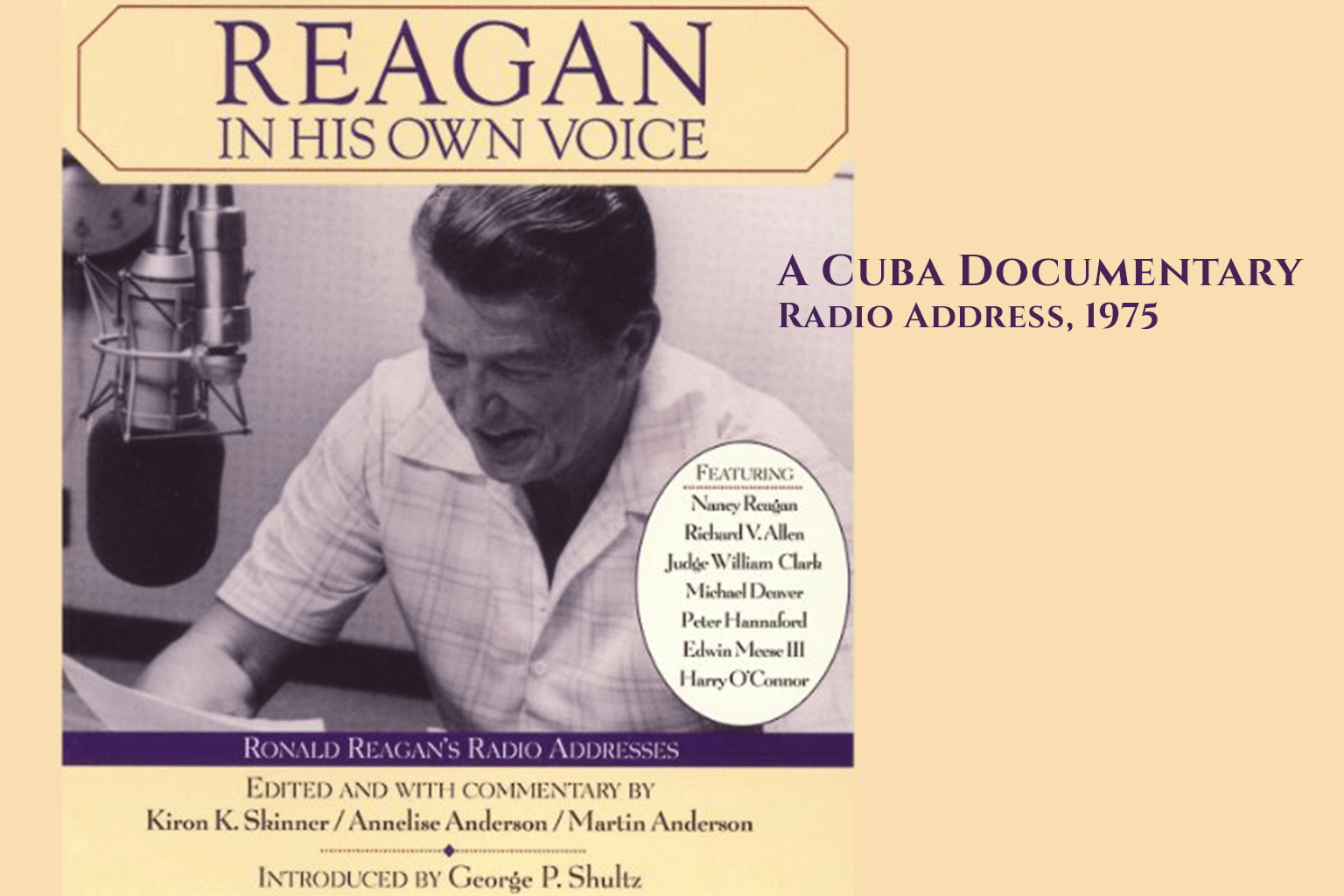
Listen to the original radio address below.
This is Ronald Reagan’s 1975 broadcast titled A Cuba Documentary, recorded while he was a private citizen. The commentary that follows examines what Reagan was responding to and why his warning still matters.
In February 1975, Ronald Reagan recorded a short radio address titled A Cuba Documentary. At the time, Reagan was not president. He was not even an elected official. He was a private citizen speaking into a microphone once a week, trying to explain how the world actually worked to people who were being told otherwise.
This context matters.
America was still reeling from Vietnam and Watergate. Trust in institutions was collapsing. Inflation was high. Unemployment sat above 8 percent. The federal budget was running a peacetime deficit that would have shocked earlier generations. Abroad, the Soviet Union was expanding its influence across Africa, Asia, and Latin America.
It was also a moment when American media organizations were beginning to rebrand ideological storytelling as objective reporting. Reagan noticed this and said so plainly.
This particular address focused on a television program that described itself as a documentary about Cuba. Reagan did not object because it praised socialism. He objected because it misused the word documentary.
That distinction is everything.
What Reagan Was Actually Arguing
Reagan began with a simple claim. A documentary implies factual rigor. It implies research, context, and honest comparison. Viewers are entitled to assume they are being shown reality rather than persuasion.
The program he criticized did not meet that standard.
The message of the broadcast was that Cuba was progressing under socialism and leaving its underdeveloped past behind. Reagan responded with a question that modern viewers almost never hear asked anymore. Underdeveloped compared to what.
Before Fidel Castro seized power in 1959, Cuba ranked at or near the top of Latin America by nearly every measurable standard. Reagan cited data that was easily verifiable even then.
Cuba had a higher per capita income than most of its neighbors. It had one of the highest literacy rates in the region. It had more doctors per capita than many European countries. It had widespread automobile ownership, extensive television access, and one of the highest rates of newspaper circulation in the hemisphere. In terms of movie attendance, Cuba ranked second in the world, behind only the United States.
These are not conservative talking points. They are historical facts drawn from U.S. government reports and international data from the 1950s.
Reagan then contrasted that reality with what socialism produced.
By the early 1960s, Cuba had introduced food rationing. Agricultural output declined. Mechanized farming gave way to oxen. Basic goods became scarce. Citrus fruits that had once been sold cheaply on Havana street corners could only be obtained with a doctor’s prescription.
Reagan did not dramatize this. He did not raise his voice. He simply read from a 1962 report by the U.S. Department of Agriculture describing Cuba’s food situation after the revolution.
The conclusion was unavoidable. Cuba did not become prosperous because of socialism. It became poorer in spite of its previous advantages.
Why This Was About Media, Not Just Cuba
The most important part of Reagan’s argument came at the end.
He warned that when language is distorted, understanding collapses. A documentary that omits baseline comparisons is not objective. It is editorial advocacy disguised as fact. And that disguise matters because people lower their defenses when they believe they are being informed rather than persuaded.
Reagan even extended the warning to himself. He told listeners not to accept his words blindly either. Check the facts. Verify the claims. Compare before and after.
That level of intellectual honesty is almost extinct today.
Cuba Was Not an Exception. It Was a Pattern.
What happened in Cuba repeated itself elsewhere.
Venezuela followed the same trajectory decades later. Before Hugo Chávez, Venezuela had the highest per capita income in South America. It had a functioning middle class, private industry, and one of the region’s most stable currencies. After two decades of socialist central planning, Venezuela experienced hyperinflation that exceeded one million percent by 2018. By the early 2020s, over seven million Venezuelans had fled the country. Food rationing returned. Electricity failed. Hospitals collapsed.
Once again, foreign media framed the crisis as the result of sanctions or inequality rather than policy. Baselines were erased. Comparisons were avoided. The same rhetorical moves Reagan warned about reappeared almost unchanged.
The difference now is that these narratives circulate faster and face less resistance.
The American Parallel Reagan Anticipated
Reagan was not claiming the United States would become Cuba overnight. He was warning about something more subtle.
He understood that decline does not begin with empty shelves. It begins with dishonest descriptions. When falling standards are reframed as moral progress, when scarcity is presented as virtue, and when planning failures are blamed on preexisting inequality rather than structural policy choices, the ground is prepared for further collapse.
As of January 2026, the United States carries over $34 trillion in federal debt. Real wages for many working Americans have failed to keep pace with inflation since 2021. Major cities governed almost exclusively by the Democrat Party struggle with housing shortages, deteriorating infrastructure, and declining public services, even as taxes rise.
Yet media coverage increasingly avoids historical comparison. Americans are told conditions are normal, unavoidable, or the best that can be expected. That is precisely the kind of narrative laundering Reagan warned about.
Reagan’s Wisdom
Reagan did not defeat bad ideas by shouting at them. He defeated them by insisting on comparison, context, and evidence. He trusted ordinary people to recognize reality when it was presented clearly.
That trust was not naive. It was earned.
The tragedy today is not that socialism keeps failing. It is that many institutions no longer feel obligated to explain why. Reagan understood that when words lose their meaning, citizens lose their bearings.
That was true in 1975. It is more true now.
One Honest Paragraph Before You Go
I am going to be direct. Work like this does not survive on shares, likes, or quiet agreement. It survives only if enough readers decide it is worth paying for. This series exists because I believe the ideas Ronald Reagan was warning about matter now more than ever, and because too few people are willing to explain them honestly. If you read this and thought, someone needs to keep saying this, that belief has a cost. This is the moment when support stops being symbolic and becomes real.
If you want this work to continue, here are the simplest ways to support it:
Become a Paid Subscriber
https://mrchr.is/help
Make a One-Time Contribution
https://mrchr.is/give
If you can step up at the highest level right now:
Join The Resistance Core
This tier defaults to $1,200, but you can give any amount that’s comfortable for you.
https://mrchr.is/resist
Another nice article, Chris. One of the things that bugs me about the way our Country is going is something we’ve come to share with socialist countries - centralization. Government, economic planning, banks, the media, corporations, even our food production have all been consolidated into the hands of a very few people or organizations. It’s what Hamilton wanted, but on steroids. Unfortunately, centralization brings mediocrity everywhere it’s been tried.
Power in this Country used to be more diffusely held. It promoted innovation and distributed risk. If one bank failed, for example, it may have affected a limited region but not the entire Country. Having smaller corporations promoted competition and innovation. Again if one failed, the impact was limited. Smaller government meant citizens had more say in how they were governed, promoted accountability, and protected individual liberty.
The Civil War brought on the explosive growth of a federal bureaucracy to manage the war and cemented the superiority of the federal government in DC over state governments. Taking the selection of Senators out of the hands of state legislatures further weakened the states which increased the federal government’s power, and instituting a federal income tax gave the centralized federal government the means to sustain its continued growth and expansion of power. Instead of governments at all levels heeding George Washington’s toast proclaiming “Sufficient power for limited purposes” we now have “Overwhelming power for any purpose”.
We’re suffering from over consolidation and over centralization. The result is sclerotic decision making, lack of accountability, and the loss of our individual agency to make decisions for ourselves to live our lives freely.
This Country is like the movie “Invasion of the Body Snatchers”. We look like the old Constitutional Republic but that’s not what we really are anymore.
Once great American cities, New York, San Francisco, New Orleans, St. Louis, Altanta... all shadows of their previous selves. Historical data demonstrates a carving out of small businesses and therefore the narrowing of the middle class. America's greatest achievement was proving nations could have a robust middle class - not this division of Haves and Haves Not. Socialism for all its claims kills the Golden Goose.