

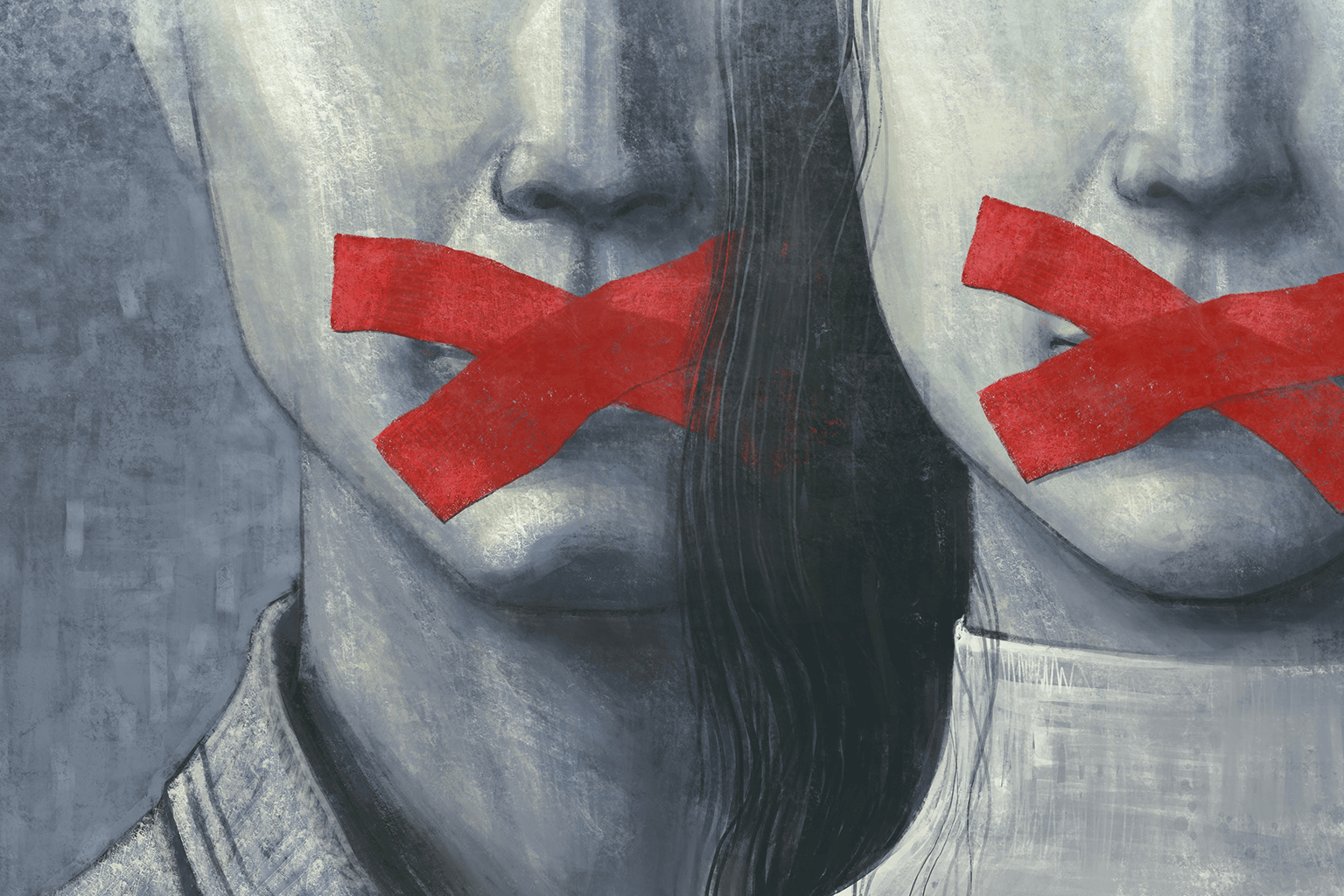
The carol says “Silent night, holy night.” Our politics has its own version now. A Silent Right that treats its caution as virtue and its silence as holiness.
When people talk about censorship in America, they usually point to the Democrat Party, to universities, or to the institutions that have spent years treating disagreement as violence. What most readers miss is that a quieter form of suppression has grown inside the movement that claims to oppose all of this.
I learned this lesson as An Inconvenient Black Truth approached 100,000 views. It reached liberals, independents, and conservative activists. It was shared organically because ordinary people recognized something they rarely see in public conversation. A direct answer to the question every major poll hints at but most institutions refuse to address.
After the article took off, I reached out to prominent conservative voices. These were people who spoke constantly about censorship and the moral price of silence. They run platforms with large followings and warn repeatedly that America cannot survive if its citizens stop speaking honestly.
Not one replied.
The silence was not logistical. It was informational. It revealed that conservative media has spent so long reacting to the left that it has absorbed many of the left’s habits. The strongest habit is the fear of saying something that does not fit within the accepted range of opinion.
This fear is not imagined. Institutions across the country have shown what happens when someone violates the new speech codes. Teachers suspended. Police officers reassigned. Employees dismissed over comments that conflicted with political fashion. The surprise is not that the Democrat Party enforces these norms. The surprise is that the conservative world has become shaped by them as well.
The silence I received was not personal. It was a symptom. Many of the same people who built reputations on fighting censorship now practice a softer version of it. They do not ban. They avoid. They do not threaten. They withdraw. And when a movement becomes afraid of its own message, it loses the very thing that gives it moral authority.
The Illusion of a Dissident Movement
Many people assume that conservative media operates as a counterweight to the Democrat Party. It feels true on the surface. They criticize the legacy press and expose failures in cities run by Democrat officials. They challenge Washington agencies that drift into political activism.
But once you look closely, the image of a dissident movement begins to fade. What emerges is the same hierarchy and incentive structure that dominates every major institution in the country, only decorated with different slogans.
The public believes these outlets are free. The incentives say otherwise.
Large conservative platforms rely on advertisers who do not want to be associated with ideas outside the accepted boundaries of public conversation. They rely on major donors whose influence grows behind closed doors. They rely on politicians who reward cooperation and discourage narrative disruption. These forces do not silence with force. They guide and filter.
In 2024, an American Enterprise Institute study found that many conservative commentators admitted privately that they avoided specific topics to protect relationships with sponsors, networks, and political allies. Their behavior mirrored the very newsroom pressures they often criticize.
As conservative media has grown more professional, it has grown more cautious. Institutions protect themselves, not their principles. They prefer controversies that can be managed rather than truths that create conflict. They criticize the border crisis, inflation, and urban decline. These are necessary subjects, but safe ones. None of them threatens the internal comfort of their own institutions.
This is not a movement without courage. It is a movement that has confused branding with bravery. As long as the appearance of opposition is profitable, the substance of it becomes optional.
The Psychology of Cowardice
Most moral failures do not begin with a dramatic confrontation. They begin with private calculations about reputation and risk. The reluctance to speak plainly is driven less by external pressure than by a psychological need for safety.
The first factor is the fear of reputation contagion. In a country where nearly every public and private institution monitors speech, associating with someone who speaks too directly about race, crime, immigration, or cultural decline is considered risky. By 2024, national surveys showed that more than half of Americans believed a single controversial statement could permanently damage their career. Conservative commentators operate inside that same culture. They understand that association alone can become a liability. Silence becomes the easiest choice.
A second factor is the pursuit of respectability. Many conservatives believe that softened language will reach moderates. This assumes that political persuasion comes from tone rather than clarity. The evidence says otherwise. People who reject traditional norms do not respond to mildness. They respond to power. Respectability does not persuade them. It only convinces conservatives to dilute arguments while their opponents strengthen theirs.
A third factor involves platforms. When YouTube altered content rules in 2023, several conservative channels covering crime saw their reach drop sharply. When Facebook reduced political content distribution in early 2025, both left and right outlets lost significant visibility. The algorithm delivered the message. Commentators took note. Once people depend on platforms for income, the urge to self-censor grows.
These pressures create a system that rewards the appearance of courage without its substance. Commentators know the crime data. They know the immigration numbers. They know the narratives pushed by the Democrat Party do not match measurable reality. Yet the fear of social punishment outweighs the responsibility to speak.
Cowardice in this context is not dramatic. It is incremental. It begins with one avoided subject, then another, until an entire range of truths becomes untouchable.
The Cultural Cost of This Cowardice
The reluctance to speak plainly does not remain within media studios. It filters into daily life in a country trying to maintain basic order and shared norms. When people at the top choose caution, people at the bottom learn that caution is the only safe response.
Schools offer a clear example. Between 2019 and 2024, Department of Education data showed a steady decline in classroom discipline and a sharp rise in chronic absenteeism. Many teachers reported feeling unable to enforce rules because any firm response risked being interpreted as bias. Colleagues who tried to address these issues publicly faced investigations or removal. Teachers learned that truth carries penalties.
Police departments faced a similar collapse. By 2023, officer resignations were more than forty percent higher than in 2019. Officers became hesitant to intervene because they knew that the political climate blurred the line between enforcement and accusation. FBI data from 2024 confirmed rising violent crime rates in several major cities, yet officers understood that explaining why could result in disciplinary review. Silence became a method of survival.
Ordinary citizens watched these changes unfold. They noticed the growing gap between official statements and observable reality. They saw media outlets, including those that oppose the Democrat Party, avoid the most difficult subjects. This avoidance erodes public trust. By 2025, Gallup recorded confidence in public schools, Congress, television news, and large corporations at or near historic lows.
A society cannot function when its citizens no longer believe that the people in authority will speak honestly. The cost appears in classrooms that cannot teach, neighborhoods that cannot stabilize, and public debates that never reach the central questions.
The Mirror Effect: The Right Becomes the Left
The left uses institutional power to silence disagreement. Universities restrict speech. Media companies police language. Bureaucracies enforce ideological norms through policies that punish dissent.
The conservative world rejects these tactics publicly, yet often mirrors them in practice. Instead of banning speech, it ignores it. Instead of policing language openly, it polices it by omission. When a subject threatens internal alliances or donor relationships, it simply disappears from discussion. The mechanism differs, but the outcome is identical. The range of acceptable views narrows.
Historically, groups that try to resist cultural pressure often adopt the habits of the forces they oppose. Fear creates imitation. Conservative outlets want to challenge the left without appearing too different from the cultural environment the left has constructed. They try to avoid conflict by avoiding truth. They succeed in avoiding conflict but fail to preserve honesty.
The effect is clear. The public hears about symptoms, not causes. They hear that the Democrat Party has mismanaged cities, but not why those failures follow predictable patterns. They hear that the border is collapsing, but not how immigration policy affects wages, crime, and public resources. They hear that cultural norms are weakening, but not the deeper forces driving that decline.
The gap between the two political camps becomes smaller than either side admits. The left says you cannot say something. The right says you should wait until it is convenient to say it. Both positions produce silence.
The Future Belongs to the Unmanaged
Every era produces voices that rise outside the institutions that claim to shape public thought. Today those voices appear through Substack, independent podcasts, newsletters, and small research channels. Their shared strength is independence. People who speak without permission end up influencing the culture more than those inside rigid systems.
This shift is measurable. In 2025, independent newsletters and podcasts accounted for a growing share of national political engagement. Reader time, sharing rates, and subscription growth for decentralized writers outpaced many traditional outlets. The reason is simple. Trust in major institutions is collapsing, and people are turning to individuals who speak plainly.
The success of An Inconvenient Black Truth followed this pattern. It spread without assistance from institutional media because it confronted realities that major outlets avoid. Readers recognized the difference between commentary shaped by committees and commentary shaped by evidence and experience.
This is the advantage of independence. It allows truth to move directly from writer to reader. An independent writer cannot hide behind a network brand. If the work is weak, readers leave. If the work is clear and supported by facts, readers stay and bring others. Courage becomes a competitive advantage.
The future belongs to the unmanaged because they are the only ones who still treat truth as a responsibility rather than a calculation.
A New Code of the Honest
The country cannot correct itself until people begin to speak in public with the same clarity they use in private. Every major issue facing America has been made worse because influential people have chosen safety over truth.
The first step is to stop waiting for institutions to rediscover courage. They will not. Their incentives are fixed. Universities protect reputations. Media companies protect advertisers. Political organizations protect access. Even conservative outlets that oppose the Democrat Party operate inside boundaries they rarely admit.
The second step is consistency. Facts do not become less relevant because they are inconvenient. Crime does not decline when its causes are ignored. Immigration does not stabilize when its consequences are dismissed. Cultural decline does not reverse because institutions pretend the problem is less severe than it is. A new code of honesty requires describing reality even when that description conflicts with political goals.
The third step is resilience. America has entered a period in which plain speech carries social penalties. Many people know the truth but wait for someone else to say it. They watch to see who will bear the cost. Yet there is no path back to cultural stability that does not involve individuals accepting the price of honesty. That price is smaller than the country believes. The consequences of silence have been far greater.
Every society reaches a moment when its official language becomes too far removed from observable facts to command respect. America is in that moment now. The only reliable path forward is a renewed commitment to plain speech.
If truth costs reputation, then reputation is the cheapest price any of us will ever pay.
Help Keep Honest Speech Alive
Everything in this essay exists for one reason. Institutions are afraid to tell the truth. The people inside those institutions feel the same pressure. They learn to soften their voices, avoid certain subjects, and wait for someone else to speak first. That is how a country loses its honesty.
Independent work survives only because readers choose to support it. There is no network behind me. No party donors. No advertisers shaping the message. It is just me, my desk, and the responsibility to say what others are afraid to say.
If this work matters to you, here are the ways to help.
Become a Paid Subscriber
Your subscription is what makes this work possible. It buys the time needed to research, write, and publish without seeking permission from any institution. It keeps the lights on and gives me the freedom to speak plainly.
[Subscribe here]
Make a One-Time Gift
If a subscription is not the right fit, a one-time contribution still makes an enormous difference. It fills the gaps that allow me to write pieces that no editor, network, or committee would ever approve.
[Contribute here]
Join The Resistance Core
The Resistance Core is the community of readers who want to help build something larger than a single newsletter. It is the infrastructure that keeps independent writing strong and makes sure the truth has a place to stand.
[Join here]
Become a Cornerstone Supporter
Some readers have the ability to make a larger commitment. These are the people who ensure that independent work does not bend to political winds or financial threats.
If you are able to give at the ten thousand or twenty thousand level, you become a foundational partner in building a media project that answers to readers alone. This level of support allows me to expand investigations, hire research help, and create work that institutional media avoids because it cuts too close to the truth.
Please reply directly to this email or message me here to arrange a confidential conversation.
What Your Support Builds
Truth that is not shaped by donors or political parties.
Research that is not filtered through institutional fear.
Writing that speaks directly to readers without hesitation or euphemism.
A future where plain speech remains possible because ordinary people insisted on it.
If You Cannot Give
Sharing the work matters just as much. Independent writers grow because readers carry the truth farther than any institution will.
This project survives for one simple reason. People like you still believe America deserves honesty. If truth costs reputation, then this is where we choose to pay that price together.
As a paid subscriber I certainly hope your work flourishes with new followers. As I read your article I thought of the current attempt at "speech code" enforcement on Trump related to governor Walz and Omar. Of course the left is all over it, but so are many on the right, those you have just described. Those that prefer "softer language and approved narratives." I often think Trump's remarks are crude and unbecoming a president; however, when I stop and consider the fact for years we have all been systematically programed to accept euphemisms instead of truths, I welcome his blunt language. For example, the conversion of "illegal alien > undocumented," "homeless > unhoused," "homosexual > alternative lifestyle," there is a long list of such "reimagined" terminology which is straight out of Orwell's "Ministry of Truth." This is the very definition of "misinformation" because it hides truth by distortion.
I think you are correct, conservatives are participating in this farce. The more I think about it, the more I welcome blunt, crude comments which cut through the soft, half-baked bullcrap. Looking at the absolute larceny in Minnesota, Trump was right about Walz and Omar, even if the language was crude, it is accurate. If we are to preserve individual liberty, we need more people like yourself, willing to speak truth to the central causes of our problems, regardless of party affiliation. I first became familiar with your work through "An inconvenient black truth." I was impressed by the raw fact-based reporting and wanted more of it. I wish more freedom loving folks would get acquainted with your work as well.
Thoughtful column. And, true.