

The Democrat Party doesn’t need to break the law to move your money.
It only needs to redefine the words.
One of the oldest skills in politics is the ability to mislead people without technically lying. A clever speaker can tell the truth in a way that hides more than it reveals. Over the past few decades, the Democrat Party has turned that habit into something closer to a governing philosophy. Nothing shows it more clearly than the insistence that illegal immigrants receive no taxpayer-funded benefits.
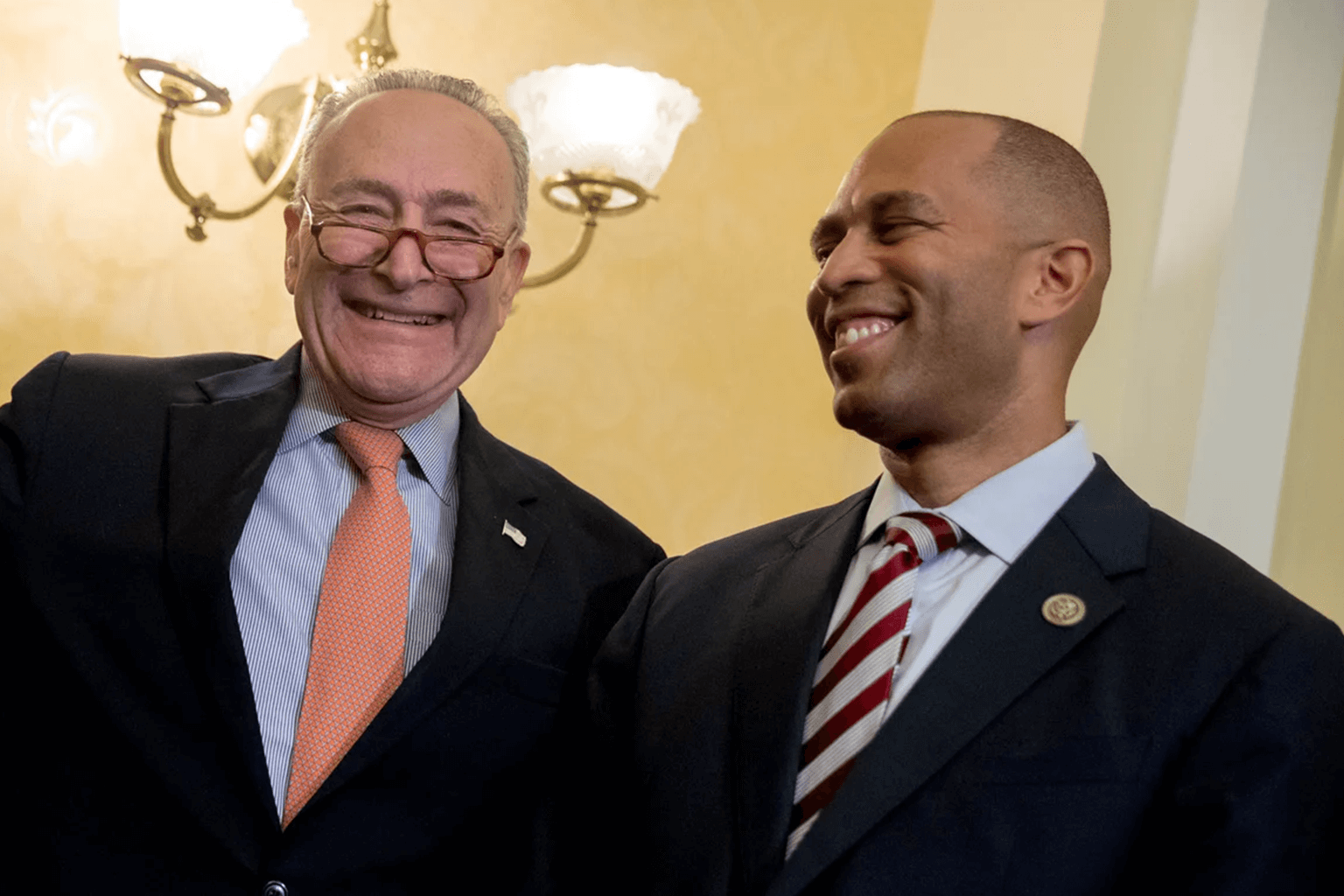
When reporters pressed party leaders during the 2025 budget battles, Chuck Schumer and Hakeem Jeffries reached for the same scripted line. Schumer declared, “Not a single federal dollar goes to providing health insurance for undocumented immigrants. Not one penny.” Jeffries followed with the legal version: “Federal law prohibits the use of Medicare, Medicaid, and CHIP to provide health insurance to undocumented immigrants. Period. Full stop.” The cadence was so rehearsed you could swap the names, and no one would notice. The whole point was to sound final.
These sentences are lawyer-crafted masterpieces. They are technically correct in the same way a magician’s patter is technically honest. What is said can be true, while what the audience believes is false. The reason the words are repeated so precisely is that the reality behind them is too embarrassing to state plainly.
Federal law does forbid illegal immigrants from enrolling directly in Medicaid or Medicare. But what Washington forbids with one hand, it subsidizes with the other. Hospitals treat uninsured patients and bill emergency Medicaid after the fact. States create “state-funded” programs that still run through the same federal infrastructure and reimbursement machinery. Illegal alien parents of U.S.-born children handle benefit cards and deposits “for the child.” The legal paperwork keeps categories tidy. The dollars still move. Billions of them, year after year, routed through enough intermediaries that the fingerprints are harder to see.
That gap between what is legal in wording and what is real in practice is not an accident. It is how a political machine protects itself. By pretending that technical ineligibility equals nonexistence, the Democrat Party maintains a moral posture of compassion while dodging the fiscal consequences of its own policies. The media’s role has often been to guard that illusion, policing language instead of tracking outcomes. It is easier to label something a “false claim” than to follow a trail of reimbursements, waivers, and cross-program transfers.
The habit predates this debate. The government learned long ago, especially in the Great Society era, that grand programs survive only when voters do not look too closely at results. In his later years, Thomas Sowell repeatedly pointed out that the welfare state is judged less by what it accomplishes than by how nobly it is sold. When reality contradicts the sales pitch, politicians change the vocabulary, not the policy. That same instinct now governs the discussion of immigration benefits.
The consequences are not trivial. Every dollar spent to maintain this fiction is also a transfer of trust. It teaches citizens that words no longer signify reality, that “federal” can mean “state,” and that compassion requires concealment. Once that lesson settles in, objective truth becomes negotiable. The country can survive waste for a while. It cannot survive the normalization of deceit.
What is taking shape is less a policy dispute than a philosophy of governance. Outcomes matter less than appearances, and the right feelings justify evasions. That mindset has burned trillions over the years under different labels: poverty relief, equity programs, and climate spending. The immigration version may be the most brazen because the political class insists the problem does not exist, precisely because it depends on the problem remaining unresolved.
Schumer’s “not one penny” hangs in the air the way most official assurances do: like a promise from someone who already knows the wording is doing the work, not the truth.
The Political Script
When politicians repeat the same sentence verbatim, it usually means the polls wrote it. The Democrat Party learned years ago that the safest defense is not accuracy but confidence. You write a phrase that sounds airtight, drill it into every spokesman and surrogate, and repeat it until it becomes accepted reality. The claim that “not one federal dollar” goes to illegal immigrants is one of those phrases.
The timing of the latest version was no accident. In the fall of 2025, Congress faced another funding standoff. The administration wanted stricter enforcement of eligibility rules in welfare programs. Democrats sought to block changes that threatened the state systems on which they rely. When reporters asked whether their defense of Medicaid funding included benefits flowing to illegal immigrants, leaders like Schumer and Jeffries had their line ready. They delivered it with television precision: “Federal law prohibits the use of Medicare, Medicaid, and CHIP to provide health insurance to undocumented immigrants. Period. Full stop.” The pause after “period” was not for clarity. It was for the camera.
The average viewer heard certainty and moved on. The phrase was designed for that. It gave Democrats moral cover in two words: federal law. Anyone who challenged it could be waved off as ignorant or bigoted. The entire dispute was reduced to legal semantics rather than practical results.
Behind the soundbite is a strategy that has been in motion for decades. Democrats built a coalition that depends on growing immigrant populations, legal or not. They also built their identity around being the party of compassion. Those goals collide the moment voters ask who bears the cost. To keep both, they had to separate what they say from what the system finances.
The script works because the underlying machinery is complex enough that few people can follow the money. Federal and state Medicaid systems are so tightly linked that accountability becomes unclear. When a state like California uses Medi-Cal to cover illegal immigrants and then receives emergency reimbursements through federal channels, both sides can claim innocence. The state says it used “state money.” The federal government states that it reimbursed only “emergency care.” The paperwork satisfies the lawyers and leaves citizens with the impression that no one paid for anything.
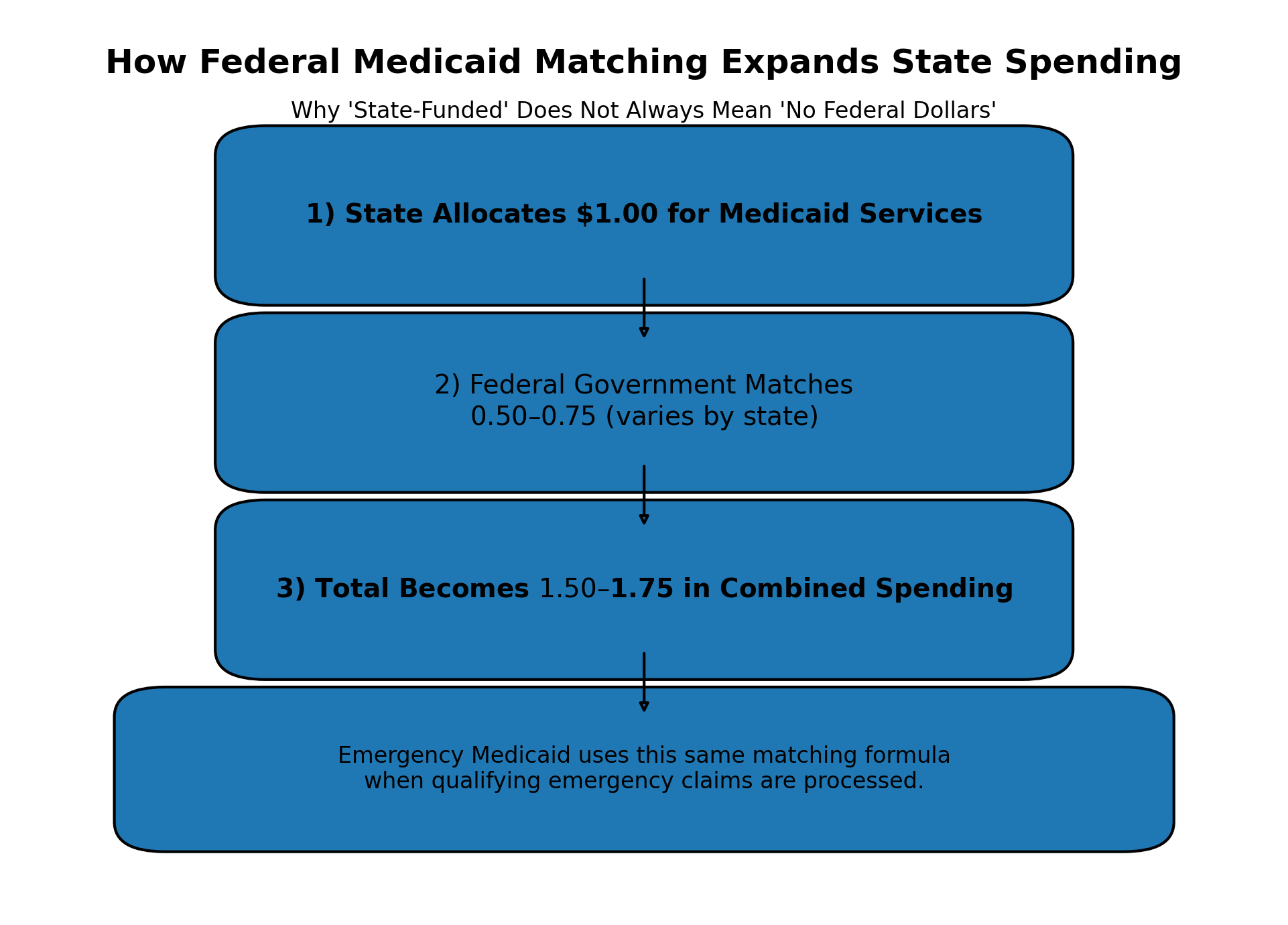
Democrats have learned that complexity gives rhetoric room to breathe. Every layer of bureaucracy creates another excuse. When challenged, they fall back on the same shield: “The law forbids it.” They rarely mention how weak enforcement is, how limited data sharing can be, or how often citizenship is treated as a box checked on trust. In practice, many systems are built to avoid asking questions that would create political friction.
The script has another advantage. It sells virtue at wholesale prices. By denying that illegal immigrants receive benefits, Democrats avoid the harder question of whether the policy itself makes sense and whether it benefits the American taxpayer. They can continue to present themselves as both a generous nation that helps the poor and a responsible government that protects taxpayers. The contradiction disappears behind a cloud of carefully chosen words.
This method is now standard in modern politics. A statement’s success depends less on whether it clarifies reality than on whether it sounds good while being repeated. The same pattern shows up across Democrat talking points, from climate subsidies to housing policy. But in the case of Medicaid and illegal immigration, the stakes are higher because the words shape public understanding of who is paying for whom. Many Americans believe the country cannot afford its own citizens’ healthcare, yet they are asked to believe that billions spent on emergency services for illegal residents somehow cost “not one penny.”
The people who repeat these lines are not naive. Bureaucrats brief them on the flows of money. They know how hospital claims are submitted, how states blend funds, and how audits can expose reimbursements that contradict the public messaging. They also know that most voters will not read audits. What voters hear is the rhetoric. What bureaucrats hear is permission.
If words were currency, the Democrat Party would be running a printing press. The script has kept the issue frozen for years. Every time someone points to the real mechanisms, party spokesmen recycle the same sentence that makes the evasion possible. They treat repetition as proof. And in politics, repetition often wins.
The irony is that this is the same rhetorical move Democrats accused others of using decades ago. When welfare programs were questioned in the 1990s, party leaders insisted the spending was humane and manageable. When costs rose and results fell short, they changed the labels rather than confront the evidence. “Safety net” replaced “welfare,” just as “state funded coverage” replaces “Medicaid dollars.” The pattern remains. Only the vocabulary changes.
The political script did more than save face. It preserved the core narrative that compassion is always the government’s job and that any limit on spending must be cruel. Once that idea took hold, policy shifted: dependence was no longer treated as a failure but as a political asset. Because dependence is difficult to justify to the people paying for it, the quickest way to keep it acceptable is to disguise it, to route it through definitions, and to insist that the money being spent is not really theirs.
When words can do that kind of work, facts struggle to compete.
Concrete Examples and Quotes
It is one thing to describe political language. The point becomes real when you look at what the words are hiding. The Democrat Party’s claim that illegal immigrants receive no federal benefits collapses the moment you trace where money actually goes. Facts, as John Adams said, are stubborn things.
Consider California. Under Medi-Cal, the state opened full health coverage to adults who were in the country illegally. By 2025, approximately 1.4 million people were covered at a cost of more than $ 12 billion per year. Governor Gavin Newsom insisted this was “state-funded” and therefore not a burden on American taxpayers. Yet California still receives federal reimbursements for emergency services through what bureaucrats call emergency Medicaid. The same hospitals use the same systems, and federal infrastructure processes the claims. The state may sign checks in one category, but Washington still pays in another. If that does not count as a federal dollar, then language has ceased to mean anything.
Oregon and Illinois offer similar examples. In both states, audits conducted by the Centers for Medicare and Medicaid Services in 2025 found that federal funds had been misused to pay for health care for noncitizens. Dr. Mehmet Oz, then heading the agency, said plainly that “some states have pushed the boundaries, putting taxpayers on the hook for benefits that are not allowed.” That statement received little coverage outside the financial press. Where it was mentioned, reporters often framed it as “disputed” before offering state denials. Once the states labeled the issue “emergency reimbursements,” much of the press treated it as settled.
The pattern repeats across the country. New York’s Essential Plan provides coverage “for all residents regardless of status.” The governor called it an act of humanity. Buried in budget documents are references to federal supportive subsidies that allow politicians to claim the dollars support “operations,” not “care for illegals.” The effect is the same. Money moves. The public hears a carefully edited version of what happened.
Even nationwide, government accounting tells a different story than Schumer’s “not a single federal dollar.” In 2022, emergency Medicaid spending for undocumented immigrants accounted for approximately 0.4% of the total program. That sounds small until you translate it into dollars. It amounts to approximately four billion. Add overlap with state programs like Medi-Cal, and the number grows far beyond what most voters imagine when they hear “not one penny.”
These examples show why the statute itself does not prevent the flow of money. It creates a technical distance between the cash and the beneficiary, so television spokesmen can say, with a straight face, that no benefit was given. The game is played in definitions. Hospitals are reimbursed. States file claims. Funds are categorized. Once the words are adjusted, legality is restored, and the public is told the system functions “within the limits of federal law.”
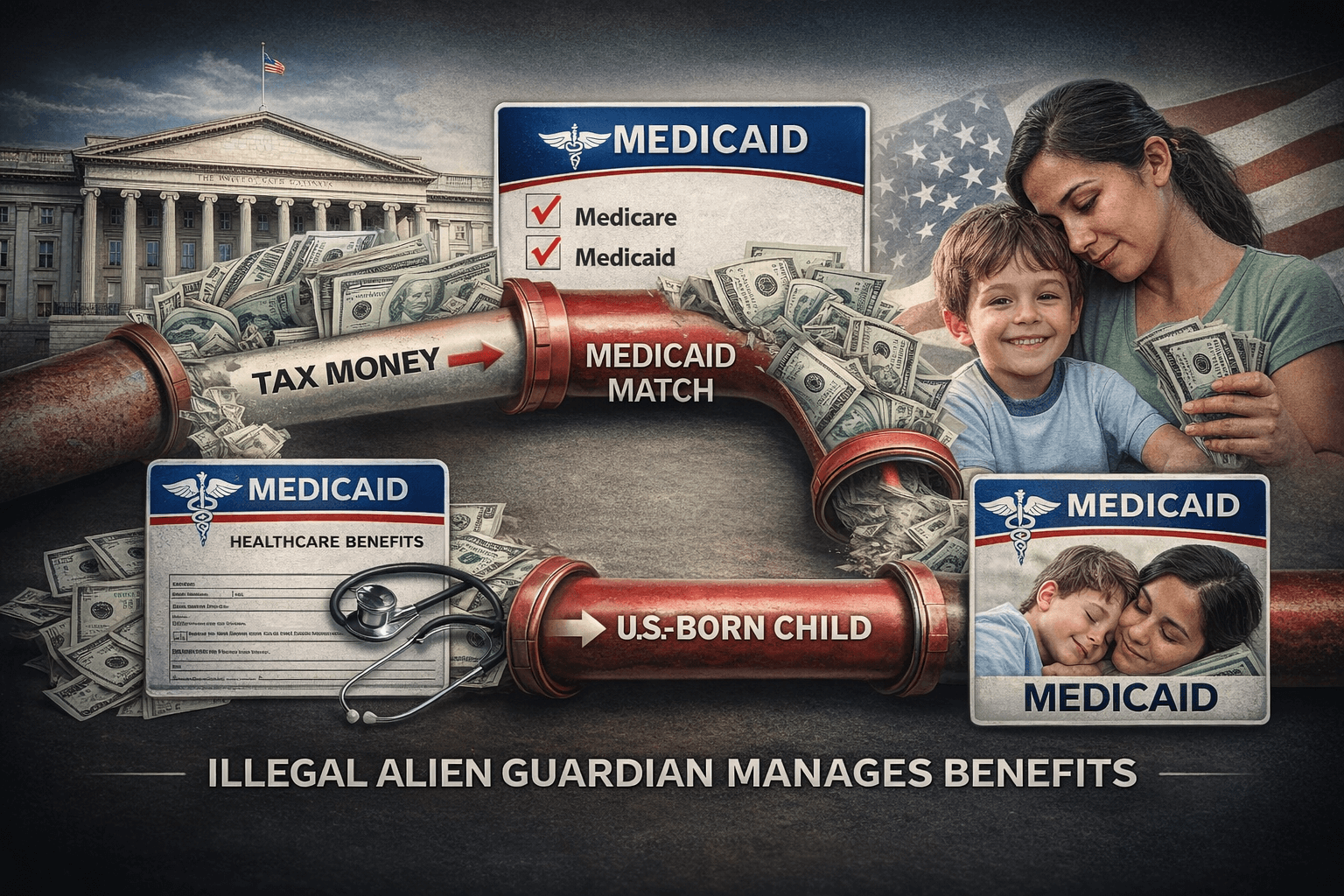
The same verbal gymnastics show up in nutrition and assistance programs. Citizenship criteria often apply to the named recipient, not to who controls the benefit. An undocumented parent applies on behalf of a U.S. born child. The account is opened in the parent’s name “for the child.” The parent uses the funds. The system counts it as a benefit to the infant. Politicians then swear that “no illegal adult receives cash assistance.” Technically true. Practically ridiculous.
The deeper problem is not only the dollars but also the deliberate blindness that enables them. When CMS audits identified misuse, the states involved were not treated as criminals. They were told to tighten reporting. That was the end of it. There was no scandal because many major outlets refused to treat it as one. Officials learned they could continue as long as they used the right language. In modern government it is often enough to rename what you do rather than hide it.
The numbers are large enough to ruin the pose of ignorance. Medicaid alone costs around 800 billion dollars annually. Even a sliver of misuse equals real money. Imagine running a business that lost billions each year on payments to ineligible clients while your spokesperson went on television to say, “Not a dime.” In private industry that would be called fraud. In politics it earns applause.
A few Democrats occasionally admit pieces of the truth in quieter settings. A state health official in New York, asked by a local reporter in January 2026 whether federal funds were used in the Essential Plan, answered candidly: “Technically no, but practically yes, because it all runs through the same infrastructure.” The quote was cut. Another analyst in California admitted on background that federal reimbursements would dry up instantly if eligibility were strictly separated in practice. That is as close as the public usually gets to honesty.
Those who still believe Schumer’s claim should try a simple test. If no federal dollars truly go to illegal immigrants, why does the federal government maintain programs like emergency Medicaid and reimbursements for uncompensated care? The existence of those programs answers the question. No one establishes a reimbursement channel for something that never occurs.
Facts will not change political rhetoric, but they matter for anyone who wants to see how far the country has drifted from basic honesty. The issue is not generosity toward the poor. Americans have always been capable of generosity. The issue is deceit, the habit of disguising spending as virtue and shouting “federal law” whenever the numbers surface. The politician who plays that game counts on public ignorance. The journalist who repeats him counts on public trust. Together they form the circuit that keeps the system running.
The Media’s Job
When politicians construct a fiction, someone has to keep it alive. That job has fallen to the national press, which too often behaves less like a watchdog and more like a public relations arm of the Democrat Party. The story of “no benefits to illegal immigrants” could not survive without reporters willing to protect it from scrutiny.
In healthier times, the press competed to investigate what the powerful wanted hidden. Today, its pride often lies in defending the same people from embarrassment. Nowhere is that clearer than in how journalists “fact check” government benefits. The method is predictable. They begin with a claim such as “illegal immigrants receive healthcare at taxpayer expense.” Then they redefine terms. By narrowing “receive healthcare” to mean “formally enrolled in Medicaid,” they can declare the statement false. The reader nods, reassured. The complex truth disappears under one confident paragraph.
This inversion of journalism into advocacy has trained the public to respond to cues rather than information. NPR reports that immigrants “are already barred from Medicaid.” The New York Times repeats that “federal law explicitly forbids these benefits.” The Los Angeles Times quotes state officials denying misuse and rarely demands receipts. Most articles end with an approved expert confirming the official line. It is not that the facts are impossible to find. It is that the press often refuses to treat the money trail as the story.
Take the coverage after the CMS findings in 2025. When the agency reported that several states had pushed reimbursement boundaries, major networks largely ignored it at first. When it became unavoidable, some framed it as an “accusation” rather than an audit or enforcement action. CNN labeled the report “disputed” even when the underlying numbers were not actually refuted. When Oregon and Illinois called the dollars “emergency reimbursements,” reporters treated the label as a resolution. If a private company tried that move, the same journalists would call it fraud.
The media’s role is not confined to shaping opinion. It also deters whistleblowers. Anyone who contradicts the narrative risks being branded politically motivated. The few who speak are framed as outliers accused of misunderstanding “complex funding mechanisms.” Complexity is the place propaganda hides.
This matters because when the press chooses sides, accountability breaks. Citizens cannot correct policies they are never told exist. Public conversation becomes morality theater instead of evidence. Pundits ask whether America should “show compassion” while skipping the arithmetic of what their compassion costs. The result is national debate rich in emotion and poor in numbers.
The deception works because the media operates as a moral filter. Once an idea is sanctified as kindness, analysis is treated as cruelty. This selective morality has produced more ignorance than censorship ever needed. A false assumption repeated by trusted voices can override a library of facts. Even the phrase “fact check” now functions like a spell, stopping thought the moment it appears.
Thomas Sowell once wrote that modern media treat words as a substitute for reality rather than a description of it. The point was not style. It was power. When an industry decides its job is to preserve a narrative instead of pursue truth, it stops informing and starts persuading. The cost is borne by citizens who live in a manufactured reality where sincerity counts more than evidence.
The public still believes it is informed because it hears constant repetition. But repetition is not knowledge. When every station airs the same talking points, it feels like a consensus. The individual who questions that consensus is told to “check the facts,” unaware that the facts have been pre-selected and sterilized. That is how a free people end up living by slogans while their money funds the very things they were told did not exist.
The press once justified its privileges by performing a public service. As it continues to trade that duty for partisanship, it has lost all credibility that it will ever regain. Eventually, even loyal readers tire of being treated like children. The hope is that enough people begin asking the simple questions that force real answers: Where does the money go? Who writes the checks? Who gets reimbursed? If journalists ever return to those questions, much of the deceit around Medicaid and illegal immigration would collapse quickly. Until then, the story remains what it has always been: not a truth, but a slogan dressed up as one.
What They’re Really Protecting
Politics is often less about what leaders say they believe than about what their interests require them to protect. When it comes to illegal immigration and the flow of benefits, the Democrat Party’s core concern is not justice or compassion. It is power. Everything else is decoration.
The system serves several political purposes. It keeps population numbers high in states that are already losing native-born residents. The Census does not distinguish between citizens and noncitizens when enumerating persons for apportionment. Every million residents, lawful or not, can translate into congressional clout and more weight in the Electoral College. The same counts influence the distribution of federal grants. The incentive is obvious. Import population, import political influence.
That helps explain why Democrat strongholds like California, New York, and Illinois act as sanctuaries even as working-class neighborhoods strain under rising costs. The burden falls hardest on citizens at the bottom of the wage ladder, not on the pundits and activists promoting the policies. But politicians need numbers more than they need prosperity. A district that grows through migration, even illegal migration, is a district that keeps them in office.
Another motive lies in the long game of amnesty. By allowing illegal immigrants to remain and participate indirectly in public programs, Democrats build a case for legalization later. They can argue that “these people are already part of the system.” The public that was told no benefits were being distributed will later be told that the recipients have earned legalization through the very benefits previously denied in public rhetoric. The contradiction is useful. Policy drift today becomes moral leverage tomorrow.
Keeping illegal immigrants economically afloat also sustains the network of Democrat allies who depend on government funding. The maze of nonprofits, advocacy groups, and agencies administering these programs forms a massive patronage system. It channels salaries, contracts, and grants to people who reliably vote, donate, and campaign for the same party that keeps the money flowing. When the government writes a check for “community outreach” or “public health navigation,” it is often funding activism under a bureaucratic label.
This is not new. Great Society programs followed a similar path. Poverty was not eliminated, but the administrative apparatus multiplied. Sowell often noted that success was measured by how many people were processed, not how many escaped dependence. Today, the same logic is applied to immigration: constant assistance is marketed as reform, dependence is marketed as inclusion.
There is also moral vanity. Many officials overseeing these programs have convinced themselves they are rescuing the nation from the sins of inequality or prejudice. Opposing illegal immigration becomes, in their moral framework, opposing compassion. That posture protects them from asking whether outcomes match intentions. When policies fail, they blame the electorate for cruelty instead of examining the policy. The self-image of moral superiority is why waste and fraud do not trigger reform. The narrative must be preserved.
Behind these motives runs a quieter calculation. By sustaining a population dependent on assistance and legal ambiguity, Democrat leadership ensures permanent demand for government. Every program that keeps people half in and half out of the system becomes justification for expanding the system. Dependence becomes an asset to manage. Because much of the middle class lacks the time and information to verify what is being done in its name, the cycle can continue.
The pattern would be easier to excuse if it produced results. Instead, it weakens institutions. Schools and hospitals near the border strain. Wages stagnate. Budgets buckle under expansions sold as temporary and never rolled back. Even residents who once sympathized with sanctuary rhetoric grow frustrated when services become unreliable. Compassion without limits cannot coexist with solvency.
In every period of history, those who promised generosity using other people’s money eventually met arithmetic. Arithmetic always wins, though it can take time. By then, the damage is not only fiscal. It is moral. Citizens lose trust in words. Government loses legitimacy. Leaders may gain another election, but they lose the credibility that any stable democracy depends on.
Who Profits
It is tempting to see government spending as a contest between recipients and taxpayers. In reality, the major beneficiaries often sit in the middle: the managers, contractors, consultants, and institutions that administer the programs. Bureaucracies feed on dependency. The more complicated the rules, the more experts are needed to interpret them. The story of Medicaid funds flowing to illegal immigrants is not only a moral issue. It is an industry.
Every expansion of the welfare state brings with it a new class of people whose livelihoods depend on the program’s continuation. Healthcare assistance is no different. Behind every dollar that reaches a patient, additional dollars go to administrators, social workers, and nonprofits hired to keep the machinery moving. This is the hidden half of spending: people who earn comfortable incomes managing dependency rather than reducing it.
Hospitals in sanctuary states have learned to rely on federal disproportionate share payments and other reimbursements meant to cover the cost of treating the uninsured. A portion of those patients are illegal immigrants. Each additional case strengthens the argument for larger subsidies. A crowded emergency room becomes proof of “need,” and need becomes leverage in the next budget cycle. Disorder becomes financial security.
Nonprofits operate under similar incentives. Groups describing themselves as immigrant rights advocates receive government grants for outreach, navigation, and language access. They file paperwork, arrange appointments, and train applicants to navigate the system. Each success serves as a metric for renewing funding. To the public, they are charities. In practice, they are brokers expanding a client base of dependency.
Even state agencies profit from confusion. California’s approach illustrates the loop. The state imposes taxes on managed care providers, uses the revenue to draw matching funds, then spends through categories that make the funding look “state-based” while the broader structure remains intertwined. Both state and federal actors benefit from the arrangement. The payer is the citizen whose taxes underwrite the system, while labels keep the public calm.
Lobbyists tie these interests together. Hospital associations, insurers, and pharmaceutical firms profit from Medicaid growth. Their lobbyists pressure lawmakers to protect the funding stream. When someone proposes stricter eligibility checks, the same warnings appear: it will cost more to administer, patients will go untreated, and lawsuits will follow. These arguments protect cash flow, not human welfare.
The economic consequences reach beyond healthcare. Programs like SNAP and TANF generate contracts for benefit card systems, data services, and software maintenance. Large firms compete for those contracts. The overlap between welfare management and corporate profit is now deep enough that neither side retreats easily. It is not ideology but revenue that makes the alliance between big government and big business so durable.
Over time, those who profit most develop a strong interest in maintaining sympathy for the system. They lobby under the banner of compassion, but the real objective is predictable funding. Sowell’s point years ago was blunt: as programs expand, poverty becomes a way of life not only for recipients but for those administering aid. What began as temporary help becomes permanent careers. The modern immigration bureaucracy extends that logic to a new population.
The media often present this as evidence of generosity. In reality, it is evidence of inefficiency. The more intermediaries between taxpayers and outcomes, the more money vanishes before reaching its stated goal. A complex bureaucracy cannot be humane because it prioritizes procedure over results. Those who live off the programs defend them because thousands of paychecks and reputations depend on their continuation. To question the structure is to threaten an entire class of beneficiaries.
When large sums circulate through multiple layers of approval, corruption need not be overt. The system simply drifts toward the interests of the people managing it. The tragedy is that taxpayers believe their dollars are lifting people out of hardship when much of the money never leaves administrative channels. Misplaced compassion becomes a steady income for bureaucrats.
Every society eventually learns that government help can behave like a drug. It creates its own clientele. As long as people gain by distributing other people’s money, there will be no shortage of justifications for doing more of it. The only question is how long the public continues to buy the story.
Why This Works on the Public
Every system built on deception depends on a public that finds the lie comfortable. The mechanics behind the Medicaid racket are complex, but the reason it works is simple. Most people do not want to believe their leaders are deceiving them, and they do not have time to prove otherwise.
Few Americans understand how Medicaid financing works. They know it exists, that costs are high, and that large bureaucracies claim to have safeguards. That ignorance is not stupidity. It is normal life. People worry about groceries, rent, premiums, and their own bills. They do not track how a hospital files reimbursement categories across agencies. Politicians live off that gap.
Public confusion allows official words to replace facts. When voters hear “not one penny,” they assume the speaker could not say it if it were not true. They might distrust the motives, but they still trust the sentence because it sounds precise. The difference between how money is labeled and how it moves is invisible to them. That is what modern propaganda exploits. It uses limited attention against the listener.
Human sympathy also plays a role. Americans dislike cruelty. Political rhetoric exploits that decency. When someone points out that illegal immigrants receive taxpayer-funded care, defenders respond with an emotional question rather than an accounting question: Should we let people die? That ends the conversation. The critic is compelled to debate compassion rather than policy. By shifting the debate from mechanics to pity, the policy becomes immune to audit.
People also underestimate scale. When the press reports that only a small fraction of Medicaid spending covers emergency care for noncitizens, many stop thinking. They see a fraction and assume the issue is marginal. They forget that half a percent of a near-trillion-dollar program equals billions. Numbers lose meaning once they get big enough. The difference between hundreds of millions and billions feels abstract, so outrage fades. Bureaucrats count on that fatigue.
Moral intimidation also keeps people quiet. Anyone who insists that benefits should go only to citizens risks being labeled anti-immigrant. A journalist who digs into abuse risks being accused of amplifying hate. Words like fairness and accountability are displaced by inclusivity and empathy. Language shields failure.
Most Americans believe themselves fair minded. They hesitate to challenge anything marketed as humanitarian, even when it violates the law or self-interest. Politicians learned long ago that they can sell almost any program if it carries the right emotional label. This is the politics of self-congratulation: defining goodness by intentions rather than results. It lets voters feel noble while being exploited.
Education reinforces the problem. Civic literacy has collapsed. Many graduates have never seen a federal budget or learned how entitlement spending is structured. In that environment, slogans fill the space where understanding should be. “Federal law prohibits it” sounds definitive when people have never learned how exceptions, waivers, and reimbursements work. Where understanding is thin, the appearance of authority becomes power.
Technology compounds it. Public attention is now measured in seconds. A seven-word line outperforms a thousand pages of audit reports because the line confirms feelings while the reports demand thought. The people shaping opinion have learned to boil complexity into moral shorthand. Anyone who questions it becomes a target, and that discourages the next person from asking.
The outcome is a population that hears constant information but has less understanding. A person bombarded with short explanations of complex issues is not better informed. He is easier to manage. The government and its media allies have little incentive to address that. Confusion grants freedom of action.
The saddest part is that many who fall for this are not fools. They are trusting people who assume compassion and honesty belong on the same side. History teaches the opposite. Those who insist most loudly on virtue often use it to escape accountability.
The arrangement rests on a quiet contract between politicians and the public. Politicians promise to say the right words about compassion and fairness. Citizens promise not to examine the cost too closely. It is an agreement between comfort and conscience. As long as it holds, nothing changes.
What Must Be Done
Every generation reaches a point when evasion stops working. Arithmetic and human nature eventually expose the illusions governments build. The United States is approaching that point regarding immigration and welfare. The only question is whether reality is faced while reform is still possible or whether collapse makes it unavoidable.
A society that promises open borders and unlimited social benefits cannot survive on good intentions. Compassion detached from accountability leads to ruin. Restoring honesty requires steps that are predictable, whether taken early or later after unnecessary pain.
First, the country must end birthright citizenship for the children of illegal immigrants. The policy was not meant for this purpose. The Fourteenth Amendment recognized rights of freed slaves, not foreign nationals who entered without permission. Citizenship by location encourages illegal immigration by guaranteeing benefits that reach far beyond a child’s first medical visit. It transforms unlawful presence into a long term entitlement and gives politicians an excuse to avoid enforcement. Restoring meaning to citizenship is not cruelty. It is the foundation of a functioning nation.
Second, the federal government must separate data systems from state programs that deliberately blur legal distinctions. Medicaid’s architecture allows state agencies to blend funds through the same channels, hiding who receives assistance. CMS should require public reporting each year identifying reimbursements linked to noncitizens and publish those reports in plain language. Sunlight is not cruelty. It is the precondition for trust. If the public could see how money actually moves, the “not one penny” myth would collapse quickly.
Third, Washington should end the practice of contracting nonprofits to act as intermediaries between illegal immigrants and state programs. These groups perform government functions with less transparency than government agencies. If they wish to serve immigrant communities, they should do so with voluntary donations, not money extracted from people struggling to pay their own premiums. Compelled generosity is not a moral achievement.
Fourth, the law needs consequences. When hospitals, states, or administrators knowingly use federal funds for ineligible patients, the penalty should resemble what a private citizen would face for misuse of public money. Intentional violation of spending rules is not “stretching boundaries.” It is fraud. Permitting it invites more of it. Humanitarian care can coexist with enforcement, but not if enforcement is treated as theater.
Finally, the country must relearn the difference between helping people and subsidizing lawlessness. If the goal is to attract immigrants who build and contribute, rules must be clear and enforced. If the goal is permanent dependency managed by bureaucrats, then the current path continues. Democracy cannot function when laws are optional for some and compulsory for others.
None of these measures are radical. They amount to reintroducing integrity into a system that has relied on feelings. The issue is not whether America can show kindness. Americans have always shown kindness. The issue is whether kindness must come at the expense of law, truth, and solvency.
Sowell often argued that the welfare state succeeds politically because it fails in practice. Each failure justifies additional funding, and every expansion deepens dependence. If that remains true, then reform will come only when citizens refuse to be flattered while being robbed. One of the most compassionate acts a country can perform is to stop lying to itself.
“Period. Full stop.” makes a good soundbite. A nation’s survival depends on action, not punctuation. When arithmetic and honesty finally meet again in public life, slogans will fade, and reality will have the last word.
Independent writing like this does not come from institutions, political parties, or corporate sponsors. It comes from readers who believe truth matters more than slogans and arithmetic matters more than applause. If you value work that follows the money, challenges the narrative, and says what others won’t, consider supporting it.
Become a Paid Subscriber:
https://mrchr.is/help
If you prefer a one-time contribution to support the work:
Make a One-Time Gift:
https://mrchr.is/give
If you want to strengthen this platform at the highest level:
Join The Resistance Core:
https://mrchr.is/resist
Very good piece, Mr. Arnell. All factual. One suggestion from a dedicated paid subscriber: we live in a fast paced world. Shorter pieces would be more effectual. Be well. Write on.
The Cloward-Piven Strategy is not a conspiracy theory. We're watching it play out in real time...