

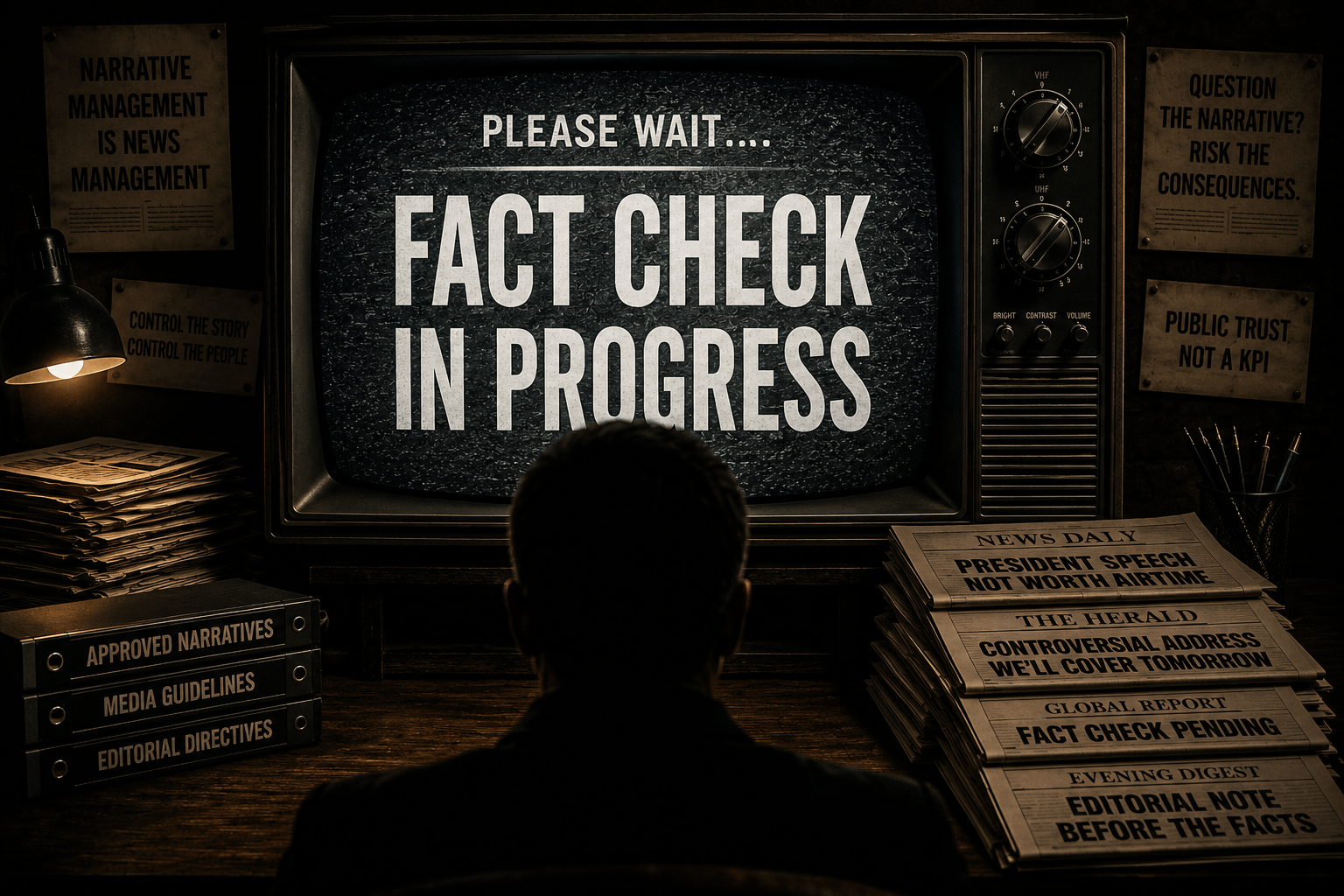
“Control the information, and you rarely have to win the argument.”
There was a time when Americans expected the press to show them the news.
Today, they increasingly expect the press to explain it, interpret it, fact-check it, protect them from it, and sometimes decide whether they should see it at all.
That change did not begin with Donald Trump. Politicians have always lied, exaggerated, and presented facts selectively. Thomas Jefferson complained bitterly about newspapers. Abraham Lincoln battled hostile editors. Franklin Roosevelt cultivated favorable coverage, while Richard Nixon believed much of the national press wanted him destroyed.
Bias is not new. What has changed is the assignment many journalists believe they have been given.
The traditional job of the press was to gather facts, verify them, place them in context, and expose dishonesty. Citizens were expected to hear competing arguments and decide what to believe.
Modern journalism increasingly asks a different question. Instead of beginning with, “Is this true?” it often begins with, “What will happen if people believe this?”
Once editors begin weighing information according to its political or social effect, journalism stops functioning only as a window and starts functioning as a filter. Stories are judged not merely by importance, but by whether they might strengthen the wrong politician, weaken confidence in an institution, or lead the public toward a conclusion the newsroom considers dangerous.
Some caution is justified. Social media spreads false claims rapidly. Foreign governments conduct influence operations. Artificial intelligence can manufacture convincing images, voices, and videos. Presidents cherry-pick evidence, omit inconvenient facts, and use public addresses as propaganda.
Donald Trump has often exaggerated, omitted context, and presented disputed claims as settled conclusions. So have presidents before him. That is why journalism exists.
Its purpose is not to protect citizens from hearing political arguments. Its purpose is to let them hear those arguments, investigate the claims, expose the lies, and provide the missing context.
A journalist asks whether a claim is true. A gatekeeper decides whether the public should hear the claim at all.
Public trust suggests that Americans have noticed the difference. In 1976, Gallup found that 72 percent of Americans had a great deal or fair amount of confidence that the mass media would report the news fully, accurately, and fairly. By 2025, that figure had fallen to 28 percent. Seventy percent said they had little or no confidence in the media.
Journalists often blame that collapse on polarization, declining readership, social media, online misinformation, and Donald Trump’s attacks on the press. Each explanation contains some truth.
There is another possibility: many Americans have concluded that the press no longer sees its primary job as informing the public, but managing it.
Three presidential speeches help explain why.
During the past decade, the major broadcast networks declined to carry three significant presidential addresses live to their national audiences. One was delivered by Donald Trump. The other two were delivered by Democrat presidents Barack Obama and Joe Biden.
That fact complicates the usual partisan explanation. If the networks refused speeches from presidents of both parties, perhaps they were simply exercising ordinary editorial judgment.
They had every legal right to do so. The First Amendment protects the right to publish and the right not to publish. No president may compel private broadcasters to carry a speech or punish them for refusing. Trump’s suggestion that networks should lose their licenses for declining his address was foolish and incompatible with a free press.
The question is why editors considered those addresses less worthy of broadcast than sitcoms, nature documentaries, or reruns.
Barack Obama was announcing one of the most controversial immigration actions of his presidency. Joe Biden was delivering a highly partisan speech at Independence Hall while Marines stood behind him and red lighting covered the building. Donald Trump was presenting newly released government documents involving election security, voter registration, foreign access, and cybersecurity.
The presidents, subjects, and political circumstances were different. The institutional instinct was remarkably similar.
Each speech collided with a narrative the national media had already spent years constructing.
Obama complicated the immigration narrative. Biden complicated the competency narrative. Trump complicated the election narrative.
That does not mean network executives met secretly and agreed to protect those narratives. Large institutions rarely need conspiracies when shared incentives and assumptions will do the work. Editors, producers, and reporters often share views about which stories deserve attention, require caution, or may produce harmful consequences without professional interpretation.
Instead of allowing citizens to hear a president’s complete argument and then judging it afterward, news organizations increasingly prefer to place the interpretation before the event, around the event, or in place of the event.
That is not merely bias. It reflects a different understanding of journalism.
Nowhere is that change easier to see than in the story of election security.
Election Security Wasn’t Crazy Until It Hurt the Wrong Candidate
Before Americans were told that questioning election systems threatened democracy, they were repeatedly told that questioning election systems was necessary to protect democracy.
The change did not occur because the machines suddenly became perfect, foreign governments lost interest in American elections, or computer networks stopped being vulnerable. It occurred after the political consequences of those concerns changed.
Following Donald Trump’s victory in 2016, election security became a national obsession. Russia had stolen and released Democrat emails, used social media to influence political debate, and probed American election infrastructure. The bipartisan Senate Intelligence Committee found that Russian government-linked cyber actors extensively scanned state systems, attempted to enter numerous election networks, and gained access to voter-registration databases in a small number of cases. The committee found no evidence that vote totals were changed, but it treated the attempted intrusions as a serious national-security problem.
That was a sensible distinction. Accessing a registration database is not the same as changing votes, just as discovering a vulnerability does not prove exploitation. After 2016, election security was discussed with enough precision to separate risk, attempted intrusion, and proven manipulation.
Hillary Clinton continued warning about those risks years after her defeat. Speaking at George Washington University in September 2019, she identified cybersecurity weaknesses as a threat to free and fair elections. Her concerns included remote-access software in election-management systems and ballot scanners connected to the internet.
Kamala Harris made similar arguments. As a senator in 2018, she agreed during a hearing that voting machines could be vulnerable to hacking. In 2019, she argued that paper ballots were the safest protection against foreign attacks.
Senator Ron Wyden was even more direct. After visiting the DEF CON Voting Village in Las Vegas, he described watching cybersecurity researchers compromise election equipment, alter votes, disrupt ballot printers, and interfere with registration systems. He did not claim those demonstrations proved an American election had been stolen. His point was that equipment controlling something as important as an election should not depend on the hope that nobody discovers its weaknesses.
Wyden and other lawmakers pushed for voter-verified paper ballots, careful ballot accounting, and risk-limiting audits. Computerized systems can fail through bad code, poor maintenance, weak passwords, malicious employees, outside attack, or ordinary human error. A trustworthy paper record gives officials something independent to compare against the electronic result.
This was not a fringe Republican campaign. It was a prominent Democrat concern.
In March 2019, Democrat senators Amy Klobuchar, Mark Warner, Jack Reed, and Gary Peters questioned the three dominant election-equipment companies: Election Systems & Software, Dominion Voting Systems, and Hart InterCivic. Those companies supplied machines and software to jurisdictions covering roughly 92 percent of America’s eligible voting population. The senators wanted to know why manufacturers continued selling equipment with known vulnerabilities and why states were still relying on outdated systems.
The word Dominion did not yet end the conversation.
It appeared in congressional letters, cybersecurity reporting, hearings, and debates over the private control of election technology. Researchers demonstrated attacks against election devices. HBO released Kill Chain in 2020, warning that American voting technology remained vulnerable to hacking. None of this was called election denial. It was called election security.
The concern did not disappear after Biden won. In June 2022, CISA identified vulnerabilities in certain versions of Dominion’s Democracy Suite ImageCast X system. Exploitation would require access to affected devices, management systems, or election files, and the agency found no evidence the flaws had changed a result. It confirmed something ordinary: voting equipment, like other computerized equipment, can contain vulnerabilities.
Banks, hospitals, pipelines, power grids, universities, corporations, and the Pentagon all spend enormous sums protecting systems that remain imperfect. Election technology has not escaped the limitations of software, hardware, vendors, networks, passwords, and human beings.
CISA still operates an election-security program because election systems still face phishing, ransomware, denial-of-service attacks, weak networks, physical access, and other threats. An institution does not maintain a national cybersecurity program for systems that cannot be attacked.
The existence of risk does not prove an election was stolen. It proves security remains necessary. That was considered obvious before 2020.
Afterward, several separate questions were collapsed into one. Were election systems vulnerable to error or attack? Were foreign governments interested in influencing them? Did voting machines contain exploitable weaknesses? Did registration databases contain inaccurate or fraudulent records? Did any of those problems occur on a scale large enough to change the presidential outcome?
Each question required different evidence. Yet after 2020, raising the first four was often treated as though it automatically proved belief in the fifth.
There were understandable reasons for the reaction. Trump did not merely ask whether vulnerabilities existed. He often presented disputed evidence, unresolved questions, and incomplete findings as though they had already established his broader conclusion. His legal challenges did not establish enough unlawful votes under the official 2020 rules to reverse the certified result, and audits did not show that voting machines secretly transferred the presidency to Biden.
CISA and members of the Election Infrastructure Government Coordinating Council said on November 12, 2020, that there was no evidence any voting system had deleted votes, changed votes, lost votes, or been otherwise compromised. Those facts belong in any honest account.
They do not explain why questions once promoted by Democrat politicians, cybersecurity experts, and the national press suddenly became morally suspect when raised by Republicans.
The machinery did not become invulnerable on November 3, 2020. What changed was the political direction of the suspicion.
Before the election, warning that machines could be hacked demonstrated seriousness about cybersecurity. Afterward, mentioning those vulnerabilities often became evidence of dangerous misinformation. Paper ballots, audits, vendor transparency, and secure networks had been safeguards when Democrats feared Russian interference. Once Republicans feared irregularities, many of the same concerns became attacks on democracy.
Some caution was justified. Several specific accusations against Dominion were unsupported and defamatory. Fox News later agreed to pay Dominion $787.5 million to settle the company’s defamation lawsuit over false claims aired after the election.
That case concerned a precise allegation: that Dominion had secretly helped steal the 2020 election. It did not establish that computerized voting systems can never contain exploitable flaws.
The difference should not require a law degree. “Voting systems can contain vulnerabilities” is a general cybersecurity fact. “Dominion secretly changed the 2020 result” is a specific accusation requiring specific proof. Rejecting the second does not disprove the first.
Trump’s tendency to present unresolved questions as settled conclusions made it easier to blur that distinction. So did manipulated videos, misunderstood procedures, and numerical claims made without sufficient context. Every weak or unsupported argument gave journalists another excuse to dismiss legitimate questions along with illegitimate ones.
Bad arguments, however, do not make every related concern imaginary. The sensible response is to investigate the specific claim and separate what happened from what merely could have happened.
That was largely how election security was discussed after 2016. Experts demonstrated vulnerabilities, officials examined foreign intrusions, senators questioned vendors, and journalists reported the risks. Nobody needed proof that Russia had rewritten vote totals before acknowledging that vulnerable systems deserved attention.
After Biden’s victory, the standard changed. Concerns were increasingly judged by the conclusions they might encourage rather than by the evidence supporting them.
Political hypocrisy existed on both sides. Many Republicans became interested in practices they had ignored when their own candidates won. The more revealing inconsistency came from institutions claiming neutral standards of evidence.
If election equipment deserved scrutiny when Democrats feared Russian interference, it still deserved scrutiny when Republicans feared other forms of interference. Registration databases, paper trails, audits, secure networks, and vendor transparency did not cease to be important when Biden won.
Election security cannot depend on who won.
None of this establishes that machines, foreign governments, or fraudulent ballots secretly changed enough votes to make Trump the winner under the official 2020 rules. That is a different question from whether unprecedented rule changes, private election funding, weakened verification standards, and a controlled information environment altered the conditions under which the election was decided.
It establishes something narrower: institutions that spent years teaching Americans to worry about foreign interference, registration systems, voting machines, private vendors, outdated software, and missing paper trails later treated similar concerns as dangerous when they threatened confidence in Biden’s victory.
The facts did not reverse themselves. The incentives did.
Three Presidents, Three Editorial Judgments
The refusal to carry Donald Trump’s 2026 address was not unprecedented. Major broadcast networks had previously declined significant speeches by Barack Obama and Joe Biden.
That does not make every decision wise. It does show that networks no longer assume a presidential address is automatically important enough to place before a national audience. Editors now decide whether a speech is presidential enough, newsworthy enough, or safe enough to air without first being interpreted. They have the legal right to make that judgment. They are still making it for millions of people.
Barack Obama and the Speech That Lost to The Big Bang Theory
On November 20, 2014, President Barack Obama delivered a 15-minute address announcing major changes in federal immigration enforcement.
The policy was consequential. Obama planned to shield millions of undocumented immigrants from deportation, change enforcement priorities, and expand temporary protections through executive action involving presidential authority, immigration law, border enforcement, and the legal status of millions.
ABC, CBS, NBC, and Fox declined to carry it live. CBS aired The Big Bang Theory. NBC showed The Biggest Loser. ABC continued with Grey’s Anatomy. Fox carried Bones. Univision delayed the Latin Grammy Awards and broadcast Obama instead.
The networks had commercially understandable reasons. The White House reportedly had not formally requested airtime far enough in advance, and the speech remained available on cable, online, and Spanish-language television. None of that made it unimportant.
Obama was not giving a campaign speech or answering questions at a fundraiser. He was announcing one of the most controversial uses of executive authority in his presidency. Its legality and scope would be debated for years.
The speech complicated the prevailing immigration narrative. Obama’s action was presented as humane enforcement discretion, but its scale raised a harder question about executive power. He had previously acknowledged limits on his authority to suspend immigration law broadly. Now he was announcing protections affecting millions without Congress. Broadcasting the speech would have required networks to show the public not merely a compassionate policy, but a president stretching the boundaries he had once described himself as unable to cross.
The Obama example is important because it prevents Republicans from pretending the networks invented this practice for Trump. They had already decided that a major presidential announcement could lose to scheduled entertainment.
The question was never whether presidents were entitled to prime time. They were not.
The question was why a sitcom deserved it more.
Joe Biden and the Battle for the Soul of the Nation
On September 1, 2022, President Joe Biden stood outside Independence Hall in Philadelphia and delivered what the White House called an address on the “continued battle for the soul of the nation.”
The setting did much of the talking. Independence Hall stood behind him under red and blue lighting. Two Marines were visible in the background. Biden warned that Donald Trump and “MAGA Republicans” represented an extremism threatening the foundations of the republic.
He added that not every Republican was a MAGA Republican and condemned political violence in all forms. Even so, the speech was plainly partisan. Two months before the midterm elections, a sitting president used the imagery and authority of the presidency to describe his principal political opponents as a threat to American democracy.
ABC, CBS, and NBC declined to carry it live on their broadcast networks. ABC showed Press Your Luck. CBS aired a rerun of Young Sheldon. NBC ran a Law & Order replay. Cable, streaming, and public-broadcast outlets carried the address.
Unlike Obama’s immigration speech, Biden announced no major executive action or legislative initiative. Networks could reasonably view it as political rather than a national emergency. But the event was newsworthy precisely because of how political it was.
The words, Marines, lighting, location, and timing were all part of the message. Supporters saw a necessary warning against extremism. Critics saw a president using military imagery and Independence Hall to brand his opponents as enemies of the republic.
Biden’s speech complicated a different narrative. The press had spent much of his presidency presenting him as a stable, competent, moderate, unifying alternative to Trump’s chaos. Independence Hall offered a more difficult image: a sitting president, framed by Marines and blood-red lighting, denouncing a large portion of the opposition as a threat to the republic weeks before an election. The speech did not fit comfortably with the reassuring version of Biden many journalists had helped construct.
Most broadcast viewers saw neither. They saw Young Sheldon.
CBS apparently considered Sheldon Cooper less dangerous to democracy.
Donald Trump and Fifty-Eight Documents
The third case occurred on July 16, 2026.
President Donald Trump delivered a prime-time White House address centered on election security, foreign interference, voter-registration systems, noncitizen voting, and newly declassified government documents. The speech came four months before the midterm elections and returned public attention to several questions surrounding the 2020 election that Trump had continued to raise.
Fox News carried the speech. CBS aired a substantial portion before cutting away for analysis. MS NOW showed portions with fact-checking and commentary. ABC and NBC did not carry it live on their principal broadcast networks, although coverage was available through digital and streaming outlets. CNN declined to air the address live and instead offered analysis of Trump’s claims.
NBC continued with a nature documentary.
Trump responded as Trump usually does. He accused the networks of participating in a plot and suggested that broadcasters refusing his speech should lose their licenses.
That was wrong. The government cannot punish news organizations for rejecting a presidential speech. Trump’s threat also handed the networks an easier story than the one contained in the documents.
The more important question was what the documents actually said.
The White House released hundreds of pages involving foreign collection of voter data, software vulnerabilities, suspicious registration activity in Michigan, cybersecurity assessments, and historical concerns involving foreign governments. Some documents discussed Chinese acquisition of voter-registration information; others addressed possible threats to election systems.
They did not establish that China changed vote totals or resolve the broader dispute over the 2020 election. Some of the information was inconclusive, heavily qualified, previously known, or unverified.
The documents did not settle every question Trump raised, but neither were they meaningless pages that responsible journalists could simply wave away.
A journalist could examine the documents, explain where Trump’s conclusions exceeded the available evidence, and still conclude that they raised legitimate questions about foreign access to voter data, cybersecurity weaknesses, registration systems, intelligence assessments, and the government’s handling of election threats.
The traditional journalistic response was to show the president’s argument and then test it against the evidence.
Several networks chose the reverse. They judged the claims first and decided how much of the speech viewers should hear afterward.
Their defense was that Trump had repeatedly made claims about the 2020 election that were disputed, unsupported, or overstated, and that live television would allow misleading conclusions to travel faster than corrections. That concern was not invented. Trump often presented unresolved questions as though they had already established his broader conclusions.
But his tendency to overstate his case made careful reporting more necessary. It did not make the source material disappear.
The documents existed independently of Trump’s interpretation. Reporters could read them, challenge them, compare them with previous government findings, interview experts, and explain where Trump’s claims exceeded the evidence.
Trump’s address threatened the most protected narrative of the three. Since 2020, the public has often been told that serious questions about election infrastructure, voter databases, foreign access, registration irregularities, and the rules under which ballots were cast had been fully examined and settled.
I examined a different part of that question in One Nation Under Fraud: Trump Wins 2020 Under 2016 Rules. The argument was not that machines secretly switched enough ballots to elect Biden. It was that the election was conducted under rules, procedures, funding arrangements, ballot-verification standards, and information controls that differed substantially from those governing the 2016 election. The official count may accurately reflect the rules used in 2020 while still leaving open whether a different rulebook would have produced a different president.
These are related but distinct questions. One asks whether the official count accurately reflected the ballots accepted under the rules governing the 2020 election. The other asks whether those rules, procedures, and information controls differed so substantially from those used in 2016 that they changed who ultimately won. It is possible to accept the first proposition while also concluding that unprecedented procedural changes, private election funding, weakened verification standards, and information management altered the outcome. Confusing those questions has obscured much of the public debate.
This essay does not attempt to relitigate that entire argument. It examines a narrower question: whether journalists should decide which evidence, documents, and presidential arguments the public is permitted to evaluate directly.
The newly released documents did not resolve the broader dispute over 2020, but they showed that federal agencies had privately taken several election-security risks seriously. Airing the speech would have forced journalists to explain why concerns dismissed publicly continued receiving attention inside the government.
Whether the documents ultimately sustained every conclusion Trump drew from them was not the central issue. They contained newsworthy evidence involving election security, foreign access, voter data, registration systems, and federal investigations. The journalistic duty was to show the public the evidence and then examine its meaning.
Instead, some networks concluded that viewers should first receive the journalists’ interpretation of a speech they had not been permitted to watch.
The viewer received the verdict before the evidence. Whether readers ultimately agreed with Trump was never the point. They could not fairly evaluate his argument, or reject it on its merits, if major gatekeepers first decided how much of it they were allowed to see.
There was no need to choose between airing Trump uncritically and refusing to air him. Networks could have carried the speech with a warning, delayed it briefly, added on-screen fact-checking, or presented an immediate rebuttal. CBS came closest by showing much of the address before cutting away for analysis. ABC, NBC, and CNN made a different choice.
Supporters saw responsible editors protecting the public from a president they believed routinely overstated the evidence. Distrustful viewers saw institutions that had spent years warning about election vulnerabilities refusing to air newly released documents because Trump was presenting them. That perception cannot be separated from the collapse in media trust.
The networks did not have to agree with Trump. They did not have to accept speculation as proof. They were not legally required to carry the speech.
But journalism should become uneasy when the preferred solution to a disputed claim is preventing the public from hearing it directly.
Obama’s speech involved immigration policy and executive authority. Biden’s involved a sitting president branding part of the opposition as a threat to the republic. Trump’s involved election security and newly released government records.
The speeches and editorial excuses were different. The institutional instinct was the same.
Show the public less. Interpret more. Decide in advance which information can be trusted outside professional supervision.
The issue was never the speeches alone. It was who decided which truths the public was permitted to hear.
Fifty-Eight Documents Nobody Wanted You to Hear About
The White House did not release a single document that settled every dispute surrounding the 2020 election. It released 58 documents totaling 269 pages, including intelligence assessments, internal emails, investigative records, and newly declassified material.
What they contained was less satisfying to Trump’s strongest supporters and more inconvenient to his strongest critics: evidence that several election-security concerns dismissed after 2020 were serious enough to receive attention from intelligence agencies, federal investigators, and cybersecurity officials.
The documents addressed four distinct issues: vulnerabilities in election infrastructure, Chinese acquisition of American voter data, suspicious registration activity in Michigan, and possible inaccuracies involving noncitizens on voter rolls.
No single category resolved the broader election dispute. Together, however, they showed that the system was more vulnerable, complicated, and imperfect than much of the public discussion allowed.
The Machines
The first group of documents dealt with vulnerabilities in electronic voting equipment, ballot-counting systems, voter-registration databases, electronic pollbooks, election websites, and other parts of the nation’s election infrastructure.
One intelligence assessment said foreign adversaries including Russia, China, Iran, and North Korea had the ability to compromise parts of that infrastructure. Centralized voter-registration databases and electronic pollbooks were considered especially attractive targets. An adversary would not need to change vote totals to cause damage. Altering registration records, disrupting polling operations, creating delays, or generating public confusion could be enough.
This did not establish that any foreign government successfully manipulated the 2020 result. It did establish that the systems were not invulnerable.
That should not surprise anyone who followed the issue before 2020. CISA acknowledged vulnerabilities in Dominion’s ImageCast X equipment in 2022 while emphasizing that exploitation would require access and that there was no evidence the flaws had been used in an election. Paper records, physical security, equipment testing, and post-election audits exist precisely because computer systems can fail or be attacked.
The newly released documents did not reveal vulnerability for the first time. They revealed that intelligence officials were discussing it while the public debate was being reduced to two choices: absolute trust or a stolen election.
There was always a third possibility. The machines could contain real weaknesses even when the available evidence did not establish that those weaknesses changed the certified count.
That position was once called cybersecurity.
China Had the Data
The White House said China acquired as many as 220 million American voter records containing names, addresses, telephone numbers, party affiliations, and other information. The documents indicated that Chinese actors collected or obtained large amounts of voter-related data from numerous states and that intelligence officials considered how Beijing might use it.
The records did not show China casting fraudulent ballots or changing vote totals. Much voter information is publicly available or commercially obtainable, and extensive data can be acquired without touching a voting machine. That hardly makes the collection harmless.
A foreign government can use voter data for influence operations, propaganda, identity theft, social manipulation, and efforts to aggravate political divisions. Information showing where people live, how they are registered, and how they can be reached has obvious intelligence value.
The worthwhile questions were what China collected, how it obtained the information, what it intended to do with it, and whether American officials responded adequately.
Instead, the debate was reduced to whether the documents, standing alone, conclusively established Trump as the rightful winner.
That was never the only question, and it was not the question most of the documents were capable of answering.
The Michigan Registrations
The Michigan records concerned a voter-registration operation in Muskegon during the 2020 election.
Local officials received thousands of applications they considered suspicious. Investigators found evidence that some canvassers had signed forms using other people’s names, submitted registrations involving nonexistent people, or received compensation connected to the number of applications produced. At least one FBI agent pushed for further investigation or possible charges.
The questionable applications were identified, and the records did not show that thousands of fraudulent votes were cast. The investigation was eventually closed after officials said available leads had been exhausted and no criminal violation or national-security threat had been established.
Trump’s version treated the file as proof that fraud had been buried. The dismissive version treated the closed investigation as proof that nothing had happened at all.
Neither conclusion follows.
Fabricated registration applications can exist without producing fraudulent ballots. A closed file also does not prove that every suspicious application had an innocent explanation. Investigations end for many reasons, including unidentified suspects, weak evidence, jurisdictional limits, difficulty proving intent, or limited prosecutorial resources.
This investigation did not establish enough illegal voting to reverse the certified count. It did establish that a large batch of suspicious applications generated legitimate state and federal concern, and that registration drives that reward workers according to volume create predictable incentives for abuse.
The public was entitled to know that.
Noncitizens on the Rolls
The final group involved the administration’s claim that roughly 278,000 noncitizens were registered to vote in federal elections in California, Pennsylvania, New Jersey, and Nevada, with tens of thousands of additional possible matches in other states.
This was the weakest part of the release.
The analysis relied on public records and immigration databases that may have been incomplete, outdated, or mismatched. Naturalized citizens can remain incorrectly classified as noncitizens in government systems. Similar names and birth dates can create false matches. Some jurisdictions also permit noncitizens to vote in limited local elections, complicating comparisons between voter rolls and immigration records.
The documents also did not establish that every person identified had voted in a federal election.
A database match is not proof of illegal registration. Neither is a quarter-million possible matches a serious official’s definition of nothing.
The proper response is verification: confirm citizenship and identity, remove ineligible registrations where the evidence supports it, protect lawful voters from wrongful removal, and disclose the method. Instead, the political choices are usually presented as mass disenfranchisement or complete indifference.
Apparently a government capable of tracking tax payments, Social Security records, immigration status, passports, criminal histories, and military eligibility becomes helpless when asked whether someone registering for a federal election is an American citizen.
What the Documents Actually Establish
The documents did not conclusively establish that foreign governments changed vote totals, that every suspicious registration produced an unlawful ballot, or that every citizenship match identified an ineligible voter.
They showed something narrower but still important.
Foreign governments collect American voter information. Intelligence agencies recognize vulnerabilities throughout election infrastructure. Suspicious registration activity can be serious enough to trigger federal investigation. Voter-roll databases can contain errors or questionable records requiring verification.
None of those propositions was considered radical before 2020.
They became radical after Trump attached them to his insistence that the election had been stolen.
Trump contributed to that collapse by too often presenting legitimate questions as though every uncertainty pointed toward the same conclusion. Vulnerabilities were sometimes described as proof of exploitation. Suspicious forms were treated as though they necessarily produced fraudulent votes. Unresolved discrepancies were presented as evidence of a coordinated scheme before every factual step had been established.
That is not how evidence works.
The press responded by committing the opposite error. Because Trump often claimed more than the available records could conclusively establish, many journalists behaved as though the records contained nothing worth examining.
That is not how journalism should work either.
The choice was never between accepting Trump’s conclusions and ignoring the documents. Reporters could have separated foreign data collection from vote manipulation, suspicious registrations from fraudulent ballots, system vulnerabilities from successful intrusions, and database matches from confirmed illegal voting.
Instead, much of the coverage arrived prepackaged around a conclusion that answered only one question: the documents did not, by themselves, conclusively settle the 2020 election dispute.
That may be true, but it was never a complete account of what the documents contained.
A fire inspection that discovers faulty wiring does not prove the building burned down last year. It does tell sensible people to repair the wiring before next year.
That was the real importance of the release. It did not settle every claim Trump had made, but it showed that weaknesses, unresolved questions, data vulnerabilities, and opportunities for abuse existed and deserved investigation regardless of which candidate benefited from the answer.
Fifty-eight documents did not settle the election debate. They did destroy the pretense that there was nothing legitimate left to examine.
From Reporting the News to Managing the Public
None of the three presidents had a constitutional right to interrupt prime-time television. The issue is not entitlement. It is what the networks believed their role to be.
A news organization may decide that a presidential address is repetitive, partisan, misleading, badly timed, or commercially inconvenient. Those are editorial judgments, and editorial judgment is unavoidable. But there is a difference between deciding how to cover a speech and deciding that the public should not hear it until journalists have explained what it means.
The older model assumed citizens needed information. Reporters gathered, verified, organized, and placed it before the public. The newer model increasingly assumes information itself can be dangerous without supervision. Claims must be pre-labeled, speeches framed, and evidence filtered through trusted interpreters before ordinary people judge it.
The journalist becomes less a reporter than a custodian of acceptable conclusions.
This is usually defended as protection against misinformation, and the concern is sometimes legitimate. Presidents lie. Politicians exaggerate. Governments release selective records. Partisans turn fragments into certainty. None of that began with Donald Trump.
What changed was the growing belief that the answer to political dishonesty was not better reporting, but less direct access to the source.
That creates a useful circle for the institutions involved. The public cannot be trusted because it may reach the wrong conclusion, so journalists decide which information it receives. When citizens notice and become suspicious, that suspicion is treated as further proof that they are vulnerable to misinformation and require even more supervision.
An institution may preserve authority that way for a while, but it cannot preserve trust.
Trust is not created by demanding it. It is earned by telling people what happened, distinguishing fact from inference, admitting uncertainty, correcting mistakes, and applying the same standards regardless of which party benefits.
The media’s problem is not that every decision helps Democrats or harms Republicans. The Obama and Biden examples make that explanation too simple. The deeper problem is that editors increasingly treat access to information as something the public must earn by first accepting the editor’s judgment. Obama, Biden, and Trump gave very different speeches, but television executives decided how much direct access the public required.
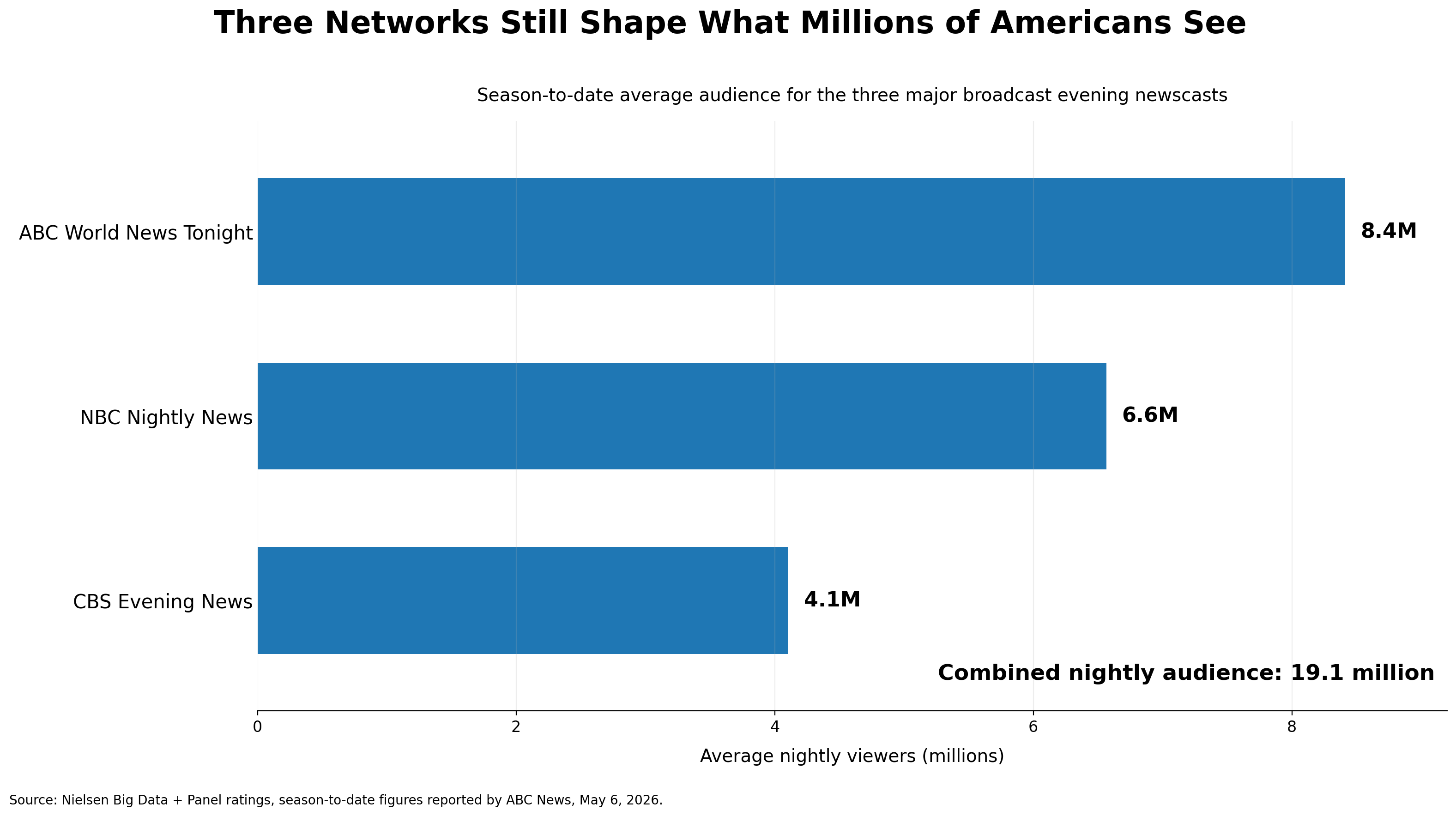
Readers of my recent essay Sowell of a Nation may recognize the larger pattern. That essay examined how one of America’s greatest economists became largely invisible, not because his ideas had been defeated, but because the institutions that shape public attention chose other voices to elevate instead. The same instinct appears here in a different form. Whether deciding which thinkers deserve an audience or which presidential speeches deserve airtime, controlling the flow of information can be more effective than winning the argument.
That principle becomes especially destructive when the institutions making the decision already suffer from collapsing credibility. The less the public trusts journalists, the more journalists feel obligated to control misleading information. The more they control it, the less the public trusts them.
The result is a public divided between those who trust the gatekeepers and those who assume that anything hidden behind the gate must be true. The first accepts conclusions because approved institutions delivered them. The second accepts claims because approved institutions tried to suppress them.
Both become easier to manipulate.
Journalism should encourage neither habit. Its job is to show the evidence, explain what is known and uncertain, and allow adults to reach conclusions reporters may consider mistaken.
That will sometimes produce bad judgments. Freedom usually does.
The alternative is not a society without error. It is a society in which a shrinking class of editors, executives, platforms, officials, and professional interpreters decides which errors the public is permitted to consider.
The networks did not need to endorse Obama, Biden, or Trump. They needed to report them. The networks did not need to accept Trump’s conclusions about the 58 documents. They needed to show what the records contained, what they established, what they failed to establish, and why the difference mattered.
The press once believed sunlight was the best disinfectant. It now seems increasingly concerned that the public might misuse the sunlight.
That concern may sound responsible. It is also a claim to power.
Journalism cannot restore trust by giving the public less to judge. It restores trust by showing its work, applying the same standards regardless of who benefits, and accepting that free citizens will sometimes reach conclusions journalists dislike.
That is not a failure of journalism.
It is its purpose.
Help Keep the Gate Open
This publication exists because important questions should not disappear simply because powerful institutions decide the public has heard enough.
The essay you just read is about more than three presidential speeches. It is about who controls access to information and what happens when journalists begin treating citizens as people to be managed rather than informed.
Independent writing cannot force networks to air a speech or compel reporters to examine inconvenient documents.
It can place the evidence before the public and trust readers to judge it for themselves.
Become a Paid Subscriber
Paid subscribers make it possible for me to keep researching, writing, and publishing without asking advertisers, political organizations, or institutional gatekeepers for permission.
Your support helps keep every essay free to read while keeping this publication independent.
Become a paid subscriber:
https://mrchr.is/help
Make a One-Time Gift
A one-time contribution helps cover the research, time, and expense required to produce long-form work that challenges powerful narratives.
Make a one-time gift:
https://mrchr.is/give
Join The Resistance Core
The Resistance Core is for readers who believe controlling information is one of the most effective ways to control public opinion.
Members help fund deeper research, document reviews, and long-form analysis that examines what gatekeepers often overlook.
Join The Resistance Core:
https://mrchr.is/resist
If You Cannot Give
You can still help.
Share this essay. Restack it. Send it to someone who values evidence over narratives.
Gatekeepers retain power when important work goes unseen.
Help put it in front of more people.
One clarification because I've already seen some people jump to this conclusion:
This essay is not arguing that the 58 documents prove Donald Trump won the 2020 election.
It asks a different question:
Should journalists decide which evidence and presidential arguments the public is allowed to see before reaching its own conclusions?
If you're interested in my broader argument about the 2020 election itself, I covered that separately in One Nation Under Fraud: Trump Wins 2020 Under 2016 Rules.
https://mrchrisarnell.com/p/one-nation-under-fraud-pt1
The two essays complement each other. One examines whether the rules of the game changed. This one examines who controls the information about the game.