

“You’ve Got Mail. They’ve Got Propaganda.”
An account associated with Zohran Mamdani currently shows more than 61,000 subscribers, despite having produced only two posts, neither of which contains original written content. At first glance, this appears to indicate a large and growing audience. A closer look suggests something else entirely.
The Appearance of an Audience
Most people approach Substack with a simple assumption. If an account shows tens of thousands of subscribers, then it must have built that audience through writing and engagement on the platform. That assumption would make sense in a system where growth is tied directly to output.
But the examples now visible do not follow that pattern. What appears to be an audience is often a number that has already arrived assembled.
Back in December, I examined what I described as the Substack illusion. The platform presents itself as a place where writers build an audience over time through consistent work. What I showed then was that subscriber counts can be imported rather than earned, creating the appearance of scale without the activity that would normally produce it.
Since then, those same accounts have continued to grow, even as their level of activity has remained largely unchanged.
Mamdani’s account has increased from roughly 45,000 subscribers in early December 2025 to more than 61,000 by March 25, 2026. During 2025, the account produced only two posts, both of which were video clips from interviews conducted elsewhere. There is no visible pattern of sustained writing and no clear evidence of audience development within the platform.
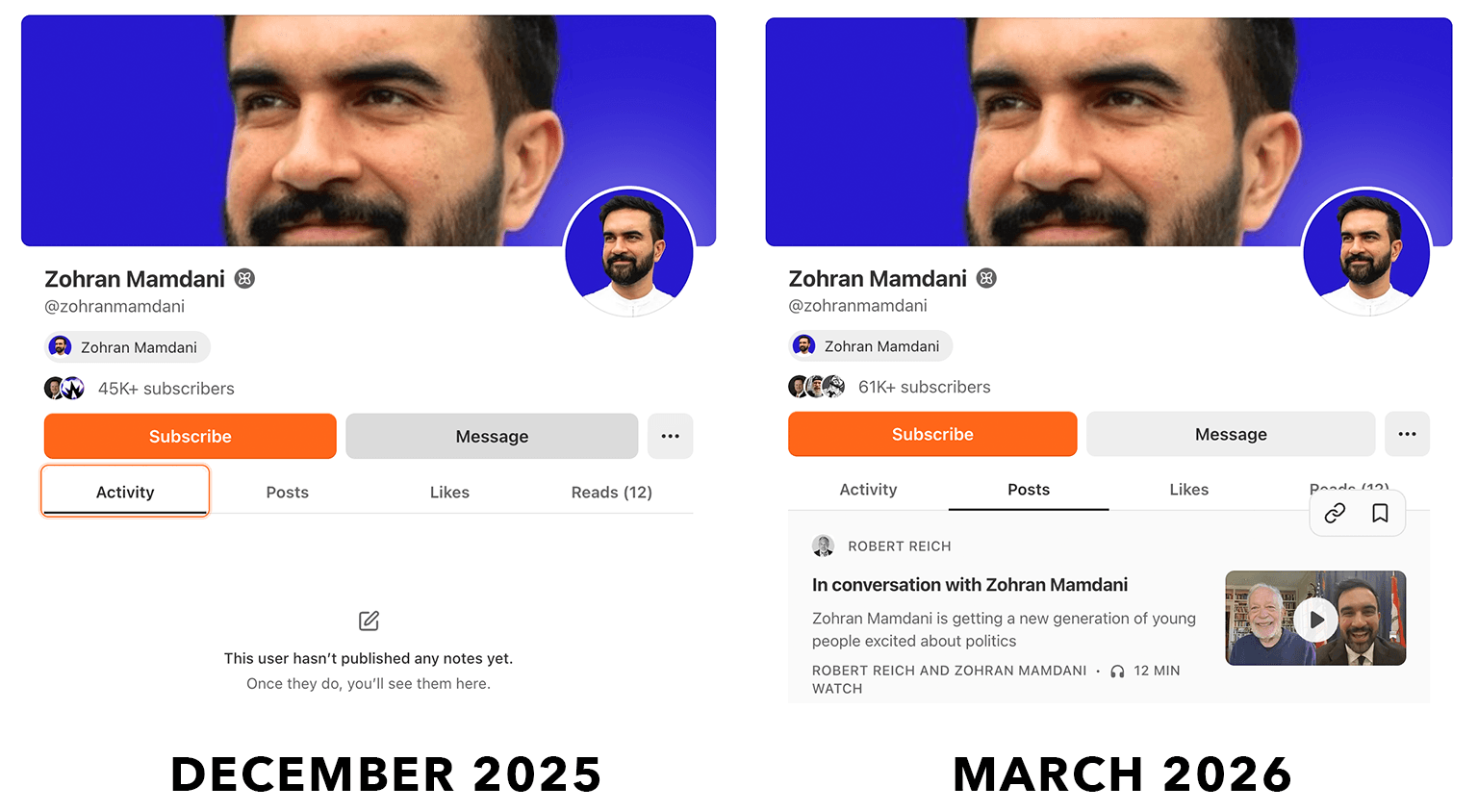
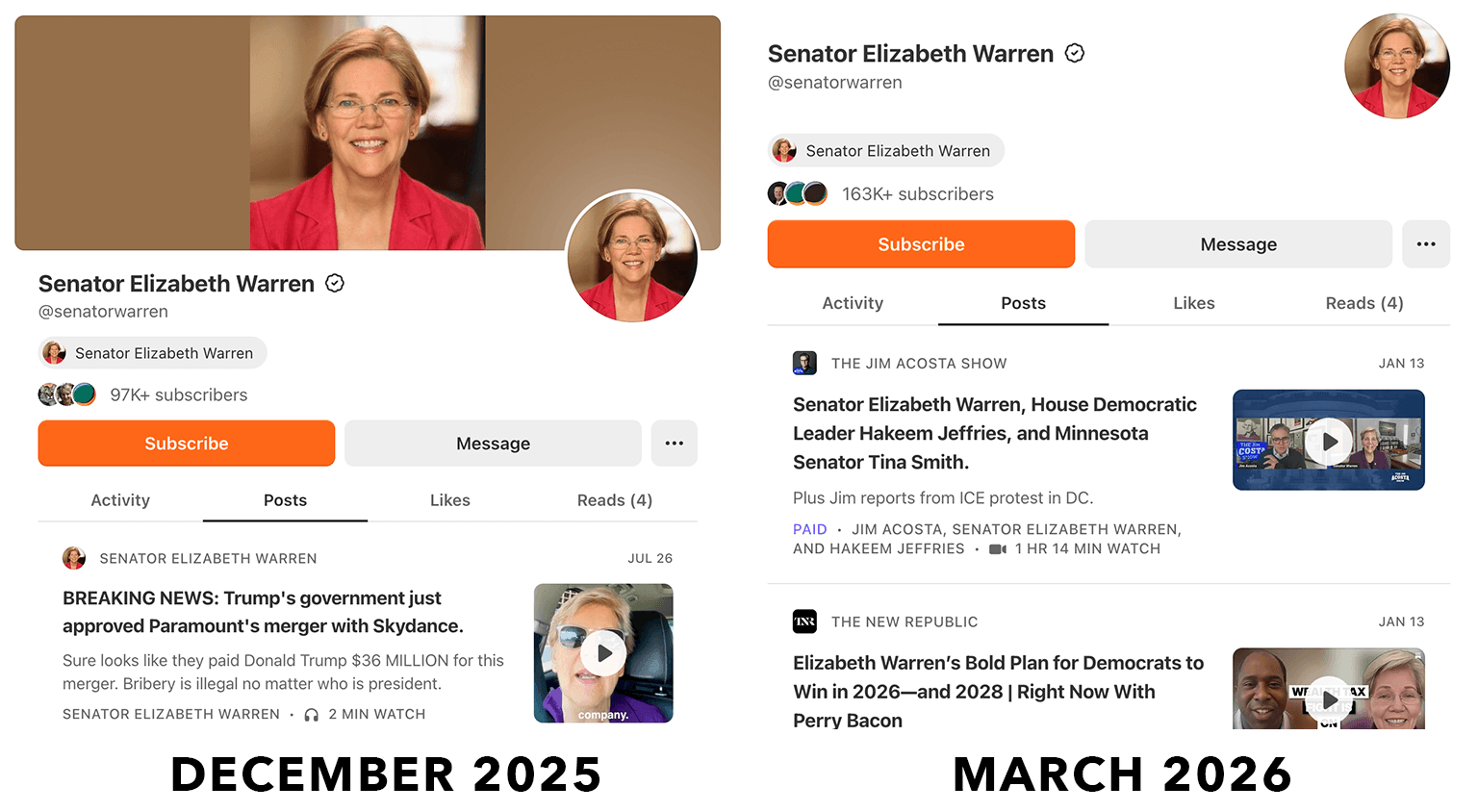
A similar pattern appears with Elizabeth Warren. Her subscriber count rose from approximately 97,000 to more than 162,000 over the same four-month period, with three posts in 2025 and three posts in 2026. Only one post was original, and it was just a short video.
The case of Jasmine Crockett follows the same structure on a larger scale. Her account increased from about 254,000 to more than 362,000 subscribers, an increase of over 100,000, while total content remains minimal.
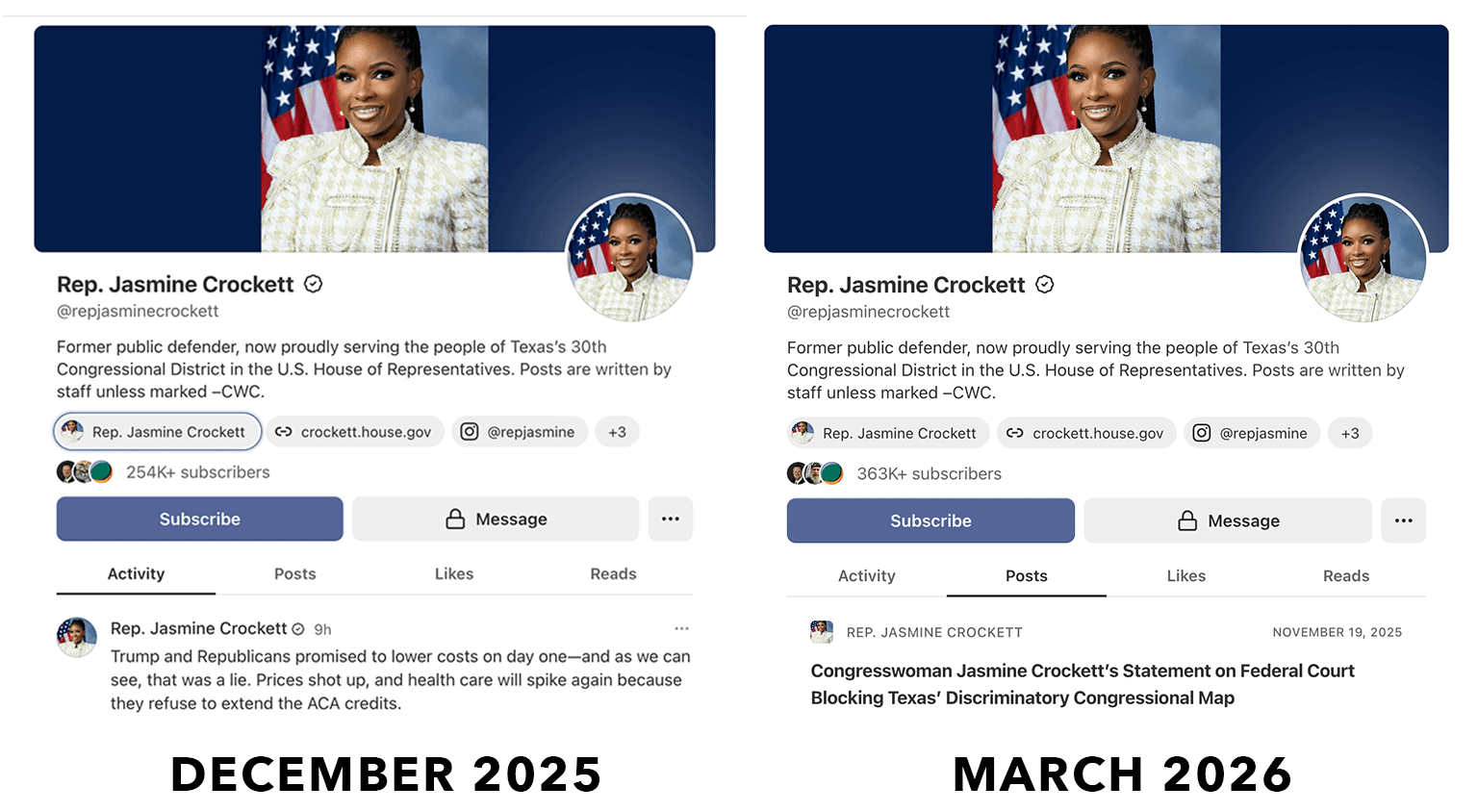
An increase of this magnitude, without a corresponding increase in output, is not consistent with audience formation driven by content.
Where These Numbers Come From
Modern political campaigns, particularly within the Democrat Party, maintain large email databases built through fundraising, petition drives, volunteer sign-ups, and related outreach. These lists often contain hundreds of thousands of addresses.
When such lists are imported into Substack, they are counted in the same way as readers who discovered a publication on the platform and chose to subscribe. The platform treats fundamentally different processes as if they were identical.
A subscriber who entered an email address during a campaign is displayed the same way as a reader who engaged with the writing and then returned. The distinction disappears once the number is shown.
What appears to be an audience is often the visible extension of a database created elsewhere.
Consent and Public Meaning
Individuals who provide their email address to a campaign understand that they will receive communication. That is the expected outcome of their action.
What they typically do not expect is that their presence on that list will later be used to signal influence on a publishing platform.
Consent to receive an email is not the same as consent to be represented as part of a public audience.
The issue is not the exposure of personal identity. Substack does not publicly identify individual subscribers. The issue is that a private action is being assigned a public meaning that it did not originally carry.
An email list is a private communication tool. A subscriber count is a public signal. Moving a list from one to the other changes its function.
It is similar to signing up to receive mail at home and then being counted as part of a public audience. One action is private. The other is visible and interpreted by others.
Propaganda by Presentation
This is what can be described as propaganda by presentation.
No false statement is required. There is no need to claim that the audience was built on Substack. The number itself implies what most readers already assume: that large subscriber counts reflect activity and engagement on the platform.
Most people will not investigate how those numbers were created. They interpret them based on the norms of the environment they are in. When a blockbuster film draws a large audience, the reason is usually visible. There is a product, a promotional campaign, and a public response. The scale corresponds to something observable.
On Substack, readers make a similar assumption when they see a large subscriber count. They assume it reflects writing, readership, and engagement within the platform. In the cases examined here, however, the scale is visible while the activity that would normally explain it is not.
In this way, presentation performs the persuasive function.
A large subscriber count shapes perception. It signals importance and suggests reach. When those numbers are detached from the activity that would normally justify them, they still carry the same weight in how they are interpreted.
The Substack Feedback Loop
The pattern becomes clearer when considered in reverse. An account that begins with zero subscribers and produces little or no content does not grow to tens or hundreds of thousands of readers in a short period of time. Such growth requires either sustained output or the transfer of an existing audience.
In the cases examined here, the latter explanation fits the available evidence.
These accounts are also connected to external platforms. Profiles such as Warren's and Crockett's are linked to Instagram, where large audiences already exist. Their visibility did not originate on Substack. It was brought into it.
Once displayed, these numbers interact with the platform’s discovery systems. Larger accounts are more likely to be surfaced and recommended. Imported scale leads to visibility. Visibility attracts attention. That attention reinforces the perception that the number reflects something earned within the platform.
These accounts also show very large follower counts within Substack itself. Mamdani has more than 500,000 followers, Warren roughly 450,000, and Crockett close to 700,000. Those figures suggest broad visibility across the platform.
But visibility is not the same as engagement. A follower may have seen a post once, clicked in passing, or ended up in that category through an import. That is not the same as the repeated, voluntary attention from which an audience is actually built.
The number comes first. The assumption follows.
How Real Audiences Are Built
For independent writers, the process works in the opposite direction. Audience size is the result of repeated decisions by readers who encounter the work, engage with it, and choose to return.
Growth is tied to output and leaves a visible record.
There is also a more meaningful signal that Substack recognizes. When a publication reaches certain levels of paid support, it is marked accordingly. These markers reflect readers' decisions to provide financial backing, which is a stronger indicator of engagement than a passive subscription.
An imported list can instantly increase a subscriber count. It cannot, by itself, produce paying readers at scale without the work that justifies that support.
What Actually Counts
When numbers can be imported and displayed without context, the platform begins to reward scale regardless of how that scale was created. Readers are presented with accounts that appear large, even when little has been built within the platform itself.
At the same time, writers building real audiences are evaluated against metrics that reflect entirely different processes.
If you are reading this, you arrived here through a decision. That decision is what defines an audience.
The difference between a list and an audience is not simply one of size. It is a difference in how that group came to exist. One is assembled externally and then displayed. The other is built through sustained attention and repeated interaction.
Numbers can be moved from one place to another. Audiences cannot.
Build What This Platform Was Meant to Be
Become a Paid Subscriber
Most of what you just read does not come from a list. It comes from time, research, and a willingness to follow the numbers where they lead.
There is no campaign infrastructure behind this. No imported database. No institutional backing.
Just the work.
If you believe Substack should reward real audiences instead of manufactured ones, becoming a paid subscriber helps make that possible.
Make a One-Time Gift
This kind of analysis takes time to build and even more time to verify.
If you prefer to support the work without a subscription, you can do that here.
Join The Resistance Core
Some readers go further. They do not just support the writing. They help sustain it.
The Resistance Core is the group that makes long-form investigations like this possible.
What Your Support Builds Right Now
Right now, support goes directly into:
Continuing the Substack Illusion series
Expanding data-backed investigations into platform dynamics
Tracking how influence is constructed and presented online
Producing work that does not rely on institutional funding
This is not passive content. It is built piece by piece.
If You Cannot Give
You can still help.
Share this piece with someone who still believes these numbers represent organic influence. Most people have never looked at it this way.
That is how this spreads.
You’ve touched on this hoodwinking growth in the past. Obnoxious. We will complain. Write on.
Check out the first part published in Dec. > https://mrchrisarnell.com/p/substack-illusion