


“A society that treats responsibility as oppression should not be surprised when adulthood is replaced by protest.”
If you listen to the explanations offered for today’s unrest, you will hear a familiar list. Racism. Capitalism. Donald Trump. Misinformation. Lack of empathy. Pick your poison.
What you will not hear is the explanation that fits the evidence best.
Modern America did not become unstable because people suddenly became cruel or ignorant. It became unstable because a stabilizing purpose was removed, and then purpose itself was declared optional, or worse, oppressive.
That may sound abstract. Its effects are not.
We are told that constant protest is proof of moral progress. That anger is evidence of compassion. That disruption is justice in motion. Yet the results are hard to miss. Disorder increases. Institutions deteriorate. Children do worse. Judgment erodes. Mental health declines. The protests multiply anyway.
This is not how successful societies behave.
For most of human history, moral energy was anchored to responsibility. People had obligations that did not depend on how they felt that day. Those obligations imposed limits, and limits imposed order. You did not have to invent meaning because meaning came with duties.
When those duties were weakened, nothing equally stabilizing took their place. We were told we could build meaning out of autonomy alone. That freedom itself would be enough.
It was not.
Human beings do not stop caring when responsibility disappears. They redirect that care. They attach it to causes, identities, and abstractions. The energy remains, but it is no longer disciplined by consequence.
That is why so much modern outrage feels intense and hollow at the same time. It is moral passion without a hierarchy of priorities. Everything is an emergency, so nothing is resolved.
The result is a politics of permanent agitation. Protest becomes an identity. Anger becomes a credential. Being upset replaces being useful.
This did not happen because people suddenly became worse. It happened because we dismantled structures that once forced moral instincts to answer to reality.
If you remove purpose and tell people they are liberated, do not be surprised when they spend the rest of their lives searching for something to be angry about.
What a Stabilizing Purpose Actually Is
Before we talk about what was lost, we have to be clear about what it was. Otherwise, people argue with a caricature instead of the idea.
A stabilizing purpose is not a slogan. It is not a passion. It is not something you invent after a weekend retreat or discover through political activism.
A stabilizing purpose is a responsibility that exists outside your feelings and persists whether you are motivated or not.
For most people throughout history, purpose was not optional. It was embedded in daily life. You worked because people depended on you. You raised children because they were there, not because it was emotionally fulfilling that week. You showed restraint because the cost of not doing so fell on others, especially the young.
This kind of purpose did three things modern substitutes do not.
First, it imposed limits. Limits are unpopular in cultures that worship choice, but limits are how societies function. They force tradeoffs. They establish priorities. They prevent every impulse from demanding equal attention.
Second, it ordered compassion. When you have real responsibilities, you learn quickly that not every cause can come first. Children come before abstractions. Your household comes before ideology. Proximity matters more than symbolism.
Third, it tied meaning to consequences. You could not declare yourself virtuous without results. If your household fell apart, no amount of moral posturing could hide it for long.
That is what made this kind of purpose stabilizing. It disciplined moral instincts rather than inflating them.
For women especially, family formation historically served this role, not because women were incapable of other pursuits, but because biology, time, and responsibility intersect there in ways they do not elsewhere. Children require attention on a schedule that cannot be postponed indefinitely. Fertility has limits that ideology cannot repeal. Neglect produces visible consequences.
None of this required romance or sentimentality. It was simply reality.
Modern culture treats these facts as offensive rather than factual. Responsibility is framed as a burden imposed by tradition. Motherhood is described as a trap rather than a role. Stability is recast as stagnation. Restraint is confused with repression.
Once that reframing takes hold, stabilizing purpose does not merely fade. It is delegitimized.
People are told they can delay indefinitely without cost. That they can substitute identity for obligation. That meaning can be assembled later, on their own terms, after all other options have been explored.
History and data tell a different story.
Societies that sever purpose from responsibility do not become freer. They become louder, angrier, and less satisfied. Individuals are left to construct meaning out of emotion and affirmation rather than duty and consequence.
That is not liberation. It is drift.
And drift is never neutral. It always carries people somewhere, whether they understand the current or not.
The Lie That Followed
Once a stabilizing purpose was weakened, it did not simply disappear on its own. It had to be explained away. Cultures do not abandon responsibility quietly. They justify the abandonment with stories.
The most influential story of the past several decades was not that purpose could be postponed. It was that purpose itself was suspect. Responsibility was not merely optional. It was described as imposed, outdated, or quietly oppressive.
This reframing did not arrive as a single declaration. It entered through language, incentives, and institutions. Marriage became a social construct rather than a social achievement. Motherhood was redefined as a lifestyle choice rather than a central responsibility. Stability was described as complacency. Sacrifice was framed as loss.
The promise was simple and seductive. You could have meaning without constraint. You could delay the hard parts without paying interest. You could construct a life first and figure out purpose later, on your schedule.
Biology never agreed to this arrangement.
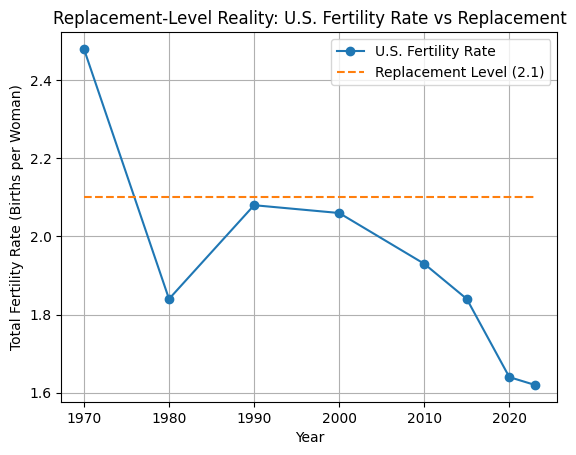
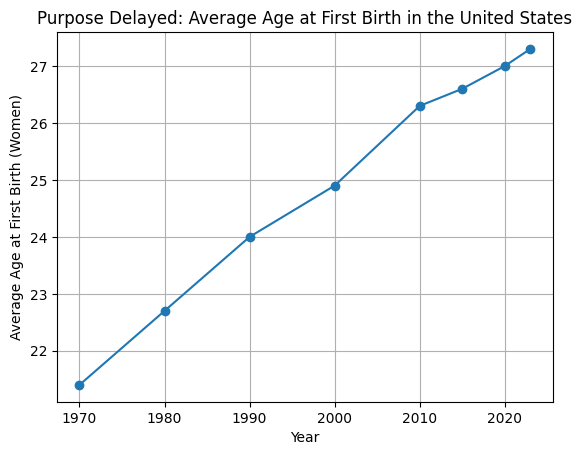
The mean age at first birth in the United States has risen sharply. That is not a moral judgment. It is a measurable shift in the timing of life. The fertility rate is down to levels that would have been considered a demographic warning sign in earlier eras.
The cultural messaging rarely acknowledged tradeoffs. Instead, it treated limits as insults. Any suggestion that timing matters was dismissed as fearmongering. Any reminder that responsibility anchors meaning was framed as pressure.
This is where the lie hardened.
The claim was not merely that people should have choices. It was that choices had no cost. That postponement carried no consequence. That meaning could be assembled like furniture, long after the factory had stopped making parts.
People were told they could outrun time. They discovered instead that time was patient.
The lie also reshaped politics. When responsibility is no longer the main source of meaning, identity moves in to take its place. Moral energy that once flowed into building a stable household does not vanish. It attaches itself to causes that offer affirmation without obligation.
That shift helps explain why political disputes began to feel existential. Losing an election was no longer about policy disagreement. It was experienced as a threat to identity and meaning itself. Protest became less about persuasion and more about self-expression.
This is where the Democrat Party plays an important role, often without admitting it. Over time, it aligned itself with narratives that framed boundaries as cruelty and enforcement as oppression, even when many of its own leaders had supported similar policies in practice. The result was not consistency, but moral theater.
Once purpose is declared oppressive, restraint itself must be cast as immoral. Boundaries cannot be tolerated, because boundaries remind people of limits they were told no longer exist.
The lie did not make people freer. It made them angrier and more fragile. It promised meaning without cost and delivered frustration without direction.
When purpose is stripped away and responsibility is treated as optional, meaning does not evaporate. It curdles. And then societies begin mistaking noise for progress.
When Time Reveals the Cost
The consequences of cultural lies rarely show up right away. If they did, fewer people would believe them.
In my mid twenties, I worked with a woman who was about twenty-five years older than I was. She was a competent, calm, and quietly strong manager. She was also feminine in the old sense of the word, not performative, not ideological, not trying to compete with anyone. She carried herself like someone who had built a life, not like someone still auditioning for one.
We talked a lot over the years, about work and about life. Eventually, the subject of marriage came up. She had been divorced for a long time, and the way she spoke about it was not the way most people speak about divorce. There was no anger. No blame. No speeches about finding herself. She said it plainly, like someone stating an unpleasant fact.
She told me that leaving her husband was the worst mistake of her life.
She said he was the best man on the planet. A great husband. A great father. The kind of man you build a life with if your goal is to have a stable home and raise decent kids. By her own description, she had that.
Then she said something that made it clear she was not rewriting history to make herself look innocent. She told me she had been hypnotized by the feminist era. That is the word she used. Hypnotized. Her friends were talking about freedom and fun and how much they were enjoying life, and she felt like she was missing out. The cultural messaging did not help. It made stability sound dull. It made responsibility sound like a trap. It suggested that real life was somewhere else.
So she filed for divorce, and she left.
She did not pretend the aftermath was simple. She dated a man for a long time after that, but she never remarried. Her kids grew up. Her life became quieter. The story she had been sold did not deliver what it promised.
The part that stuck with me was not just the regret. It was the timing.
She told me this when she was around fifty. Not old age. Midlife. The stage where time is no longer theoretical but it is not yet finished with you either. It is the stage where you begin to see what choices actually produce, and what choices merely felt exciting at the time. She is approaching eighty now. Never remarried. Living alone. The regret never faded.
That is why this matters. Cultural lies often work because they delay the bill. The costs come later, when undoing them is harder. In your twenties and thirties, you can tell yourself there is always time. In your forties and fifties, you begin to understand that time is not an idea. It is an inventory that runs down.
This is not an argument that every marriage should be saved or that every divorce is wrong. Some marriages are disasters, and leaving is necessary. That was not what she described. She described a good man, a stable home, and a decision driven not by cruelty or danger, but by the cultural mood of the moment.
In other words, she did not lose something because life was unfair. She lost it because she believed a lie.
And when those lies are absorbed at scale, you do not just get personal regret. You get a society full of people trying to replace lost meaning with something louder.
When Feminism Turned Obligation Into Suspicion
It is impossible to understand the present moment without separating feminism into phases. Treating it as a single, continuous movement obscures more than it explains.
Early feminism focused on access. Education. Legal rights. Employment opportunities. Those changes expanded the range of choices available to women and corrected real barriers. They did not require hostility toward marriage or motherhood. In many cases, they assumed those institutions would remain central.
That assumption did not last.
Later feminism shifted emphasis from access to antagonism. Responsibility itself became suspect. Roles that required long-term commitment were recast as tools of control. The language changed. Marriage was no longer a social achievement. It became a power imbalance. Motherhood was no longer a central contribution. It became a burden imposed by expectations.
This shift mattered because it did not merely add options. It undermined the legitimacy of the very structures that once stabilized adult life.
The message was subtle but consistent. Delay commitment. Prioritize autonomy. Treat obligations as negotiable. If dissatisfaction appears, assume the structure is the problem rather than the choice.
And then the results arrived. Not as a single catastrophe, but as a slow demographic slide.
Birth timing moved later, with first births increasingly concentrated in later reproductive years. The U.S. fertility rate fell well below replacement level. Birth rates for younger women declined while births among women in their early forties rose.
None of that is good or bad by slogan. It simply means a lot of people are living out a script that assumes biology can be negotiated. It cannot.
Economics matters, but it does not explain everything. Countries with stronger safety nets and higher wages also experienced similar declines. What changed across societies was not just money. It was meaning.
As family formation weakened, expectations were adjusted rather than questioned. The narrative shifted from asking whether something important had been lost to insisting that loss itself was progress. If women reported dissatisfaction later in life, the answer was not to reexamine the cultural script but to medicalize the discomfort or redirect it toward politics.
This is where removal of stabilizing purpose becomes visible.
When responsibility is framed as oppression, people are encouraged to sever themselves from long-term commitments without replacing them with anything equally grounding. The result is not freedom. It is drift. Drift creates anxiety. Anxiety looks for explanation. Explanation becomes ideology.
Feminism did not cause this on its own, but it provided the language that made the transition respectable. It allowed people to abandon obligations while telling themselves they were resisting injustice rather than escaping responsibility.
That distinction matters. When people believe they are rebelling against oppression, they do not ask whether their choices lead anywhere. They ask only whether those choices feel affirming in the moment.
This is also where politics enters the picture. As marriage and motherhood lost legitimacy, political identity gained it. Moral energy that once went into building households flowed instead into causes that offered recognition without permanence.
And here is where the modern era gets interesting.
Because the most visible carrier class of this redirected moral energy is not humanity in general. It is not even liberals in general. It is educated, middle aged, white women, often unmarried or childless, often employed in institutions where moral signaling is rewarded and where consequences for failure are delayed, spread out, or shifted to someone else.
When you see the street protests, the signs, the tears on cable news, the theatrical outrage in school board meetings, and the online mobbing, you are looking at a demographic that has been overrepresented for years in organized Resistance style activism.
This is not an insult. It is a description. If you want to explain the pattern, you have to name the pattern.
What the Mental Health Data Is Actually Telling Us
When people hear that depression and anxiety have risen sharply over the past several decades, they are usually given one explanation. Life is stressful. The economy is hard. Social media is toxic. All of that is true, as far as it goes.
But it does not go far enough.
If stress alone were the explanation, we would expect mental health outcomes to track hardship fairly evenly across groups. They do not.
One of the clearest differences shows up in women in midlife. Women are more likely than men to be prescribed antidepressants, and usage is high in the 40 to 60 range.
Do not misunderstand what that means. It does not mean women are broken. It means a large number of women are living with chronic distress. And the interesting question is not whether they have stress. Everyone has stress. The question is why so many have high distress in the very years when the cultural script promised maximum freedom.
Here is the part modern institutions do not want to say out loud.
Many people were sold a life strategy based on postponement and self-focus. They were told the hard commitments could wait. They were told duty was negotiable. They were told meaning would arrive later, once they had explored enough options.
Then later arrived.
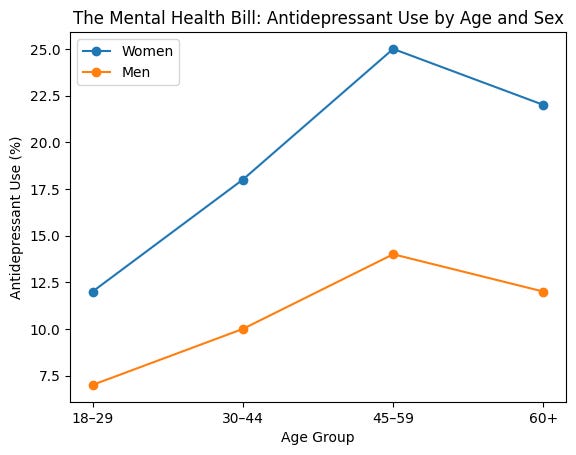
For a lot of middle-aged women, especially educated white women, the later years are when the bill comes due. Not in a moral sense, but in a plain arithmetic sense. Fewer durable bonds. Fewer daily obligations that force you out of self-obsession. More time alone with your thoughts. More reliance on work, politics, or online community to provide identity.
When those substitutes fail, or when they stop rewarding you, the result is emptiness with a microphone.
That is why some modern outrage feels both intense and strangely unproductive. It is real emotion, but it is emotion looking for structure.
Politics becomes attractive in this environment.
Political causes offer moral clarity without personal consequence. They provide community without permanence. They allow people to feel righteous without being responsible for outcomes beyond the moment.
The Democrat Party has become the primary home for this form of moral expression, particularly among educated white women. Not all women. Not all white women. But enough to shape the tone of the party, the nonprofit world around it, and the media culture that amplifies it.
The party offers narratives that frame personal dissatisfaction as systemic injustice and provide outlets for anger that feel socially approved. It sells moral identity. It hands out virtue points. It turns private frustration into public crusade.
That is not a conspiracy theory. It is how incentives work. People invest their emotional energy where they are rewarded.
Mental health data does not tell us these women are malicious. It tells us many are unmoored from the structures that used to steady adult life.
When meaning is absent, distress does not stay quiet. It looks for an explanation. It looks for an audience. It looks for a cause.
That is why modern activism often feels emotionally intense but socially unproductive. It is not solving a problem. It is compensating for one.
Why Modern Protests Feel Different
Protest itself is not new. The United States has a long history of public demonstrations, many justified and effective. What has changed is not the existence of protest but its character.
Earlier protests were typically tied to specific policies with clear objectives. End the war. Pass a law. Repeal a statute. Once the objective was achieved or failed, the protest ended and people went back to their lives.
Modern protest often does not work that way.
Today’s demonstrations are frequently open-ended. They do not aim for a measurable outcome. They aim for expression. Participation itself becomes the point.
This shift did not happen by accident.
When the stabilizing purpose weakens, people still need a place to put moral energy. Protest offers community without permanence, meaning without obligation, intensity without responsibility for results.
That combination is powerful.
It also shapes who shows up and who stays. The visible organizing core often skews female, white, and college educated. That does not describe everyone. It describes the group most likely to turn protest into routine.
The emotional tone of these protests also changed. Anger is no longer directed mainly at specific policies. It is directed at legitimacy itself. Elections are framed as threats. Enforcement is framed as violence. Disagreement is framed as harm.
This explains why losing an election now feels existential to so many people. When politics becomes a substitute for purpose, political defeat feels like personal erasure.
The Democrat Party has benefited from this transformation. It increasingly functions as a moral identity rather than a policy coalition. Its messaging emphasizes victimhood, affirmation, and symbolic compassion, which resonates with people whose lives lack other sources of meaning. The party does not have to solve problems. It has to validate feelings.
That incentive structure shapes behavior on the ground. Protests escalate quickly because escalation generates attention and emotional payoff. Resolution would end the experience, so it is quietly avoided. Outrage must be sustained, which requires constantly redefining threats and emergencies.
This also explains why modern protests often resist factual correction. Facts threaten the emotional narrative. If an incident is ambiguous, the protest does not dissolve. It intensifies. The story must be preserved because it serves a psychological function.
Older protest movements accepted tradeoffs. They understood limits. They expected losses. Modern protest culture treats limits as betrayal and compromise as violence.
That is not how people behave when protest is a tool. It is how people behave when protest is a substitute.
Same Country, Same Laws, Very Different Reactions
One of the easiest ways to see how much protest culture has changed is to compare reactions to similar events across time.
During the presidency of George W. Bush there were large protests. Millions opposed the Iraq War. Bush was portrayed as reckless and morally suspect.
What is also true is what did not happen.
There was no permanent national protest movement. No sustained riots after the election. No months of street occupations. No widespread claim that the system itself was illegitimate. Protesters opposed policies, not the country's existence.
When the demonstrations ended, people went home. The protests were episodic, not a lifestyle.
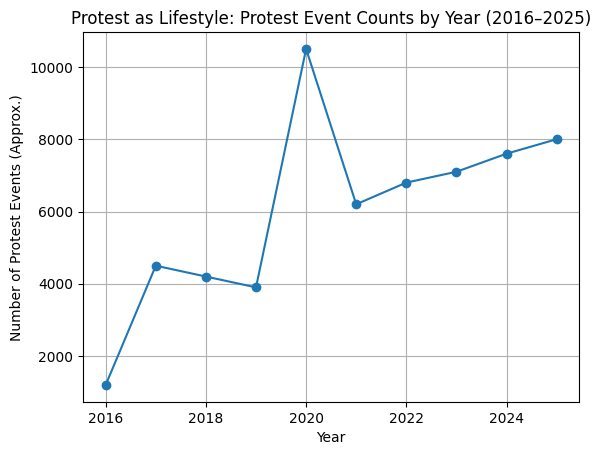
After 2016, protests erupted immediately and did not subside. Resistance was adopted as an identity. Demonstrations became recurring rituals rather than tools aimed at specific outcomes.
The laws did not suddenly change.
Immigration enforcement is a useful example. Enforcement did not begin with Donald Trump. It expanded under both parties for decades.
Yet for many years the emotional reaction was not what it became later.
What changed was not simply policy. It was the meaning attached to policy.
Under Democrat administrations, enforcement was framed as unfortunate necessity. Under Trump, similar enforcement was reframed as moral catastrophe. The same actions produced radically different emotional responses.
This is not best explained by rhetoric alone. It is better explained by the role politics had come to play in people’s lives.
When political identity becomes a substitute for purpose, losing feels existential. Enforcement becomes symbolic. Boundaries become personal. Disagreement becomes a threat.
That is why protests intensified after elections rather than after legislation. The outrage was tied to identity and legitimacy more than policy detail.
The Middle-Aged White Woman Factor
A lot of people want to talk about unrest as if it is driven mostly by the desperate, the poor, the marginalized, or the directly harmed. Sometimes it is.
But the steady, organized, professionally credentialed engine of modern left activism is often something else. A class of educated, comfortable, middle-aged white women who have replaced traditional sources of meaning with moral performance.
You can see it in the demographics of major protest movements. You can see it in the nonprofit workforce. You can see it in school and university bureaucracies. You can see it in human resources departments. You can see it in media production and editorial pipelines.
And you can see it in the emotional style of the politics itself.
This group tends to have three traits that matter.
First, it has time and institutional cover. Many work in settings where political expression is treated as a virtue rather than a distraction. The person who builds something is often less celebrated than the person who declares something.
Second, it has status anxiety. Many of these women were told they could have everything: careers, romance, endless optionality, and then later discovered that everything is not a plan. It is a slogan. When life does not feel meaningful, they do what modern institutions trained them to do. They externalize. They moralize. They search for villains.
Third, it has a moral economy that rewards complaint. In this environment, being offended is a form of social capital. Public tears are a credential. Constant outrage is proof you are a good person.
This is why the activism often feels like theater. It is theater. It is not fake emotion, but it is emotion trained to seek applause.
It also explains why the politics skews so heavily toward symbolic fights, language policing, purity tests, and public shaming. Those are not effective ways to improve society. They are effective ways to gain status in an environment that has replaced responsibility with performance.
The Democrat Party benefits because it has positioned itself as the political home for grievance, affirmation, and symbolic compassion. It often speaks the language of therapy rather than the language of tradeoffs. It offers moral validation without requiring competence.
That is a potent product. Especially for people who feel empty but want to feel righteous.
Minnesota as a Useful Example
Minnesota did not become unstable because of a single incident. It is useful because it shows how modern protest now unfolds, almost on a schedule.
An encounter occurs involving law enforcement or immigration enforcement. Details are incomplete. Video is partial. Context is missing. Within hours, a narrative solidifies. Within days, protests escalate. Within weeks, the protest itself becomes the story.
Facts do not drive the process. Emotion does.
Places with large nonprofit ecosystems and activist networks can sustain this better than places without them. An ecosystem can turn protest from an event into a career track. It can provide funding, language, training, and social reinforcement. It can also make disorder feel like a pathway to recognition.
Meanwhile, the costs of unrest fall on people with less cultural power. Small businesses. working-class neighborhoods. ordinary commuters. Students who just want school to be school.
This is what happens when compassion is severed from responsibility. Proximity no longer restrains action. Consequences no longer restrain narrative. Moral satisfaction takes precedence over material outcomes.
What the Protest Data Shows Right Now
If you want to talk about unrest through January 23, 2026, it helps to note that protest activity did not cool down. It expanded.
By 2025, protest counts recorded by major trackers were far higher than in 2017. You can argue about what that means, but you cannot argue that it did not happen.
The point is that a society that treats protest as a routine substitute for purpose will generate a lot of protest. It becomes the default outlet for moral energy, especially for those trained to treat outrage as identity.
When Compassion Loses Its Anchor
Compassion is not the problem in modern society. The problem is what happens when compassion is severed from responsibility.
In earlier eras, compassion operated within boundaries. You helped where you could. You prioritized those closest to you. You understood resources were finite and choices had consequences. This did not make people cold. It made their care effective.
When stabilizing purpose weakens, that structure disappears.
Compassion becomes abstract. It is no longer directed first toward those for whom you are responsible. It is directed toward symbols, causes, and distant narratives. The closer the problem, the more demanding the response. The farther away the problem, the safer the emotion.
This is how moral inversion begins.
Children, who require patience and long-term commitment, lose priority to causes that offer immediate moral affirmation. Law and boundaries, which exist to protect the vulnerable, are reframed as cruelty. Enforcement becomes violence. Restraint becomes oppression.
None of this happens because people stop caring. It happens because caring is no longer ordered.
This is also why modern political language is so allergic to limits. Limits imply tradeoffs. Tradeoffs imply adulthood. Adulthood implies responsibility. And responsibility is the very thing modern ideology has been trained to suspect.
What Actually Restores Stability
Every society runs on more than laws and incentives. It runs on assumptions about human nature. When those assumptions are wrong, no amount of good intention can save the outcomes.
The central mistake of the modern era was not failing to expand opportunity. It was treating responsibility as optional and pretending nothing important would be lost.
A stabilizing purpose does not eliminate hardship. It gives hardship meaning. It channels effort into something durable. It forces people to consider consequences beyond the present moment.
That is why societies that emphasize continuity and obligation tend to be more stable, even when they are imperfect. It is also why societies that dissolve those structures experience rising disorder, even when they are wealthy.
The data supports this quietly and consistently.
Fertility rates remain below replacement. The mean age at first birth has risen. Mental health treatment has expanded, yet distress persists. Protest activity has intensified.
These trends did not arise independently. They move together because they share a cause.
When purpose rooted in responsibility weakens, people do not become neutral. They become restless. Moral instincts do not disappear. They detach from consequence. Politics absorbs what household and continuity once contained.
This is why so much modern activism feels urgent but unproductive. It expresses emotion without resolving conditions. It substitutes affirmation for accountability. It offers meaning without sacrifice.
The Democrat Party did not create human nature, but it has learned how to exploit this particular version of it. By framing politics as moral identity rather than a system of tradeoffs, it provides a home for people whose lives lack other sources of grounding. That approach generates passion. It does not generate stability.
Stability is restored the same way it was built in the first place.
By recognizing limits. By accepting tradeoffs. By prioritizing responsibility over symbolism. By anchoring compassion to consequence.
None of this requires coercion. It requires honesty.
Honesty about biology. Honesty about time. Honesty about what produces long-term meaning rather than short-term affirmation.
People are not fulfilled by endless choice. They are fulfilled by commitments that require something of them. Societies do not flourish by indulging every grievance. They flourish by ordering priorities and protecting what cannot be replaced.
The most damaging lie of the past half-century was not that people deserved more freedom. It was that freedom alone could replace purpose.
It cannot.
Purpose does not vanish when denied. It reappears distorted. It shows up as rage without resolution, compassion without limits, and protest without end.
The unrest we see today is not a mystery. It is the bill coming due.
And the bill is not paid by shouting louder. It is paid by rebuilding the structures that once gave moral instincts somewhere useful to go.
One Honest Paragraph Before You Go
I’m going to be blunt. I’m in a tight spot financially right now, and work like this doesn’t survive on shares and applause alone. It survives on readers who decide it is worth paying for. If you believe this kind of writing should continue, becoming a paid subscriber is the most direct way to keep it alive. If you can’t, I understand. But if you read this and thought, someone needs to keep saying this, this is the moment where support actually matters.
If you believe this kind of writing should continue, here are the simplest ways to support it:
Become a Paid Subscriber
https://mrchr.is/help
Make a One-Time Contribution
https://mrchr.is/give
If you can step up at the highest level right now, I would genuinely appreciate it:
Join The Resistance Core
https://mrchr.is/resist
Great one ! As a well educated middle aged white woman I am finding that I have nothing in common with them. A lot of the difference I think is that I haven’t had a comfortable life. I grew up without economic stability. My first career was incredibly hard and I had to work hard to be successful. In the last ten years I’ve hit some difficult times without the benefit of family support. So now I do a job that leaves little time or energy to stupid stuff on the side. Actually living in a poor neighborhood and teaching poor kids is great for shattering illusions. I’ve become conservative over several years but more so all the time.
So well written and analyzed, I had to become a paid subscriber. My goodness, your writing makes me wish I had a one million friend group so I could share it with all of them!