

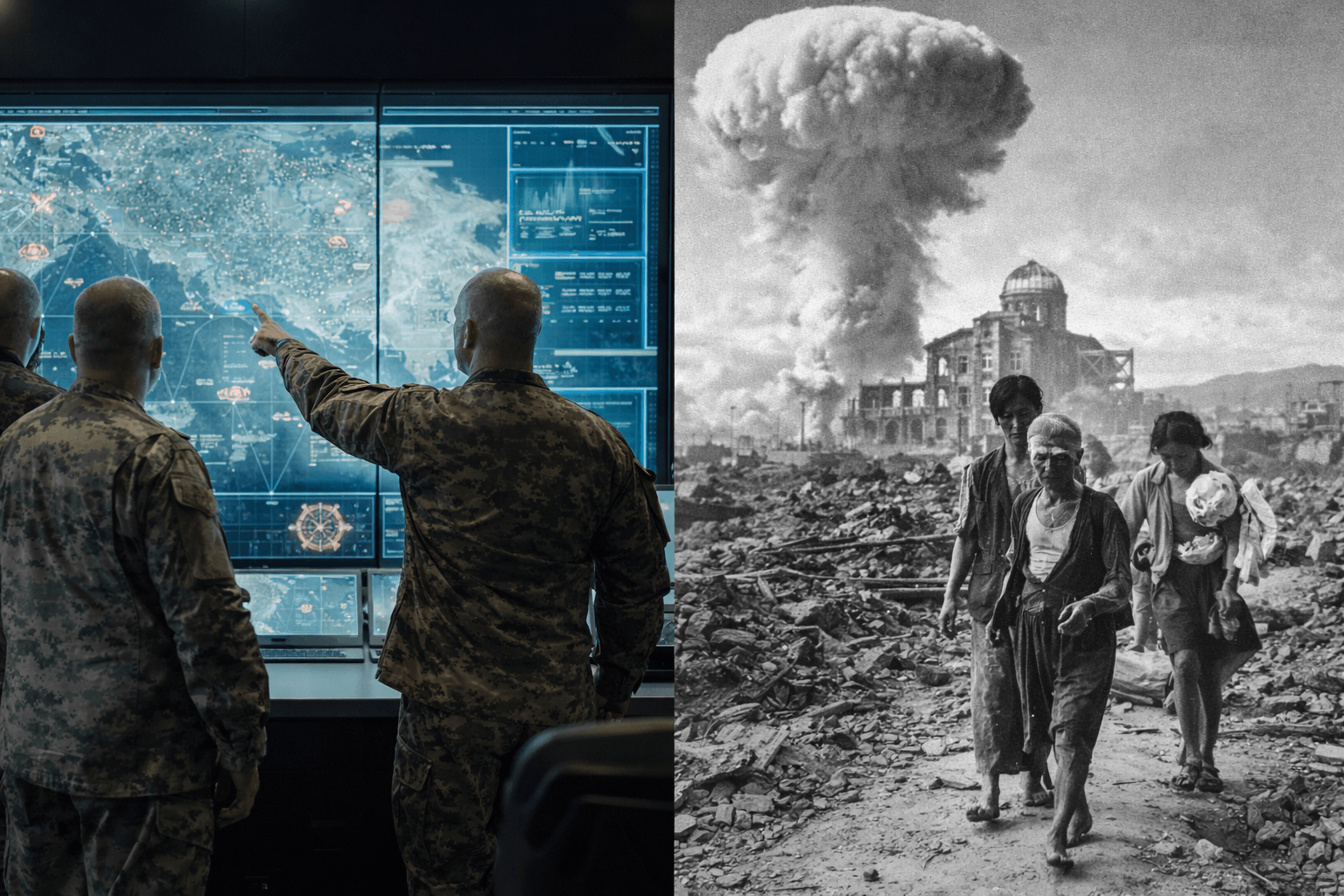
“Wars only end when the cost becomes real to the people living through them.”
Most people think wars end because one side wins. That idea sounds obvious, almost too obvious to question, which is probably why it survives.
We tend to imagine war like a contest where performance determines the outcome. One side fights better, plans better, or adapts faster. Eventually, the losing side recognizes reality, and the conflict comes to a close. That is the story people are told in school, in movies, and often even in political discussions.
The problem is that this version of events does not hold up very well when you compare it to what has actually happened.
If wars truly ended because one side was clearly superior on the battlefield, then the United States would have achieved decisive victories in Vietnam and Afghanistan. In both conflicts, American forces won the overwhelming majority of engagements. They had superior weapons, better logistics, and a level of coordination that their opponents could not match in a conventional sense. Yet neither war produced the kind of ending people associate with victory.
At the same time, countries like Germany and Japan went from aggressive expansion to total surrender within a relatively short window near the end of the Second World War. That shift was not gradual. It did not come from a long period of reflection. It happened quickly once certain conditions were met.
So the question is not who fought better. The question is what changed.
The answer is less comfortable than the simplified version people prefer. Wars do not end when one side performs better. They end when the structure that supports the war begins to fail all at once.
That structure is not abstract. It is made up of three very real components. There is the military, which does the fighting. There is the leadership, which directs that military and sets objectives. And there is the civilian population, which sustains both, whether through resources, labor, or simple tolerance of the situation.
As long as those three pieces remain intact, a war can continue even after repeated losses. A country can lose battles and still fight. A government can make mistakes and still maintain control. A population can suffer and still endure.
What matters is not whether pressure exists, but whether it becomes too much for all three parts of the system at the same time.
When the military can no longer function, the leadership can no longer direct, and the population no longer believes the situation can continue, the war does not wind down. It stops.
This is not a moral argument about what should happen. It is an observation about what has happened, repeatedly, across very different conflicts and time periods.
Once you start looking at wars through that lens, the difference between decisive endings and endless conflicts becomes much clearer. It also raises a more uncomfortable question about the way modern wars are fought and why so many of them never seem to reach a real conclusion.
The Myth of Winning Wars
If you listen to how modern wars are discussed, you would think the main challenge is fighting them the right way.
Use precision. Limit damage. Avoid civilian casualties. Win support from the population. Keep the moral high ground. Combine military pressure with diplomacy. Manage perception at home and abroad.
This is presented not just as a preferred approach, but as the correct one. In many circles, especially among political leaders and much of the media, it is treated as the only acceptable way to fight.
The problem is not that these ideas are entirely wrong. The problem is that they are often mistaken for a strategy that can reliably end wars.
They cannot.
They can shape how a war looks. They can influence how it is perceived. They can even reduce certain kinds of damage in the short term. What they do not consistently do is bring conflicts to a decisive conclusion.
If they did, the last seventy years would look very different.
The United States has spent decades refining this approach. In Vietnam, there were restrictions on where and how force could be applied, driven in part by concerns about escalation and international reaction. In Afghanistan, rules of engagement became increasingly restrictive over time, especially as attention shifted toward minimizing civilian harm and maintaining legitimacy.
According to data compiled by Brown University’s Costs of War project, the United States spent over $2 trillion in Afghanistan alone. Civilian casualties were tracked carefully. Precision weapons were used extensively. Entire strategies were built around protecting the population while targeting insurgent networks.
After twenty years, the Taliban returned to power in a matter of days.
That outcome is difficult to reconcile with the idea that better, cleaner, more restrained warfare produces decisive results.
It is not just Afghanistan. In Iraq, despite an initial military victory in 2003 that removed the existing government quickly, the conflict shifted into an insurgency that lasted for years. At its peak, U.S. troop levels exceeded 170,000. Billions were spent on reconstruction and stabilization. Yet the underlying problem never fully disappeared. Groups adapted, reorganized, and reemerged.
Even when conditions improved, they did not collapse.
This is where the gap between theory and reality becomes impossible to ignore.
The modern model assumes that if you fight carefully enough, you can control the outcome. It assumes that minimizing harm will shorten the conflict. It assumes that civilians, if treated well, will naturally align with the side offering them stability.
That sounds reasonable. But it is false.
People in war zones do not operate based on abstract ideas about stability or legitimacy. They operate based on immediate risk and long-term survival. If the force protecting them today is not the force that will be there tomorrow, their behavior reflects that.
This is where the clean war model begins to break down.
It tries to manage war without forcing the kind of collapse that actually ends it. It treats war like something that can be adjusted and optimized, rather than something that, historically, has only ended when the system behind it fails.
So what you get instead is not victory. You get duration.
The war continues, often at a lower intensity, often with better optics, but without a real conclusion.
And the longer it continues, the more it begins to resemble a managed problem rather than something anyone expects to end.
How Wars Actually End
If you want to understand how wars end, you do not start with modern conflicts. You start with the last war that ended in a way no one could dispute.
World War II
By 1945, Germany was not negotiating its way out of war. It was collapsing in a way that left no room for interpretation.
This is where a lot of modern discussion goes wrong. People like to focus on turning points, key battles, or strategic brilliance. Those things had an impact, but they were not what ended the war. What ended the war was that Germany reached a point where it could no longer function as a system capable of continuing the fight.
Its military had already absorbed catastrophic losses. Estimates place German military deaths at over 5 million. Entire formations had been destroyed or rendered ineffective. Fuel shortages were so severe that armored units often could not move. On the Eastern Front, the scale of loss was difficult to comprehend, and by the time Soviet forces pushed toward Berlin, there was no realistic capacity to stop them.
Leadership was no longer operating as a coherent command structure. Adolf Hitler had become increasingly isolated, issuing orders that bore little connection to reality. Communication within the chain of command deteriorated at the exact moment when coordination mattered most. Decisions were made, but they could not be executed in any meaningful way.
The civilian population was not simply strained. It was overwhelmed. Allied bombing campaigns had inflicted widespread destruction across major cities. Hamburg, Dresden, and Berlin were heavily damaged. Millions were displaced. Infrastructure was failing. Food shortages were no longer occasional disruptions but part of daily life.
What makes a difference here is not any single factor. It is the convergence of all of them.
The military could not fight effectively. The leadership could not direct it. The population could not endure further strain.
When Berlin fell in May 1945, the war in Europe did not slowly wind down. It ended because there was nothing left to sustain it. There was no functioning system that could continue resistance at scale. There was no hidden structure waiting to reemerge. Collapse had already occurred before the final surrender formalized it.
Japan followed a similar pattern, though the sequence was different.
By mid 1945, Japan had already lost much of its naval capacity. Its air defenses were weakened, and its industrial output had been significantly reduced by sustained bombing. The firebombing of Tokyo in March of that year killed tens of thousands in a single night and destroyed large portions of the city. Civilian casualties across the country continued to rise as bombing intensified.
Then came the atomic bombings of Hiroshima and Nagasaki, followed closely by the Soviet Union entering the war against Japan. Historians still debate which of these factors weighed most heavily in the final decision to surrender, but that debate misses the larger point.
Japan was already under extreme pressure across every part of its system.
Its military position was deteriorating. Its leadership was divided on whether to continue fighting. Its civilian population had already endured sustained destruction and faced the prospect of more. Even then, surrender was not automatic. It required direct intervention from Emperor Hirohito to break the internal deadlock.
Once that decision was made, the war ended quickly, because the system that had sustained it could no longer hold together.
This is what decisive victory actually looks like in practice. It is not clean, and it is not gradual. It does not come from one side simply recognizing that it has been outperformed. It comes from a point where continuing the war is no longer possible in any meaningful sense.
That is the standard most people have in mind when they think about winning a war, whether they realize it or not. It is also the standard that has rarely been met in the decades since, which is why so many modern conflicts feel unresolved even after years of fighting.
What Changed After World War II
If World War II shows how wars end decisively, the decades that followed show what happens when those same conditions are no longer allowed to develop.
The shift did not happen all at once. It emerged gradually, shaped by technology, politics, and a growing fear of escalation. By the early Cold War, the United States and the Soviet Union were both nuclear powers. That fact alone placed limits on how far either side was willing to go in direct conflict. War was no longer just about defeating an opponent. It carried the risk of something far worse.
At the same time, media coverage began to change how wars were experienced at home. During World War II, information was controlled and often delayed. By the time of Vietnam, images and reports were reaching the public quickly and in detail. Graphic footage, rising casualty numbers, and unclear objectives all began to shape public opinion in real time.
In Vietnam, American troop levels peaked at over 540,000 in 1969. The United States dropped more tonnage of bombs in Southeast Asia than it had during all of World War II. North Vietnamese and Viet Cong forces suffered massive losses, often estimated in the millions. Civilian casualties were also severe, with estimates ranging widely but consistently in the millions.
Despite this level of force, the war did not end in collapse.
Part of the reason was that the war was never allowed to reach that point. There were limits on where and how force could be applied, driven by concerns about provoking China or the Soviet Union. At the same time, domestic opposition grew as the war dragged on without a clear path to victory. By the early 1970s, political pressure at home became as important as conditions on the battlefield.
The result was not defeat in the traditional sense. It was withdrawal.
Korea had already shown a version of this pattern earlier. After initial advances and reversals, the war settled into a stalemate near the 38th parallel. Casualties were enormous, including millions of civilians, yet neither side collapsed. Instead, an armistice was signed in 1953 that left the peninsula divided.
That division still exists today.
By the time of Afghanistan, the model had been refined further. The United States and its allies were not trying to conquer territory in the traditional sense. They were attempting to dismantle terrorist networks while building a functioning state that could sustain itself.
According to Brown University’s Costs of War project, the United States spent more than $2 trillion in Afghanistan over twenty years. Tens of thousands of Afghan civilians were killed. The Taliban lost fighters repeatedly and were pushed out of major cities early in the conflict.
But the system behind the Taliban did not disappear.
It adapted. It shifted into rural areas. It maintained influence through local networks. It waited.
When U.S. forces withdrew in 2021, the Afghan government collapsed in a matter of days. The Taliban returned to power without needing to fight a prolonged conventional war.
What changed after World War II was not simply how wars were fought. It was what was no longer allowed to happen.
Wars were no longer pushed to the point where entire systems collapsed under sustained pressure. They were managed, limited, and constrained, often for understandable reasons. The intention was to reduce destruction and avoid wider catastrophe.
The unintended result was that many conflicts no longer reached a decisive end.
They continued, sometimes quietly, sometimes intensely, but without the kind of finality that defined earlier wars. And once that pattern took hold, it became the norm rather than the exception.
The Civilian Reality
One of the biggest lies people tell themselves about war is that civilians are somehow standing outside it, watching events unfold around them like weather. That is not how war works, especially not in the kinds of conflicts the United States has fought since World War II.
Civilians are part of the environment that determines whether a war continues or ends. That does not mean they are all ideological participants, and it certainly does not mean they are all willing supporters of the armed groups around them. It means they live under pressure, and human beings under pressure adjust to the force that can most directly shape their lives.
This is where so much naïve thinking collapses. People in safe countries like to imagine that civilians will naturally side with whoever offers them the best ideas, the most freedom, or the most humane intentions. That is how comfortable people think. It is not how people think when armed men can show up at their door after dark.
In those conditions, survival becomes the first priority. Everything else moves down the list.
If an insurgent group controls an area at night, punishes cooperation, collects information, and makes examples out of those who disobey, civilians do not have the luxury of acting like foreign policy analysts. They are not asking which side wrote the better white paper. They are asking who will still be here tomorrow, who knows where I live, and what happens to my children if I guess wrong.
That is one of the hardest realities for Western policymakers to grasp, partly because it offends their own self-image. They want to believe that if they build a school, fix a road, distribute aid, or hold an election, the population will respond with loyalty. Sometimes that buys temporary cooperation. What it does not necessarily buy is commitment, especially when the local population knows that the armed group in the hills is not going anywhere.
Afghanistan is one of the clearest examples. The Taliban did not need to control every district permanently in order to exert influence. They only needed to maintain enough presence, enough fear, and enough patience to remind people that they were still part of the future. Coalition forces could clear an area, establish order, and work with local partners, but if that presence was temporary, civilians understood what that meant long before most American officials admitted it.
According to the Special Inspector General for Afghanistan Reconstruction, or SIGAR, repeated assessments over the years showed that territory, district influence, and local security conditions were often unstable and frequently reversed. In plain English, gains did not stay gained. Areas that looked secure on paper could become contested again once pressure eased. Civilians living there knew this. They had every incentive to hedge their bets.
Vietnam followed a similar pattern, though in a different cultural and political setting. The Viet Cong did not need to outgun the United States in conventional terms. They needed to remain embedded, patient, and able to punish cooperation with the South Vietnamese government or American forces. Villagers caught between both sides often adjusted to whoever had the more immediate capacity to retaliate. That did not mean they loved communism. It meant they understood consequences.
This is the part people keep trying to sentimentalize. Civilians in these wars are often described as though they are simply waiting to be inspired by good governance. Some may be. Most are trying to stay alive. They respond to incentives, threats, signals of permanence, and demonstrations of power. That is not cynicism. That is human nature under dangerous conditions.
Once you understand that, a lot of modern war starts to make more sense. It becomes easier to see why battlefield success can coexist with strategic failure. A force can win engagements and still lose the larger struggle if the civilian population does not believe that force will remain dominant long enough to protect them. Protection that expires is not protection. It is a temporary arrangement, and people living in war zones know the difference better than the people writing speeches about them.
This is why the clean-war model so often runs into a wall. It assumes civilians are choosing between moral packages. In reality, they are often choosing between dangers. If one side can punish them tonight and the other side might leave next month, many will adjust accordingly. They may smile at one force during the day and cooperate with another after sunset. That is not hypocrisy. It is adaptation.
And unless that basic fact is understood, the rest of the war is usually misunderstood too.
Why Modern Wars Are Built to Stay Alive
If you step back and look at the last several decades, something becomes difficult to ignore.
Modern wars are not just failing to end. In many ways, they are structured in a way that makes ending them unlikely.
This is not because military forces have become weaker. It is not because the people fighting them have become more capable in any traditional sense. It is because the incentives surrounding war have changed.
In earlier conflicts, especially something like World War II, the objective was clear. Defeat the enemy completely. Remove their ability to continue. Accept the cost required to reach that outcome. Once that was done, the war ended because there was nothing left holding it together.
That clarity no longer exists.
Today, wars are often fought with competing constraints that work against decisive outcomes. Political leaders want to apply force, but only to a degree that does not risk escalation. Military planners are asked to achieve objectives while limiting damage, even when the enemy is embedded in environments where that is difficult. Media coverage ensures that every mistake, every civilian casualty, and every setback becomes part of a larger narrative in real time.
At the same time, the enemy adapts to those constraints.
In Afghanistan, the Taliban did not try to match the United States in conventional terms. That would have been suicide. Instead, they relied on time, local knowledge, and persistence. They avoided decisive engagements when it did not benefit them. They blended into civilian populations. They maintained influence in rural areas where control was harder to establish and easier to lose.
They did not need to win quickly. They needed to not lose.
According to U.S. Department of Defense reporting over the course of the war, Taliban forces were repeatedly degraded, pushed out of areas, and targeted through both conventional operations and special forces missions. Yet year after year, assessments would note that the group remained resilient, capable of regenerating, and able to influence large portions of the country.
This was not a failure of tactical ability. It was a structural reality.
The United States was operating under a system that required rotation, political support, and long supply chains. The Taliban were operating under a system that required endurance, local presence, and the ability to wait.
Those two systems were not competing on the same timeline.
Vietnam showed the same pattern earlier. The United States fought a war that required sustained political support at home, while North Vietnam fought a war that was treated as existential. One side needed progress to justify continuation. The other needed survival to achieve eventual victory.
Over time, that difference becomes decisive.
This is where the modern approach begins to reveal its limits. When a war is fought under constraints that prevent total collapse, and the opponent is structured in a way that allows it to persist under pressure, the conflict does not end. It stretches.
It becomes something that can be managed but not finished.
There is also a political reality that rarely gets discussed openly. Wars that are managed can be sustained longer than wars that demand finality. A conflict that remains below a certain threshold of intensity can continue without forcing the kind of national decision that total war requires.
That creates a situation where the war exists in a kind of permanent middle state. It is serious enough to justify ongoing involvement, but not decisive enough to conclude. It consumes resources, attention, and lives, but never reaches the point where all of it stops at once.
This is not a conspiracy. It is an outcome of competing incentives.
Political leaders want to avoid catastrophic escalation. Military leaders want to achieve objectives without unnecessary losses. Media organizations want visibility and accountability. The public wants results without the kind of cost that historically produced those results.
Taken together, those pressures produce a form of conflict that is controlled, constrained, and prolonged.
The result is not victory in the traditional sense. It is continuation.
And once a war settles into that pattern, it becomes very difficult to break out of it, because doing so would require crossing the very lines that were put in place to prevent it from escalating in the first place.
Why Overwhelming Force Worked Before
One of the first things people say when they hear this argument is that the answer must be overwhelming force. That reaction is understandable. After all, if Germany and Japan were defeated through massive force, why would the same principle not apply everywhere else?
The answer is that overwhelming force did work in earlier wars, but not simply because there was a lot of it. It worked because it was applied against enemies whose systems could actually be broken in a decisive way.
In World War II, Germany had a centralized state, a defined military hierarchy, and an industrial base that was visible and vulnerable. Japan operated under a similar logic. These were not loose networks hiding in villages and reappearing after a few months. They were governments directing armies, industries, transportation systems, and command structures that could be identified and targeted. When Allied force was applied, it did not just kill soldiers in the field. It damaged the machinery that made continued war possible.
Factories were destroyed. Rail networks were crippled. Fuel supplies were reduced or cut off. Air power was degraded. Experienced military formations were lost and could not simply be recreated overnight. Communication and command became harder to maintain. Once enough of those components failed together, the system could no longer carry the war. That is why overwhelming force produced collapse. It was not merely punishing. It was disabling.
This is where people often misunderstand the lesson. They remember the scale of force, but they forget the structure it was used against. Then they assume that more force in any war should produce the same kind of outcome. History does not support that conclusion.
Vietnam is one of the clearest examples. The United States applied tremendous force there by any historical standard. The amount of bombs dropped across Southeast Asia exceeded the total tonnage used during World War II. Enemy casualties were severe. Large operations were conducted repeatedly. Yet the war did not end because the underlying structure on the other side never fully broke. North Vietnam and the Viet Cong were not dependent on one exposed industrial machine that, once damaged badly enough, would bring everything down with it. They operated through networks, local support, underground systems, and a political commitment to endure losses that would have broken many other societies.
Afghanistan presented the same problem in a different form. The United States and its allies had overwhelming advantages in air power, technology, intelligence, and logistics. When they chose to hit the Taliban directly, they could destroy positions, kill leaders, and dominate engagements. But the Taliban were not built like Germany in 1945 or Japan in 1945. They were not one exposed system waiting to be shattered. They were a loose but durable structure with local roots, ideological cohesion, and the ability to disappear, wait, and return. Their survival did not depend on holding a factory complex, a standing armored corps, or a conventional front line. It depended on remaining present enough, feared enough, and patient enough to outlast the system arrayed against them.
Force only ends a war when it destroys the enemy’s ability to continue existing as an organized and sustainable system. If the enemy can absorb that force, adapt to it, and continue operating in another form, then the war itself survives even when the battlefield tells a different story.
This is why so many modern conflicts create the same strange contradiction. One side can dominate tactically, win engagements, kill large numbers of enemy fighters, and still fail to produce anything that resembles decisive victory. From the outside, that can look like a failure of execution. In reality, it is often a mismatch between the kind of force being applied and the kind of enemy system it is being applied to.
Overwhelming force worked in earlier wars because it was applied against centralized systems that could not survive once enough of their core functions were destroyed. When those conditions are absent, even very large amounts of force can produce disruption without producing collapse. And when there is no collapse, the war does not really end. It only changes shape.
Why It Doesn’t Work the Same Way Now
If overwhelming force once worked because it could break a system, then the next question becomes obvious. What happens when the system you are fighting no longer looks like that?
This is where modern wars become difficult to understand if you are still thinking in terms of World War II.
In conflicts like Vietnam, Iraq, and Afghanistan, the enemy is not organized in a way that can be cleanly dismantled. There is no single industrial base that, once destroyed, shuts everything down. There is no central command structure that, once removed, leaves the rest unable to function. There is no clear separation between the fighters and the environment they operate in.
Instead, what you have is something far more flexible and, in many ways, more durable.
In Vietnam, the Viet Cong operated through local networks that blended into the population. They did not need to hold territory in the same way a conventional army does. They needed to maintain presence, gather information, and apply pressure where it mattered. North Vietnam, for its part, absorbed enormous losses and continued because its leadership and population remained committed to the outcome.
The United States could win battles in that environment, but those victories did not remove the underlying system. When American forces cleared an area, they could establish control for a time. But once that pressure eased, the same networks could reappear because they had never been fully removed.
Afghanistan made this dynamic even clearer. The Taliban did not function as a traditional army waiting to be defeated in a decisive engagement. They operated as a mix of insurgency, local governance, and ideological movement. They had influence in villages, ties to local communities, and the ability to enforce rules in areas where centralized authority was weak or inconsistent.
Reports from the Special Inspector General for Afghanistan Reconstruction repeatedly pointed to the same problem. Territory classified as controlled or influenced by the Afghan government could shift over time. Districts would be cleared and then contested again. Gains were often temporary because the underlying structure opposing them was still present.
For civilians, this created a predictable reality. They were not choosing between two stable systems where one would clearly replace the other. They were living between forces that came and went, each capable of exerting pressure in different ways. Under those conditions, behavior becomes practical rather than ideological. People respond to whoever can affect their lives most directly and most consistently.
This is why the idea of separating fighters from civilians is so central and so difficult. When fighters are embedded within the population, any effort to apply force risks harming the very people you are trying to influence. At the same time, avoiding that risk allows those fighters to remain in place. It is a problem without an easy solution, and it sits at the center of most modern conflicts.
The numbers reflect this complexity. According to the Costs of War project, civilian deaths in Afghanistan and Pakistan related to the post 2001 conflict are estimated in the hundreds of thousands. In Iraq, civilian casualties from 2003 onward also reached into the hundreds of thousands. These are not small numbers. Yet despite that level of loss and sustained military pressure, the conflicts did not produce the kind of systemic collapse seen in World War II.
That is the difference.
In earlier wars, pressure could be applied to a system that could not survive once enough of its core parts were destroyed. In modern wars, pressure is applied to systems that are designed, or have evolved, to survive that pressure by dispersing, adapting, and continuing in another form.
This is why the same level of force produces very different results. It is not that the force is weaker. It is that the target is different.
And as long as that difference exists, the expectation of a clean, decisive ending becomes harder to justify.
The Clean War Fallacy
By this point, the pattern should be clear. Modern wars are not just harder to win. They are harder to finish.
That is not an accident.
The way wars are fought today places limits on the very conditions that historically produced decisive endings. Those limits are often well-intentioned. They are designed to reduce destruction, avoid escalation, and maintain legitimacy both at home and abroad. The problem is that those same limits can prevent the kind of systemic breakdown that actually ends a war.
This creates a tension that most policymakers prefer not to acknowledge directly.
On one hand, there is a desire to apply force in a way that is precise, controlled, and defensible. On the other hand, there is an expectation that this controlled application of force will still produce a clear and final outcome. Those two goals do not always align.
In conflicts where the enemy is embedded within the population, precision becomes more difficult to achieve in a meaningful sense. Intelligence can improve targeting, but it cannot eliminate uncertainty. Rules of engagement can reduce risk, but they cannot remove it. Every decision about when and how to use force becomes a tradeoff between immediate effectiveness and broader consequences.
In Afghanistan, this tension showed up repeatedly over the course of the war. Rules of engagement were adjusted over time, sometimes tightened, sometimes loosened, depending on political and military priorities. Efforts were made to reduce civilian casualties, improve local relationships, and strengthen the legitimacy of the Afghan government. At the same time, the Taliban continued to operate in areas where control was incomplete and enforcement was inconsistent.
The result was a cycle that never fully resolved itself. Areas could be secured, but not permanently. Local cooperation could be gained, but not guaranteed. Pressure could be applied, but not always sustained in a way that forced a lasting change.
Iraq followed a similar path after the initial invasion. The removal of the existing government in 2003 happened quickly. What followed was not a stable transition, but an insurgency that took advantage of the gaps left behind. Even when conditions improved, the underlying issues were not eliminated. They were managed.
This is where the idea of a “clean war” begins to show its limits.
A war that is fought under strict constraints can reduce certain kinds of damage, but it can also preserve the very conditions that allow the conflict to continue. If the enemy can operate within those constraints while the opposing force is bound by them, the result is often a prolonged struggle rather than a decisive outcome.
There is also a political dimension that shapes how these wars unfold.
In democratic societies, wars are fought with an awareness of public opinion that was far less immediate in earlier periods. Casualty figures, images from the battlefield, and shifting narratives can influence support for a conflict while it is still ongoing. Leaders must balance military objectives with political realities at home.
This creates a situation where sustaining a war requires not just success on the battlefield, but continued acceptance from a population that is not directly experiencing the conflict in the same way as those living in the war zone.
Over time, that balance becomes harder to maintain.
The longer a war continues without a clear outcome, the more difficult it becomes to justify the cost. That cost is measured not only in money, though the financial figures are substantial, but also in time, attention, and trust. When those begin to erode, the pressure to reduce or end involvement grows, even if the conditions on the ground have not fundamentally changed.
This is one of the reasons modern wars often end in withdrawal rather than collapse. The system supporting the war shifts before the system being targeted does. Once that happens, the outcome is largely set, even if it takes time to become visible.
The clean war approach was meant to produce better outcomes by limiting destruction and maintaining legitimacy. In practice, it has often produced conflicts that are sustained without being resolved. They are fought carefully, sometimes effectively in a narrow sense, but without reaching the point where the underlying system breaks.
And without that break, the war does not truly end.
When the Enemy Is Not Just an Army
Up to this point, the argument has focused on structure in a general sense. Military, leadership, civilians. Systems that can break or survive. That framework explains a lot, but it still leaves out something that makes certain modern conflicts even harder to resolve.
In some wars, the enemy is not just an army or even just a network. It is a system of belief, law, and authority that exists inside the population itself.
In World War II, Germany and Japan were states. Their power came from centralized governments that controlled territory, industry, and military forces. When those governments collapsed, the system collapsed with them. There was no second layer waiting underneath to regenerate the conflict once the main structure was gone.
In Afghanistan, that was not the case.
The Taliban were not just fighters moving from one battle to another. They operated as a parallel authority in many areas. They ran courts. They enforced rules. They collected taxes. They resolved disputes. In places where the official government was weak, inconsistent, or absent, the Taliban often filled the gap.
This created a different kind of problem. You were not simply trying to defeat an army. You were trying to replace a system that already had roots in the population.
Reports from the Special Inspector General for Afghanistan Reconstruction repeatedly pointed to this issue. In many districts, the Afghan government struggled to provide consistent services or maintain authority without continuous support. In those same areas, the Taliban could step in, not necessarily because they were universally supported, but because they were present and capable of enforcing their version of order.
This is where many Western assumptions break down. There is a tendency to believe that if you offer a better system, people will naturally choose it. Sometimes they do, but only if that system is reliable and durable. If it appears temporary, or dependent on outside support that may disappear, people adjust their behavior accordingly.
This is not unique to Afghanistan, but it is one of the clearest examples.
When belief, law, and governance are tied together, the system becomes harder to dismantle. It is no longer something you can target in a conventional sense. It exists in how people organize their lives, resolve disputes, and understand authority. Removing one part does not necessarily remove the whole.
That is why defeating fighters does not always eliminate the conflict. New fighters can emerge from the same system if that system remains intact.
It also explains why attempts to build alternative structures often struggle. Creating institutions on paper is one thing. Making them function in a way that people trust, rely on, and defend is something else entirely.
In Iraq, after the removal of the existing government, efforts were made to build new political and security institutions. Some progress was made, especially during periods of increased security and local cooperation. But the underlying divisions, power struggles, and competing sources of authority did not disappear. They were managed, sometimes effectively, but not eliminated.
This is where the nature of the conflict changes from something that can be won quickly to something that can only be influenced over time, and even then with uncertain results.
The more deeply a system is embedded in the population, the harder it is to remove through force alone. Force can disrupt it. It can weaken it. It can create space for alternatives. But if the underlying structure remains, the conflict can return, sometimes in a different form, sometimes in the same form with new faces.
That is the part that makes modern wars feel unresolved. You can win battles, remove leaders, and still find yourself facing the same problem again because the system producing it was never fully replaced or broken.
And when that system survives, the war, in one form or another, survives with it.
The “But the Crusades” Argument
At this point in the discussion, someone will almost always bring up the Crusades, as if that ends the conversation. The move is predictable. If Christianity had violent episodes too, then supposedly there is nothing structurally different about modern conflicts involving religion, law, and government. That sounds clever for about five seconds, until you look at the history with even a little honesty.
The Crusades did not begin in a vacuum. That’s important context, because people who throw the word around usually present them as though medieval Christians simply launched an unprovoked campaign of conquest out of religious excitement.
The First Crusade came after centuries of Islamic expansion into territories that had once been overwhelmingly Christian, including places in the Levant, North Africa, and parts of the Byzantine world. It also came after a direct appeal from the Byzantine emperor for Western military aid against advancing Muslim forces. In other words, the Crusades were not some original sin that appeared out of nowhere. They were, at least at the outset, a response to earlier conquest and mounting pressure.
That does not mean everything done in the Crusades was defensible. It was not. There were atrocities, ambitions, rivalries, and plenty of brutality. But that is precisely why the cheap comparison is so weak. It takes a long, complicated historical conflict and reduces it to a slogan, then pretends the slogan proves that all religiously influenced wars operate the same way.
They do not.
The Crusades were still tied to identifiable political and military structures. Kingdoms raised armies, rulers directed campaigns, and territory was fought over in visible ways. When those structures weakened or withdrew, the campaigns ended. There was violence, but there were also boundaries. The conflict did not survive indefinitely through a decentralized system embedded across daily life in quite the same way modern insurgencies often do.
That is the distinction people keep trying to avoid. In most modern Western societies, Christianity does not function as the primary framework of government, law, and local enforcement. A Christian belief may shape a person’s values, but it does not usually operate as a parallel court system, an armed local authority, a tax structure, and a governing code all at once. In societies where belief, law, and governance are fused much more tightly, removing the visible government does not necessarily remove the operating system underneath it. That system can survive, adapt, and regenerate.
So the issue is not whether Christianity ever had violent episodes. Of course it did. The issue is whether the conflict you are dealing with is tied to a centralized structure that can be broken, or to a distributed system that survives even after you destroy its most visible parts.
Once that distinction is clear, the Crusades stop being the clever rebuttal people think they are. They become just another example of why sequence, structure, and context matter more than slogans.
The Hard Truth
Here is the truth that polite people, television generals, think tank frauds, and the professional clean-war class do not want to say plainly. Wars do not end because one side means well. They do not end because a country writes enough reports, gives enough speeches, builds enough schools, or drops enough precision bombs while pretending morality can substitute for finality. They end when the side sustaining the war is broken badly enough that continuing means destruction rather than difficulty.
That is the reality people keep trying to soften with nicer language. Difficulty does not end wars. Hardship does not end wars. Casualties by themselves do not end wars. Human beings can absorb an astonishing amount of suffering and still keep going if they believe there is still something left to defend, something left to win, or even just enough hatred left to keep them moving. What ends wars is not pain by itself, but collapse. Military collapse. Political collapse. Social collapse. The point where the people fighting can no longer fight effectively, the people leading can no longer direct anything that matters, and the civilian population no longer sees endurance as sacrifice but as national suicide.
Until that point is reached, what many modern societies call “progress” is often just continuation with better branding. The language changes, the PowerPoint slides get cleaner, and the officials use softer words like stabilization, counterinsurgency, capacity building, and sustainable governance. What those phrases often mean in practice is brutally simple. The war is still alive, but the people running it want a more respectable vocabulary for something that is not being finished.
And it is not being finished.
It is hard to call something victory when a country can win battle after battle, spend trillions of dollars, kill enemy fighters by the thousands, and still leave behind a system so weak that it folds the moment outside support disappears. That is not triumph. It is not even an honorable draw. It is the expensive theater of pretending force was applied without ever forcing the condition that actually ends wars.
What people want is a fantasy package that history almost never offers. They want war to be humane, limited, morally clean, politically safe, and still somehow decisive. History does not usually work that way. In fact, history is merciless toward that kind of wishful thinking. The same people who want final outcomes also want to be shielded from the brutal mechanics that have historically produced those outcomes. So they demand a contradiction and then act surprised when the contradiction produces stalemate, drift, and eventual withdrawal.
That is why so many wars since World War II have felt unfinished. They were unfinished. The enemy survived in some form. The civilian population adapted instead of turning. The leadership structure, however damaged, remained alive enough to continue. The war never reached the point where one side truly faced ruin as the price of pressing on. So it kept going until the outside force lost patience, lost nerve, or lost the political will to keep paying for a conflict it never intended to finish the way wars have traditionally been finished.
That is the brutal reality beneath all the euphemisms. As of April 4, 2026, the world still offers the same lesson to anyone willing to look directly at it. Precision has improved. Surveillance has improved. Communications have improved. The vocabulary has improved most of all. But none of that has changed the basic law of how wars end. If the structure beneath the conflict survives, the conflict survives. It may go quiet for a while. It may shrink. It may slip out of the headlines. But if the system is still breathing, the war is still alive.
That is the truth people hate, because it strips away the comforting fiction that violence can be tightly managed all the way to a clean ending. Usually it cannot. You can manage appearances. You can manage headlines. You can manage timelines and public relations. But if you do not break the structure sustaining the war, you do not end the war. You postpone the next stage of it and then pretend to be surprised when it returns.
And that is what much of the modern world has been doing for decades. Not ending wars, but stretching them out, renaming them, and mistaking delay for resolution.
The Lie at the Center of Modern War
If you strip everything else away, the pattern is not complicated.
Wars end when the system behind them collapses. Not when it is pressured. Not when it is inconvenienced. When it breaks.
Everything else people talk about tends to orbit around that fact without confronting it directly. Strategy matters, but only if it contributes to that outcome. Technology matters, but only if it changes the structure of the fight. Intentions, messaging, and political positioning may shape perception, but they do not substitute for the conditions that actually bring a war to an end.
The reason so many modern conflicts feel endless is that they never reach that point. They are fought within limits, against enemies built to survive those limits, in environments where civilians adapt rather than resolve the conflict themselves. The pressure is real, but it is not decisive. The damage is real, but it is not final.
So the war continues, sometimes loudly, sometimes quietly, sometimes under a different name.
This is not a failure to understand war. It is often a refusal to accept what ending one actually requires. People want outcomes without the conditions that produce them. They want closure without collapse. History does not offer that option very often.
As long as that gap between expectation and reality remains, the pattern will continue. Wars will be entered with confidence, managed with care, and exited without resolution. Then, after a period of relative quiet, the same conflict will return in a slightly different form, and the cycle will repeat.
At that point, the problem is no longer just the enemy. It is the assumption that war can be controlled all the way to a clean ending without ever forcing the moment that actually ends it.
That assumption has been tested for decades.
It has not held up.
This Doesn’t Continue Without You
There’s a difference between reading something and supporting it.
Most people will read this, nod, maybe share it, and move on.
Right now, I’m building this while dealing with real-world pressure that doesn’t stop. No safety net. No institutional backing. No corporate funding.
Just time, effort, and a belief that this needs to be said.
That only works if people step up.
If this kind of writing matters to you, this is where you decide whether it keeps going or not.
Help Build More Work Like This.
Become a paid subscriber: https://mrchr.is/help
Make a one-time contribution: https://mrchr.is/give
Join The Resistance Core: https://mrchr.is/resist
Excellent summary. Arnell meet Brackens post today. Bracken, meet Arnell.
Two distinct views of war and how they are won.
This is why I subscribe to Substack.
So CHRIS..your astute post or should I say mini history book 😉 makes great sense and if I'm reading it right then President Trump and our War Dept may be kidding themselves that this war is basically over because none of the three structural elements you mentioned have been substantially weakened enough to cause defeat and a win.
Saying, the main tier of leaders have been eliminated at the top and some middle levels too but they were smart to plan for that happening thus leadership continuation was delegated for war-making and decision making-abilities to others so to continue fighting especially in districts and regions outside the capitol where a lot of the war machinery is still hidden & stored for later use.
Then, the Army is still huge, scattered for safety purposes, still getting paid so are loyal and awaiting any foreign ground troops that dare to confront them.
Also, the funds to keep this conflict going much longer are still readily available especially with the sale of oil and tanker shipping fees.
Also, the Iranian citizens are doing what other people have done during wars..chill out, hide, escape, be wary of the local police & military but not to count on being saved by the opposing enemy until they see the whites of their eyes and even then half of the citizens may stand up for the current regime & military since they know the well-meaning invaders will eventually leave.
Lastly, Americans & their politicians over the past several wars have basically dictated when the war effort will essentially be over and withdrawal is in their personal & political interest versus those of the military..
so with that said I suspect that 4-6 more weeks of fighting in Iran to get the job done versus present or even higher gas & food costs here will be the catalyst for winding it down. Cheers~