

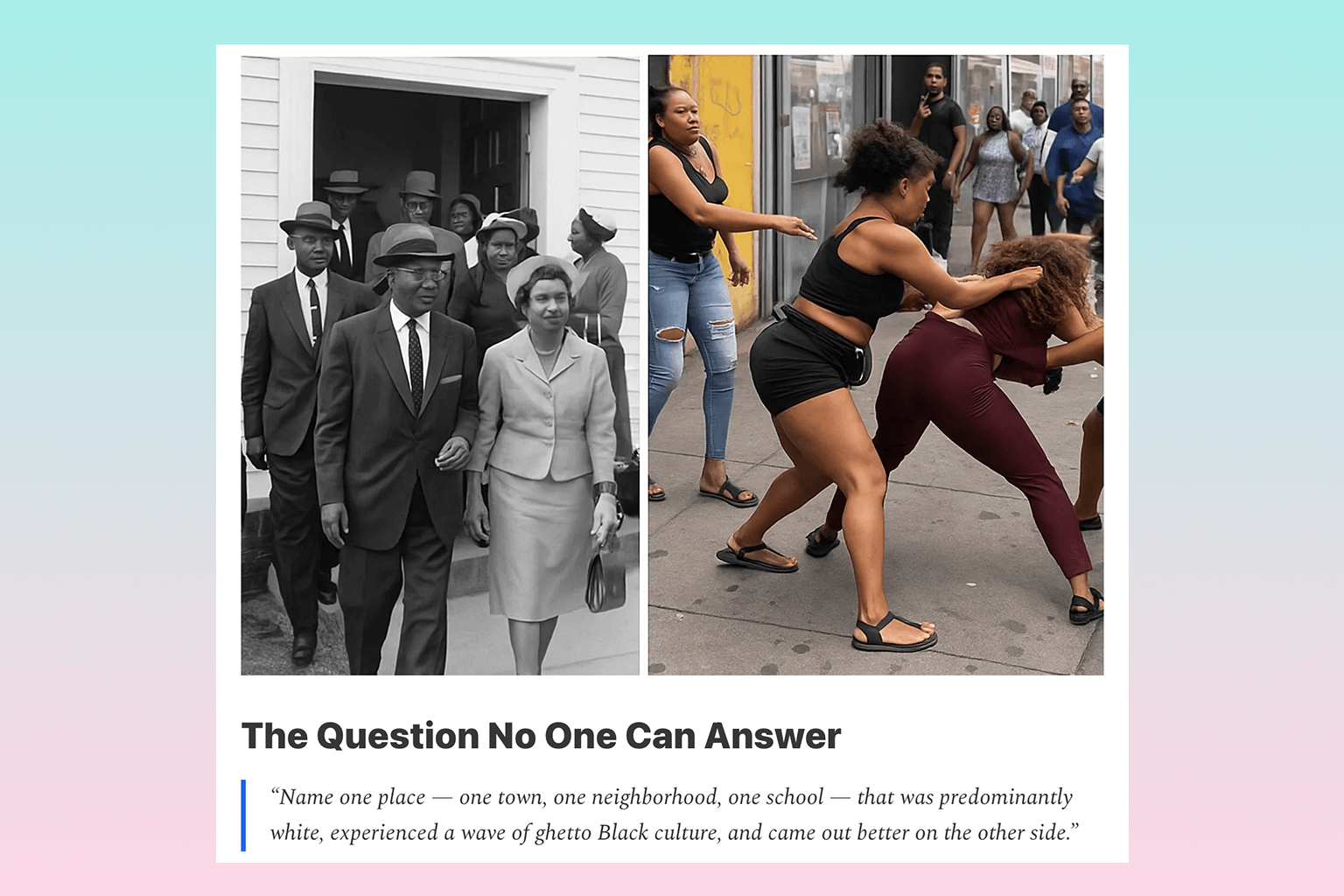
I assumed An Inconvenient Black Truth would have a short life.
That is usually how it goes with essays that touch a nerve. There is an initial burst of attention, a predictable round of outrage, a few denunciations, and then silence. Sometimes the topic burns out. Sometimes people learn quickly that speaking plainly carries social costs. Either way, controversial writing tends to fade.
I expected the same outcome here. What I did not expect was what the data showed months later.
That is why reintroducing it now matters. Most people reading me today were not on the list when it first went out, and the essay has quietly become a reference point in conversations I keep seeing. If newer readers never got the foundation, they are left trying to understand later arguments without the original frame.
A Detail That Changes the Story
There is one fact that matters more than most readers realize. When I published the essay on July 29, 2025, the first email went out to 229 subscribers. That was the entire audience at the time.
Today, the audience is almost 10x that size. Many people reading me now never received that original email. They did not scroll past the essay. They never saw it. So when the piece resurfaces today, it is not nostalgia. It is discovery. For newer readers, it is a missing chapter they keep hearing referenced and finally decide to read for themselves.
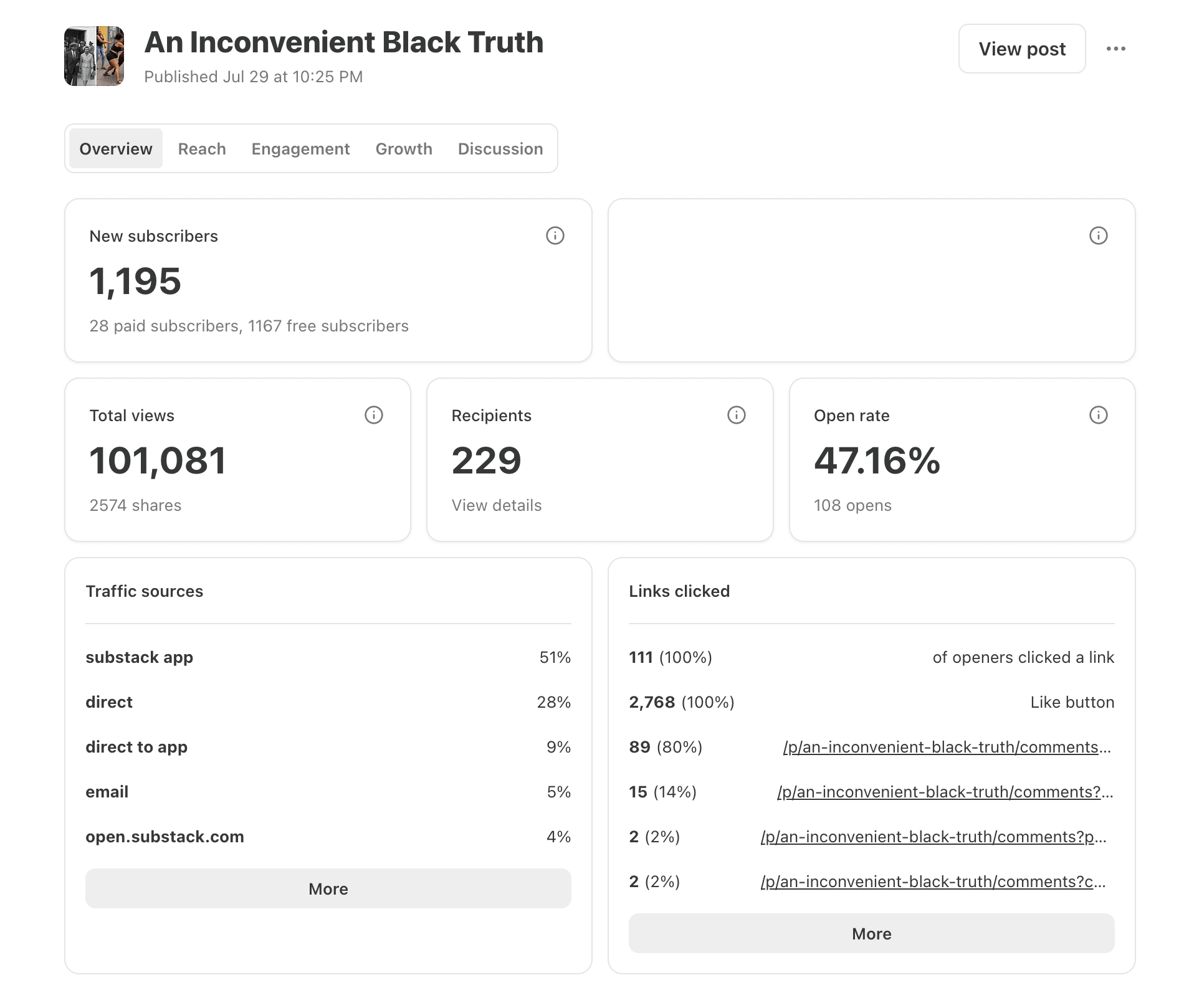
That context is crucial because it explains why I decided to look at the day-by-day traffic rather than rely on impressions.
What I Expected to See
Most posts follow a simple curve. There is a spike, then a rapid decline, then a long flat tail. Unless the writer keeps pushing the link, attention moves on. This is not a judgment. It is how human attention works.
If An Inconvenient Black Truth were like most controversial essays, it would have done its work and quietly disappeared.
That is not what happened.
What the Numbers Actually Show
Using GA4, I pulled the daily view data through December 12, 2025. In mid to late November, the essay was still drawing steady traffic. Not a flood, but consistent readers finding it anyway.
Then, in early December, the pattern changed. Views did not merely hold. They climbed. In a matter of days, traffic moved from roughly a hundred or so views per day into the several-hundred range. One day crossed six hundred. The following days remained elevated.
There was no new email blast. No promotion. No coordinated push. The essay simply reentered circulation.
That shape matters. It is not the pattern of a post people glanced at once and forgot. It is the pattern of a post people keep returning to, sharing, and sending to someone else.
This Is Not Virality
The word “viral” gets used too loosely. Viral content behaves like a firework. It explodes, burns bright, and disappears. It is powered by novelty and emotion.
What I was seeing was different. Consistent views and a second wave months later indicate rediscovery, not hype. Readers were finding the essay through other paths. They discovered my work elsewhere, noticed the essay referenced, or heard someone mention it, and then went looking for it on their own.
That is how reference material behaves. Not outrage content.
Why This Essay Behaves Like a Reference Point
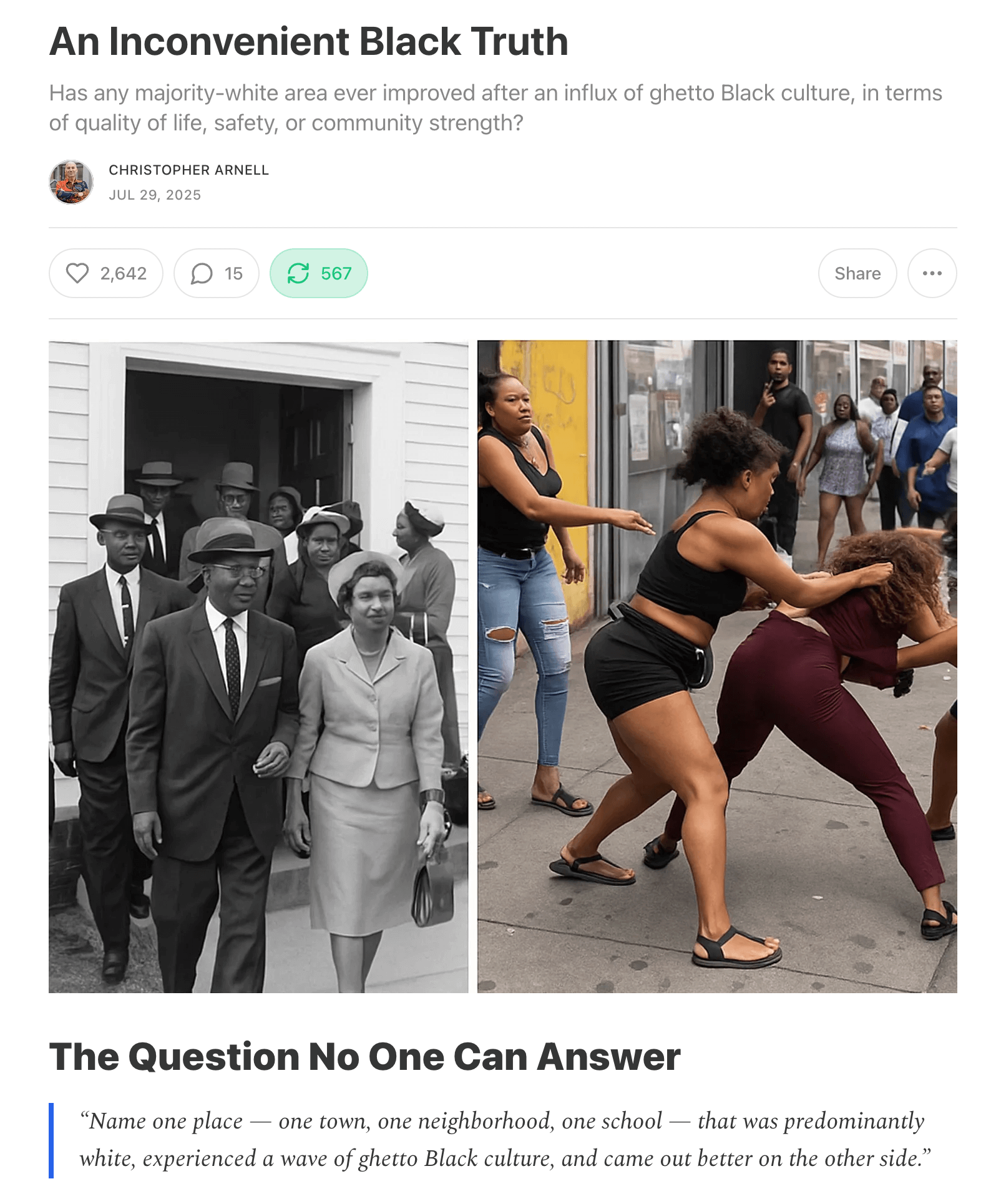
The original essay opens with a simple, testable challenge:
Name one place, one town, one neighborhood, or one school that was predominantly white, absorbed a wave of ghetto Black culture, and came out better on the other side.
That is not a slogan. It is a request for a counterexample. It forces the discussion out of moral posturing and into observable reality.
The essay then makes a distinction many people avoid saying aloud. It separates race from culture. It states plainly that many Black Americans reject ghetto culture and often pay a social price for doing so. It draws on Thomas Sowell’s historical work to show that the behaviors now defended as “authentic” did not originate in Africa or slavery, but in a dysfunctional Southern subculture that later became racialized and politically protected.
It also names institutions and consequences. Schools that shift from instruction to crowd control. Retailers that lock merchandise or leave entire neighborhoods. Corporations that quietly rewrite rules to filter behavior they cannot publicly discuss. Whether a reader agrees with every conclusion or not, the structure is clear. A claim is made, evidence is presented, and a counterexample is invited.
That structure is hard to replace with a slogan. You can disagree with it, but you cannot easily pretend it is incoherent.
The Quiet Way People Share It
Another reason the essay resurfaces without fanfare is how people share it.
Most readers do not broadcast it publicly. They send it privately. They drop it into a group chat. They bookmark it. They come back later to reread a section that put language to something they have already seen.
Silence is often mistaken for indifference. In 2025, silence more often signals caution. There are subjects where even reading the wrong thing can invite accusations. So people act accordingly. They share carefully.
If you want to understand why certain essays keep coming back, watch what people circulate quietly, not what they perform loudly.
What This Says About the Moment We Are In
People are not starved for more slogans. They are starved for language that describes reality without euphemism.
Much of modern politics, particularly within the Democrat Party and the institutions aligned with it, relies on moral framing rather than measurable outcomes. If every failure is explained as systemic racism, then behavior is never examined and accountability is never required. If every critique is labeled hateful, the people living with the consequences are told to remain silent.
Culture is dangerous to that framework because culture implies choices, standards, discipline, and consequences. It implies that outcomes follow behavior more reliably than they follow narratives.
Even readers who dislike my conclusions often recognize that the question itself has been dodged for a long time. Questions like that do not disappear. They wait. They circulate. They return when official explanations no longer match what people see in their daily lives.
A Note for Newer Readers
If you subscribed after July 2025, you likely never saw An Inconvenient Black Truth when it first went out to those 229 people. That is part of why it keeps being rediscovered now.
If you want to read the original essay in full, you can find it here.

I did not write that essay expecting it to last. I expected a brief storm and then silence.
Instead, readers keep finding it. They keep passing it along. They keep returning to it when they want language for something they have been told not to notice.
That is the real story. Readers decide what survives over time. And when an essay survives without being pushed, it is usually because it is doing a job the rest of the culture refuses to do.
Become a Paid Subscriber
Support work that asks questions most people are afraid to ask out loud.
«Become a Paid Subscriber»
Make a One-Time Gift
If you want to help without another subscription, a one-time contribution makes a real difference.
«Make a One-Time Gift»
Join The Resistance Core
This tier funds the work at its most serious level and keeps it moving forward.
«Join The Resistance Core»
What Your Support Builds Right Now
Time, focus, and independence. It keeps the pressure where it belongs, on comforting stories that collapse under evidence.
If You Cannot Give
Sharing the work is really helpful. Quiet help still counts.
Sign Up for the Boost Page Free
If you are a creator and want to amplify essential posts, the Boost list is the best way to do it.
«Join the Boost page»
I first read "An Inconvenient Black Truth" on SubStack and became interested because of your willingness to articulate hard truths supported by empirical facts. Also, because I am a huge Thomas Sowell fan, I was familiar with "Black Rednecks and White Liberals" and many of his other works. Unfortunately, Thomas Sowell is perhaps one of the most underrated writers of our time. I became a paid subscriber after reading several more of your articles. I really appreciate what you are doing and I felt a keen sense of guilt consuming the work for free.
I have always been suspicious of mainstream media; however, after COVID there was no longer any room for doubt. They exposed their complete corruption so clearly, only a fool would continue participating in that farce. I turned to platforms like Substack and various Podcasts and began taking in all my news from sources outside of MSM. After listening to Mike Benz expose the web of deceit via USAID, my suspicions of our own government were confirmed and I was driven even further from any form of MSM or government sponsored content (NPR/PBS etc..).
Thankfully, Elon purchased Twitter and provided a forum for free speech (even bad free speech) to flourish. Then the election, at least temporarily, paused the government sponsored censorship. I will never ever trust MSM or our own government again. I depend on independent sources for all my news. Referencing Thomas Sowell, "anything made artificially cheap will be abused," I think that is what happened to government and corporate sponsored news, it "appeared to be free." So I only consume news and information produced by independent "non-governmental or corporate" sources now and I believe I am obligated to pay for such quality. That is why I decided to become a paid subscriber to your work.
I think if free speech and freedom of thought is to survive in this country then many more Americans will have to do the same thing. If not, we are all destined to become wards of the state.
The failure of black leadership to fulfill the terms of the social contract forged in political praxis from 1966 to 1972 gives legitimacy to Christopher Arnell’s honest critique of ghetto culture, expressed with common-sense intelligence based in the experience of white society.
https://charlesmckelvey.substack.com/p/ghetto-culture-and-its-consequences