


“America didn’t lose its values. It lost the expectation that those values should be lived.”
Something feels different in America, and most people know it long before they try to put it into words.
They notice it in ordinary places. On the road. In stores. In neighborhoods that used to feel predictable. In the way strangers speak to each other, or avoid speaking at all. There is less ease in daily life than there used to be. Less assumption of goodwill. Less confidence that the person standing in front of you was raised with anything close to the same understanding of how to behave.
That is not hysteria. It is not nostalgia run wild. Every generation tends to think the past was more decent than the present. But that instinct alone does not explain why so many people, including those who are not especially political, keep arriving at the same conclusion in their own words: something is off.
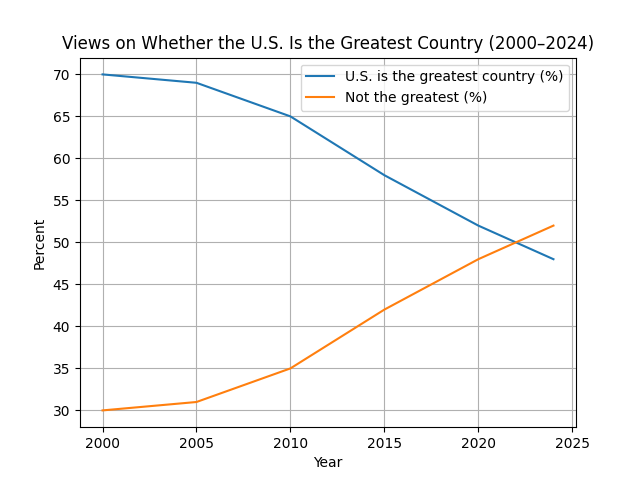
For years, Americans have been told not to trust that judgment. They have been told that what they are seeing is simply change. The country is evolving. It is becoming more modern, more open, more diverse. Some of that is true. No society stays the same. But change, by itself, explains very little. A country can change and still remain stable. A society can become more varied and still remain functional.
What people are reacting to is not change. It is the breakdown of a common culture that once made everyday life more workable than it is now.
There was a time in this country when many of the most important rules were never written down because they did not have to be. People understood them. You stood in line. You showed basic courtesy in public. You did your job even when you did not feel like doing it. You treated police officers, firefighters, and teachers with a level of respect because they represented order, service, and authority. You tried not to embarrass yourself in public. You tried, in general, to carry yourself like somebody had raised you to live among other people.
That was not perfection. There were rude people, dishonest people, and reckless people then, just as there are now. The difference is that they were understood as departures from the norm, not as rival ways of living that demanded equal standing. A society can absorb people who break its standards. It struggles once it stops believing it has standards worth defending.
A country does not come apart simply because people vote for different parties or argue over policy. Free societies have always done that. The deeper danger appears when people no longer share the same basic habits and assumptions that make freedom workable. Once that common ground weakens, trust becomes harder. Cooperation becomes harder. Even simple interactions carry more friction than they should.
You can see this in ways that do not require a stack of studies. Stores lock up everyday items because too many people take what used to sit openly on shelves. Schools spend more time controlling behavior that once would have been handled at home. Businesses hire security because basic order can no longer be taken for granted. More people keep to themselves because they are less sure of what they are dealing with.
The data, when you look at it, points in the same direction. According to long-running surveys from the Pew Research Center, trust in the federal government, which was around 70 percent in the late 1950s and 1960s, has for years sat closer to 20 percent or below. Confidence in media, schools, and other major institutions has also declined sharply. That does not prove every concern people have is correct. It does show that the broad trust required to hold a society together has been weakening for a long time.
Crime tells part of the story as well. Violent crime is not uniformly higher than it has ever been, but the surge in homicide and aggravated assault in many cities beginning in 2020 was real. Even where rates later declined, the sense of disorder remained. Once people see everyday life become less predictable, they do not easily return to their old assumptions.
Laws alone do not create a stable society. Laws can punish theft, assault, and fraud after the fact. What they cannot do is create the habits that make enforcement less necessary. They cannot teach restraint. They cannot make a person feel ashamed of acting like a fool in public. They cannot raise children who understand that other people exist and matter. They cannot create the quiet, everyday expectations that allow millions of people to live together with less conflict than pure self-interest would produce.
Culture does that.
And culture, in the American sense, rested on more than slogans. It rested on shared heritage, shared values, and shared expectations. Americans did not all come from identical backgrounds, nor did they agree on everything, but there was enough overlap to form a recognizable mainstream. People broadly admired work, marriage, self-control, honesty, responsibility, and respectability. Those things were not universally practiced, but they were widely understood as the standard.
That kind of common culture made freedom possible. It reduced friction. It lowered the number of things that had to be argued over. It gave people a common understanding of behavior before politics entered the room.
When that culture weakens, societies do not collapse overnight. They continue for a time on habits formed in earlier generations. But as those habits fade, the decline becomes harder to ignore. Standards loosen. Behavior becomes less predictable. Institutions take on burdens they were never designed to carry. Then people begin asking what went wrong.
Too often, the answers they receive are evasive. They are told this is simply the cost of progress. Or they are told that expecting common standards is restrictive or unfair. That kind of thinking does not solve the problem. A society does not become more stable by treating all standards as optional. It becomes more erratic.
In Paradise Lost, the fall does not begin with chaos. It begins with a change in thinking. It begins with the belief that an inherited order no longer deserves to be followed. That is how decline usually works in the real world. It does not begin when everything is already broken. It begins when people stop believing that the standards holding things together are necessary.
That is what makes the present moment worth examining. The question is not whether America has changed. It always has. The question is whether it can remain stable once it loses the culture that made its freedoms workable in the first place.
This is not a poetic concern. It affects whether neighborhoods remain livable, whether schools can teach, whether businesses can operate, and whether strangers can trust one another.
This essay is about that loss. Not as nostalgia, and not as a claim that the past was perfect. It is about cause and effect. What held the country together, what weakened it, and what happens when shared standards are replaced by permanent negotiation.
Because a nation needs more than laws and elections. It needs a people who share enough in common to live together without constantly renegotiating the basic rules of life.
A Nation Is More Than Laws
Laws are necessary. No serious society can function without them. They define boundaries, settle disputes, and punish behavior that threatens others. But laws, by themselves, have never been enough to hold a country together.
They can tell people what they are not allowed to do. They cannot make people trustworthy or create a sense of obligation to others. Nor can they make a person care whether his behavior makes life easier or harder for the people around him.
A society where people behave well only because they fear punishment is a society that requires constant supervision. It becomes expensive to run and difficult to sustain. Every interaction has to be monitored. Every disagreement has to be mediated. Every breakdown has to be handled by some formal authority.
A society where people share common expectations operates very differently. Much of what needs to happen simply happens. People cooperate without being told. They follow norms that are not written down because those norms have been absorbed over time. They know where the lines are, even when no one is watching.
Culture is what makes that possible.
Culture is not a slogan. It is not something you can manufacture overnight through a program or a campaign. It is the accumulation of habits, expectations, and values passed from one generation to the next. It shows up in small decisions more than big ones. How people speak to each other. How they handle disagreement. Whether they take responsibility for their actions or look for someone else to blame.
When that culture is widely shared, the need for enforcement drops. People do not need to be told to stand in line or to show basic courtesy. They do it because that is how they were raised. When it is not shared, the opposite happens. The same society begins to rely more heavily on rules, surveillance, and penalties to achieve what used to happen on its own.
You can see this shift in ways that do not require theory. Walk into a large retail store today and look at what is locked behind glass. Items that once sat on open shelves now require an employee to retrieve them. That change did not happen because the products became more valuable. It happened because the cost of trusting the public rose.
The same pattern shows up in the growth of regulations over time. The Federal Register, which documents federal rules and regulations, ran to just over 20,000 pages in 1970. In recent years, it has exceeded 80,000 pages. That increase did not happen because Americans suddenly became more virtuous. It happened because more and more behavior had to be formalized, specified, and enforced.
That does not mean every regulation is unnecessary. It does suggest that informal norms are doing less of the work they once did.
The same pattern appears elsewhere. Businesses spend more on loss prevention. Schools devote more time to managing behavior that once would have been handled at home. Public spaces require more oversight to maintain order. None of these changes occurred in a vacuum. They are responses to a shift in how people behave when they are left to their own judgment.
When people cannot rely on shared expectations, they rely less on each other. They pull back and avoid unnecessary interaction. Trust declines, not because people suddenly become irrational, but because the environment gives them fewer reasons to assume that others will act predictably.
The data reflects this change. Surveys from organizations like the Pew Research Center and Gallup show long-term declines in trust across a range of institutions. Confidence in government, media, and other major pillars of public life has weakened for decades. Just as important is the decline in interpersonal trust. Fewer people believe that others will deal with them fairly. That belief shapes behavior before any law comes into play.
When trust declines, everything becomes more difficult.
Simple transactions require more verification. Agreements require more documentation. Disputes escalate more quickly because there is less shared ground to resolve them. What used to be handled through informal understanding now requires formal intervention.
This is not a talking point. It is a practical reality.
A country can pass better laws. It can reform institutions. It can adjust policies. But if the underlying culture does not support those changes, the results will be limited. Laws can restrain behavior at the margins. They cannot replace the habits that make cooperation possible in the first place.
The more a society relies on enforcement, the more resistance it generates, which in turn requires even more enforcement.
This is where many modern discussions go off track. People talk about policy as if it operates in isolation. They debate laws, funding levels, and administrative changes as though those things exist independently of the culture they are meant to govern.
They do not.
The same policy can produce very different outcomes depending on the cultural context in which it is applied. A rule that works in a high-trust environment may fail in a low-trust one. A program that depends on voluntary compliance may function well among people who feel a sense of obligation, and poorly among those who do not.
Ignoring that reality leads people to assume that if a policy fails, the answer is simply to expand it, fund it more heavily, or enforce it more aggressively. Sometimes that is true. Often it is not.
The problem lies deeper.
It lies in the erosion of the shared habits and expectations that made simpler systems work in the first place.
Once those habits weaken, the burden shifts to institutions. Schools are expected to do more than educate. They are expected to socialize. Police are expected to manage situations that once would have been resolved before they escalated. Businesses are expected to absorb losses that would once have been unthinkable. Government agencies are expected to solve problems that begin far outside their reach.
At some point, those institutions begin to strain.
They were not designed to replace culture. They were designed to operate within it.
When people say that something feels off in America, this is a large part of what they are sensing. They are sensing that the country is asking its formal systems to do work that was once handled informally. They are sensing that the unwritten rules have weakened, and that the written rules are struggling to compensate.
That is not a sustainable arrangement.
A nation is more than its laws because laws depend on something deeper to function well. They depend on a population that shares enough common ground to make cooperation normal rather than exceptional. They depend on habits that reduce the need for constant oversight. They depend on expectations that guide behavior before enforcement becomes necessary.
Without those things, laws remain in place, but the society they are meant to support becomes harder to manage, more expensive to maintain, and less stable over time.
That is the foundation on which everything else rests.
What Americans Once Shared
To understand what has changed, it helps to be clear about what once existed. Not a perfect society, and not a time when everyone agreed on everything, but a country where enough people shared the same basic understanding of how to live that everyday life worked with less friction than it does now.
That shared understanding showed up first in how people approached work. A job was not only a way to earn money. It was a responsibility. People were expected to show up, do what they were paid to do, and take some pride in doing it well. There were always exceptions, but the expectation was widely understood. Employers could assume a certain level of reliability, and employees knew that cutting corners or failing to carry their weight would bring consequences, not only from management but from coworkers who depended on them.
You can see this in long-term labor data. Through much of the postwar period, labor force participation among prime-age men remained high, often above 90 percent. That did not happen because every job was fulfilling. It happened because work itself was treated as a normal and necessary part of adult life. In more recent decades, that participation rate has fallen significantly, dropping into the mid-80 percent range and at times lower. Economists debate the causes, but the change reflects more than economics. It reflects a shift in expectations about work and responsibility.
Family life followed a similar pattern. Marriage was not seen as one lifestyle among many. It was the expected foundation for raising children and building a stable household. According to data from the U.S. Census Bureau, around 70 percent of adults were married in 1960. Today, that figure is closer to half. At the same time, the share of children born outside of marriage has risen from under 10 percent in 1960 to around 40 percent in recent years.
Those numbers do not tell the whole story, but they point to a shift in how family is understood. When marriage is widely expected, it creates a structure that shapes behavior before problems arise. When it becomes optional in a deeper sense, that structure weakens, and more of the burden shifts to schools, courts, and social programs to deal with the consequences.
Courtesy and public behavior also followed a pattern that required little explanation at the time. People were expected to show a basic level of respect in shared spaces. That did not mean everyone was polite, but it did mean that rudeness, disorder, and open hostility were seen as unacceptable in most settings. A person who behaved badly in public risked more than a fine or a warning. He risked social disapproval, which in many cases was a stronger deterrent than formal punishment.
That kind of informal enforcement is difficult to measure, but its absence is easier to see. When stores begin locking up everyday goods, when public transit systems deal with more visible disorder, and when schools spend more time managing behavior than teaching, it suggests that the informal expectations that once kept conduct within certain bounds are no longer as effective as they once were.
Respect for authority, particularly for those charged with maintaining order, was another part of this shared culture. Police officers, firefighters, and other public servants were not viewed as perfect, and they were not above criticism, but they were generally seen as necessary and legitimate. That baseline of legitimacy made it easier for them to do their jobs without constant resistance. When that legitimacy weakens, every interaction becomes more difficult, and more situations escalate that might once have been resolved quickly.
Religion also played a role, even for those who were not deeply observant. In the mid-20th century, regular church attendance was far more common than it is today, and religious institutions helped reinforce ideas about right and wrong, responsibility, and self-restraint. According to Gallup, church membership in the United States was above 70 percent for much of the period from the 1940s through the 1990s. By 2020, it had fallen below 50 percent for the first time in modern polling.
The point is not that religious belief guarantees good behavior, or that a more religious society is automatically a better one. The point is that these institutions provided a shared framework that shaped expectations across large segments of the population. When fewer people participate in those institutions, that shared framework becomes weaker.
Education reinforced many of the same expectations. Schools were expected to teach academic subjects, but also to instill discipline and prepare students to function in adult life. Teachers had more authority in the classroom, and parents were more likely to back that authority. When problems arose, they were often addressed with the assumption that the student needed to adjust his behavior, not that the system needed to be redesigned around him.
That dynamic has shifted in many places. Teachers report spending more time on classroom management, and less on instruction, than in previous decades. Surveys from organizations like the National Center for Education Statistics show increases in reported disruptions and behavioral challenges in schools. Again, this is not universal, but the trend is significant enough to affect how schools operate.
What ties all of these areas together is not that everyone behaved well, or that there were no serious problems. It is that there was a broadly shared sense of what was expected. People knew, in general terms, what a responsible adult looked like, what a functioning family looked like, and how one was supposed to act in public. That knowledge reduced the need for constant negotiation.
When expectations are widely shared, they create a kind of social shorthand. People can move through daily life without having to question every interaction. They can assume that others understand the same basic rules, even if they do not always follow them. That assumption lowers the cost of cooperation and makes trust more rational.
When those expectations weaken, the opposite occurs. People become less certain about what others will do, and they adjust accordingly. They rely more on formal rules, more on enforcement, and less on informal understanding. That shift does not happen all at once, and it does not affect every place equally, but over time it changes how a society functions.
This is what is often missing from discussions about change in America. The focus tends to be on individual issues, such as crime, education, or economic policy, without recognizing the common thread that connects them. That thread is the strength or weakness of a shared culture.
A society does not need uniformity to function, but it does need enough common ground to make cooperation the default rather than the exception. For much of American history, that common ground existed to a degree that made daily life more stable than it is now. Understanding that baseline is necessary before examining what has weakened it and what has followed from that change.
When Expectations Became Optional
The shift from a culture of shared expectations to one where those expectations are treated as optional did not happen all at once. It developed gradually, often in ways that seemed reasonable at the time. Each change, taken on its own, could be explained as an effort to expand freedom, increase fairness, or correct past shortcomings. Over time, however, those changes accumulated and began to alter the underlying assumptions that once guided behavior.
One of the clearest changes was in how standards themselves were viewed. There was a time when common expectations were understood as necessary for a functioning society. They were not seen as perfect, and they were not applied equally in every case, but they were broadly accepted as legitimate. Over time, that view began to shift. Standards that had once been taken for granted came to be seen by some as arbitrary, outdated, or even unjust.
This change did not remain confined to academic debates or policy discussions. It filtered into everyday life. Expectations about work, family, education, and public behavior were increasingly framed as personal choices rather than shared obligations. The language changed first. Words like duty, responsibility, and discipline became less common in public conversation, while words like expression, identity, and preference became more prominent.
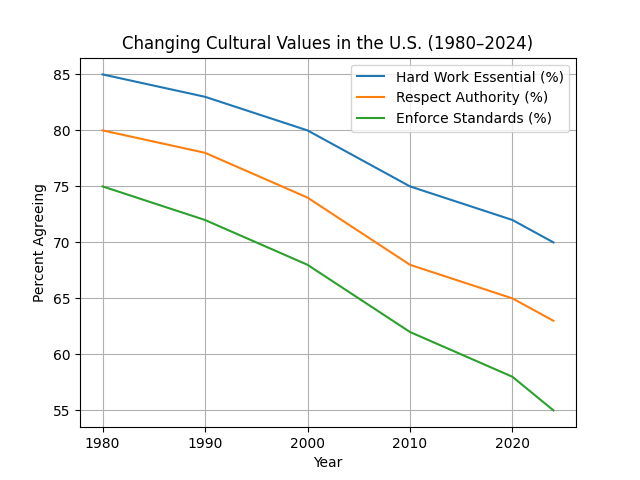
That change in language mattered because it reflected a deeper shift in how people understood their relationship to society. When behavior is framed primarily as a matter of personal choice, the idea that there should be a common standard becomes harder to defend. What was once expected becomes something that individuals may or may not choose to follow, depending on their circumstances and preferences.
You can see this shift in several areas.
In the workplace, expectations about reliability and effort have become less consistent. Surveys from organizations like Gallup have shown declining levels of employee engagement over the past two decades, with a significant share of workers reporting that they feel disconnected from their jobs. That does not mean people have become less capable. It does suggest that the sense of obligation that once tied individuals more closely to their work has weakened in some settings.
In education, expectations about behavior and performance have also changed. Teachers report spending more time managing disruptions and less time on instruction than in previous decades. Data from the National Center for Education Statistics shows increases in reported behavioral issues in classrooms, particularly in the years following the disruptions of 2020. At the same time, grading standards and disciplinary policies have been adjusted in many districts in ways that reduce the consequences for poor performance or misconduct.
In family life, the idea that certain structures are necessary has been replaced in many discussions by the idea that all arrangements are equally valid. The result is not simply a greater variety of family forms, but a reduced clarity about what is expected. When expectations are unclear, outcomes tend to vary more widely, and institutions are left to deal with the consequences.
Public behavior reflects similar changes. Standards that once governed how people acted in shared spaces are less consistently applied. What used to draw immediate social disapproval is now more likely to be ignored, tolerated, or reframed as a matter of personal expression. This does not mean that disorder is accepted everywhere, but it does mean that the boundaries are less clear than they once were.
These changes are often defended in terms of freedom, and there is some truth to that. When expectations become less rigid, individuals have more room to make their own choices. But that freedom comes with tradeoffs. When fewer behaviors are guided by shared expectations, more behaviors have to be managed through formal systems. The burden shifts from culture to institutions.
You can see the result in how problems are addressed. When a student disrupts a classroom, the response is less likely to involve immediate correction backed by a shared understanding of proper behavior, and more likely to involve a formal process. When theft becomes more common in retail settings, the response is not simply social disapproval, but increased security, restricted access, and higher prices to cover losses. When public spaces become less orderly, the response is more regulation, more enforcement, and more tension between those enforcing the rules and those being asked to follow them.
None of this happens in isolation. As expectations weaken in one area, the effects spread to others. A decline in standards in schools affects the workplace. Changes in family structure affect education and social services. Shifts in public behavior affect how communities function. Over time, these changes reinforce each other.
This is not a claim that the past was ideal or that every change has been harmful. It is an observation about how systems work. A society that relies less on shared expectations must rely more on formal controls. Those controls are more costly, more complicated, and often less effective than the informal norms they replace.
The question is not whether individuals should have freedom to make their own choices. The question is what happens to a society when the expectations that once guided those choices are no longer widely shared. When that happens, the line between acceptable and unacceptable behavior becomes less clear, and more situations fall into a gray area that requires intervention.
Over time, that gray area expands.
As it expands, institutions are asked to do more, and individuals rely less on each other to maintain basic standards. The result is not necessarily immediate breakdown, but a steady increase in friction. More rules, more oversight, more conflict over what should be expected in the first place.
That is the environment that many Americans are reacting to, whether they describe it in those terms or not. They are responding to a world in which the basic rules of conduct feel less certain, and where the burden of maintaining order has shifted away from shared culture and toward formal systems that were never designed to carry it alone.
That shift, once it reaches a certain point, is difficult to reverse.
Coalitions and the Loss of a Common Culture
Political coalitions are not new. Every major party builds support by bringing together groups with shared interests, priorities, or concerns. That is how a representative system is supposed to work. The question is not whether coalitions exist. The question is how they are built, and what happens to a common culture when those coalitions expand in ways that pull in different directions.
There are two broad approaches to building political support. One relies more heavily on reinforcing existing norms and appealing to people who already share a similar understanding of how society should function. The other places more emphasis on assembling a broader coalition by appealing to groups with different experiences, interests, and grievances. Both approaches can succeed politically. They do not produce the same cultural outcomes.
When a coalition is built around a relatively narrow set of shared assumptions, it tends to reinforce those assumptions. The people drawn to it are already aligned on many basic questions, so the coalition can focus on policy differences without constantly renegotiating underlying values. That kind of alignment does not eliminate disagreement, but it limits the number of areas where disagreement becomes fundamental.
A broader coalition operates differently. To bring together groups with varied priorities, the message has to be flexible enough to resonate across those differences. Over time, that flexibility often requires loosening the emphasis on any single set of shared expectations. What one group sees as a necessary standard, another may see as a constraint. To keep the coalition intact, those standards are often reframed as optional, negotiable, or dependent on context.
This is not a matter of good intentions or bad intentions. It is a matter of incentives.
A political organization that depends on an expanding coalition has a strong incentive to lower barriers to entry. It has an incentive to avoid emphasizing norms that might exclude potential supporters. It has an incentive to frame differences in behavior or outcomes in ways that do not place responsibility on the individuals within the coalition. Over time, those incentives shape not only political messaging, but the broader culture in which that messaging operates.
The Democrat Party has been particularly effective at building this kind of coalition in recent decades. It has drawn support from a wide range of groups, including urban voters, younger voters, and many minority communities. That coalition is not uniform, and it does not agree on everything, but it has been held together by a set of narratives that emphasize inclusion, representation, and the reduction of disparities, aka victimhood.
Those narratives have political advantages. They allow the party to speak to multiple constituencies at once. They provide a framework for interpreting differences in outcomes. They also tend to shift the focus away from shared behavioral expectations and toward structural explanations for those outcomes.
You can see this shift in how issues are discussed. Differences in educational performance, income, or involvement with the criminal justice system are more often explained in terms of external factors than individual behavior. Again, this does not mean that external factors are irrelevant. It does mean that the role of personal responsibility and shared expectations receives less emphasis than it once did.
Over time, that shift affects more than policy debates. It influences how people understand their own choices and the choices of others. If outcomes are primarily attributed to systems rather than behavior, the incentive to conform to shared standards weakens. If standards are seen as unevenly applied or inherently unfair, the motivation to uphold them declines further.
This is where the cultural impact becomes more visible.
A coalition that depends on minimizing internal conflict has reason to avoid enforcing common standards too strictly. What might once have been treated as a failure to meet expectations is more likely to be reframed as a difference in perspective or circumstance. That reframing can reduce immediate tension within the coalition, but it also reduces the clarity of the standards themselves.
When standards become less clear, behavior becomes less predictable. When behavior becomes less predictable, trust declines. When trust declines, institutions are forced to compensate through rules, oversight, and enforcement.
The connection between coalition politics and cultural change is not always direct, but it is consistent. Political incentives shape the language used to describe problems, and that language shapes how people understand those problems. Over time, those interpretations influence behavior.
It is also important to understand that this dynamic extends beyond formal politics. The same narratives are reinforced through media, education, and community organizations. Nonprofit structures, including groups organized under 501(c)(3) organization and 501(c)(4) organization, play a role in shaping how issues are presented and discussed. These organizations often operate within legal boundaries, but they can still contribute to a broader environment in which certain explanations are emphasized and others are downplayed.
Most people do not study policy in detail. They absorb ideas from the people and institutions around them. When those sources consistently frame issues in similar ways, those frames become the default. They shape how individuals interpret their own experiences and the experiences of others.
This is how cultural change occurs without a single, central directive. It emerges from a set of incentives and reinforcing mechanisms that push in the same direction over time.
The result is not immediate breakdown. It is a gradual shift in what is expected. Standards that once guided behavior become less central. Differences that were once managed within a common framework become more prominent. The shared culture that made cooperation easier begins to weaken.
When that happens, the effects show up elsewhere. Schools take on more responsibility for behavior that was once addressed at home. Businesses invest more in security and loss prevention. Public institutions face greater resistance when trying to enforce rules that are no longer widely accepted.
When expectations weaken, institutions inherit problems they cannot solve on their own.
This is not a problem that can be addressed solely through political change. It is rooted in how a society defines its standards and how strongly it expects those standards to be followed. Political coalitions can accelerate or reinforce those changes, but they do not operate in isolation.
A country can function with differences in opinion and interest. It becomes much harder to sustain when those differences are no longer anchored in a shared understanding of how people are expected to live.
The Decline of Assimilation
For most of American history, cultural differences did not disappear, but they were expected to narrow over time. People arrived from different countries with different languages, customs, and habits, yet there was a general understanding that becoming American meant adopting a common way of living. That expectation was not always stated formally, and it was not applied perfectly, but it was widely understood.
Assimilation did not mean abandoning everything from one’s past. It meant learning the language, understanding the norms, and operating within a shared set of expectations that made cooperation easier. It meant that over time, differences became less central to daily life. A person might retain cultural traditions at home, but in public settings there was a common standard that guided behavior.
That expectation produced measurable results. Large waves of immigrants in the late nineteenth and early twentieth centuries arrived speaking different languages and coming from very different backgrounds. Within a generation or two, English became the dominant language in their households, intermarriage increased, and economic outcomes improved. Studies from institutions like the National Bureau of Economic Research have documented how second-generation immigrants often surpassed their parents in education and earnings, in part because they were able to operate more fully within the broader culture.
This process was not automatic. It was reinforced by schools, workplaces, and communities that expected newcomers to adapt. Public schools emphasized a common language and a shared national story. Employers expected workers to follow established norms. Communities applied informal pressure that rewarded conformity to those norms and discouraged behavior that disrupted them.
Over time, that framework began to change. The expectation of assimilation became less clear, and in some cases it was replaced by the idea that maintaining distinct cultural identities should take priority over adopting a common one. This shift was often presented as a matter of respect and inclusion, and there is a legitimate concern behind it. People do not want to be told that their background has no value.
The problem arises when the expectation of a shared culture weakens without anything equally strong replacing it. When individuals are encouraged to maintain separate norms in public as well as private life, the overlap that once made cooperation easier becomes smaller. Communication becomes more difficult, not only in terms of language, but in terms of expectations about behavior.
You can see this in language use. The United States has never had an official national language at the federal level, but English has functioned as a common medium that allowed people from different backgrounds to interact. As immigration has increased in recent decades, the number of households where English is not the primary language has grown. According to the U.S. Census Bureau, more than 20 percent of people in the United States now speak a language other than English at home, compared to around 10 percent in 1980. Most of these individuals also speak English to some degree, but the increase reflects a broader trend toward linguistic diversity.
Diversity in itself is not the issue. The issue is whether there is a strong incentive to move toward a shared standard. When that incentive weakens, differences persist longer and play a larger role in daily interactions. That can be seen in the growth of language-specific media, services, and institutions that allow individuals to operate within narrower cultural circles without engaging as fully with the broader society.
Assimilation also depends on the willingness of the receiving society to define and maintain its own standards. When those standards become uncertain, it becomes harder for newcomers to know what they are expected to adopt. If long-standing norms are treated as optional or even suspect, the process of assimilation loses its direction.
This creates a feedback loop. As assimilation weakens, differences become more visible and more politically significant. As those differences become more central, political organizations have an incentive to appeal to them directly rather than encouraging convergence. That reinforces the very patterns that make assimilation more difficult.
The role of the Democrat Party fits into this dynamic. By building a broad coalition that includes many immigrant communities, the party has an incentive to emphasize inclusion and representation. That emphasis can make it less likely to stress the importance of adopting a common set of cultural expectations, particularly when those expectations are seen as associated with an earlier period of American life.
Again, this is not simply a matter of intent. It is a matter of incentives and outcomes. A coalition that depends on maintaining support across diverse groups has reason to avoid highlighting differences in behavior that might create internal tension. Over time, that avoidance contributes to a broader environment in which expectations are less clearly defined.
The effects show up in practical ways. When people do not share a common language fluently, misunderstandings become more common. When norms about behavior differ, interactions require more negotiation. When expectations are unclear, institutions must step in more often to resolve issues that might otherwise be handled informally.
None of this means that immigration is inherently harmful or that cultural diversity cannot coexist with stability. The United States has long benefited from the energy and ambition of people who arrived from elsewhere. The question is not whether people come from different backgrounds. The question is whether there remains a strong enough common culture to bring those backgrounds into alignment over time.
When that alignment weakens, the burden shifts again to formal systems. Schools are asked to bridge larger gaps. Employers must account for wider differences in expectations. Public institutions face greater challenges in maintaining consistent standards.
Assimilation, in that sense, is not about uniformity. It is about reducing the distance between different groups so that cooperation becomes easier rather than harder.
When that distance grows instead of shrinking, the effects do not remain isolated. They begin to show up across institutions and in everyday life. Schools, workplaces, and public spaces all start to reflect the same underlying shift.
That is when the consequences stop being theoretical and become part of daily life.
Help Keep Work Like This Alive
You just read thousands of words that didn’t come from a headline, a press release, or a talking point.
It came from time.
Time spent digging, connecting dots, and trying to make sense of things most people feel but can’t quite put into words.
That kind of work doesn’t happen by accident.
It happens because people decide it’s worth supporting.
If this piece made you stop and think…
If it put words to something you’ve been noticing…
If it helped you see the bigger picture a little more clearly…
Then this is the moment to act.
Become a Paid Subscriber
Help support the work on an ongoing basis and keep this going.
https://mrchr.is/help
Make a One-Time Contribution
If a subscription isn’t right right now, any support helps more than you think.
https://mrchr.is/give
Join The Resistance Core
For those who want to go further and help build this into something lasting.
https://mrchr.is/resist
What Your Support Actually Does
It buys time.
Time to research instead of react.
Time to go deeper instead of rushing something out.
Time to build something that doesn’t rely on algorithms, headlines, or permission.
If you’ve ever thought,
“Someone needs to be saying this…”
You’re looking at it.
The only question is whether you'll help support it now, or wonder where it went later.
Wow...talk about writing ability (!) - very well written and insightful. Truly. So much so, I'm at a loss for words.
The seriousness of the subject matter compells me to to refrain from stating simply, "Bravo"...
Let's leave it with, "Godspeed".
Part two should go live tomorrow.