

In recent years, political polarization in America has intensified dramatically, raising alarming questions: What would happen if these deep-seated ideological tensions erupted into a full-scale civil conflict between Liberals and Conservatives? Although hypothetical, exploring this scenario provides a meaningful lens to understand America's vulnerabilities, resource dependencies, and inherent strategic strengths on each side.
Geographic and Resource Advantages
Conservatives dominate vast swathes of rural America, controlling essential agricultural lands, freshwater resources, and energy-producing regions. Conversely, liberals occupy densely populated urban centers, which are economic powerhouses yet heavily reliant on external resource inflows. This geographic divide creates stark differences in sustainability and logistical resilience during prolonged conflict.
A 2020 study by the USDA highlighted that approximately 85% of America's agricultural output originates from conservative-leaning rural counties, underscoring conservatives' significant advantage in food security.
Food and Water Security
Conservative-held regions include America's agricultural heartland—states like Iowa, Nebraska, Kansas, and Texas. These areas produce a significant portion of the nation's grains, beef, dairy, and produce. In a protracted conflict, Conservatives could sustain food supplies indefinitely, whereas liberal-controlled urban centers would face immediate shortages.
For example, New York City, home to over eight million people, maintains only about a week’s worth of food in local storage facilities. Research by FEMA (Federal Emergency Management Agency) indicates urban centers typically hold only a three-to-seven-day food supply in an emergency scenario, making cities highly vulnerable.
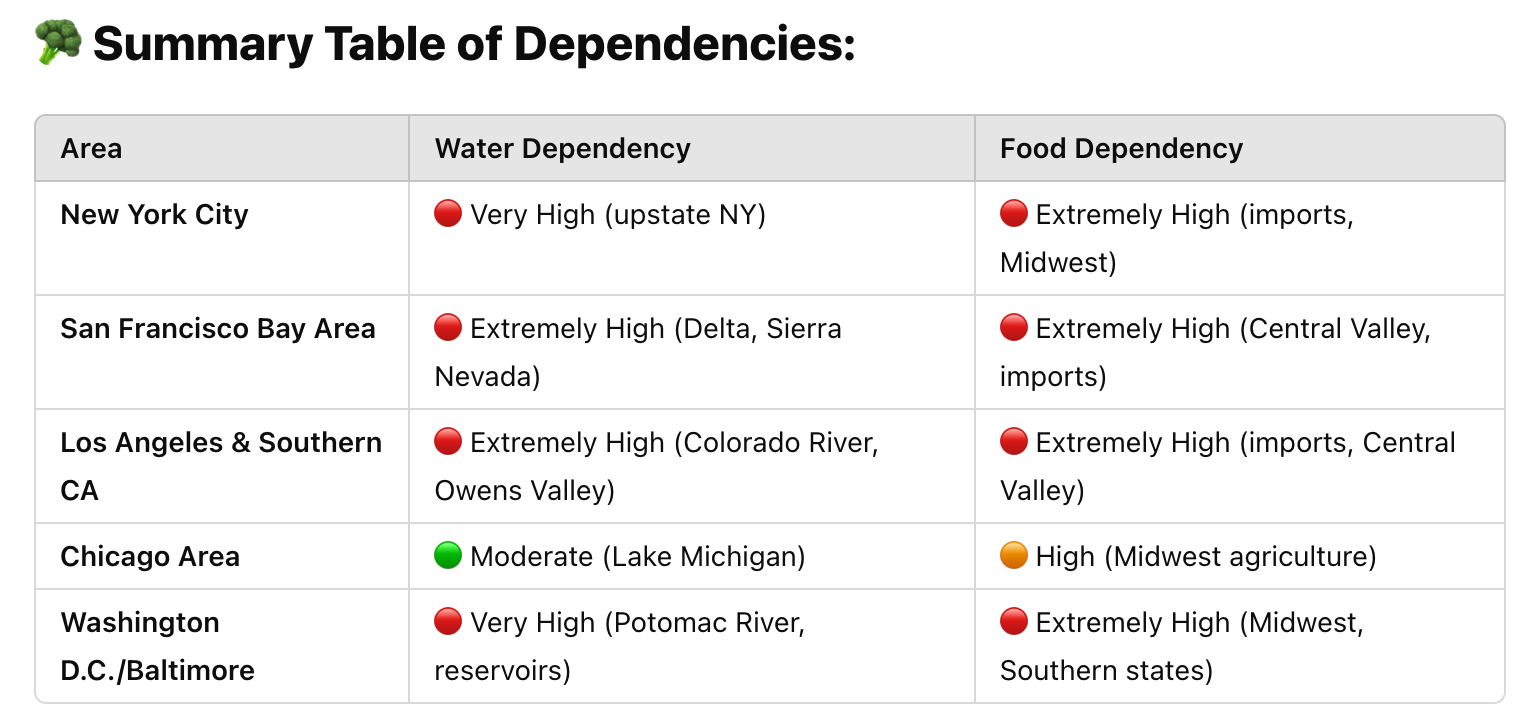
Water security further exacerbates the vulnerabilities of liberal cities. Los Angeles and the San Francisco Bay Area rely heavily on distant water supplies, like the Colorado River Aqueduct and the Hetch Hetchy system in the Sierra Nevada. Any sabotage or disruption of these external water sources would result in dire shortages, forcing mass evacuations or humanitarian crises within a week or two. According to studies by the California Department of Water Resources, nearly 75% of California's population relies on vulnerable external water sources.
Energy Resources
Conservatives control major domestic energy-producing regions: the oil-rich Permian Basin in Texas, coal mines in Wyoming and Appalachia, and extensive natural gas reserves in Pennsylvania, Texas, and Louisiana. Liberals, particularly in coastal cities, depend on imports and external refining capacity, making energy supplies a critical vulnerability.
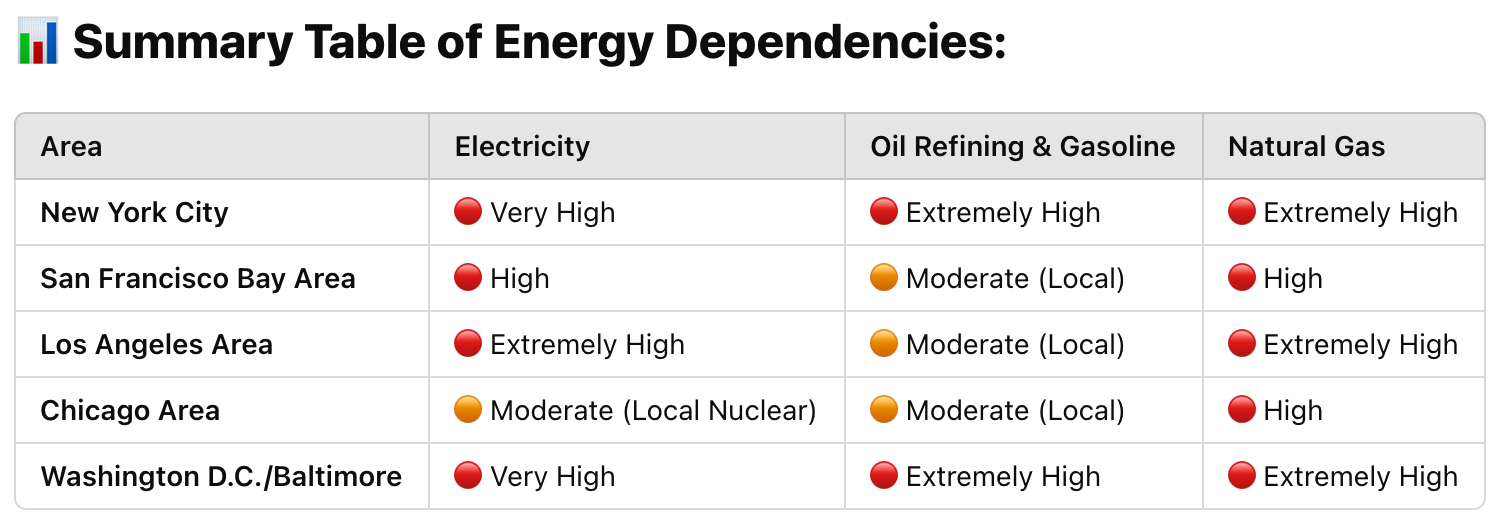
The U.S. Energy Information Administration reports that over 70% of refining capacity is concentrated along the conservative-leaning Gulf Coast, highlighting a critical vulnerability for liberal urban areas dependent on refined fuel.
Infrastructure and Communication
Initially, liberals hold a substantial advantage in communication infrastructure. Major technology hubs like Silicon Valley (Google, Apple, Facebook), New York City (financial and media centers), and Los Angeles (entertainment and media networks) boast advanced data centers, fiber-optic networks, and satellite systems. However, this advantage rapidly diminishes without sustained electricity and fuel.
According to a report by the Department of Homeland Security (DHS), communication networks can collapse within days without power and fuel, drastically limiting emergency response and coordination capabilities. Consider a scenario where Conservatives disrupt power grids or pipelines supplying fuel to urban backup generators. Communications infrastructure—including cellular networks, internet services, and media broadcasting—would degrade swiftly.
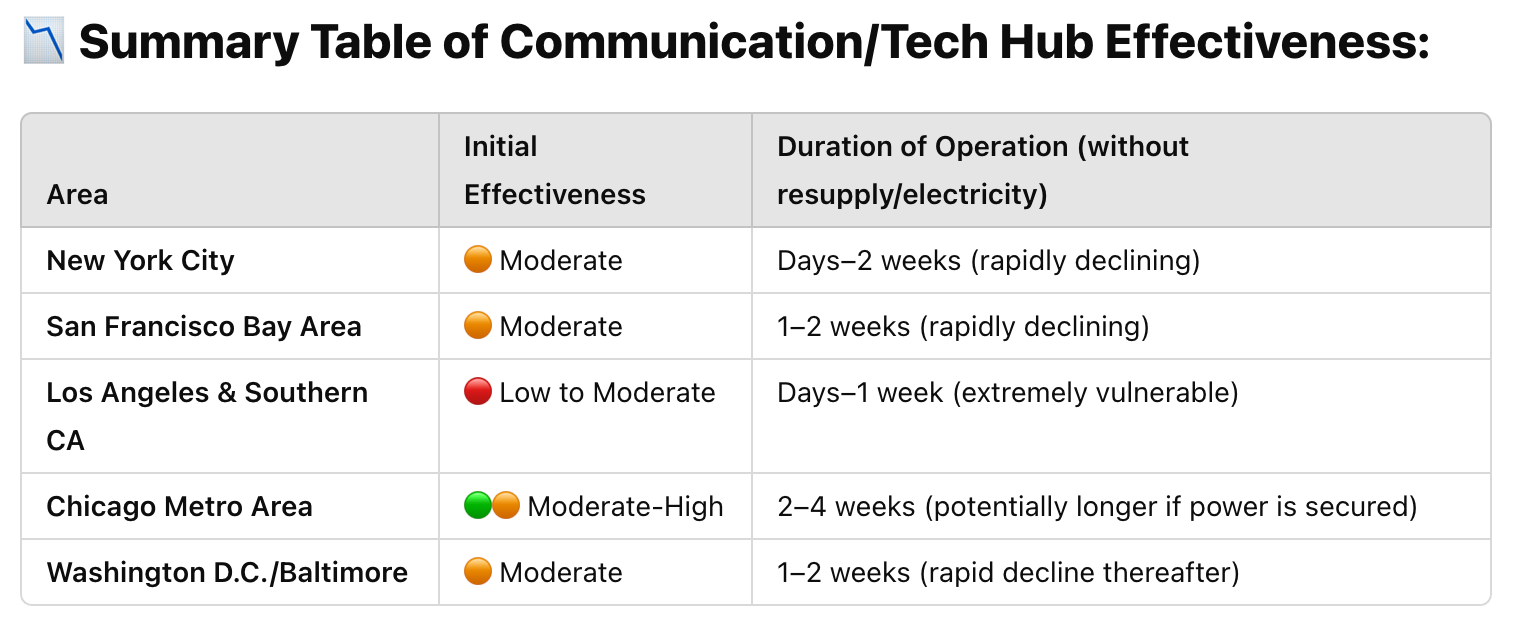
Moreover, sabotage of data centers and physical attacks on critical infrastructure like bridges and highways could further isolate urban areas, making recovery and resupply efforts virtually impossible. A 2018 RAND Corporation report emphasized how quickly infrastructure sabotage could cripple urban centers, further validating the potential severity of these scenarios.
Medical and Healthcare Resources
Medical infrastructure in liberal urban centers is world-class—major hospitals like Johns Hopkins (Baltimore), Cedars-Sinai (Los Angeles), and New York-Presbyterian provide cutting-edge care. However, these facilities depend heavily on international supply chains for pharmaceuticals, medical devices, and personal protective equipment (PPE).
A Congressional Research Service report (2020) indicated the U.S. imports approximately 80% of active pharmaceutical ingredients from China and India. Disruption of these supply chains or sabotage of ports such as Los Angeles/Long Beach or New York/New Jersey would quickly lead to severe shortages of essential medicines and PPE.
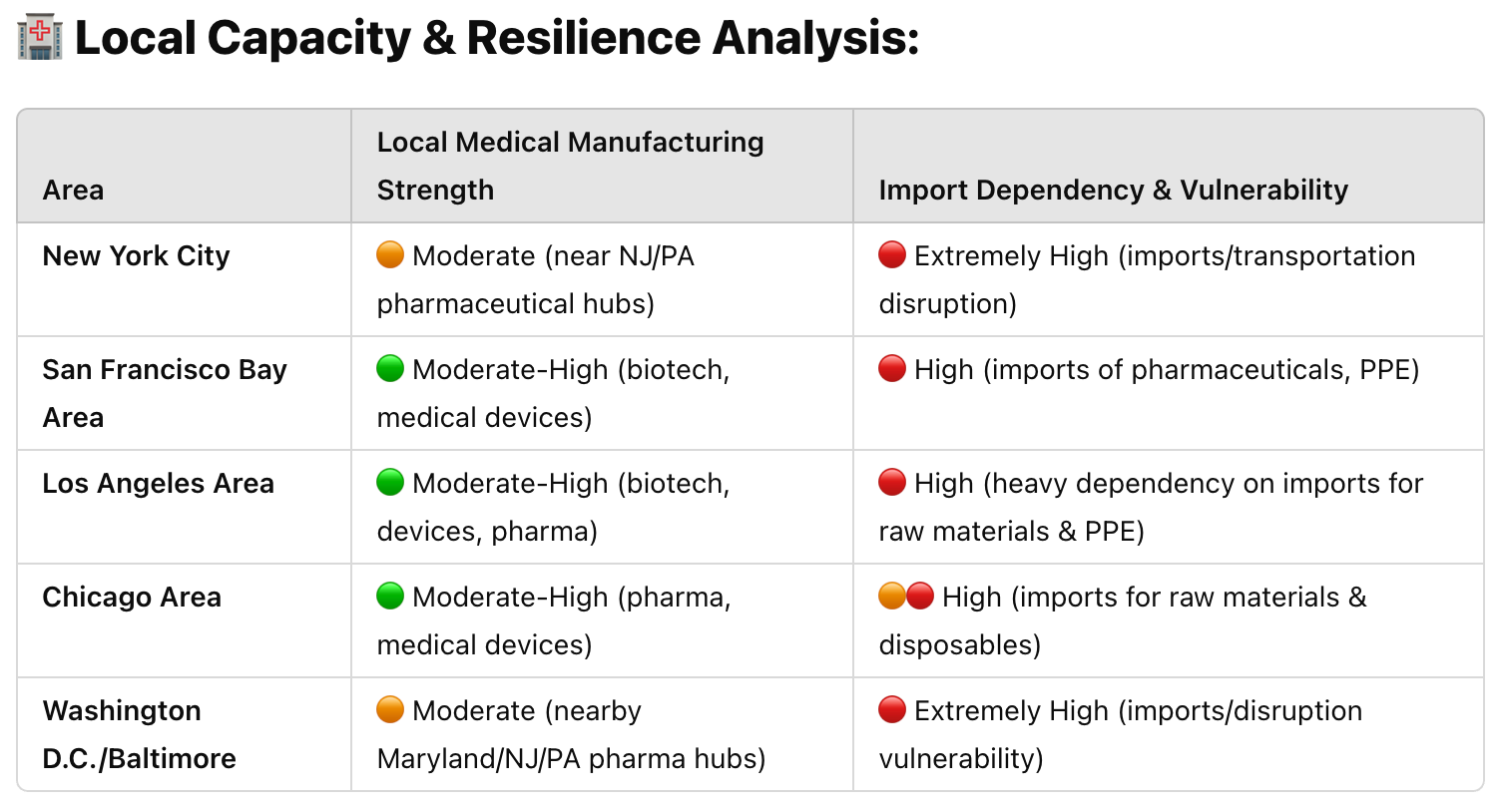
Additionally, urban areas’ dense populations and reliance on specialized healthcare services heighten the risk of the rapid spread of infectious diseases if medical supplies become unavailable, further compounding the humanitarian disaster. The CDC highlighted in a 2019 study that densely populated urban areas are particularly susceptible to rapid disease spread during supply shortages.
Psychological and Military Factors
Psychologically, Conservatives often demonstrate higher community cohesion, emotional resilience, and firearm familiarity—attributes advantageous during prolonged conflict. Research published in the Journal of Personality and Social Psychology (2015) indicates conservatives typically exhibit higher levels of resilience and community cohesion under crisis conditions.
Although initially more adaptive to new technological solutions, liberals exhibit vulnerabilities such as ideological fragmentation, higher anxiety under crisis conditions, and less familiarity with self-sufficient survival strategies. According to a Pew Research Center study (2020), ideological fragmentation and internal disputes are significantly higher among liberal groups.
Moreover, conservatives benefit from disproportionately higher representation in military and law enforcement ranks. A study by Military Times (2019) found that approximately two-thirds of active-duty military and veterans identify as conservative, which provides them with substantial tactical advantages in conflict scenarios.
Probability of Outcomes
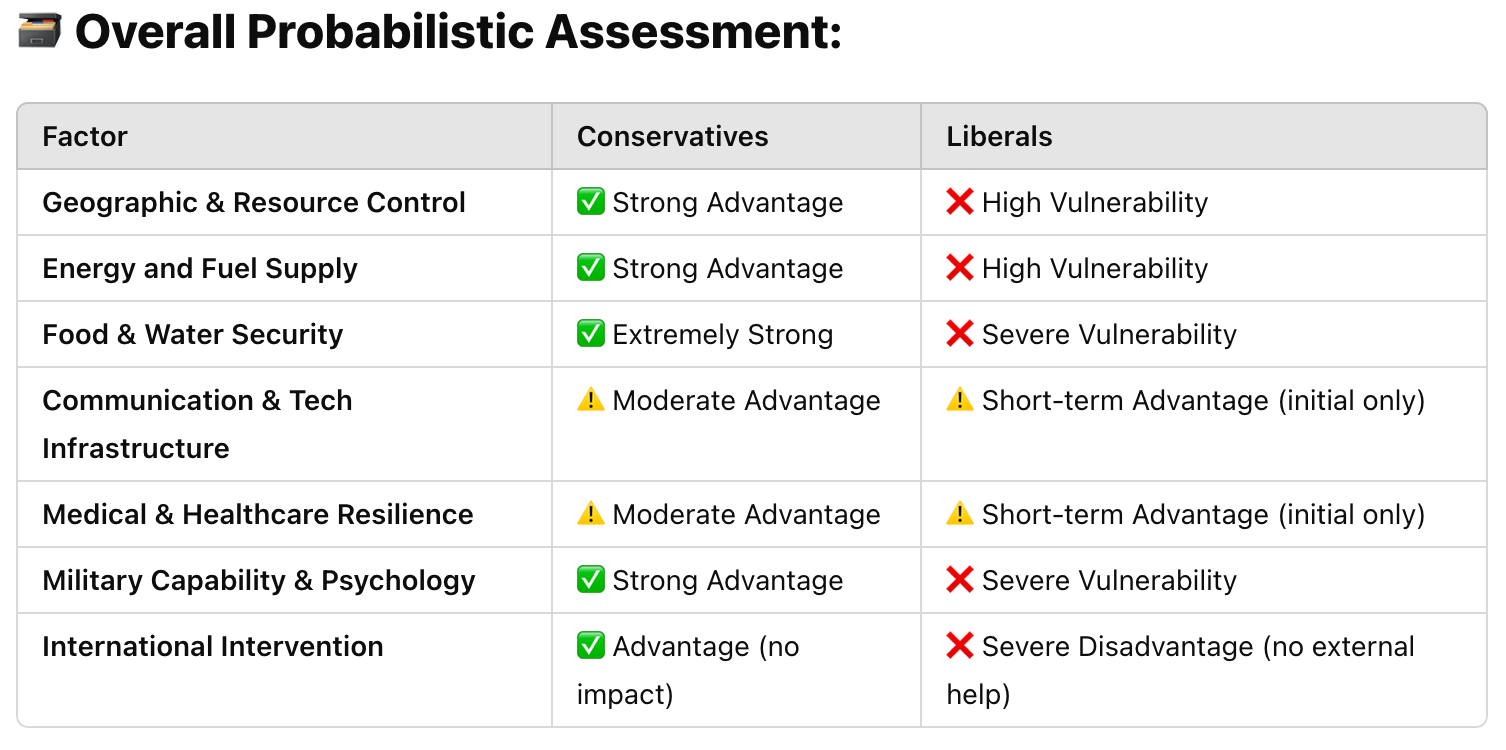
Given all these detailed considerations, a conservative victory becomes highly probable. Specifically, approximately 85-90% of food-producing areas, 75% of domestic energy production, and over 80% of freshwater sources are in conservative-controlled regions. Additionally, conservatives disproportionately represent roughly 65-70% of military veterans and law enforcement personnel, enhancing tactical advantages.
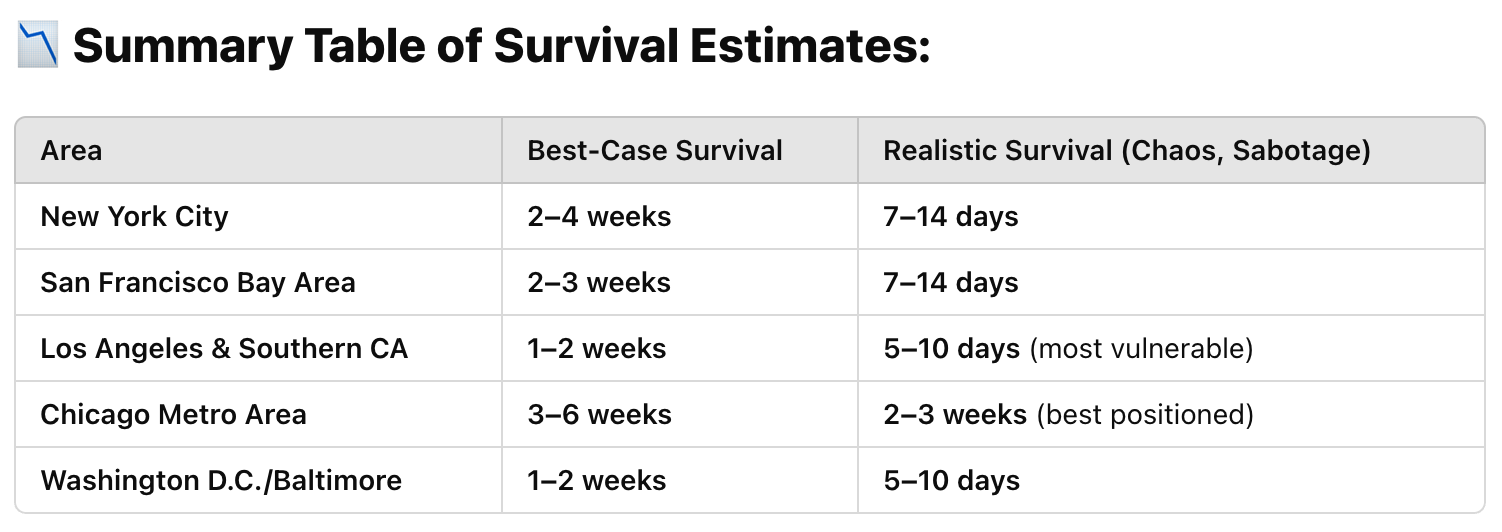
Liberals' limited paths to victory would hinge upon unlikely scenarios: rapid political negotiations, sudden conservative infighting, or immediate international aid intervention. Diplomatic complexities and logistical barriers limit the chances of rapid external assistance, significantly reducing liberal prospects.
Remember, This is Just a Hypothetical
Exploring this hypothetical conflict underscores how fragile modern urban centers are to disruptions in essential resources and how significant conservative strategic advantages are in prolonged conflicts. The catastrophic humanitarian implications reinforce the imperative to maintain national unity, strengthen resilient infrastructure, and foster dialogue over political division. While theoretical, this analysis highlights real vulnerabilities that deserve serious consideration in contemporary policymaking.