

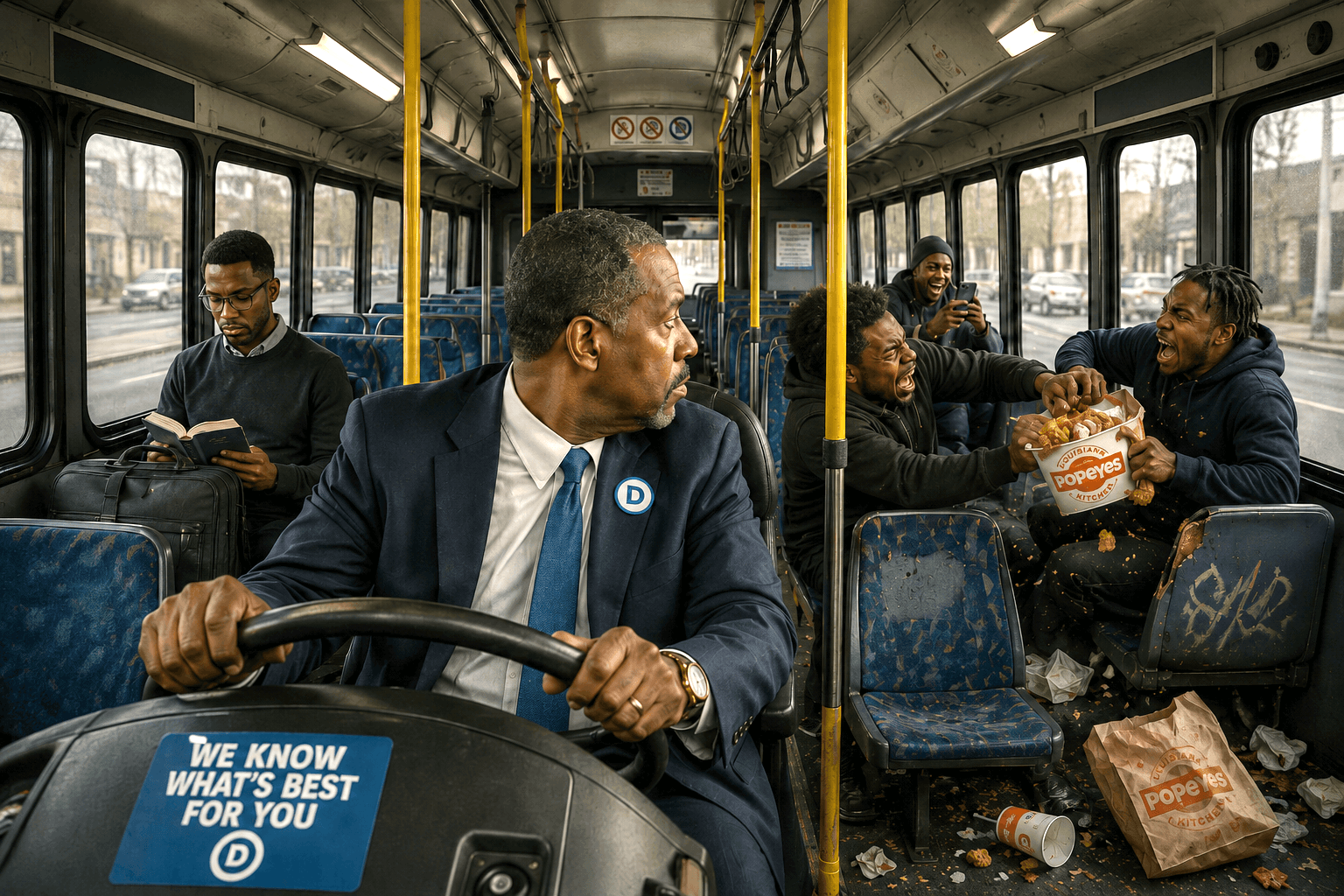
“‘Separate but equal’ denied black Americans equal treatment by placing them under a separate system. ‘Equal but separate’ claims to honor equality while placing black Americans under separate standards, separate expectations, and separate excuses. The language changed. The assumption of black incapacity survived.”
The black Americans who marched through hostile Democrat towns were not asking America to lower its standards. They were demanding the right to meet them.
They wanted to vote without being threatened, attend schools their taxes helped support, compete for jobs, purchase homes, serve on juries, and enter public places without being turned away because of their skin color. They wanted America to apply its own stated principles to them.
The Civil Rights Act of 1964 attacked legal segregation in employment, education, and public accommodations. The Voting Rights Act of 1965 gave the federal government power to confront the deliberate disenfranchisement of black citizens. These laws could not eliminate racial prejudice, but they dismantled the legal machinery that had treated black Americans as lesser citizens.
That generation fought for equality. It did not fight for softer grading, racial hiring preferences, selective law enforcement, protection from criticism, or a permanent excuse for every failure that followed.
Yet much of modern racial politics now rests on precisely that bargain. Black Americans are praised in speeches as strong, resilient, brilliant, and powerful while being treated in practice as too fragile to obey the law, pass an examination, hear criticism, control their tempers, raise their children, or prosper without political supervision.
The old Democrat said black people could not meet the standard. The modern Democrat says requiring the standard is racist. The vocabulary is more fashionable now, but the assumption beneath it is disturbingly familiar.
This leaves an uncomfortable question. Did the struggle for equality produce equal citizenship, or did it slowly become a demand for exemption from the obligations citizenship requires? Worse, have the excuses, indulgence, violence, family collapse, educational failure, and institutional cowardice become so destructive that parts of black America are consuming the future earlier generations fought to secure?
That is what I mean by “extinct.”
I do not mean black Americans are literally disappearing. A population can grow while its neighborhoods decay, its families weaken, its schools commit academic fraud, and its young men kill one another at horrifying rates. People can survive numerically while losing the habits and institutions required to build, improve, and endure.
The danger is not physical extinction by some reborn white supremacy. It is the steady extinction of responsibility, trust, family, order, competence, and hope.
What Equality Once Meant
The civil rights argument was powerful because it was simple. America claimed all citizens were equal before the law while enforcing racial inequality through law. It claimed to be a representative republic while preventing millions of black citizens from voting. It praised individual liberty while assigning rights according to ancestry.
The contradiction could not survive public examination.
The movement succeeded because it appealed to universal principles: one law for everyone, equal access to public institutions, judgment according to conduct rather than skin color, and the opportunity to compete without government deliberately placing a racial thumb on the scale.
Those principles demanded something from white America. They also assumed that black Americans were capable of competing once the barriers were removed.
That belief has been quietly abandoned by many of the people who claim to defend black interests. Equality once meant opening the competition. Modern equity increasingly means manipulating the competition until approved racial totals appear.
Unequal preparation is real. The honest answer is better preparation. Instead, modern equity often waits until the end of the process and alters the test, grade, admissions rule, or disciplinary standard after the failure has already occurred.
If an examination produces unequal results, the examination becomes suspect. If disciplinary rules affect black students more frequently, the rules are blamed before anyone asks whether conduct differed. If criminal enforcement produces racial disparities, arrest figures are presented as proof of bias before offending patterns are considered. If admissions standards produce fewer black students at an elite institution, the institution is pressured to alter the standards, change the weighting, or hide how decisions are made.
A disparity can result from discrimination. It can also result from age, sex, family structure, preparation, culture, geography, behavior, incentives, or personal choices.
Men are imprisoned at vastly higher rates than women. Young people commit more violent crime than elderly people. Children raised in stable homes generally perform better than children raised amid disorder. Students who arrive prepared usually outperform students who do not.
Nobody looks at the unequal incarceration of men and declares prisons part of an anti-male conspiracy. Nobody sees the tiny arrest rate of elderly women and assumes police have granted them a privilege unavailable to teenage boys.
Once race enters the discussion, however, arithmetic is often expected to surrender to politics. An unequal outcome becomes evidence of an unjust standard when the politically preferred group performs worse. When that same group performs better, nobody demands that the standard be abolished.
The debate is no longer about equality. It is about whether equal rules may be permitted to produce unequal results.
The Politics of Exemption
Exemption does not mean every black American believes the law should not apply to him. Millions of black Americans obey the law, work hard, raise families, pay taxes, and want nothing to do with the racial circus performed in their name.
Exemption is the political doctrine that ordinary consequences become suspicious whenever they fall disproportionately on black offenders, students, employees, or public officials.
A student repeatedly disrupts class, but administrators fear racial discipline statistics more than they fear the destruction of everyone else’s education. A habitual offender is released because incarceration produces racial disparities, then another family pays when he attacks again. An employee performs poorly, but honest criticism risks becoming a racial complaint. A public official behaves like an ignorant fool, but anyone who describes the conduct plainly is accused of resenting black representation.
Race becomes an alibi that pushes the conduct out of view.
This is especially visible in police encounters. A short cellphone video begins when the officer uses force, not during the threats, resistance, flight, assault, or repeated refusals that led to it. The clip spreads before body-camera footage is released. Politicians announce outrage before investigators know what happened. Activists locate another martyr. Cable news receives a week of racial theater.
When the full video tells a different story, the correction arrives after the country has moved on.
Police officers are not always right. Black Americans are killed by police at a higher per-capita rate than white Americans, and genuine cases of unlawful force deserve prosecution rather than bureaucratic excuses. Most fatal police shootings, however, involve armed subjects, which does not prove every shooting was justified but does destroy the dishonest impression that most cases involve unarmed black citizens casually executed for their skin color.
Authority requires accountability. Officers who abuse citizens, plant evidence, falsify reports, or use unlawful force should be prosecuted. Accountability cannot mean examining only the person wearing the badge.
A citizen who believes a traffic stop is unlawful can challenge it in court. He does not get to turn the shoulder of a highway into his personal Supreme Court. A suspect who believes an arrest is unfair can hire a lawyer. He does not get to punch an officer, grab for a weapon, flee into traffic, or resist until an ordinary encounter becomes deadly.
Teaching people that any rule may be physically contested whenever they feel disrespected is not civil rights. It is a reliable way to create more funerals.
Black politicians and activists who encourage that attitude rarely absorb the cost. They hold a press conference, accuse the police, invoke history, and return to neighborhoods where security is plentiful. The black mother living where gunfire is common has no such luxury. She needs police to answer the telephone. She needs violent men removed from the street. She needs disruptive students removed from her child’s classroom. She needs the pharmacy, grocery store, and gas station to remain open.
When government refuses to punish offenders, punishment does not disappear. It is transferred to the innocent.
The merchant pays through theft and insurance. The customer pays through higher prices. The student pays through lost instruction. The neighborhood pays when employers leave. The family pays when a violent criminal returns, and sometimes the victim pays with his life.
The people demanding leniency call themselves compassionate because they are rarely required to live with the consequences of their compassion.
The Grievance Alibi
The most politically useful explanation is one that can never be disproved.
If a black American succeeds, he overcame systemic racism. If he fails, systemic racism defeated him. If he is punished, the system is biased. If he is spared punishment, activism worked. If a school enforces standards, the standards are racist. If the school lowers them, the change is called equity.
Every possible outcome confirms the theory, which makes it closer to theology than analysis.
It also protects everyone who has failed black Americans for decades. Mayors do not have to explain why their cities remain dangerous. School officials do not have to explain why children cannot read. Prosecutors do not have to defend releasing habitual criminals. Activists do not have to prove that their programs improved a single neighborhood. Entertainers do not have to answer for selling violence and degradation to children.
They can blame a system with unlimited reach, no clear boundaries, and no condition under which its existence could ever be disproved.
America has spent decades being told that black people are trapped by forces so powerful that personal conduct barely counts. This has produced one of the strangest forms of bigotry in modern life. The people constantly praising black strength often treat black adults as though expecting responsible behavior would be an act of cruelty.
A black child supposedly needs easier standards. A black offender needs greater understanding. A black public official needs protection from harsh criticism. A black voter needs guidance from people who have already decided what his interests must be.
There is always someone ready to speak for black Americans, explain their failures, manage their anger, assign their opportunities, and collect a salary for doing it. After all the speeches, slogans, agencies, consultants, foundations, and government programs, measurable improvement remains surprisingly difficult to find.
The Bodies Behind the Slogans
The word “extinct” is harsh because the reality is harsher.
The United States recorded 20,162 homicide deaths in 2024, including 15,364 firearm homicides. The FBI estimated that murder and non-negligent manslaughter fell 14.9 percent from 2023 to 2024. Preliminary figures released in May 2026 indicate that murder fell another estimated 18.1 percent in 2025. Those declines are welcome, but they do not erase the extraordinary concentration of homicide among young black men.
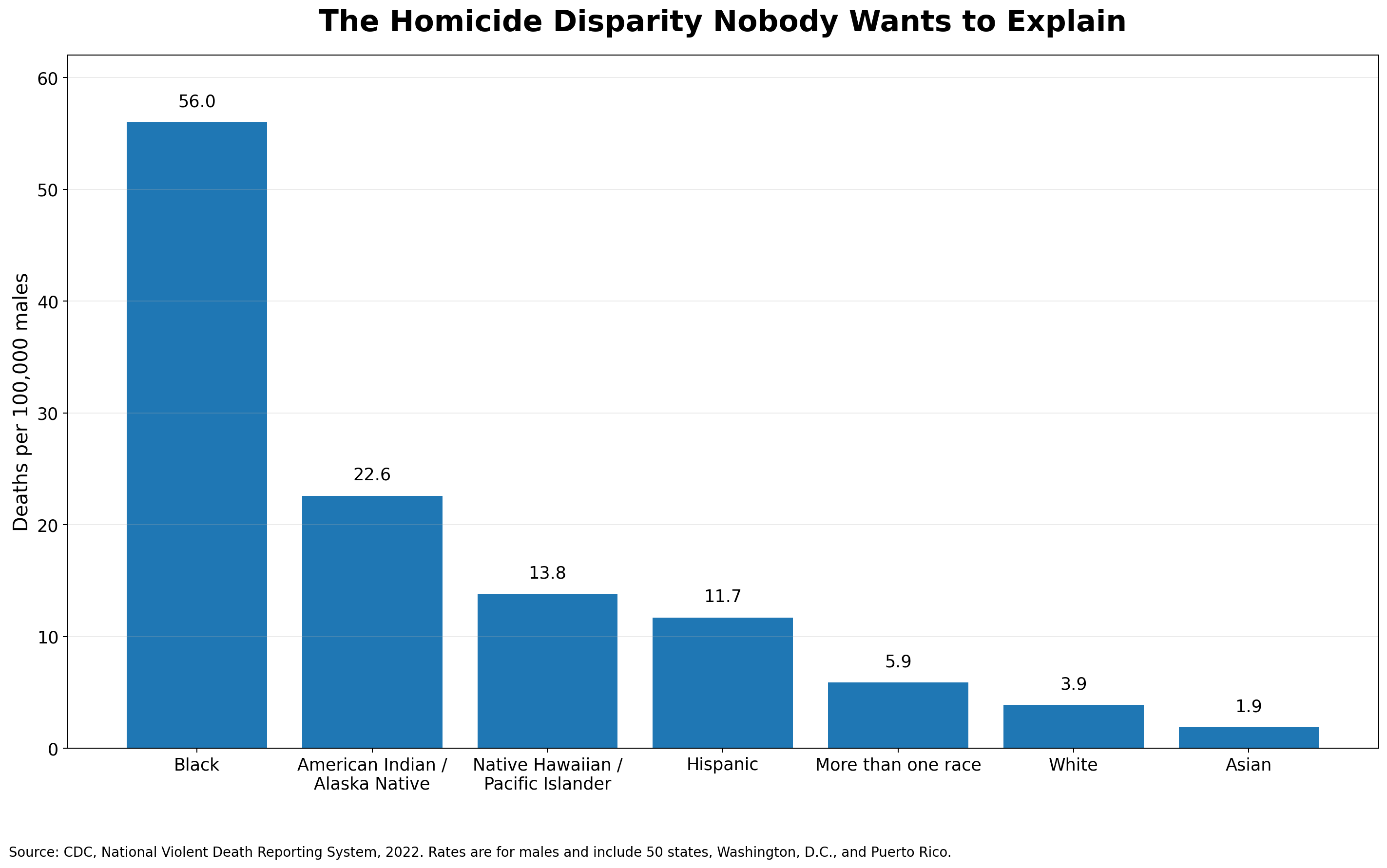
CDC data show that homicide was the leading cause of death for black males ages 15 through 34 in 2019. A later CDC surveillance report found that it remained the leading cause for black males ages 15 through 24 in 2021. Black Americans also had a firearm-homicide rate of 27.5 per 100,000 in 2022, far above the national rate, even after declining from the previous year.
This should dominate any serious discussion of black lives in America. Instead, the country receives far more sustained racial agitation over black people killed by police, including many shootings involving armed suspects, than over the vastly larger toll of ordinary criminal homicide.
Possible police abuse should be investigated honestly. Officers do not receive moral immunity because they carry badges. But scale cannot be ignored. If black lives are the concern, the primary danger to young black lives cannot be treated as an embarrassing footnote merely because the killer is unsuitable for a civil rights narrative.
Behind the numbers are mothers burying sons, children sleeping away from windows, families leaving neighborhoods they can no longer tolerate, and decent people discovering that government is often more interested in the offender’s social explanation than the victim’s shattered body.
Why does this not produce marches of equal size, corporate statements, professional-athlete boycotts, school lessons, murals, and months of national coverage?
A black victim killed by a white officer is politically valuable. A black victim killed by another black man is politically inconvenient. The first case points toward white America. The second points toward criminal conduct, failed families, weak schools, gangs, retaliation, drugs, cultural rot, and cities governed for generations by entrenched progressive political machines.
One creates racial leverage. The other requires self-examination, and there is little money or political power in that.
The Family Lie
No single factor explains violence, poverty, or educational failure. Anyone claiming otherwise is selling simplicity to people too angry to think.
The refusal to discuss family structure has nevertheless become its own form of dishonesty.
A Census Bureau analysis released in December 2025 found that approximately 40 percent of first-time black mothers from 2020 through 2024 were neither married nor living with a partner when they gave birth. The corresponding shares were 22.2 percent for Hispanic mothers, 8.5 percent for white mothers, and 5.5 percent for Asian mothers.
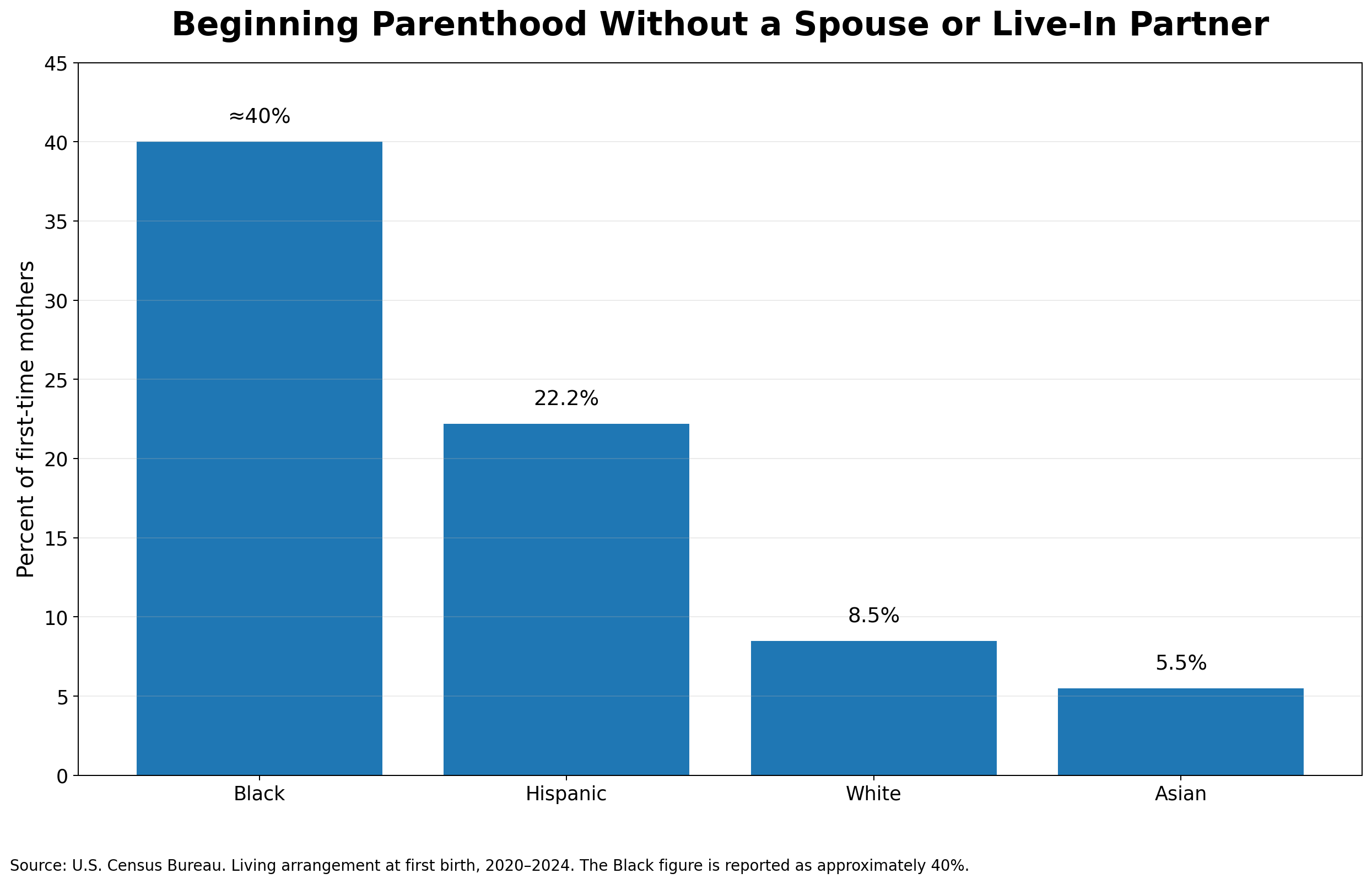
These numbers are not an insult to single mothers. Many perform heroic work after a father disappears, dies, becomes violent, goes to prison, or simply refuses to behave like a man. They are often carrying two people’s burden with one person’s income and time.
The insult is pretending that none of this affects children.
Two dependable parents generally provide more income, supervision, protection, time, and emotional stability than one exhausted parent can provide. This should be obvious to anyone who has raised a child, yet the family has become the one social institution respectable people are afraid to defend.
Government can send money, but it cannot sit beside a frightened child at two in the morning, teach a boy how a grown man controls his anger, or model fidelity and daily responsibility. It cannot replace the thousands of ordinary interactions through which children learn what adulthood looks like.
A welfare office, school counselor, or nonprofit program with a racial logo cannot replace a father.
The political class understood this decades ago and decided that saying it aloud was too dangerous. It became easier to blame housing, policing, history, employment, transportation, food access, environmental racism, and every other external influence than to ask why so many children begin life without a stable father in the home.
Those conditions can affect families, but they do not erase human agency. Millions of poor people throughout history married, worked, raised children, and refused to abandon them. Poverty can make responsibility harder. It does not make responsibility impossible.
Schools That Manufacture Diplomas
America’s schools are failing children of every race. Black children are among those paying the highest price.
The 2024 National Assessment of Educational Progress found that 40 percent of fourth graders performed below the Basic level in reading. Among eighth graders, 33 percent were below Basic. Twelfth-grade reading scores fell three points from 2019, and performance declined across nearly the entire achievement distribution.
Those are national figures. They describe a country allowing its educational foundation to rot.
The racial gaps make the fraud harder to hide. The Department of Education’s 2020–21 Civil Rights Data Collection found that black boys were 8 percent of total K–12 enrollment but accounted for 18 percent of students receiving out-of-school suspensions and 18 percent of those expelled. Those figures establish a disparity. They do not, by themselves, tell us how much came from unequal behavior, unequal treatment, school conditions, or some combination of the three.
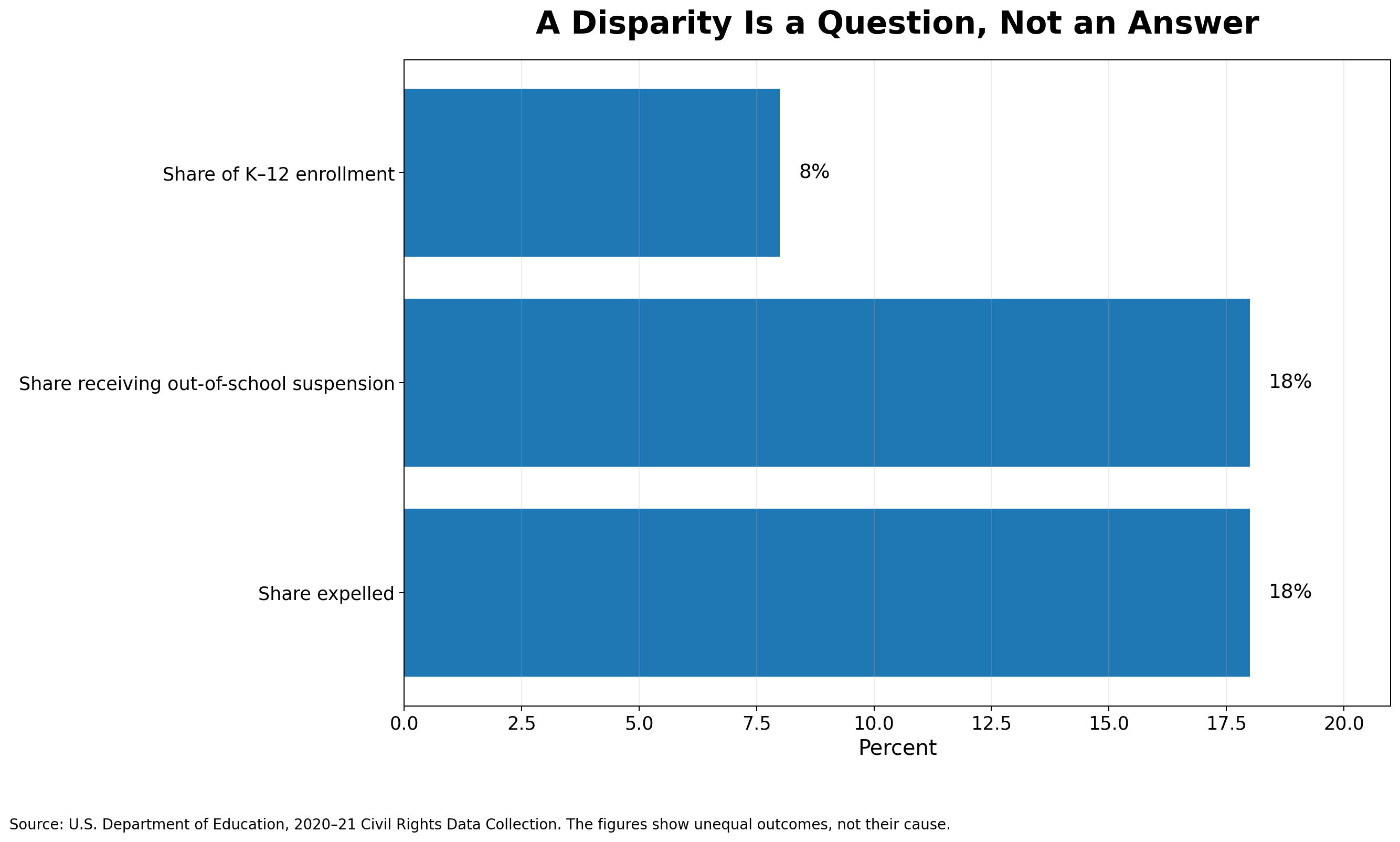
That distinction is usually ignored. Activists point to the racial totals as though the figures alone prove discrimination. Administrators respond by reducing punishment, changing categories, or pressuring teachers not to record incidents. The appearance of equity improves while the classroom becomes harder to control.
The same game is played with academic performance. Schools inflate grades, reduce homework, offer effortless credit recovery, eliminate entrance examinations, and push students toward graduation whether or not they have mastered elementary material. Then officials celebrate the graduation rate.
A diploma cannot read a job application for the person holding it. It cannot perform arithmetic, arrive on time, write a coherent paragraph, or understand workplace instructions. Handing an illiterate teenager a graduation certificate is fraud against a child, regardless of how compassionate the adults feel while doing it.
When black students perform poorly, activists accuse tests of bias. When black students are disciplined more often, administrators reduce discipline rather than determine how much of the disparity comes from behavior and how much comes from treatment. When teachers complain about violence or chaos, they are told to examine their prejudice. When parents demand order, officials point toward equity plans and restorative-justice language.
The adults receive new terminology while the children receive less education.
One of the ugliest ideas in modern education is that discipline, punctuality, formal English, objective testing, and orderly conduct are expressions of white culture. That belief does not challenge racism. It assigns competence to white people and dysfunction to black people.
Children living amid disorder need more order from school, not less. They need teachers permitted to teach, consequences that arrive quickly, honest grades, phonics, mathematics, history, and adults who believe they are capable of difficult work.
Instead, too many receive excuses from people who would never send their own children into the same classroom.
Selling Destruction as Black Authenticity
Government policy is not the only problem. Culture cannot be dismissed whenever it becomes inconvenient.
Black American culture has produced extraordinary music, literature, scholarship, churches, businesses, soldiers, athletes, and political leaders. That history makes the celebration of its worst elements more disgraceful, not less.
A large and profitable corner of popular entertainment sells violence, criminality, sexual irresponsibility, drug dealing, contempt for women, retaliation, and public stupidity as signs of authentic blackness. Wealthy performers leave dangerous neighborhoods, purchase guarded mansions, send their children to private schools, and continue selling the neighborhood’s worst habits to children still trapped there.
They escaped the product while continuing to market it.
Defenders say the music is merely entertainment. Many of those same people insist that representation in entertainment shapes children’s self-image and changes society. They cannot credibly claim positive portrayals transform culture while endless portrayals of murder, degradation, and criminal status have no influence at all.
A song does not mechanically turn a listener into a killer. Culture works more subtly. It determines what receives admiration, what creates status, what looks normal, what appears masculine, and what kind of behavior earns attention.
The damage becomes worse when constructive behavior is treated as racial betrayal. Studying becomes “acting white.” Standard English becomes “talking white.” Cooperation with police becomes snitching. Marriage becomes unnecessary. Leaving a violent neighborhood becomes selling out.
A young man who learns a trade, marries, raises children, and lives quietly receives less cultural attention than an idiot waving a gun on social media. A culture that makes failure authentic and success suspicious has built a prison stronger than anything white America could construct for it.
The People Paid to Keep the Wound Open
Black America is not one culture, one neighborhood, or one political mind.
Millions of black Americans work, raise children, build businesses, serve in the military, attend church, earn degrees, learn trades, and live decent lives. They do not awaken every morning wondering what white people think of them. They have jobs to do and families to support.
Millions more live in communities burdened by violence, weak schools, family instability, addiction, and limited opportunity. Most want what ordinary people everywhere want: safe streets, functioning schools, honest employment, fair treatment, and a future for their children.
Then there is the grievance industry.
It includes politicians, academics, consultants, nonprofit executives, corporate diversity officials, media personalities, race hustlers, and entertainers whose influence grows when black failure continues. They receive grants when disparities widen, television appearances when racial tensions rise, consulting work when institutions panic, and votes when fear replaces judgment.
Their careers do not require black America to improve. They require black America to remain angry.
If schools improved, neighborhoods became safer, families stabilized, and racial gaps narrowed, many of these people would lose their reason for existing. That does not mean every person working in a civil rights organization or nonprofit is corrupt. It means incentives do not become irrelevant merely because an organization uses compassionate language.
When failure produces funding, failure acquires defenders.
Responsible and productive black America is often ignored because ordinary success produces little racial drama. Struggling black America is displayed as evidence, and the grievance industry claims authority to speak for both.
That is how failure becomes a political resource.
A Race Treated as Party Property
No party owns a race, but the Democrat Party has behaved for decades as though black votes were inherited property.
It has benefited from overwhelming black electoral support while presiding over many of the cities where black children attend failed schools, black families endure persistent violence, and black neighborhoods receive endless promises followed by remarkably little improvement.
The arrangement survives because performance is rarely measured against alternatives. The party does not have to persuade many black voters on the merits. It needs only to frighten them about Republicans, invoke the civil rights era, and present political independence as racial betrayal.
When black voters move even modestly toward Republicans, analysts ask what misinformation reached them, what grievance Republicans exploited, or why those voters acted against their own interests. White voters are permitted to reconsider their politics. Black voters are treated as defective products when they do the same.
The insults aimed at black dissenters make the ownership claim explicit. Thomas Sowell, Walter Williams, Clarence Thomas, Glenn Loury, Coleman Hughes, John McWhorter, and others do not agree on every subject. They do agree that racial slogans are no substitute for evidence.
For that offense, black dissenters are called Uncle Toms, sellouts, tokens, traitors, and worse. The movement claiming to oppose racial stereotypes insists that black people must share the same politics because of their skin.
The Democrat Party did not free black Americans from racial classification. It updated the classification and appointed itself manager.
Equality Is Not Rescue From Reality
No legislature can abolish cause and effect.
Government can prohibit discrimination, enforce contracts, prosecute corrupt police officers, protect voting rights, and remove unjust barriers. It cannot make violent conduct harmless, fathers unnecessary, disorder educational, or resentment competent.
Politicians can rename failure, but they cannot repeal its consequences. Calling an offender a victim of society does not revive the person he killed. Calling standards biased does not teach a child to read. Calling family collapse a lifestyle difference does not place a father at the dinner table. Calling enforcement racist does not make an unsafe neighborhood livable.
Reality is under no obligation to respect political sensitivities.
Real equality means black Americans receive the same protection from discrimination and the same expectation of responsible behavior as everyone else. A police officer who abuses a citizen should be punished. A citizen who attacks an officer should be punished. A school that discriminates should be corrected. A student who refuses to behave should not be allowed to destroy the education of thirty classmates.
An employer who discriminates by race should face consequences. An employee who performs poorly should not be protected from honest criticism because of race.
That is not hostility toward black Americans. It is the respect owed to adults.
The civil rights generation did not risk its life so future black Americans could be told that punctuality is white, discipline is oppression, criminals are political symbols, academic standards are discriminatory, and one political party owns their votes. It fought for the right to stand as equals.
Equal, Exempt, or Extinct?
Black Americans fought to be equal, and they won victories that changed the country.
Then came the people who discovered there was more power in permanent grievance than completed progress. Equality under the law gradually gave way to racial preferences, managed outcomes, softer discipline, diluted standards, and endless explanations for conduct that would be condemned without hesitation in anyone else.
Exemption was sold as compassion. Its price has been paid in failed classrooms, abandoned children, destroyed businesses, frightened neighborhoods, political dependency, and young bodies lowered into graves.
None of this is inevitable. Millions of black Americans reject it through the ordinary discipline of work, marriage, faith, education, parenthood, and personal responsibility. Their lives prove the problem is not black skin. They also expose the people who use black skin as an excuse for everything.
The greatest threat to black America is not criticism. It is a political and cultural machine that treats criticism as racism, failure as authenticity, criminality as victimhood, and responsibility as betrayal.
Earlier generations faced governments that openly denied their equality. This generation faces leaders who publicly celebrate black people while building careers on the assumption that they cannot govern themselves. The first enemy was easier to recognize.
Equality was the victory. Exemption became the trap. The destruction of a people’s families, standards, safety, and future is what extinction looks like long before the last person disappears.
Help Keep This Work Independent
The easiest thing in America is to pretend not to notice.
Pretend failed schools are compassion. Pretend abandoned children are merely the result of “systems.” Pretend criminals are the real victims. Pretend lowering standards is a form of respect. Pretend the people making money from black failure are somehow the people best qualified to fix it.
That is how failure becomes permanent.
The facts are visible. The bodies are real. The schools are collapsing. The families are breaking apart. Yet the same politicians, activists, consultants, academics, and media figures keep offering the same excuses while demanding more power, more money, and more obedience.
This work exists for the people who are done pretending.
Become a Paid Subscriber
Your support keeps this work free for people who need to read it, helps these essays reach readers outside the approved channels, and gives arguments like this the distribution they need before the grievance industry buries them under slogans.
Subscribe here:
Make a One-Time Gift
If you do not want another subscription but still want to help, a one-time gift helps fund the research, writing, editing, and distribution behind this work.
Give here:
Join The Resistance Core
For readers who want to do more than quietly agree, The Resistance Core helps support a larger effort to challenge the narratives dominating politics, education, media, and culture.
Join here:
Venmo
You can also support this work directly through Venmo:
https://account.venmo.com/u/mrchrisarnell
If You Cannot Give
You can still help.
Share this essay with someone who has been trained to avoid this conversation. Restack it. Leave a comment. Post it on X, Facebook, or wherever people are still willing to confront an argument instead of hiding from it.
The people profiting from failure already have institutions, foundations, media outlets, universities, government agencies, and corporate money behind them.
Independent writers have readers.
That only works when readers act.
Black America does not need more excuses, softer standards, or another generation of politicians getting rich by explaining failure. It needs honesty, order, fathers, discipline, education, and consequences.
Which part of that is supposed to be racist?
Another great analysis Chris.
Perhaps we could solve the black equality problem with massive reparations. Sure.
Mo money for the race baiters should fix the decades of Democrat gaslighting by social program entitlement and imprisonment.
Can’t wait for the commie wing of the dems to lather up Sharpton to cry fo mo.